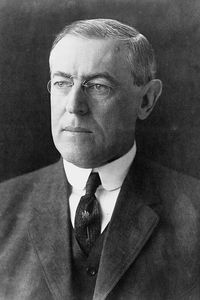
Woodrow Wilson (b. on December 28, 1856, in Staunton, Virginia) was the 28th president of the United States. He served from March 4, 1913, until March 4, 1921, after serving two terms in office. He died three years after leaving office on February 3, 1924, at age 67.
Wilson was known for his tenure during World War I, his negotiations in the Treaty of Versailles, his involvement in the creation of the League of Nations, and his endorsement of the Suffrage Movement after entering office. During his first year in office, he signed the Federal Reserve Act into law, creating the central banking system of the United States. Both the 18th Amendment (prohibition) and 19th Amendment (women's right to vote) were ratified during the Wilson presidency.[1]
Prior to his presidency, Wilson was the president at Princeton University and the governor of New Jersey for two years. Wilson was also an author, writing a biography on George Washington and History of the American People.
Biography
Timeline of life events
Below is an abbreviated outline of Wilsons's professional and political career:[1]
- 1856: Born in Staunton, Virginia
- 1866: His education stopped and started, possibly due to his dyslexia
- 1870: His family moved to Columbia, South Carolina
- 1874: His family moved to Wilmington. North Carolina
- 1873-74: He attended Davidson College, but stopped due to illness
- 1874-1879: Wilson attended, and graduated from, Princeton University
- 1885: Wilson married Ellen (nee Axson). They went on to have three daughters
- 1887: He began teaching, including at Cornell University and Bryn Mawr
- 1890: He joined the faculty at Princeton
- 1911: Wilson ran for, and won, the governorship of New Jersey
- 1912: He won the presidential election
- 1913: He signed into law the Federal Reserve Act
- 1914: Ellen died
- 1915: Wilson got remarried to Edith Bolling Galt
- 1916: Re-elected as president of the United States
- 1917: Wilson declared war on April 2, 1917, beginning America's official involvement with WWI
- 1918: Wilson gave a speech before Congress supporting women's suffrage
- 1919: He signed the Treaty of Versailles and proposed the League of Nations
- 1921: Opened a law firm after leaving office
- 1924: Died from a stroke and other probable heart problems
Presidency
Among Wilson's major campaign promises were lower tariffs and restructuring banking regulations. By September of his first year in office, he signed into law the Underwood Tariff, which reintroduced the federal income tax and lowered tariff rates from 40 percent to 25 percent.[1]
While the legislation on tariffs was progressing through Congress, Wilson began his restructuring of the banking system. In an address to a joint session of Congress, he stated that banking must be "public not private, must be vested in the government itself so that the banks must be the instruments, not the masters, of business." In December 1913, he signed into law the Federal Reserve Act, creating and establishing the Federal Reserve System. Twelve private regional Federal Reserve banks were created and a national currency and monetary system was established.[1]
In the first few years of his tenure, Wilson's policy on World War I was to keep "the true spirit of neutrality, which is the spirit of impartiality and fairness and friendliness to all concerned." In May 1915, a German u-boat sank the RMS Lusitania, a British ocean liner. Among the passengers on the boat were 100 Americans. Another liner, the SS Arabic, was also torpedoed, killing two Americans. Wilson asked Germany to repudiate these actions. They proceeded to promise that "liners will not be sunk by our submarines." In March 1916, The SS Sussex, a French ferry, was torpedoed in the English Channel, killing four Americans. In response to concern from Wilson, Germany then pledged to keep their warfare to the rules of cruiser warfare. Wilson made offers to help negotiate peace deals between all involved during this time, however, after the German ambassador told the U.S. that they would continue their practice of unrestricted submarine warfare, and tried to recruit Mexico as an ally in the Zimmermann Telegram, Wilson delivered his War Message to Congress on April 2, 1917.[1]
In 1919, Wilson spent six months in Paris for the Peace Conference that eventually became the Treaty of Versailles. Within the Treaty was the charter of the proposed League of Nations, the precursor to the United Nations. Getting this passed by Congress in America became an ordeal. It was never ratified by Congress.[1]
Elections
1916 presidential election
In 1916, Wilson defeated Charles Hughes (R) in the general election for the United States presidency.
| U.S. presidential election, 1916 |
| Party |
Candidate |
Vote % |
Votes |
Electoral votes |
| |
Democratic |
Woodrow Wilson/Thomas Marshall Incumbent |
49.2% |
9,130,861 |
277 |
| |
Republican |
Charles Huhges/Charles Fairbanks |
46.1% |
8,549,700 |
254 |
| |
Socialist |
Allan Benson/George Kirkpatrick |
3.2% |
590,190 |
0 |
| |
Prohibition |
James Hanly/Ira Landrith |
1.2% |
221,302 |
0 |
| |
N/A |
Others |
0.3% |
49,259 |
0 |
| Total Votes |
18,541,312 |
531 |
| Election results via: 1916 official election results |
1912 presidential election
In 1912, Theodore Roosevelt (Progressive) and William Taft (R) in the general election for the United States presidency.
| U.S. presidential election, 1912 |
| Party |
Candidate |
Vote % |
Votes |
Electoral votes |
| |
Republican |
William Taft/Nicholas Butler Incumbent |
23.2% |
3,487,939 |
8 |
| |
Democratic |
Woodrow Wilson/Thomas Marshall |
41.8% |
6,294,384 |
435 |
| |
Progressive |
Theodore Roosevelt/Hiram Johnson |
27.4% |
4,121,609 |
88 |
| |
Socialist |
Eugene Debs/Emil Seidel |
6% |
900,743 |
0 |
| |
N/A |
Other |
1.6% |
241,865 |
0 |
| Total Votes |
15,046,540 |
531 |
| Election results via: David Leip's Atlas of U.S. Presidential Elections |
State of the Union addresses
Every year in office, the president of the United States addresses Congress on the present state of affairs as well as the administration's goals for the coming year.[2] Following are transcripts from Wilson's State of the Union addresses.
- First inaugural address: March 4, 1913
- Second inaugural address: March 5, 1917
- December 2, 1913
- December 8, 1914
- December 7, 1915
- December 5, 1916
- December 4, 1917
- December 2, 1918
- December 2, 1919
- December 7, 1920
See also
- William Howard Taft
- Warren Harding
- Federal judges nominated by Woodrow Wilson
- The Administrative State Project
External links
- Presidential Library and Museum website
- Official White House biography
- C-Span video on the Wilson presidency
- ↑ 1.0 1.1 1.2 1.3 1.4 1.5 Biography.com, "Woodrow Wilson," accessed July 12, 2018
- ↑ Congressional Research Service, "The President’s State of the Union Address: Tradition, Function, and Policy Implications," January 24, 2014
| Political offices
|
Preceded by William Howard Taft (R)
|
President of the United States 1909-1913
|
Succeeded by Warren Harding (R)
|
| U.S. Executive Branch |
|---|
| | Elected offices | President Joe Biden • Vice President Kamala Harris
|  | | | Executive departments | Department of Defense • Department of State • Department of Homeland Security • Department of Justice • Department of Commerce • Department of Education • Department of the Treasury • Department of Agriculture • Department of Energy • Department of Labor • Department of Transportation • Department of the Interior • Department of Health and Human Services • Department of Veterans Affairs • Department of Housing and Urban Development
| | | Cabinet-level offices | Environmental Protection Agency • Office of Management and Budget • U.S. Mission to the United Nations • Council of Economic Advisors • Small Business Administration • White House Chief of Staff
| | | Federally appointed offices | Federal Reserve System • National Security Advisor • White House Press Secretary • U.S. Postmaster General • Central Intelligence Agency • Federal Bureau of Investigation • Internal Revenue Service • Bureau of Alcohol, Tobacco, Firearms and Explosives • National Security Agency • Congressional Budget Office • Federal Election Commission • Transportation Security Administration • Drug Enforcement Administration • Federal Communications Commission
| | | Glossary | Appointment confirmation process • United States Constitution • Electoral College • Deferred action • Deferred Action for Childhood Arrivals (DACA) • Deferred Action for Parents of U.S. Citizens and Lawful Permanent Residents (DAPA) • Impeachment of federal officials • Investor-State Dispute Settlement (ISDS) • North American Free Trade Agreement (NAFTA) • P5+1 and E3+3 • Trade adjustment assistance (TAA) • Trade promotion authority (TPA)
|
|
| U.S. presidents |
|---|
| | U.S. presidents | George Washington • John Adams • Thomas Jefferson • James Madison • James Monroe • John Quincy Adams • Andrew Jackson • Martin Van Buren • William Henry Harrison • John Tyler • James Polk • Zachary Taylor • Millard Fillmore • Franklin Pierce • James Buchanan • Abraham Lincoln • Andrew Johnson • Ulysses S. Grant • Rutherford B. Hayes • James Garfield • Chester A. Arthur • Grover Cleveland • Benjamin Harrison • William McKinley • Theodore Roosevelt • William Howard Taft • Woodrow Wilson • Warren Harding • Calvin Coolidge • Herbert Hoover • Franklin D. Roosevelt • Harry Truman • Dwight Eisenhower • John F. Kennedy • Lyndon B. Johnson • Richard Nixon • Gerald Ford • Jimmy Carter • Ronald Reagan • George H.W. Bush • Bill Clinton • George W. Bush • Barack Obama • Donald Trump • Joe Biden | |
|
| The Administrative State Project |
|---|
| | Main | The Administrative State Project main page • Administrative State Project Index • Glossary of administrative state terms • Quotes about the administrative state • Administrative state • Rulemaking • Deference • Adjudication • Nondelegation doctrine |  | | | Reporting | Changes to the Federal Register • Completed OIRA review of federal administrative agency rules • Federal agency rules repealed under the Congressional Review Act • Historical additions to the Federal Register, 1936-2016 • Pages added monthly to the Federal Register, 1995-2017 | | | Laws | Administrative Procedure Act • Antiquities Act • Civil Service Reform Act • Clayton Antitrust Act • Communications Act of 1934 • Congressional Review Act • Electronic Freedom of Information Act • Federal Food, Drug, and Cosmetic Act of 1938 • Federal Housekeeping Statute • Federal Reserve Act • Federal Trade Commission Act of 1914 • Freedom of Information Act • Government in the Sunshine Act • Independent Offices Appropriations Act of 1952 • Information Quality Act • Interstate Commerce Act • National Labor Relations Act • Paperwork Reduction Act • Pendleton Act • Privacy Act of 1974 • Regulatory Flexibility Act • REINS Act • REINS Act (Wisconsin) • Securities Act of 1933 • Securities Exchange Act of 1934 • Sherman Antitrust Act • Small Business Regulatory Enforcement Fairness Act • Truth in Regulating Act • Unfunded Mandates Reform Act | | | Cases | Abbott Laboratories v. Gardner • A.L.A. Schechter Poultry Corp. v. United States • Association of Data Processing Service Organizations v. Camp • Auer v. Robbins • Chevron v. Natural Resources Defense Council • Citizens to Preserve Overton Park v. Volpe • Federal Trade Commission (FTC) v. Standard Oil Company of California • Field v. Clark • Food and Drug Administration v. Brown and Williamson Tobacco Corporation • Humphrey's Executor v. United States • Immigration and Naturalization Service (INS) v. Chadha • J.W. Hampton Jr. & Company v. United States • Lucia v. SEC • Marshall v. Barlow's • Massachusetts v. Environmental Protection Agency • Mistretta v. United States • National Federation of Independent Business (NFIB) v. Sebelius • National Labor Relations Board v. Noel Canning Company • National Labor Relations Board v. Sears, Roebuck & Co. • Panama Refining Co. v. Ryan • Securities and Exchange Commission v. Chenery Corporation • Skidmore v. Swift & Co. • United States v. Lopez • United States v. Western Pacific Railroad Co. • Universal Camera Corporation v. National Labor Relations Board • Vermont Yankee Nuclear Power Corp. v. Natural Resources Defense Council • Wayman v. Southard • Weyerhaeuser Company v. United States Fish and Wildlife Service • Whitman v. American Trucking Associations • Wickard v. Filburn • Wiener v. United States | | | Terms | Adjudication (administrative state) • Administrative judge • Administrative law • Administrative law judge • Administrative state • Arbitrary-or-capricious test • Auer deference • Barrier to entry • Bootleggers and Baptists • Chevron deference (doctrine) • Civil servant • Civil service • Code of Federal Regulations • Codify (administrative state) • Comment period • Compliance costs • Congressional Record • Coordination (administrative state) • Deference (administrative state) • Direct and indirect costs (administrative state) • Enabling statute • Ex parte communication (administrative state) • Executive agency • Federal law • Federal Register • Federalism • Final rule • Formal rulemaking • Formalism (law) • Functionalism (law) • Guidance (administrative state) • Hybrid rulemaking • Incorporation by reference • Independent federal agency • Informal rulemaking • Joint resolution of disapproval (administrative state) • Major rule • Negotiated rulemaking • Nondelegation doctrine • OIRA prompt letter • Organic statute • Pragmatism (law) • Precautionary principle • Promulgate • Proposed rule • Publication rulemaking • Regulatory budget • Regulatory capture • Regulatory dark matter • Regulatory impact analysis • Regulatory policy officer • Regulatory reform officer • Regulatory review • Rent seeking • Retrospective regulatory review • Risk assessment (administrative state) • Rulemaking • Separation of powers • Significant regulatory action • Skidmore deference • Statutory authority • Substantive law and procedural law • Sue and settle • Sunset provision • Unified Agenda of Federal Regulatory and Deregulatory Actions • United States Code • United States Statutes at Large | | | Bibliography |
- "Administrative Law - The 20th Century Bequeaths an 'Illegitimate Exotic' in Full and Terrifying Flower" by Stephen P. Dresch (2000)
- "Confronting the Administrative Threat" by Philip Hamburger and Tony Mills (2017)
- "Constitutionalism after the New Deal" by Cass R. Sunstein (1987)
- Federalist No. 23 by Alexander Hamilton (1787)
- "From Administrative State to Constitutional Government" by Joseph Postell (2012)
- "Interring the Nondelegation Doctrine" by Eric A. Posner and Adrian Vermeule (2002)
- "Rulemaking as Legislating" by Kathryn Watts (2015)
- "The Checks & Balances of the Regulatory State" by Paul R. Verkuil (2016)
- "The Myth of the Nondelegation Doctrine" by Keith E. Whittington and Jason Iuliano (2017)
- "The Progressive Origins of the Administrative State: Wilson, Goodnow, and Landis" by Ronald J. Pestritto (2007)
- "The Rise and Rise of the Administrative State" by Gary Lawson (1994)
- "The Study of Administration" by Woodrow Wilson (1887)
- "The Threat to Liberty" by Steven F. Hayward (2017)
- "Why the Modern Administrative State Is Inconsistent with the Rule of Law" by Richard A. Epstein (2008)
| | | Agencies | Administrative Conference of the United States • United States Civil Service Commission • U.S. Government Accountability Office • U.S. Office of Information and Regulatory Affairs • U.S. Office of Management and Budget |
|
| Ballotpedia |
|---|
| | About | Overview • What people are saying • Support Ballotpedia • Contact • Contribute • Job opportunities
| | | Executive: Leslie Graves, President • Gwen Beattie, Chief Operating Officer • Ken Carbullido, Vice President of Election Product and Technology Strategy
Communications: Kayla Harris • Megan Brown • Mary Dunne • Sarah Groat • Lauren Nemerovski
External Relations: Alison Prange • Sara Key • Kari Berger • Hannah Nelson
Operations: Meghann Olshefski • Lauren Dixon • Kelly Rindfleisch • Sara Horton • Elizabeth Brown
Policy: Christopher Nelson • Caitlin Styrsky • Molly Byrne • Katharine Frey • Jace Lington • Jimmy McAllister
Tech: Matt Latourelle, Tech Manager • Ryan Burch • Michael Cella • Kirsten Corrao • Margaret Kearney • Tom Reitz
Contributors: Scott Rasmussen
| | | Editorial | Geoff Pallay, Editor-in-Chief • Daniel Anderson, Managing Editor • Josh Altic, Managing Editor • Cory Eucalitto, Managing Editor • Mandy Gillip, Managing Editor • Jerrick Adams • Victoria Antram • Dave Beaudoin • Jaclyn Beran • Marielle Bricker • Ryan Byrne • Kate Carsella • Kelly Coyle • Megan Feeney • Tyler King • Doug Kronaizl • Amee LaTour • David Luchs • Brittony Maag • Andrew McNair • Jackie Mitchell • Elisabeth Moore • Ellen Morrissey • Mackenzie Murphy • Samantha Post • Paul Rader • Ethan Rice • Myj Saintyl • Abbey Smith • Janie Valentine • Caitlin Vanden Boom • Joel Williams • Corinne Wolyniec • Samuel Wonacott • Mercedes Yanora |
|