Galatea (Moon)
 From Handwiki
 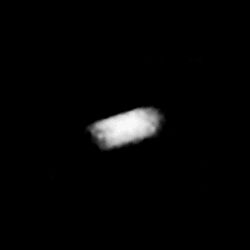 Galatea as seen by Voyager 2 (elongation is due to smearing) | |
| Discovery | |
|---|---|
| Discovered by | Stephen P. Synnott[1] and Voyager Imaging Team |
| Discovery date | July 1989 |
| Designations | |
Designation | Neptune VI |
| Pronunciation | /ɡæləˈtiːə/[2] |
| Named after | Γαλάτεια Galateia |
| Adjectives | Galatean[3] |
| Orbital characteristics[4][5] | |
| Epoch 18 August 1989 | |
Semi-major axis | 61 952.57 km |
| Eccentricity | 0.00022 ± 0.00008 |
| Orbital period | 0.42874431 ± 0.00000001 d |
| Inclination |
|
| Satellite of | Neptune |
| Group | ring shepherd |
| Physical characteristics | |
| Dimensions | 204×184×144 km (±~10 km)[6][7] |
| Mean radius | 87.4 ± 4.9 km[5] |
| Volume | ~2.8×10⁶km3 |
| Mass | 2.12 ± 0.08 ×10¹⁸ kg[8] |
| Mean density | ~0.75 g/cm3 (estimate)[9] |
surface gravity | ~0.018 m/s2[lower-alpha 1] |
escape velocity | ~0.056 km/s[lower-alpha 2] |
| Rotation period | synchronous |
| Axial tilt | zero |
| Albedo | 0.08[6][9] |
| Physics | ~51 K mean (estimate) |
| Apparent magnitude | 21.9[9] |
Galatea /ɡæləˈtiːə/, also known as Neptune VI, is the fourth-closest inner moon of Neptune. It is named after Galatea, one of the fifty Nereids of Greek legend, with whom Cyclops Polyphemus was vainly in love.
Discovery
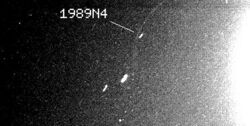
Galatea was discovered in late July 1989 from the images taken by the Voyager 2 probe. It was given the temporary designation S/1989 N 4.[10] The discovery was announced (IAUC 4824) on 2 August 1989, and mentions "10 frames taken over 5 days", implying a discovery date of sometime before July 28. The name was given on 16 September 1991.[11]
Physical properties
Galatea is irregularly shaped and shows no sign of any geological modification. It is likely that it is a rubble pile re-accreted from fragments of Neptune's original satellites, which were smashed up by perturbations from Triton soon after that moon's capture into a very eccentric initial orbit.[12]
Orbit
Galatea's orbit lies below Neptune's synchronous orbit radius, so it is slowly spiralling inward due to tidal deceleration and may eventually impact the planet or break up into a new planetary ring system upon passing its Roche limit due to tidal stretching.
Galatea appears to be a shepherd moon for the Adams ring that is 1,000 kilometres (620 mi) outside its orbit. Resonances with Galatea in the ratio 42:43 are also considered the most likely mechanism for confining the unique ring arcs that exist in this ring.[13] Galatea's mass has been estimated based on the radial perturbations it induces on the ring.[8]
Notes
- ↑ Surface gravity derived from the mass m, the gravitational constant G and the radius r: Gm/r2.
- ↑ Escape velocity derived from the mass m, the gravitational constant G and the radius r: √2Gm/r.
Since Galatea is irregularly shaped, the actual surface gravity and escape velocity will vary significantly between different positions on the surface.
References
- ↑ Planet Neptune Data http://www.princeton.edu/~willman/planetary_systems/Sol/Neptune/
- ↑ galatea (3rd ed.), Oxford University Press, September 2005, http://oed.com/search?searchType=dictionary&q=galatea (Subscription or UK public library membership required.)
- ↑ AMIA (1999) Transforming health care through informatics
- ↑ Jacobson, R. A.; Owen, W. M. Jr. (2004). "The orbits of the inner Neptunian satellites from Voyager, Earthbased, and Hubble Space Telescope observations". Astronomical Journal 128 (3): 1412–1417. doi:10.1086/423037. Bibcode: 2004AJ....128.1412J.
- ↑ 5.0 5.1 Showalter, M. R.; de Pater, I.; Lissauer, J. J.; French, R. S. (2019). "The seventh inner moon of Neptune". Nature 566 (7744): 350–353. doi:10.1038/s41586-019-0909-9. PMID 30787452. PMC 6424524. Bibcode: 2019Natur.566..350S. https://www.spacetelescope.org/static/archives/releases/science_papers/heic1904/heic1904a.pdf.
- ↑ 6.0 6.1 Karkoschka, Erich (2003). "Sizes, shapes, and albedos of the inner satellites of Neptune". Icarus 162 (2): 400–407. doi:10.1016/S0019-1035(03)00002-2. Bibcode: 2003Icar..162..400K.
- ↑ Williams, Dr. David R. (2008-01-22). "Neptunian Satellite Fact Sheet". NASA (National Space Science Data Center). http://nssdc.gsfc.nasa.gov/planetary/factsheet/neptuniansatfact.html.
- ↑ 8.0 8.1 Porco, C.C. (1991). "An Explanation for Neptune's Ring Arcs". Science 253 (5023): 995–1001. doi:10.1126/science.253.5023.995. PMID 17775342. Bibcode: 1991Sci...253..995P.
- ↑ 9.0 9.1 9.2 "Planetary Satellite Physical Parameters". JPL (Solar System Dynamics). 2008-10-24. http://ssd.jpl.nasa.gov/?sat_phys_par.
- ↑ Marsden, Brian G. (August 2, 1989). "Satellites of Neptune". IAU Circular 4824. http://www.cbat.eps.harvard.edu/iauc/04800/04824.html. Retrieved 2011-10-26.
- ↑ Marsden, Brian G. (September 16, 1991). "Satellites of Saturn and Neptune". IAU Circular 5347. http://www.cbat.eps.harvard.edu/iauc/05300/05347.html. Retrieved 2011-10-26.
- ↑ Banfield, Don; Murray, Norm (October 1992). "A dynamical history of the inner Neptunian satellites". Icarus 99 (2): 390–401. doi:10.1016/0019-1035(92)90155-Z. Bibcode: 1992Icar...99..390B.
- ↑ Namouni, F.; C. Porco (2002). "The confinement of Neptune's ring arcs by the moon Galatea". Nature 417 (6884): 45–7. doi:10.1038/417045a. PMID 11986660. Bibcode: 2002Natur.417...45N. http://www.nature.com/cgi-taf/DynaPage.taf?file=/nature/journal/v417/n6884/abs/417045a_fs.html.
External links
 |
Wikimedia Commons has media related to Galatea (moon). |
- Galatea Profile by NASA's Solar System Exploration
- Neptune's Known Satellites (by Scott S. Sheppard)
Moons of Neptune | |
|---|---|
Generally listed in increasing distance from Neptune | |
| Regular (inner) |
|
| Triton |
|
| Irregular |
|
| See also |
|
| |
 Book
Book Category
 Portal
Natural satellites of the Solar System | ||
|---|---|---|
| Planetary satellites |
|  |
| Dwarf-planet satellites |
| |
| Minor-planet moons |
| |
| Ranked by size |
| |
| ||
Neptune | |||||||
|---|---|---|---|---|---|---|---|
| |||||||
| Geography |
| _flatten_crop.jpg) | |||||
| Moons |
| ||||||
| Astronomy |
| ||||||
| Exploration |
| ||||||
| Related |
| ||||||
| |||||||
 |  |
Categories: [Moons of Neptune]
↧ Download as ZWI file | Last modified: 08/11/2024 13:50:15 | 8 views
☰ Source: https://handwiki.org/wiki/Astronomy:Galatea_(moon) | License: CC BY-SA 3.0
 KSF
KSF