Simbing
 From Handwiki
 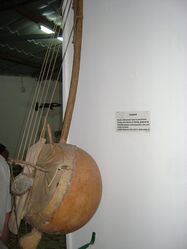 A simbing in Bakau Crocodile Museum, Gambia | |
| String instrument | |
|---|---|
| Other names |
|
| Classification | harp-lutes |
| Hornbostel–Sachs classification | 323-5 (Acoustic instruments which have a resonator as an integral part of the instrument, in which the plane of the strings lies at right angles to the sound-table; a line joining the lower ends of the strings would be perpendicular to the neck. These have notched bridges. Sounded by the bare fingers) |
| Related instruments | |
| |
The simbing is an malian harp-lute, used by the Mandinka people of Mali, and Mandinka and Jola peoples of Senegal and Gambia.[2][3] The instruments consist of a calabash resonator, a (usually curved) stick for a neck, a metal jingle attached to the neck, and a bridge that holds the string over the skin soundboard in a vertical line.[2] For comparison lutes (such as the guitar) usually have the strings held in a horizontal line above the soundboard. The instruments have five to nine strings. The instrument from the 1790s was reported as having seven strings by Mungo Park.[4]
The instrument was played in Mandinka and Jola cultures in the context of hunting.[2] With the Mandingas, the instrument was played by "the hunter's musician" who narrated songs about the hunt and the animals.[2] With the Jolas, the instrument is used to accompany men singing in groups.[2]
The instrument strings were plucked to make noise. Also, the calabash gourd could be tapped with sticks by the singer, for percussion.[2]
References
- ↑ Wallaschek, Richard (1893). Primitive Music. London and New York: Longmans, Green and Co.. "...the Mandingoes have a harp, "korro" with eighteen strings, and another, "simbing," with seven strings..."
- ↑ 2.0 2.1 2.2 2.3 2.4 2.5 Durán, Lucy. Sadie, Stanley. ed. The New Grove Dictionary of Musical Instruments. 3. p. 387.
- ↑ Simbing (plaque inside museum). Bakau, Gambia: Bakau Crocodile Museum. Retrieved 19 October 2022.
SIMBING Seven-string bow-harp in pentatonic tuning, one plane of string, played by the Jola people in Senegambia who call it also Furakaf. In Mall Bamana who call it simbi plays it.
- ↑ Park, Mungo (1893). Travels in the Interior Districts of Africa, 1795-1797. "add a list of their musical instruments, the principal of which are—the koonting, a sort of guitar with three strings; the korro, a large harp, with eighteen strings; the simbing, a small harp with seven strings..."
 |  |
Categories: [String instruments]
↧ Download as ZWI file | Last modified: 10/22/2023 09:43:44 | 8 views
☰ Source: https://handwiki.org/wiki/Engineering:Simbing | License: CC BY-SA 3.0
 ZWI signed:
 KSF
KSF