Conditional Probability
 From Conservapedia
 A conditional probability is the probability that some event A occurs given that a different event B has already occurred. This is written P(A|B) (often read as "the probability of A given B"). The conditional probability satisfies the equation
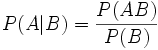
where P(AB) is the probability of both events A and B occurring and P(B) is the probability of event B occurring.
Example[edit]
A bag has 5 red balls and 3 green balls inside it. You pick out a ball and do not replace it in the bag afterwards.
Q. What is the probability of removing a red ball?
A. 5/8
Q. What is the probability of removing a red ball, given that you have already removed a red ball?
A. There are now 4 red balls and 3 greens, so: 4/7
In the second case, the question requires a conditional probability: P(red on 2nd draw|red on 1st draw).
See also[edit]
Categories: [Probability and Statistics]
↧ Download as ZWI file | Last modified: 02/18/2023 04:29:44 | 64 views
☰ Source: https://www.conservapedia.com/Conditional_probability | License: CC BY-SA 3.0
 ZWI signed:
 KSF
KSF