Frankincense
 From Handwiki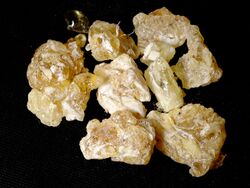
Frankincense, also known as olibanum (ō-ˈlib-ə-nəm),[1] is an aromatic resin used in incense and perfumes, obtained from trees of the genus Boswellia in the family Burseraceae. The word is from Old French franc encens ('high-quality incense').[2] There are several species of Boswellia that produce true frankincense:[3] Boswellia sacra (syn. B. bhaw-dajiana, syn. B. carteri), B. frereana, B. serrata (B. thurifera, Indian frankincense), and B. papyrifera. Resin from each is available in various grades, which depends on the time of harvesting. The resin is hand-sorted for quality.
Etymology
The English word frankincense derives from the Old French expression franc encens, meaning 'true incense', maybe with the sense of 'high quality incense'.[4][2] The adjective Lua error in Module:Language at line 197: Name for the language code "fro" could not be retrieved with mw.language.fetchLanguageName, so it should be added to Module:Language/data. in Old French meant 'noble, true', in this case perhaps 'pure'; although franc is ultimately derived from the tribal name of the Franks, it is not being used with reference to them in the word francincense.[5]
The word for frankincense in the Koine Greek of the New Testament, λίβανος, líbanos (or λιβανωτός, libanōtós), is cognate with the name of Lebanon (Greek: Λίβανος); the same can be said with regard to Arabic, Phoenician, Hebrew,[6] and Vulgar Latin: lĭbănus.[7] This is postulated to be because they both derive from the word for 'white' and that the spice route went via Mount Lebanon (Koinē Greek: Λίβανος, romanized: Libanos).[6] Template:Lang-la-x-medieval derived from λίβανος or libanus. The leading "o" may have come from Latin: oleum, lit. 'oil', or from the Greek article o- or Arabic article al-.[8] Other names include Arabic: اللبان, Persian: کندر, romanized: kondor, Syriac: בוּסמִין, romanized: busmin, Hebrew: לבונה, romanized: ləvonā, Bengali: লোবান, ধুনো, romanized: lōban, dhunō, Somali: foox, Classical Latin: tūs.[9]
Description
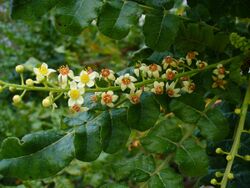
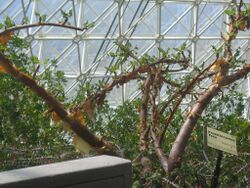
The trees start producing resin at about eight to 10 years old.[10] Tapping is done two to three times per year with the final taps producing the best tears because of their higher aromatic terpene, sesquiterpene and diterpene content. Generally speaking, the more opaque resins are the best quality. Cheap resin is produced in the Horn of Africa, which is the Roman Catholic Church's major source.[11]
The main species in trade are:
- Boswellia sacra: South Arabia.[12]:10
- Boswellia bhaw-dajiana (older spelling Boswellia bhau-dajiana): Horn of Africa.[13]:487 It is a synonym of Boswellia sacra
- Boswellia carteri (older spelling Boswellia carterii): Horn of Africa, Nubia.[12]:10 It was long considered an independent species,[14]:138 but in the 1980s it was determined to be a synonym of Boswellia sacra.[15][13]
- Boswellia serrata (synonym Boswellia thurifera, Indian frankincense): India.[12]:10
- Boswellia papyrifera: Ethiopia, Eritrea, Sudan.[12]:10
- Boswellia frereana: Horn of Africa.[12]:10 The resin is less bitter and the fragrance of incense is less "heavy" than Boswellia sacra.[13]:497 Contains no boswellic acids.[12]:19
Other notable species:
- Boswellia occulta:[16] Horn of Africa. In 2019, it was discovered that Somali harvesters considered Boswellia occulta to be the same species with Boswellia carteri even though their shapes are different, and sold resins from both species as the same thing. However, the chemical compositions of their essential oils are completely different.[17]
Recent studies indicate that frankincense tree populations are declining, partly from overexploitation.[18][19] Heavily tapped trees produce seeds that germinate at only 16% while seeds of trees that had not been tapped germinate at more than 80%. In addition, burning, grazing, and attacks by the longhorn beetle have reduced the tree population.[20] Conversion (clearing) of frankincense woodlands to agriculture is also a major threat.[21]
Chemical composition

These are some of the chemical compounds present in frankincense:
- acid resin (6%), soluble in alcohol and having the formula C20H32O4[22]
- gum (similar to gum arabic) 30–36%[22]
- 3-acetyl-beta-boswellic acid (Boswellia sacra)[23]
- alpha-boswellic acid (Boswellia sacra)[23]
- incensole acetate, C21H34O3[24]
- phellandrene[22]
- olibanic acid[25]
Among various plants in the genus Boswellia, only Boswellia sacra, Boswellia serrata and Boswellia papyrifera have been confirmed to contain significant amounts of boswellic acids.[12]:10[12][26]
History
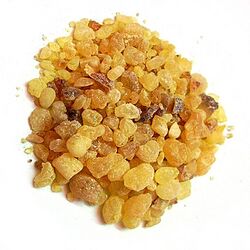
Frankincense has been traded on the Arabian Peninsula for more than 5,000 years.[26]:5 Frankincense was also traded from the Horn of Africa during the Silk Road era.[27] Greek historian Herodotus wrote in The History that frankincense was harvested from trees in southern Arabia. He reported that the gum was dangerous to harvest because of winged snakes[28] that guard the trees and that the smoke from burning storax would drive the snakes away.[29][30] Pliny the Elder also mentioned frankincense in his Naturalis Historia.[31][32]
Frankincense was reintroduced to Western Europe by Frankish Crusaders,[citation needed] and other Western Europeans on their journeys to the Eastern Roman Empire where it was commonly used in church services. Although named frankincense, the name refers to the quality of incense brought to Western Europe, not to the Franks themselves.[2]
Southern Arabia was an exporter of frankincense in antiquity, with some of it being traded as far as China. The 13th-century Chinese writer and customs inspector Zhao Rugua wrote that Script error: The function "transl" does not exist. or Script error: The function "transl" does not exist. (Chinese: 乳香 Script error: The function "transl" does not exist./ 薰陸香 Script error: The function "transl" does not exist.) comes from the three Dashi states (Chinese: 大食 Script error: The function "transl" does not exist. - Caliphate (Arab Muslims)) of Maloba (Murbat), Shihe (Shihr), and Nufa (Dhofar), from the depths of the remotest mountains;[33] the trunk of the tree is notched with a hatchet, upon which the resin flows out, and, when hardened, turns into incense, which is gathered and made into lumps; it is transported on elephants to the Dashi ports, then on ship to Sanfoqi; which is why it was known as a product of Sanfoqi.[34]
Production
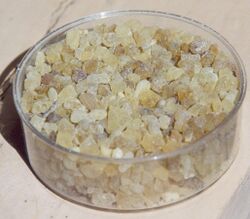
Thousands of tons of frankincense are traded every year to be used in religious ceremonies as incense in thuribles and by makers of perfumes, natural medicines, and essential oils. It can be inhaled or applied to the skin for its supposed health benefits. In the Horn of Africa, frankincense is harvested in the Bari and Sanaag regions: mountains lying at the northwest of Erigavo; El Afweyn District; Cal Madow mountain range, a westerly escarpment that runs parallel to the coast; Cal Miskeed, including Hantaara and Habeeno plateau and a middle segment of the frankincense-growing escarpment; Karkaar mountains or eastern escarpment, which lies at the eastern fringe of the frankinscence escarpment.[35][19] In Dhofar, Oman, frankincense species grow north of Salalah and were traded in the ancient coastal city of Sumhuram, now Khor Rori.[36]
Ecological status
In 1998, the International Union for Conservation of Nature warned that one of the primary frankincense species, Boswellia sacra, is "near threatened". Frankincense trees are not covered by the Convention on International Trade in Endangered Species of Wild Fauna and Flora, but experts argue that Boswellia species meet the criteria for protection. In a 2006 study, an ecologist at Wageningen University & Research claimed that, by the late-1990s, Boswellia papyrifera trees in Eritrea were becoming hard to find. In 2019, a new paper predicted a 50% reduction in Boswellia papyrifera within the next two decades. This species, found mainly in Ethiopia, Eritrea, and Sudan, accounts for about two-thirds of global frankincense production. The paper warns that all Boswellia species are threatened by habitat loss and overexploitation. Most Boswellia grow in harsh, arid regions beset by poverty and conflict. Harvesting and selling the tree's resin is one of the only sources of income for the inhabitants, resulting in overtapping.[3]
Health benefits
The use of Boswellia resin for spiritual and medicinal purposes dates back to ancient civilizations. Numerous compounds of different chemical categories are identified in the resin; the pharmacological actions of Boswellia resin are attributed to the complementary effects exerted by these compounds. Some clinical studies have weakly demonstrated the effectiveness of frankincense resin in some disease conditions like asthma, rheumatoid arthritis, inflammatory bowel diseases, osteoarthritis and relapsing-remitting multiple sclerosis, however more studies are necessary.[37][38] The essential oil obtained from the oleogum resin of Boswellia serrata showed antimicrobial activities.[39][40] A 2022 study[41] stated that "frankincense oil has a weak inhibitory effect against MRSA and MDR-P. aeruginosa"; and in vivo studies on animals revealed that frankincense oleogum resin exhibits neuroprotective activity.[42][43]
Uses
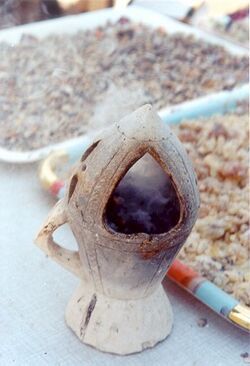
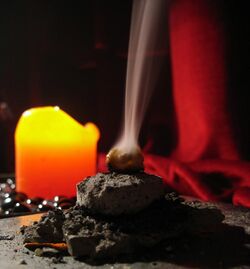
The Egyptians cleansed body cavities in the mummification process with frankincense and natron. In Persian medicine, it is used for diabetes, gastritis and stomach ulcer.[44] The oil is used in Abrahamic religions to cleanse a house or building of bad or evil energy—including used in exorcisms and to bless one's being (like the bakhoor commonly found in Persian Gulf cultures by spreading the fumes towards the body).
The incense offering occupied a prominent position in the sacrificial legislation of the ancient Hebrews.[45] The Book of Exodus (30:34–38) prescribes frankincense, blended with equal amounts of three aromatic spices, to be ground and burnt in the sacred altar before the Ark of the Covenant in the wilderness Tabernacle, where it was meant to be a holy offering—not to be enjoyed for its fragrance. Scholars have identified frankincense as what the Book of Jeremiah (6:20) relates was imported from Sheba during the 6th century BC Babylonian captivity.[46] Frankincense is mentioned in the New Testament as one of the three gifts (with gold and myrrh) that the magi "from the East" presented to the Christ Child (Matthew 2:11).
In traditional Chinese medicine, frankincense (Chinese: 乳香 Script error: The function "transl" does not exist.) along with myrrh (沒藥 Script error: The function "transl" does not exist.) are considered to have anti-bacterial properties and blood-moving uses.[citation needed] It can be used topically or orally, also used in surgical and internal medicine of traditional Chinese medicine. It is used to relieve pain, remove blood stasis, promote blood circulation and treat deafness, stroke, locked jaw, and abnormalities in women's menstruation.
Essential oil
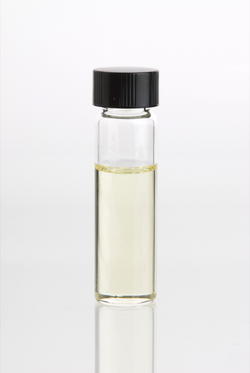
The essential oil of frankincense is produced by steam distillation of the tree resin. The oil's chemical components are 75% monoterpenes, sesquiterpenes, and ketones. Contrary to some commercial claims, steam distilled frankincense oils do not contain the insufficiently volatile boswellic acids (triterpenoids), although they may be present in solvent extractions. The chemistry of the essential oil is mainly monoterpenes and sesquiterpenes, such as alpha-pinene, Limonene, alpha-Thujene, and beta-Pinene with small amounts of diterpenoid components being the upper limit in terms of molecular weight.[47][48][49][50]
Essential oils can be diluted and applied to skin or the fragrance can be inhaled.[51]
See also
- Trade
- Land of Frankincense (Frankincense Trail), site in Oman
- Incense trade route, a large network around the Mediterranean and beyond
- Nabataeans, a trader tribe
- Literature
- Desi Sangye Gyatso, author of a Tibetan herbal
- Historia Plantarum (Theophrastus book)
- Similar plants and products
- Elemi, resin or tree
- Myrrh, resin
- Palo santo (Bursera graveolens), tree
- Agarwood
- Benzoin (resin)
- Copal
References
- ↑ "Medical Definition of OLIBANUM" (in en). https://www.merriam-webster.com/medical/olibanum.
- ↑ 2.0 2.1 2.2 "Frankincense" (in en). The Oxford English Dictionary. IV: F–G (reprint 1978 ed.). Oxford: Oxford University Press. 1933. p. 512. https://archive.org/details/in.ernet.dli.2015.271841/page/n515/mode/1up. Retrieved 2021-07-04.
- ↑ 3.0 3.1 "Frankincense trees—of biblical lore—are being tapped out for essential oils". National Geographic. 13 December 2019. https://www.nationalgeographic.com/animals/2019/12/frankincense-trees-declining-overtapping/.
- ↑ "Frankincense (n.)". https://www.etymonline.com/search?q=frankincense.
- ↑ "Frank". https://www.etymonline.com/word/frank#etymonline_v_11874.
- ↑ 6.0 6.1 Israel and Hellas. Walter de Gruyter. 1995. p. 210. ISBN 978-3-11-014233-4. https://books.google.com/books?id=SSljjU2xlecC&pg=PA210.
- ↑ "lĭbănus" (in en). A Latin Dictionary. 1879. https://www.perseus.tufts.edu/hopper/text?doc=Perseus:text:1999.04.0059:entry=Libanus1. Retrieved 2021-07-15.
- ↑ "Olibanum" (in en). The Oxford English Dictionary. VII: N–Poy (reprint 1978 ed.). Oxford: Oxford University Press. 1913. p. 103. https://archive.org/details/in.ernet.dli.2015.99996/page/n389/mode/1up. Retrieved 2021-07-04.
- ↑ "tūs" (in en). A Latin Dictionary. 1879. https://www.perseus.tufts.edu/hopper/text?doc=Perseus:text:1999.04.0059:alphabetic+letter=T:entry+group=44:entry=tus. Retrieved 2021-07-15.
- ↑ "Omani World Heritage Sites". www.omanwhs.gov.om. http://www.omanwhs.gov.om/english/Frank/FrankincenseTree.asp.
- ↑ "Frankincense: Could it be a cure for cancer?". 2010-02-09. http://news.bbc.co.uk/2/hi/middle_east/8505251.stm.
- ↑ 12.0 12.1 12.2 12.3 12.4 12.5 12.6 12.7 Michael P (2012-11-09). Chemotaxonomic investigations on resins of the frankincense species Boswellia papyrifera, Boswellia serrata and Boswellia sacra, respectively, Boswellia carterii : a qualitative and quantitative approach by chromatographic and spectroscopic methodology (Thesis). Saarland University. doi:10.22028/D291-22839.
- ↑ 13.0 13.1 13.2 "The Frankincense Trees (Boswellia spp., Burseraceae) of Northern Somalia and Southern Arabia" (in en). Kew Bulletin 42 (3): 488, 492. 1987. doi:10.2307/4110063. Bibcode: 1987KewBu..42..487T. https://www.jstor.org/stable/4110063.
- ↑ "On the Genus Boswellia, with Descriptions and Figures of three new Species" (in en). Transactions of the Linnean Society of London 27 (2): 111–148, plates Tab.29–32. 1870. doi:10.1111/j.1096-3642.1870.tb00205.x. https://babel.hathitrust.org/cgi/pt?id=chi.79869488&view=1up&seq=179&skin=2021. Retrieved 2021-07-16.
- ↑ "Boswellia carteri Birdw..". Royal Botanic Gardens, Kew. https://powo.science.kew.org/taxon/urn:lsid:ipni.org:names:127038-1. "This is a synonym of Boswellia sacra Flück; Not accepted by Govearts,R.(1996)."
- ↑ "Boswellia occulta Thulin". Royal Botanic Gardens, Kew. https://powo.science.kew.org/taxon/urn:lsid:ipni.org:names:77195494-1.
- ↑ "Organic Certification is Not Enough: The Case of the Methoxydecane Frankincense". Plants (MDPI) 8 (4): 88–. April 2019. doi:10.3390/plants8040088. PMID 30987305.
- ↑ "Could This Be the End of Frankincense?". New York Times. 5 July 2019. https://www.nytimes.com/2019/07/05/science/frankincense-trees-collapse.html?ribbon-ad-idx=5&rref=science.
- ↑ 19.0 19.1 "World's last wild frankincense forests are under threat". Yahoo Finance. Associated Press. 25 December 2016. https://finance.yahoo.com/news/worlds-last-wild-frankincense-forests-084122152.html.
- ↑ "Christmas Staple Frankincense 'Doomed,' Ecologists Warn". LiveScience. December 21, 2011. http://www.foxnews.com/scitech/2011/12/21/christmas-staple-frankincense-doomed-ecologists-warn/.
- ↑ "Manage or convert Boswellia woodlands? Can frankincense production payoff?". Journal of Arid Environments 89: 77–83. February 2013. doi:10.1016/j.jaridenv.2012.09.010. Bibcode: 2013JArEn..89...77D.
- ↑ 22.0 22.1 22.2 "Olibanum.—Frankincense.". Henriette's Herbal Homepage. www.henriettes-herb.com. http://www.henriettes-herb.com/eclectic/kings/boswellia.html.
- ↑ 23.0 23.1 "Farmacy Query". www.ars-grin.gov. http://sun.ars-grin.gov:8080/npgspub/xsql/duke/plantdisp.xsql?taxon=168.
- ↑ "Incensole acetate". NIST. http://webbook.nist.gov/cgi/inchi?ID=C34701536&Mask=2000.
- ↑ "The (+)-cis- and (+)-trans-Olibanic Acids: Key Odorants of Frankincense". Angewandte Chemie International Edition in English 55 (44): 13719–13723. October 2016. doi:10.1002/anie.201605242. PMID 27699963.
- ↑ 26.0 26.1 Simla B (2005-03-18). Phytochemical Investigations on Boswellia Species (Thesis). Universität Hamburg. urn:nbn:de:gbv:18-25030.
- ↑ Ulric Killion, A Modern Chinese Journey to the West: Economic Globalis]ation And Dualism, (Nova Science Publishers: 2006), p.66
- ↑ ὄφιες ὑπόπτεροι
- ↑ Herodotus (1904) [5c BCE], "Book_III" (in en), The History of Herodotus, p. 107
- ↑ Herodotus (1920) [5c BCE], "Θάλεια" (in el), Ιστορίαι (Ηροδότου), Cambridge, pp. 107–110
- ↑ Pliny the Elder. "THE TREES THAT BEAR FRANKINCENSE" (in en). The Natural History. XII. http://www.perseus.tufts.edu/hopper/text?doc=Perseus:text:1999.02.0137:book=12:chapter=30. Retrieved 2021-07-15.
- ↑ Gaius Plinius Secundus, "Liber XII" (in la), Naturalis Historia, pp. 51–65
- ↑ Aspects of the Maritime Silk Road: From the Persian Gulf to the East China Sea. Otto Harrassowitz Verlag. 2010. p. 130. ISBN 978-3-447-06103-2. https://books.google.com/books?id=YJibpHfnw94C&pg=PA130. Retrieved December 26, 2011. "The frankincense was first collected in the Hadhramaut ports of Mirbat, Shihr, and Zufar whence Arab merchant vessels shipped it to Srivijaya, before it was then reexported to China. The term "xunluxiang" derives from the Arab word "kundur". . . According to Li Xun, frankincense originally came from Persia. Laufer refers to the Xiangpu 香譜 by Hong Chu . . . Zhao Rugua notes: Ruxiang or xunluxiang comes from the three Dashi countries of Murbat (Maloba), Shihr (Shihe), and Dhofar (Nufa), from the depths of the remotest mountains. The tree which yields this drug may generally be compared to the pine tree. Its trunk is notched with a hatchet, upon which the"
- ↑ Ralph Kauz, ed (2010). Aspects of the Maritime Silk Road: From the Persian Gulf to the East China Sea. Otto Harrassowitz Verlag. p. 131. ISBN 978-3-447-06103-2. https://books.google.com/books?id=YJibpHfnw94C&pg=PA131. Retrieved December 26, 2011. "resin flows out, and, when hardened, turns into incense, which is gathered and made into lumps. It is transported on elephants to the Dashi (on the coast), who then load it upon their ships to exchange it for other commodities in Sanfoqi. This is the reason why it is commonly collected at and known as a product of Sanfoqi."
- ↑ War-Torn Societies Project International, Somali Programme (2001). Rebuilding Somalia: Issues and possibilities for Puntland. London: HAAN. p. 124. ISBN 978-1874209041. https://archive.org/details/rebuildingsomali00wart/page/124.
- ↑ "The Frankincense tree (Boswellia sacra, Burseraceae) from Oman: ITS and ISSR analyses of genetic diversity and implications for conservation". Genetic Resources and Crop Evolution 57 (7): 1041–1052. 2010-03-18. doi:10.1007/s10722-010-9546-8. ISSN 0925-9864.
- ↑ "Frankincense: systematic review". BMJ 337 (dec17 2): a2813. December 2008. doi:10.1136/bmj.a2813. PMID 19091760.
- ↑ "A standardised frankincense extract reduces disease activity in relapsing-remitting multiple sclerosis (the SABA phase IIa trial)". Journal of Neurology, Neurosurgery, and Psychiatry 89 (4): 330–338. April 2018. doi:10.1136/jnnp-2017-317101. PMID 29248894.
- ↑ "Biological activity of Boswellia serrata Roxb. oleo gum resin essential oil: effects of extraction by supercritical carbon dioxide and traditional methods" (in en). International Journal of Food Properties 21 (1): 808–820. 2018-01-01. doi:10.1080/10942912.2018.1439957. ISSN 1094-2912.
- ↑ "Synergistic antimicrobial activity of Boswellia serrata Roxb. ex Colebr. (Burseraceae) essential oil with various azoles against pathogens associated with skin, scalp and nail infections". Letters in Applied Microbiology 63 (6): 495–501. December 2016. doi:10.1111/lam.12683. PMID 27730658.
- ↑ Almutairi, Megren Bin Faisal; Alrouji, Mohammed; Almuhanna, Yasir; Asad, Mohammed; Joseph, Babu (10 November 2022). "In-Vitro and In-Vivo Antibacterial Effects of Frankincense Oil and Its Interaction with Some Antibiotics against Multidrug-Resistant Pathogens". Antibiotics 11 (11): 1591. doi:10.3390/antibiotics11111591. PMID 36358246.
- ↑ "Anti-inflammatory and neuroprotective activity of boswellic acids in rotenone parkinsonian rats". Canadian Journal of Physiology and Pharmacology 95 (7): 819–829. July 2017. doi:10.1139/cjpp-2016-0158. PMID 28249117.
- ↑ "Genus Boswellia as a new candidate for neurodegenerative disorders". Iranian Journal of Basic Medical Sciences 23 (3): 277–286. March 2020. doi:10.22038/ijbms.2020.35288.8419. PMID 32440312.
- ↑ "The Effects of Boswellia serrata Gum Resin on the Blood Glucose and Lipid Profile of Diabetic Patients: A Double-Blind Randomized Placebo-Controlled Clinical Trial". Journal of Evidence-Based Integrative Medicine 23: 2515690X18772728. 2018. doi:10.1177/2515690X18772728. PMID 29774768.
- ↑ The Jewish Encyclopedia, vol. VI, Funk and Wagnalls Company: New York 1904, p. 568
- ↑ An Universal History, from the Earliest Account of Time to the Present; Compiled from Original Authors and Illustrated with Maps, Cuts, Notes, Chronological and other Tables (part i). 16. London. 1734–1747. p. 257. https://archive.org/details/AnUniversalHistoryFOLIOEDITION1734.
- ↑ "A Fresh Look at the Constituents of Indian Olibanum Oil". Flavour Fragr. J. 2 (3): 99–102. 1987. doi:10.1002/ffj.2730020304.
- ↑ "Comparison of Volatile Compounds from Olibanum from Various Countries". J. Essent. Oil Res. 10: 25–30. 1998. doi:10.1080/10412905.1998.9700833.
- ↑ "A verticillane‐type diterpene from Boswellia carterii essential oil.". Flavour and Fragrance Journal 16 (5): 315–8. September 2001. doi:10.1002/ffj.992.
- ↑ "Analysis of frankincense from various Boswellia species with inhibitory activity on human drug metabolising cytochrome P450 enzymes using liquid chromatography mass spectrometry after automated on-line extraction". Journal of Chromatography A 1112 (1–2): 255–62. April 2006. doi:10.1016/j.chroma.2005.11.116. PMID 16364338.
- ↑ "Health Benefits of Frankincense Essential Oil" (in en). https://www.webmd.com/diet/health-benefits-frankincense-essential-oil.
Further reading
- "Chemical differentiation of Boswellia sacra and Boswellia carterii essential oils by gas chromatography and chiral gas chromatography-mass spectrometry". Journal of Chromatography A 1261: 158–63. October 2012. doi:10.1016/j.chroma.2012.06.073. PMID 22835693.
- "Weihrauch: Ein arabisches Produkt und seine Bedeutung in der Antike". Pauly-Wissowas Realencyclopädie der klassischen Altertumswissenschaft (Munich: Alfred Druckenmüller Verlag) (15): 700–777. 1978.
- Frankincense & Myrrh: A Study of the Arabian Incense Trade.. International Book Centre, Incorporated. 1981. ISBN 0-86685-593-9.
- Gold, Frankincense, and Myrrh: An Introduction to Eastern Christian Spirituality.. Crossroads Publishing Company. 1997. ISBN 0-8245-1616-8.
External links
Non-timber forest products | |
|---|---|
| Animal products |
|
|
|
| Edible plants / roots |
|
| Mushrooms |
|
|
|
|
|
| Resins |
|
| Sap / Gum / etc. |
|
| Other |
|
| Related |
|
| |
 Category
 Commons
 |  |
Categories: [Boswellia] [Incense material]
↧ Download as ZWI file | Last modified: 04/12/2025 14:11:57 | 4 views
☰ Source: https://handwiki.org/wiki/Biology:Frankincense | License: CC BY-SA 3.0
 KSF
KSF