Soviet Deep Space Network
 From Handwiki
 The Soviet Deep Space Network (or Russian Deep Space Network) was a network of large antennas and communication facilities that supports interplanetary spacecraft missions, and radio and radar astronomy observations for the exploration of the Solar System and the universe during Soviet times. It was built to support the space missions of the Soviet Union. Similar networks are run by the USA, China, Europe, Japan, and India. As of present, the Deep Space Network is maintained by Russia .[1]
History
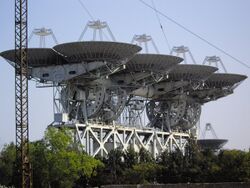
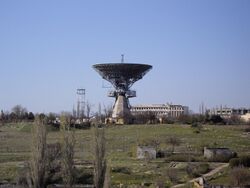
The first Soviet space communications network had 13 stations and was designed to track Earth orbiting satellites, not deep space probes.[2]
Interplanetary missions require larger antennas, more powerful transmitters, and more sensitive receivers, and an effort was started in 1959 to support the planned 1960 launch of the Venera series of missions to Venus and the Mars program of spacecraft to Mars. The selected design consisted of eight 16-meter dishes placed on two hulls of diesel submarines,[3] welded together and laid down on the railway bridge trusses. These trusses were mounted on bearings from battleship gun turrets.[2] Three such antennas were built: the two North stations for receiving, and the south station a few kilometers away for transmitting.
In 1978, these antennas were augmented by the 70-meter antennas at Yevpatoria and Ussuriisk. Construction on a third antenna at Suffa, Uzbekistan was halted with the collapse of the Soviet Union. As of 16 October 2018, the Director of the radio observatory, Gennady Shanin, announced that a two-year "roadmap" for completing construction had been agreed to by Russia and Uzbekistan.[4]
Facilities
.jpg)
There were three main antennas in the Russian Deep Space Network:[5]
- A 70 meter antenna at Yevpatoria, in Crimea, Ukraine
- A 64-meter antenna[6] at Bear Lakes, near Moscow, Russia[7]
- A 70 meter antenna at Ussuriisk, in Primorsky Krai, Russia[8]
- A Suffa RT-70 meter antenna in Uzbekistan was never completed.
Missions
Some of the Soviet space program missions that have communicated by the Soviet DSN include:
- Venera 11 and Venera 12
- Venera 13, Venera 14, Venera 15, Venera 16
- Vega program
- Astron
- Phobos program
- Granat
- Interball
- Spektr-R
- Fobos-Grunt (in 2011)
References
- ↑ "Uzbekistan, Russia to sign Suffa observatory completion plan". Tashkent Times. 16 October 2018. https://tashkenttimes.uz/science/3038-uzbekistan-russia-to-sign-suffa-observatory-completion-road-map.
- ↑ 2.0 2.1 Don P. Mitchel. Soviet Telemetry Systems. Deep-Space Communication Centers.
- ↑ Wesley T. Huntress, JR. and Mikhail Ya Marov (2011). Soviet Robots in the Solar System: Mission Technologies and Discoveries. Springer. ISBN 978-1441978974., page 27
- ↑ "Uzbekistan, Russia to sign Suffa observatory completion plan". Tashkent Times. 16 October 2018. https://tashkenttimes.uz/science/3038-uzbekistan-russia-to-sign-suffa-observatory-completion-road-map.
- ↑ Altunin, V. (1993). "Prospects for Using Soviet DSN Antennas for SETI". in G.S. Shostak. Third Decennial US-USSR Conference on SETI. ASP Conference Series. 47. pp. 37. Bibcode: 1993ASPC...47...37A.
- ↑ I. Molotov (2002). "Two-year program to upgrade Bear Lakes RT-64 for EVN membership". Proceedings of the 6th European VLBI Network Symposium. http://www.mpifr-bonn.mpg.de/div/vlbi/evn2002/book/IMolotov2.pdf.
- ↑ Molotov, I; Gorshenkov, Y; Dugin, N. "Bear Lakes Radio Astronomy Station". http://lfvn.astronomer.ru/radio/bearlakes/blras/.
- ↑ Molotov, I. (2004). "Status and Plans of the Russian Deep Space Network with Emphasis on the VLBI/Delta-DOR Techniques". 18Th International Symposium on Space Flight Dynamics 548: 443. Bibcode: 2004ESASP.548..443M. http://articles.adsabs.harvard.edu//full/2004ESASP.548..443M/0000443.000.html.
Soviet and Russian space program | |||||||||
|---|---|---|---|---|---|---|---|---|---|
| |||||||||
| Launch sites |
|  | |||||||
| Launch vehicles |
| ||||||||
| Human spaceflight programs |
| ||||||||
| Robotic programs |
| ||||||||
| Communications |
| ||||||||
| Concepts |
| ||||||||
| Images and artwork |
| ||||||||
| Related |
| ||||||||
| |||||||||
ru:Научно-измерительный пункт
 |  |
Categories: [Deep Space Network] [Space program of the Soviet Union] [Telemetry] [Space program of Russia]
↧ Download as ZWI file | Last modified: 12/06/2023 21:08:57 | 7 views
☰ Source: https://handwiki.org/wiki/Astronomy:Soviet_Deep_Space_Network | License: CC BY-SA 3.0
 ZWI signed:
 KSF
KSF