Cressida (Moon)
 From Handwiki
 - There is also an asteroid called 548 Kressida.
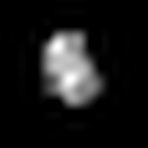 Enhanced Voyager 2 image of Cressida | |
| Discovery | |
|---|---|
| Discovered by | Stephen P. Synnott / Voyager 2 |
| Discovery date | January 9, 1986 |
| Designations | |
Designation | Uranus IX |
| Pronunciation | /ˈkrɛsədə/[1] |
| Named after | Χρησίδα |
| Adjectives | Cressidian /krɛˈsɪdiən/[2] |
| Orbital characteristics | |
| Mean orbit radius | 61,766.730 ± 0.046 km[3] |
| Eccentricity | 0.00036 ± 0.00011[3] |
| Orbital period | 0.463569601 ± 0.000000013 d[3] |
| Inclination | 0.006 ± 0.040° (to Uranus' equator)[3] |
| Satellite of | Uranus |
| Physical characteristics | |
| Dimensions | 92 × 74 × 74 km[4] |
| Mean radius | 39.8 ± 2 km[4][5][6] |
| Surface area | ~20,000 km2[lower-alpha 1] |
| Volume | ~260,000 km3[lower-alpha 1] |
| Mass | 2.5±0.4×10¹⁷ kg[7] |
| Mean density | 0.86±0.16 g/cm3[7] |
surface gravity | ~0.013 m/s2[lower-alpha 1] |
escape velocity | ~0.034 km/s[lower-alpha 1] |
| Rotation period | synchronous[4] |
| Axial tilt | zero[4] |
| Physics | ~64 K[lower-alpha 1] |
Cressida /ˈkrɛsədə/ is an inner satellite of Uranus. It was discovered from the images taken by Voyager 2 on 9 January 1986, and was given the temporary designation S/1986 U 3.[8] It was named after Cressida, the Trojan daughter of Calchas, a tragic heroine who appears in William Shakespeare's play Troilus and Cressida (as well as in tales by Geoffrey Chaucer and others). It is also designated Uranus IX.[9]
Cressida belongs to the Portia group of satellites, which includes Bianca, Desdemona, Juliet, Portia, Rosalind, Cupid, Belinda and Perdita.[10] These satellites have similar orbits and photometric properties.[10] Other than its orbit,[3] radius of 41 km[4] and geometric albedo of 0.08,[10] virtually nothing is known about it.
In the Voyager 2 images Cressida appears as an elongated object, its major axis pointing towards Uranus. The ratio of axes of Cressida's prolate spheroid is 0.8 ± 0.3.[4] Its surface is grey in color.[4]
Cressida orbits close to a 3:2 resonance with the η ring, one of the rings of Uranus. Perturbations of the ring's shape provide a way to measure the mass of Cressida, which was found to be 2.5±0.4×10¹⁷ kg. Cressida is the only small satellite of Uranus for which the mass has been directly measured.[7]
Cressida may collide with Desdemona within the next 100 million years.[11]
See also
- Moons of Uranus
References
Explanatory notes
- ↑ 1.0 1.1 1.2 1.3 1.4 Calculated on the basis of other parameters.
Citations
- ↑ Benjamin Smith (1903) The Century Dictionary and Cyclopedia
- ↑ Kellog (1995) Boccaccio's and Chaucer's Cressida
- ↑ 3.0 3.1 3.2 3.3 3.4 Jacobson, R. A. (1998). "The Orbits of the Inner Uranian Satellites From Hubble Space Telescope and Voyager 2 Observations". The Astronomical Journal 115 (3): 1195–1199. doi:10.1086/300263. Bibcode: 1998AJ....115.1195J.
- ↑ 4.0 4.1 4.2 4.3 4.4 4.5 4.6 Karkoschka, Erich (2001). "Voyager's Eleventh Discovery of a Satellite of Uranus and Photometry and the First Size Measurements of Nine Satellites". Icarus 151 (1): 69–77. doi:10.1006/icar.2001.6597. Bibcode: 2001Icar..151...69K.
- ↑ "Planetary Satellite Physical Parameters". JPL (Solar System Dynamics). 24 October 2008. http://ssd.jpl.nasa.gov/?sat_phys_par.
- ↑ Williams, Dr. David R. (23 November 2007). "Uranian Satellite Fact Sheet". NASA (National Space Science Data Center). http://nssdc.gsfc.nasa.gov/planetary/factsheet/uraniansatfact.html.
- ↑ 7.0 7.1 7.2 Chancia, Robert. A.; Hedman, Matthew M.; French, Richard G. (28 August 2017). "Weighing Uranus' moon Cressida with the η ring". The Astronomical Journal 154 (4): 153. doi:10.3847/1538-3881/aa880e. Bibcode: 2017AJ....154..153C.
- ↑ Smith, B. A. (January 16, 1986). "Satellites of Uranus". IAU Circular 4164. http://www.cbat.eps.harvard.edu/iauc/04100/04164.html#Item1. Retrieved 29 October 2011.
- ↑ "Planet and Satellite Names and Discoverers". Gazetteer of Planetary Nomenclature. USGS Astrogeology. July 21, 2006. http://planetarynames.wr.usgs.gov/Page/Planets.
- ↑ 10.0 10.1 10.2 Karkoschka, Erich (2001). "Comprehensive Photometry of the Rings and 16 Satellites of Uranus with the Hubble Space Telescope". Icarus 151 (1): 51–68. doi:10.1006/icar.2001.6596. Bibcode: 2001Icar..151...51K.
- ↑ Duncan, Martin J.; Lissauer, Jack J. (1997). "Orbital Stability of the Uranian Satellite System". Icarus 125 (1): 1–12. doi:10.1006/icar.1996.5568. Bibcode: 1997Icar..125....1D.
External links
- Cressida Profile by NASA's Solar System Exploration
- Uranus' Known Satellites (by Scott S. Sheppard)
Uranus (Outline of Uranus | |||||||
|---|---|---|---|---|---|---|---|
| Geography |
|  | |||||
| Moons |
| ||||||
| Astronomy |
| ||||||
| Exploration |
| ||||||
| Related |
| ||||||
| |||||||
Natural satellites of the Solar System | ||
|---|---|---|
| Planetary satellites |
|  |
| Dwarf-planet satellites |
| |
| Minor-planet moons |
| |
| Ranked by size |
| |
| ||
 |  |
Categories: [Moons of Uranus]
↧ Download as ZWI file | Last modified: 08/08/2023 22:16:02 | 3 views
☰ Source: https://handwiki.org/wiki/Astronomy:Cressida_(moon) | License: CC BY-SA 3.0
 ZWI signed:
 KSF
KSF