Malus, Étienne Louis
 From Britannica 11th Edition (1911)
 Malus, Étienne Louis (1775-1812), French physicist, was born at Paris on the 23rd of June 1775. He entered the military engineering school at Mezières; but, being regarded as a suspected person, he was dismissed without receiving a commission, and obliged to enter the army as a private soldier. Being employed upon the fortifications of Dunkirk, he attracted the notice of the director of the works, and was selected as a member of the École polytechnique then to be established under G. Monge. After three years at the École he was admitted into the corps of engineers, and served in the army of the Sambre and Meuse; he was present at the passage of the Rhine in 1797, and at the affairs of Ukratz and Altenkirch. In 1798 he joined the Egyptian expedition and remained in the East till 1801. On his return he held official posts successively at Antwerp, Strassburg and Paris, and devoted himself to optical research. A paper published in 1809 (“Sur une propriété de la lumière réfléchie par les corps diaphanes”) contained the discovery of the polarization of light by reflection, which is specially associated with his name, and in the following year he won a prize from the Institute with his memoir, “Théorie de la double refraction de la lumière dans les substances cristallines.” He died of phthisis in Paris on the 23rd of February 1812.
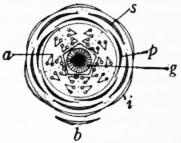 |
| Fig. 1.—Floral Diagram of Hollyhock (Althaea rosea). |
a, Stamens. b, Bract. g, Pistil of carpels. i, Epicalyx, formed from an involucre of bracteoles. p, Petals. s, Sepals. |
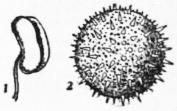 |
| Fig. 2. |
1, Anther. 2, Pollen grain of Hollyhock (Althaea rosea) enlarged. The pollen grain bears numerous spines, the dark spots indicate thin places in the extine. |
↧ Download as ZWI file | Last modified: 11/17/2022 15:23:24 | 34 views
☰ Source: https://oldpedia.org/article/britannica11/Malus_Etienne_Louis | License: Public domain in the USA. Project Gutenberg License
 ZWI signed:
 KSF
KSF