Senegalia Polyacantha
 From Handwiki
| Senegalia polyacantha | |
|---|---|
| |
| |
Scientific classification 
| |
| Kingdom: | Plantae |
| Clade: | Tracheophytes |
| Clade: | Angiosperms |
| Clade: | Eudicots |
| Clade: | Rosids |
| Order: | Fabales |
| Family: | Fabaceae |
| Subfamily: | Caesalpinioideae |
| Clade: | Mimosoid clade |
| Genus: | Senegalia |
| Species: | S. polyacantha
|
| Binomial name | |
| Senegalia polyacantha (Willd.) Seigler & Ebinger
| |
| Subspecies | |
| |
| Synonyms[1] | |
| |
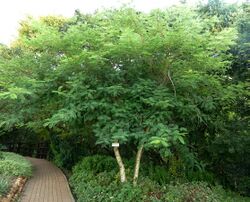
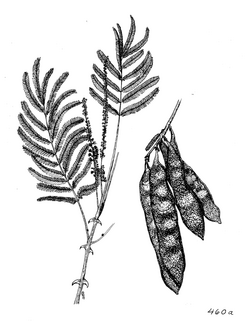
Senegalia polyacantha, also known as white thorn, is a flowering tree which can grow up to 25m tall. Polyacantha has the meaning "many thorns" in Latin.[2] The tree is native to Africa, India , the Indian Ocean and Asia, but it has also been introduced to the Caribbean.[1]
Uses
Repellent uses
The root of Senegalia polyacantha subsp. campylacantha emits chemical compounds that repel animals including rats, snakes and crocodiles.[2]
Gum
The tree's gum is used in the manufacture of candy.[2]
Medicinal purposes
Senegalia polycantha's roots and perhaps its bark have medicinal uses. The root extract is useful for snakebites[2] and is applied to wash the skin of children who are agitated at night time.[2] The root is also used for treating gonorrhea,[3] venereal diseases,[4] dysentery[4] and gastrointestinal disorders.[4]
Tannin
The bark is useful for tanning.[2]
Wood
The tree's primary use is for wood.[5]
References
- ↑ 1.0 1.1 ILDIS LegumeWeb(ILDIS)
- ↑ 2.0 2.1 2.2 2.3 2.4 2.5 PlantZAfrica.com
- ↑ van der Maesen, L. J. G.; van der Burgt, X. M.; van Medenbach de Rooy, J. M. (1996). The Biodiversity of African Plants. Springer Science+Business Media. p. 254. ISBN 0792340957. https://books.google.com/books?id=9VKdjrt8J9wC&q=Acacia+polyacantha+snakebites&pg=PA254. Retrieved November 10, 2012.
- ↑ 4.0 4.1 4.2 Uhlig, Siegbert (2003). Encyclopaedia Aethiopica: A-C. Harrassowitz Verlag. p. 66. ISBN 3447047461. https://books.google.com/books?id=nobesFx6E7oC&q=Acacia+polyacantha+snakebites&pg=PA66. Retrieved November 10, 2012.
- ↑ Speedy, Andrew. "Acacia polyacantha". http://www.fao.org/ag/agp/agpc/doc/gbase/data/pf000129.htm.
External links
Wikidata ☰ Q3320522 entry
 |  |
Categories: [Senegalia]
↧ Download as ZWI file | Last modified: 05/25/2024 14:30:04 | 4 views
☰ Source: https://handwiki.org/wiki/Biology:Senegalia_polyacantha | License: CC BY-SA 3.0
 KSF
KSF