Utah Elections, 2012
 From Ballotpedia
  |
Utah's 2012 elections U.S. Senate • U.S. House • Governor • Attorney General • Other executive offices • State Senate • State House • Candidate ballot access |
 |
| Other elections | |
|---|---|
| View elections by state and year: | |
| Contents |
|---|
| 1 2012 Elections |
| 2 Eligibility to Vote |
| 2.1 Primary election |
| 2.2 General election |
| 3 Voting absentee |
| 3.1 Eligibility |
| 3.2 Deadlines |
| 3.3 Military and overseas voting |
| 4 Voting early |
| 5 See also |
| 6 References |
The state of Utah held elections in 2012. Below are the dates of note:
- Signature filing deadline: March 16, 2012 & April 15, 2012 (Measures only)
- Primary date: June 26, 2012
- General election date: November 6, 2012
| On the 2012 ballot | Click here for all November 6, 2012 Election Results | ||
|---|---|---|---|
| U.S. Senate (1 seat) | 
|
Preview Article | |
| U.S. House (4 seats) |
| ||
| State Executives (5 seats) |
|
Preview Article | |
| State Senate (16 seats) |
|
Preview Article | |
| State House (75 seats) |
| ||
| Ballot measures (0 measures) |
|
Preview Article | |
2012 Elections[edit]
For election results in the 50 states, see our November 6, 2012 election results page
Elections by type[edit]
U.S. Senate[edit]
| Party | Candidate | Vote % | Votes | |
|---|---|---|---|---|
| Republican |  Orrin G. Hatch Incumbent Orrin G. Hatch Incumbent |
65.8% | 657,608 | |
| Democratic | Scott Howell | 30.2% | 301,873 | |
| Constitution | Shaun Lynn McCausland | 3.2% | 31,905 | |
| Utah Justice | Daniel Geery | 0.8% | 8,342 | |
| Independent | Bill Barron | 0% | 0 | |
| Total Votes | 999,728 | |||
| Source: Utah Lieutenant Governor, "2012 General Election Results" | ||||
U.S. House[edit]
| Members of the U.S. House from Utah -- Partisan Breakdown | |||
|---|---|---|---|
| Party | As of November 2012 | After the 2012 Election | |
| Democratic Party | 1 | 1 | |
| Republican Party | 2 | 3 | |
| Total | 3 | 4 | |
| District | General Election Candidates | Incumbent | 2012 Winner | Partisan Switch? |
| 1st |  Donna McAleer Donna McAleer Rob Bishop Rob Bishop Sherry Phipps Sherry Phipps |
Rob Bishop | Rob Bishop |
No |
| 2nd | Jay Seegmiller Chris Stewart Jonathan Garrard Joseph Andrade Charles Kimball Joseph Andrade Charles Kimball |
Jim Matheson | Chris Stewart |
Yes |
| 3rd | Soren Simonsen Jason Chaffetz |
Jason Chaffetz | Jason Chaffetz |
No |
| 4th | Jim Matheson Mia Love Jim Vein Jim Vein |
N/A | Jim Matheson |
No |
State Executives[edit]
There were five state executive positions up for election.
| Governor of Utah General Election, 2012 | ||||
|---|---|---|---|---|
| Party | Candidate | Vote % | Votes | |
| Democratic | Peter Cooke and Vince Rampton | 27.7% | 253,514 | |
| Republican | Gary Herbert and Greg Bell Incumbent |
68.4% | 624,678 | |
| Libertarian | Ken Larsen and Rob Latham | 2.2% | 19,956 | |
| Constitution | Kirk Pearson and Tim Alders | 1.7% | 15,548 | |
| Total Votes | 913,696 | |||
| Election results via State of Utah | ||||
| Attorney General of Utah General Election, 2012 | ||||
|---|---|---|---|---|
| Party | Candidate | Vote % | Votes | |
| Democratic | Dee W. Smith | 30.1% | 269,893 | |
| Republican | John Swallow |
64.6% | 579,118 | |
| Libertarian | W. Andrew McCullough | 5.3% | 47,347 | |
| Total Votes | 896,358 | |||
| Election results via Utah Lieutenant Governor (dead link) | ||||
| Utah State Auditor General Election, 2012 | ||||
|---|---|---|---|---|
| Party | Candidate | Vote % | Votes | |
| Democratic | Mark Sage | 29.5% | 259,576 | |
| Republican | John Dougall |
65.4% | 575,677 | |
| Constitution | Richard Proctor | 5.2% | 45,373 | |
| Total Votes | 880,626 | |||
| Election results via Utah Lieutenant Governor (dead link) | ||||
| Utah Treasurer General Election, 2012 | ||||
|---|---|---|---|---|
| Party | Candidate | Vote % | Votes | |
| Democratic | Christopher Stout | 28.1% | 247,277 | |
| Republican | Richard Ellis Incumbent |
66.9% | 589,045 | |
| Libertarian | Vincent Marcus | 5% | 44,257 | |
| Total Votes | 880,579 | |||
| Election results via Utah Lieutenant Governor (dead link) | ||||
State Senate[edit]
- See also: Utah State Senate elections, 2012
Heading into the election, Republicans maintained partisan control in the state senate.
| Utah State Senate | |||
|---|---|---|---|
| Party | As of November 5, 2012 | After the 2012 Election | |
| Democratic Party | 7 | 5 | |
| Republican Party | 22 | 24 | |
| Total | 29 | 29 | |
State House[edit]
| Utah House of Representatives | |||
|---|---|---|---|
| Party | As of November 5, 2012 | After the 2012 Election | |
| Democratic Party | 17 | 14 | |
| Republican Party | 58 | 61 | |
| Total | 75 | 75 | |
Ballot measures[edit]
- See also: Utah 2012 ballot measures
| Type | Title | Subject | Description | Result |
|---|---|---|---|---|
| LRCA | Amendment A | Taxes | Require a portion of the revenue from all of the state's severance taxes to be deposited into the permanent state trust fund | |
| LRCA | Amendment B | Taxes | Exempt military personnel from paying property taxes. | |
Eligibility to Vote[edit]

Primary election[edit]
- See also: Voting in the 2012 primary elections
Utah used a partially open primary system; Republicans had a closed primary, and Democrats and independents could both vote in the Democratic primary. Both parties held conventions before the primary. Voters were required to register to vote in the primary by June 11, 2012, which was 15 days before the primary took place , or by May 29, 2012 for mail-in registration.[1] (Information about registering to vote)
General election[edit]
- See also: Voting in the 2012 general elections
The deadline to register to vote was 28 days prior to the election day, which in 2012 was October 9. October 22, or 15 days prior to election, was the deadline if registering in person.[2]
Note: Some states had a voter registration deadline 30 days prior to the election but because this could have fallen on a weekend and Columbus Day was on Monday, October 8th, some extended the deadline to October 9, 2012.
- Voter ID info
- Residency requirements: Resident of Utah for at least 30 days.[3]
- Same-day registration: None
Voting absentee[edit]
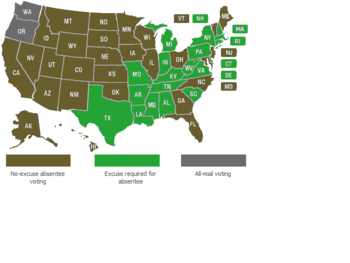
- See also: Absentee Voting
Utah is an all-mail voting state. All registered Utah voters are mailed a ballot before the election. No request is necessary. Completed ballots can be returned in person to a vote center, deposited into a local drop box, or returned by mail. If mailed, completed ballots must be received by 8 p.m. on Election Day.[4][5]
Note: Starting in 2029, Utah will require voters to request an absentee/mail-in ballot. Click here for more information.
Voting early[edit]
- See also: Early voting
Utah is one of 34 states that have early voting with no specific requirements as to who can vote early. Early voting begins 14 days before an election and ends the Friday prior to Election Day. The average number of days prior to an election that voters can cast an early ballot is 21 days in states with a definitive starting date.[6][7]
See also[edit]
Footnotes[edit]
- ↑ State of Utah, "Deadlines," accessed April 19, 2012
- ↑ Vote Utah, "Registration to Vote Deadlines" accessed May 11, 2012
- ↑ Vote Utah, "Registration Requirements" accessed May 11, 2012
- ↑ State of Utah, "Learn more about voting by mail," accessed October 31, 2025
- ↑ Utah State Legislature, "H.B. 300 Amendments to Election Law," accessed October 31, 2025
- ↑ Long Distance Voter, "Early Voting Rules," accessed December 16, 2013
- ↑ Utah Code, "Title 20A, Chapter 3, Section 601," accessed December 16, 2013

Categories: [Utah elections, 2012] [2012 election state pages]
↧ Download as ZWI file | Last modified: 03/08/2026 15:10:43 | 46 views
☰ Source: https://ballotpedia.org/Utah_elections,_2012 | License: CC BY-SA 3.0
 KSF
KSF