European Capital Of Culture
 From Handwiki
A European Capital of Culture is a city designated by the European Union (EU) for a period of one calendar year during which it organises a series of cultural events with a strong pan-European dimension. Being a European Capital of Culture can be an opportunity for a city to generate considerable cultural, social, and economic benefits, and it can help foster urban regeneration, change the city's image, and raise its visibility and profile on an international scale. Multiple cities can be a European Capital of Culture simultaneously.
In 1985, Melina Mercouri, Greece's Minister of Culture, and her France counterpart Jack Lang came up with the idea of designating an annual City of Culture to bring Europeans closer together by highlighting the richness and diversity of European cultures and raising awareness of their common history and values.
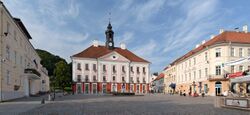
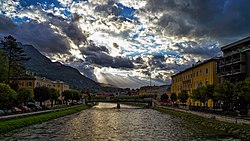
The Commission of the European Union manages the title, and each year the Council of Ministers of the European Union formally designates European Capitals of Culture: more than 40 cities have been designated so far. The current European Capitals of Culture for 2024 are Tartu in Estonia, Bad Ischl in Austria and Bodø in Norway .
Selection process
.jpg/150px-Melina_Mercouri_(1985).jpg)
An international panel of cultural experts is in charge of assessing the proposals of cities for the title according to criteria specified by the European Union.
For two of the capitals each year, eligibility is open to cities in EU member states only. From 2021 and every three years thereafter, a third capital will be chosen from cities in countries that are candidates or potential candidates for membership, or in countries that are part of the European Economic Area (EEA)[1][2]– an example of the latter being Stavanger, Norway , which was a European Capital of Culture in 2008.
A 2004 study conducted for the Commission, known as the "Palmer report", demonstrated that the choice of European Capital of Culture served as a catalyst for cultural development and the transformation of the city.[3] Consequently, the beneficial socio-economic development and impact for the chosen city are now also considered in determining the chosen cities.
Bids from five United Kingdom cities to be the 2023 Capital of Culture were disqualified in November 2017, because the UK was planning to leave the EU before 2023.[4]
History
The European Capital of Culture programme was initially called the European City of Culture and was conceived in 1983, by Melina Mercouri, then serving as minister of culture in Greece. Mercouri believed that at the time, culture was not given the same attention as politics and economics and a project for promoting European cultures within the member states should be pursued. The European City of Culture programme was launched in the summer of 1985 with Athens being the first title-holder.[5] In 1999, the European City of Culture program was renamed to European Capital of Culture.[6]
List of European Capitals of Culture

| Year | # | City | Country | Notes/Links |
|---|---|---|---|---|
| 1985 | Athens |  Greece Greece |
||
| 1986 | Florence |  Italy Italy |
||
| 1987 | Amsterdam |  Netherlands Netherlands |
||
| 1988 | West Berlin |  West Germany West Germany |
Berlin since German reunification in 1990 | |
| 1989 | Paris |  France France |
||
| 1990 | Glasgow |  United Kingdom United Kingdom |
Glasgow Garden Festival | |
| 1991 | Dublin |  Ireland Ireland |
||
| 1992 | Madrid |  Spain Spain |
||
| 1993 | Antwerp | .svg/23px-Flag_of_Belgium_(civil).svg.png) Belgium Belgium |
||
| 1994 | Lisbon |  Portugal Portugal |
||
| 1995 | Luxembourg City |  Luxembourg Luxembourg |
||
| 1996 | Copenhagen |  Denmark Denmark |
||
| 1997 | Thessaloniki | Greece |
||
| 1998 | Stockholm |  Sweden Sweden |
||
| 1999 | Weimar | Germany |
||
| 2000 | Avignon | France |
The year 2000 was called the millennium year and treated in a special way, in order to emphasize the enduring heritage and contribution of European cities to world culture and civilization. Because of that, nine locations were chosen, including two cities of states that were to join the EU on 1 May 2004.[7] | |
| Bergen |  Norway Norway
| |||
| Bologna | Italy
| |||
| Brussels | Belgium
| |||
| Helsinki |  Finland Finland
| |||
| Kraków |  Poland Poland
| |||
| Prague |  Czech Republic Czech Republic
| |||
| Reykjavík |  Iceland Iceland
| |||
| Santiago de Compostela | Spain
| |||
| 2001 | Rotterdam | Netherlands |
||
| Porto | Portugal |
|||
| 2002 | Bruges | Belgium |
||
| Salamanca | Spain |
|||
| 2003 | Graz |  Austria Austria |
||
| 2004 | Genoa | Italy |
||
| Lille | France |
|||
| 2005 | Cork | Ireland |
Cork Caucus | |
| 2006 | Patras | Greece |
||
| 2007 | Sibiu |  Romania Romania |
||
| Luxembourg City | Luxembourg |
|||
| 2008 | Liverpool | United Kingdom |
||
| Stavanger | Norway |
|||
| 2009 | Vilnius |  Lithuania Lithuania |
||
| Linz | Austria |
Linz 2009 | ||
| 2010 | Essen | Germany |
Representing the whole Ruhr as Ruhr.2010. | |
| Istanbul |  Turkey Turkey |
|||
| Pécs |  Hungary Hungary |
|||
| 2011 | Turku | Finland |
||
| Tallinn |  Estonia Estonia |
|||
| 2012 | Guimarães | Portugal |
||
| Maribor |  Slovenia Slovenia |
|||
| 2013 | Marseille | France |
Marseille-Provence 2013 | |
| Košice |  Slovakia Slovakia |
|||
| 2014 | Riga |  Latvia Latvia |
||
| Umeå | Sweden |
|||
| 2015 | Mons | Belgium |
||
| Plzeň | Czech Republic |
|||
| 2016 | San Sebastián | Spain |
||
| Wrocław | Poland |
|||
| 2017 | Aarhus | Denmark |
Aarhus 2017 | |
| Paphos |  Cyprus Cyprus |
Pafos 2017 | ||
| 2018 | Leeuwarden | Netherlands |
||
| Valletta |  Malta Malta |
Valletta 2018 | ||
| 2019 | Matera | Italy |
||
| Plovdiv |  Bulgaria Bulgaria |
Plovdiv 2019 | ||
| 2020 – April 2021 | Rijeka |  Croatia Croatia |
Rijeka 2020 | |
| Galway | Ireland |
|||
| 2022 | Kaunas | Lithuania |
Kaunas 2022 | |
| Esch-sur-Alzette | Luxembourg |
Esch-sur-Alzette 2022 | ||
| Novi Sad |  Serbia Serbia |
Novi Sad 2022 (Coronavirus postponement) | ||
| 20231 | Veszprém | Hungary |
Veszprém 2023 | |
| Timișoara | Romania |
Timișoara 2023 (Coronavirus postponement) | ||
| Eleusis | Greece |
Eleusis 2023 (Coronavirus postponement) | ||
| 2024 | 1 | Tartu | Estonia |
Tartu 2024 |
| 2 | Bad Ischl | Austria |
Salzkammergut 2024 | |
| 32 | Bodø | Norway |
Bodø 2024 | |
| 2025 | Nova Gorica/Gorizia joint bid | Slovenia Italy |
GO! 2025 | |
| Chemnitz | Germany |
Chemnitz 2025 | ||
| 2026 | Trenčín[8] | Slovakia |
Trenčín 2026 | |
| Oulu | Finland |
Oulu 2026 | ||
| 2027 | Liepāja | Latvia |
Liepāja 2027 | |
| Évora | Portugal |
Évora 2027 | ||
| 2028 | 1 | České Budějovice[9] | Czech Republic |
České Budějovice 2028 |
| 2 | Bourges[10] | France |
Bourges 2028 | |
| 32 | Skopje |  North Macedonia North Macedonia |
Skopje 2028 | |
| 2029 | TBA September 2024[11] | Poland |
shortlisted:[12] Bielsko-Biała, Katowice, Kołobrzeg, Lublin | |
| TBA | Sweden |
shortlist 21 February 2024[11] / potential candidates cities:[13] Kiruna, Uppsala | ||
| 2030 | 1 | TBA | Cyprus |
deadline 13 December 2024[14] |
| 2 | TBA | Belgium |
deadline 2 August 2024[15] / potential candidate cities: Brussels[16] Leuven,[17] Liège, Kortrijk, Ghent | |
| 32 | TBA | TBA | deadline 16 August 2024[18] | |
| 2031 | TBA | Malta |
potential candidate cities: Tarxien, Cottonera, Sliema, & Gozo | |
| TBA | Spain |
potential candidate cities: Burgos, Cáceres, Granada, Jerez de la Frontera | ||
| 2032 | TBA | Bulgaria |
potential candidate cities: Veliko Tarnovo | |
| TBA | Denmark |
potential candidate cities: Næstved[19] | ||
| 2033 | 1 | TBA | Netherlands |
potential candidate city: Enschede |
| 2 | TBA | Italy |
potential candidate city: Turin[20] | |
| 32 | TBA | TBA |
1 The European Capital of Culture was due to be in the United Kingdom in 2023. However, due to its decision to leave the European Union, UK cities would no longer be eligible to hold the title after 2019. The European Commission's Scotland office confirmed that this would be the case on 23 November 2017, only one week before the UK was due to announce which city would be put forward.[21] The candidate cities were Dundee,[22] Leeds, Milton Keynes,[23] Nottingham and a joint bid from Northern Irish cities of Belfast and Derry and the town of Strabane.[24]
2 A new framework makes it possible for cities in candidate countries (Albania, Bosnia and Herzegovina, Georgia, Moldova, Montenegro, North Macedonia, Serbia, Turkey, Ukraine ), potential candidates for EU membership (Kosovo) or EFTA member states (Iceland, Liechtenstein, Norway , Switzerland ) to hold the title every third year as of 2021. This will be selected through an open competition, meaning that cities from various countries may compete with each other.[25]


See also
- American Capital of Culture
- Arab Capital of Culture
- European Green Capital Award
- European Youth Capital
- European Region of Gastronomy
- University Network of the European Capitals of Culture
References
- ↑ "Decision No 445/2014/EU of the European Parliament and of the Council of 16 April 2014". 3 May 2014. http://eur-lex.europa.eu/legal-content/EN/TXT/PDF/?uri=CELEX:32014D0445&from=EN.
- ↑ "European Capitals of Culture 2020 to 2033 — A guide for cities preparing to bid". European Commission. https://ec.europa.eu/programmes/creative-europe/sites/creative-europe/files/capitals-culture-candidates-guide_en.pdf.
- ↑ Palmer, Robert. "European Cities and Capitals of Culture". http://ec.europa.eu/programmes/creative-europe/actions/documents/ecoc/cap-part1_en.pdf. Study prepared for the European Commission
- ↑ "Brexit blow to UK 2023 culture crown bids". 23 November 2017. https://www.bbc.co.uk/news/uk-scotland-tayside-central-42095477.
- ↑ Kiran Klaus Patel, ed., The Cultural Politics of Europe: European Capitals of Culture and European Union since the 1980s (London: Routledge, 2013)
- ↑ "History – UNeECC" (in en-US). https://uneecc.org/european-capitals-of-culture/history/.
- ↑ "Association of European Cities of Culture of the Year 2000 – KRAKOW THE OPEN CITY". https://www.krakow.pl/krakow_open_city/international_organisations/8370,artykul,association_of_european_cities_of_culture_of_the_year_2000.html.
- ↑ "Trenčín to be the European Capital of Culture 2026 in Slovakia". 2021-12-10. https://ec.europa.eu/culture/news/trencin-to-be-the-european-capital-of-culture-2026-in-slovakia.
- ↑ "České Budějovice to be the European Capital of Culture 2028 in the Czech Republic". European Commission. https://culture.ec.europa.eu/news/ceske-budejovice-to-be-the-european-capital-of-culture-2028-in-the-czech-republic.
- ↑ "Bourges to be the European Capital of Culture 2028 in France". European Commission. https://culture.ec.europa.eu/news/bourges-to-be-the-european-capital-of-culture-2028-in-france.
- ↑ 11.0 11.1 "Designated European Capitals of Culture". European Union. https://culture.ec.europa.eu/policies/culture-in-cities-and-regions/designated-capitals-of-culture.
- ↑ "Raport z pre-selekcji konkursu o tytuł Europejskiej Stolicy Kultury 2029" (in pl). Ministry of Culture and National Heritage (Poland). 6 December 2023. https://www.gov.pl/web/kultura/raport-z-pre-selekcji-konkursu-o-tytul-europejskiej-stolicy-kultury-20210.
- ↑ Paternoster, Serafino (7 July 2023). "Sweden 2029, only Kiruna and Uppsala are candidates. Why?". EcocNews.com. https://www.ecocnews.com/news/item/582-sweden-2029-only-kiruna-and-uppsala-are-candidates-why.
- ↑ "Πολιτιστική Πρωτεύουσα της Ευρώπης για το έτος 2030". http://www.culture.gov.cy/dmculture/culture.nsf/all/DA08116F26FA6EE6C2258A84002C7172?opendocument.
- ↑ "European Capital Of Culture 2030 Belgium". https://www.ecoc2030.be/.
- ↑ "Let's make Brussels the cultural capital of Europe!". https://brussels2030.be/.
- ↑ "Leuven stelt zich kandidaat als Europese Culturele Hoofdstad 2030". demorgen.be. 15 December 2017. https://www.demorgen.be/cultuur/leuven-stelt-zich-kandidaat-als-europese-culturele-hoofdstad-2030-bd3a93cc/.
- ↑ "Call for applications for the 2030 European Capital of Culture title for cities in EFTA/EEA countries, in candidate countries and in potential candidates for EU membership". European Commission. https://culture.ec.europa.eu/calls/ecoc-2030.
- ↑ "Vild plan: Vil gøre Næstved til europæisk kulturhovedstad". 11 January 2022. https://www.sn.dk/naestved-kommune/vild-plan-vil-goere-naestved-til-europaeisk-kulturhovedstad/.
- ↑ "Torino Capitale europea della Cultura nel 2033? Il Consiglio comunale dice "sì" alla candidatura". Torino Oggi. 19 April 2021. https://www.torinoggi.it/2021/04/19/leggi-notizia/argomenti/politica-11/articolo/torino-capitale-europea-della-cultura-nel-2033-il-consiglio-comunale-dice-si-alla-candidatura.html.
- ↑ Brady, Jon (23 November 2017). "Brexit destroys Dundee's hopes of being European Capital of Culture in 2023". Evening Telegraph. https://www.eveningtelegraph.co.uk/fp/brexit-destroys-dundees-hopes-european-capital-culture-2023/.
- ↑ Lorimer, Scott. "The latest news and sport from Dundee, Tayside and Fife". Evening Telegraph. http://www.eveningtelegraph.co.uk/news/local/dundee/dundee-sets-sights-on-european-capital-of-culture-bid-1.884745.
- ↑ "European Capital of Culture". Milton Keynes Council. http://www.milton-keynes.gov.uk/leisure-tourism-and-culture/european-capital-of-culture.
- ↑ Meredith, Robbie (5 July 2017). "NI councils make bid for European Capital of Culture title". https://www.bbc.co.uk/news/uk-northern-ireland-40499143.
- ↑ "European Capitals of Culture". European Union. 6 Feb 2021. https://ec.europa.eu/programmes/creative-europe/content/european-capitals-culture-2026-slovakia_en.
External links
- European Capitals of Culture
- Decision No 1622/2006/EC of the European Parliament and of the Council of 24 October 2006 establishing a Community action for the European Capital of Culture event for the years 2007 to 2019
- Decision No 445/2014/EU of the European Parliament and of the Council of 16 April 2014 establishing a Union action for the European Capitals of Culture for the years 2020 to 2033 and repealing Decision No 1622/2006/EC
 |  |
Categories: [Capitals in Europe] [Lists of capitals]
↧ Download as ZWI file | Last modified: 11/05/2025 21:40:32 | 5 views
☰ Source: https://handwiki.org/wiki/Place:European_Capital_of_Culture | License: CC BY-SA 3.0
 KSF
KSF