Trident (Spacecraft)
 From Handwiki
 Comparison of two designs for Trident | |
| Mission type | Reconnaissance, flyby of outer planets |
|---|---|
| Operator | NASA |
| Mission duration | 13 years (planned) |
| Start of mission | |
| Launch date | Proposed: 25 October 2025 (with a backup in October 2026) [1] |
| Flyby of Earth (gravity assist) | |
| Closest approach | 28 October 2026 [2] |
| Flyby of Venus (gravity assist) | |
| Closest approach | 25 March 2027 [2] |
| Flyby of Earth (gravity assist) | |
| Closest approach | 7 February 2028 [2] |
| Flyby of Earth (gravity assist) | |
| Closest approach | 7 February 2031 [2] |
| Flyby of Jupiter, Io (gravity assist) | |
| Closest approach | 28 June 2032 [2] |
| Distance | 1.24 RJ or 88,650 km (55,080 mi) |
| Flyby of Neptune, Triton | |
| Closest approach | 28 June 2038 [2] |
Discovery Program | |
Trident is a space mission concept to the outer planets proposed in 2019 to NASA's Discovery Program.[3][4] The concept includes flybys of Jupiter and Neptune with a focus on Neptune's largest moon Triton.
In 2020, Trident was selected along with three other Discovery proposals for further study, with two expected to be selected to fly as Discovery 15 and 16.[5] On 2 June 2021, NASA selected the Venus missions DAVINCI+ and VERITAS over Trident and the Io Volcano Observer.[6]
History
Triton is the largest moon of Neptune. In 1989, Voyager 2 flew past the moon at a distance of 40,000 km (25,000 mi),[7] and discovered several cryovolcanoes on its surface. Triton is geologically active, its surface is young and has relatively few impact craters. It has a very thin atmosphere. Voyager 2 was only able to observe approximately 40% of Triton's surface.
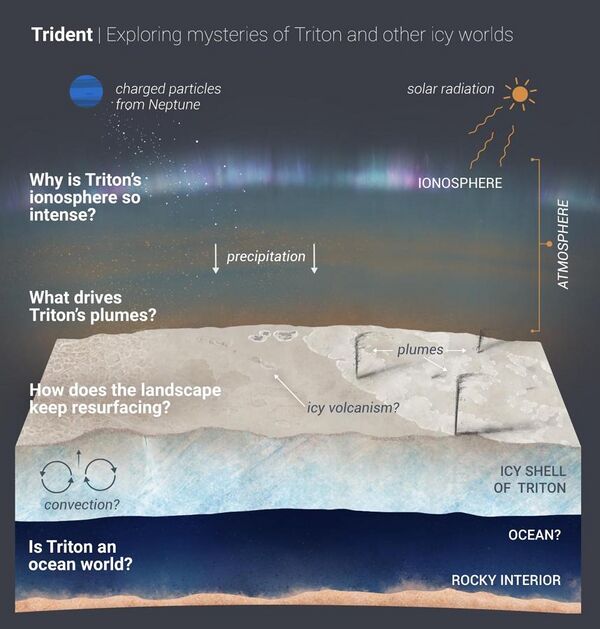
The Trident concept was proposed in March 2019 to NASA's Discovery Program. The mission concept is supported by NASA's Ocean Worlds Exploration Program and it is intended to help answer some of the questions generated by Voyager 2's flyby in 1989.[8]
Overview
Trident takes advantage of an efficient gravity assist alignment of Jupiter and Neptune (that occurs once every 13 years) to capitalize on a narrow observational window that enables assessment of changes in Triton's plume activity and surface characteristics since the previous encounter of Neptune-Triton by Voyager 2 in 1989.[3][9]
With the advances of high-resolution imaging and a unique orbital configuration of Triton in 2038, Trident would be able to obtain a near-complete map of the Neptune's moon during its sole flyby. Trident would pass through Triton's thin atmosphere, within 500 km (310 mi) of the surface, sampling its ionosphere with a plasma spectrometer and perform magnetic induction measurements to assess the potential existence of an internal ocean.[3] The principal investigator is Louise Prockter, director of the Lunar and Planetary Institute in Houston, Texas.[9]
The launch vehicle proposed for Trident is the Atlas V 401, if it is not replaced with the Vulcan.[2]
The proposed launch date in October 2025 (with a backup in October 2026) would take advantage of a once-in-13-years window, when Earth is properly aligned with Jupiter. The spacecraft would use the gravitational pull of Jupiter as a slingshot straight to Triton for an extended 13-day encounter in 2038.[1]
Payload
| Instrument[2] | Functionality | Heritage (Contractor) |
|---|---|---|
| Infrared spectrometer | 2–100 km, near-global compositional mapping at 1-5 μm wavelength. | Ralph (New Horizons) (Ball Aerospace) |
| Narrow angle camera | Anti-Neptune regional mapping and limb imaging (≤ 200 m). | Cassini camera and LORRI (New Horizons) (Ball) |
| Wide-angle camera | Sub-Neptune and haze imaging and change detection (≤ 2,500 m). | Ralph and Cassini camera (Jet Propulsion Laboratory) |
| Triaxial magnetometer | Ocean detection. | Cassini boom, Psyche and MESSENGER magnetometers (UCLA) |
| Radio science | Atmospheric occultations for neutral and electron profiles; gravimetry observations | REX (New Horizons) and BepiColombo (Italian Space Agency) |
| Plasma spectrometer | Atmospheric charged particles. Energetic inputs to ionosphere. | ICA (Rosetta) and JDC (JUICE)(IRF) |
Objects that Trident would visit
Venus (flyby)

Earth (3x flybys)

Jupiter (flyby)

Io (flyby)

Neptune (targeted flyby)
_-_non-edit_version.jpg)
Triton (targeted flyby)
See also
- Argo, a 2009 Triton flyby mission concept
- Interstellar Express, a Chinese probe proposed to fly by Neptune and Triton in January 2038 en route to the tail of the heliosphere
- New Horizons probe, performed a Pluto flyby in 2015
- New Horizons 2, a mission proposed in 2002 which might have included a Triton flyby
- Triton Hopper, a lander concept to Triton
References
- ↑ 1.0 1.1 "Proposed NASA Mission Would Visit Neptune's Curious Moon Triton". NASA. 16 June 2020. https://www.jpl.nasa.gov/news/news.php?feature=7680.
 This article incorporates text from this source, which is in the public domain.
- ↑ 2.0 2.1 2.2 2.3 2.4 2.5 2.6 2.7 "Implementation of Trident: A Discovery-Class Mission To Triton". 23 March 2019. https://www.hou.usra.edu/meetings/lpsc2019/pdf/3200.pdf.
- ↑ 3.0 3.1 3.2 NASA proposes mission to Neptune moon Triton. Paul Scott Anderson, EarthSky 28 March 2019.
- ↑ "Exploring Triton With Trident: A Discovery-Class Mission". 23 March 2019. https://www.hou.usra.edu/meetings/lpsc2019/pdf/3188.pdf.
- ↑ "NASA Selects Four Possible Missions to Study the Secrets of the Solar System". NASA. 13 February 2020. https://www.nasa.gov/press-release/nasa-selects-four-possible-missions-to-study-the-secrets-of-the-solar-system. This article incorporates text from this source, which is in the public domain.
- ↑ Potter, Sean (2 June 2021). "NASA Selects 2 Missions to Study 'Lost Habitable' World of Venus" (Press release). NASA. Retrieved 2 June 2021.
- ↑ Gray, D (1989). "Voyager 2 Neptune navigation results". Astrodynamics Conference: 108. doi:10.2514/6.1990-2876.
- ↑ Hendrix, Amanda R. (2019). "The NASA Roadmap to Ocean Worlds". Astrobiology 19 (1): 1–27. doi:10.1089/ast.2018.1955. PMID 30346215. Bibcode: 2019AsBio..19....1H.
- ↑ 9.0 9.1 Neptune's Moon Triton Is Destination of Proposed NASA Mission. David W. Brown, The New York Times. 19 March 2019.
Spacecraft missions to Jupiter | ||
|---|---|---|
| Flybys |
|  |
| Orbiters |
| |
| Atmospheric probes |
| |
| Planned missions |
| |
| Proposed missions |
| |
| Cancelled / Concepts |
| |
| Related topics |
| |
Neptune | |||||||
|---|---|---|---|---|---|---|---|
| |||||||
| Geography |
| _flatten_crop.jpg) | |||||
| Moons |
| ||||||
| Astronomy |
| ||||||
| Exploration |
| ||||||
| Related |
| ||||||
| |||||||
 Book
Book Category
 Portal
NASAPlanetary Missions Program Office|Planetary Missions Program Office]] | ||||||||||||||||||||
|---|---|---|---|---|---|---|---|---|---|---|---|---|---|---|---|---|---|---|---|---|
| ||||||||||||||||||||
| ||||||||||||||||||||
| ||||||||||||||||||||
| ||||||||||||||||||||

 |  |
Categories: [Proposed NASA space probes] [Missions to Neptune] [Triton (moon)] [Missions to Jupiter]
↧ Download as ZWI file | Last modified: 11/03/2024 03:29:36 | 2 views
☰ Source: https://handwiki.org/wiki/Engineering:Trident_(spacecraft) | License: CC BY-SA 3.0
 KSF
KSF