Prayer Bump
 From Handwiki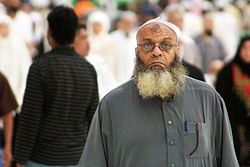
A zebibah (Arabic: زبيبة zabība, "raisin"), also known as a zabiba or zebiba, or prayer bump, is a callus on the forehead present in some Muslims, mainly in Egypt.[1] Owing to its societal significance it is also known as the devout sign.[2]
Islam requires its adherents to pray five times a day (known as salat), which involves kneeling on a prayer mat and touching the ground (or a raised piece of clay called Turbah by the Shia) with one's forehead. When done firmly for extended periods of time, a callus can develop on the forehead - the 'prayer bump' - which may be considered as a sign of piety and dedication. It is mentioned in the Quran as:
"Muḥammad is the Messenger of Allah; and those with him are forceful against the disbelievers, merciful among themselves. You see them bowing and prostrating [in prayer], seeking bounty from Allah and [His] pleasure. Their sign is in their faces from the effect of prostration [i.e., prayer]. That is their description in the Torah. And their description in the Gospel is as a plant which produces its offshoots and strengthens them so they grow firm and stand upon their stalks delighting the sowers - so that He [i.e., Allah] may enrage by them the disbelievers. Allah has promised those who believe and do righteous deeds among them forggiveness and a great reward"[3]
Some Muslims also believe that on the Day of Judgment(يوم القيامة), this bump will fluoresce with an immense white light.[4] However, "Riya" (showing-off) is prohibited in Islam; if the prayer bump may result in riya (showing-off piety), it is recommended [by whom?] to take precautionary measures to stop a bump forming, as worship may be deemed void due to riya. Therefore, showing-off piety should not be a reason for deliberately creating a prayer bump.
In extreme cases, the callus can be thick enough to create a noticeable bump that protrudes from the forehead.
References
- ↑ Slackman, Michael (December 18, 2007). "Fashion and Faith Meet, on Foreheads of the Pious". https://www.nytimes.com/2007/12/18/world/africa/18egypt.html.
- ↑ Bhargava R & Bhargava M (12 March 2018). "Devout Sign (Prayer Mark)". Austin Publications LLC. https://austinpublishinggroup.com/surgery/fulltext/ajs-v5-id1141.php.
- ↑ "Surah Al-Fath - 29". https://quran.com/al-fath?locale=en&font=v1&reading=false&translations=131,20.
- ↑ Magdi Abdelhadi (23 June 2008). "Signs of division on Egypt's brow". BBC News. http://news.bbc.co.uk/1/hi/world/middle_east/7469221.stm. Retrieved 2011-01-10.
External links
- Reference to a prayer bump in 'Men, Women and God(s)'
- Mention of a prayer scar in Middle East Report
- Mention of a prayer scar in Occupation Magazine
 |
Categories: [Salah]
↧ Download as ZWI file | Last modified: 01/23/2024 16:42:37 | 2 views
☰ Source: https://handwiki.org/wiki/Religion:Prayer_bump | License: CC BY-SA 3.0
 KSF
KSF