National Museums Of Kenya
 From Handwiki
Makumbusho ya Kitaifa ya Kenya | |
 Main entrance of the Nairobi National Museum | |
| Former name | Coryndon Museum (1929–1964) |
|---|---|
| Established | 1910 |
| Location | Museum Hill, Nairobi, Kenya |
| Coordinates | [ ⚑ ] : 1°16′26″S 36°48′54″E / 1.27389°S 36.815°E |
| Type | National museum and Research institute |
| Key holdings | Turkana Boy; Ahmed (elephant); Joy Adamson portraits |
| Collections | Palaeontology, Archaeology, Ethnography, Biodiversity |
| Collection size | Over 7.5 million specimens |
| Visitors | ~800,000 annually (national network) |
| Owner | Government of Kenya |
| Website | www |
The National Museums of Kenya (NMK; Makumbusho ya Kitaifa ya Kenya) is a multi-disciplinary state corporation established under the National Museums and Heritage Act (2006). It serves as the national custodian of Kenya's cultural and natural heritage, managing a network of over 22 regional museums, hundreds of sites, and numerous national monuments. Headquartered at Museum Hill in Nairobi, the NMK is a globally recognized hub for scientific research in palaeontology, archaeology, ethnography, and biodiversity conservation.[1]
The institution originated in 1910 under the East Africa Natural History Society (EANHS). Throughout the 20th century, notably under the direction of Louis Leakey and Richard Leakey, it became instrumental in the study of human origins. Today, the NMK oversees several UNESCO World Heritage Sites, including Fort Jesus, Lamu Old Town, and the Sacred Mijikenda Kaya Forests. Its scientific divisions, such as the East African Herbarium, house one of the largest biological repositories in Africa, containing over 7.5 million specimens.[2]
History of Nairobi National Museum of Kenya
Natural History Museum of Kenya

The East Africa and Uganda Natural History Society was founded in 1910–11 by persons with an interest in nature in British East Africa.[3] The group included two canons of the Church Missionary Society: The Rev. Harry Leakey (father of Louis Leakey) and The Rev. Kenneth St. Aubyn Rogers; some government officials: C. W. Hobley and John Ainsworth, doctors, dentists, big-game hunters and plantation owners. In 1911 they established the Natural History Museum and library with an honorary curator. Aladina Visram put up the money for a one-story, two-room building.[4]
In 1914 they could afford a paid curator. They brought in Arthur Loveridge, a herpetologist, who arrived in March 1914. Loveridge concentrated on collections, with the members volunteering to contribute specimens, labour and funds. They also ran the museum while Loveridge fought for the British in German East Africa. He returned for a brief stay after the war, only to go to America, where he eventually became a Harvard University professor.
Coryndon Museum
The next curator was A. F. J. Gedye. The museum moved to a new building at the corner of Government Road and Kirk Road. Among the new volunteers for the society were Sir Robert Coryndon, Governor of Kenya. At his unexpected death in 1925, Lady Coryndon established the Coryndon Memorial Fund to build a better museum for the society in memory of her husband. The government offered matching funds for public donations and in 1928 construction began.
The building was ready in 1929. Unfortunately no workrooms or storage space had been provided and therefore the Natural History Society declined to move in. The government then bought the old museum and the society used the money to add three rooms, gave its collections to the museum trustees, but retained the library. Everything was moved to the museum. Lady Coryndon donated Sir Robert's books to it.
The museum was officially opened on 22 September 1930, as Coryndon Museum, with Victor Gurney Logan Van Someren, a member, as curator. He was given a house on the grounds. In 1930 Evelyn Molony, née Napier was appointed the museum's first botanist after a grant was given to the museum by Ernest Carr to fund her employment. During her tenure she established within the museum a herbarium on East African plants as well as publishing a series of scientific papers on East African flora.[5]
The relationship between the museum trustees and the society became problematic, and as a result the two organisations appointed a committee including Sir Charles Belcher, a Kenyan jurist, to stabilise it. The committee turned everything over to the museum except for the library in exchange for annual payments for 15 years to the society.
The museum now had a staff. Mary Leakey became part of it and then Louis Leakey, as unpaid curator, in 1941. He stepped in when Dr. van Someren resigned after the board (including Louis) refused to dismiss Peter Bally in a personality conflict. The museum was a center for Leakey operations. In 1945 Louis was hired as paid curator with a new house, as the old one had become run-down. He built up the exhibitions and opened them to Africans and Asians by lowering the admission fee. Until then the museum had been "for whites only."
The museum was a base for Leakey operations until 1961, when Louis founded the Centre for Prehistory and Paleontology on the grounds nearby and moved himself and his collections to it. He resigned in favour of the next director, Robert Carcasson.
National Museum

Kenya became independent in 1963. The Coryndon Museum was renamed "National Museum" in 1964 and was included in a new system, the "National Museums of Kenya." In 1967 Richard Leakey was having irreconcilable differences with Louis Leakey, his employer in the centre, and decided to improve the National Museum. His main objection was that it had not been Kenyanized. He and supporters formed the Kenya Museum Associates, which obtained an observer's seat for Richard on the board from Carcasson in exchange for a 5000-pound contribution. Richard did not do much observing, as he departed for the first Omo expedition.
The Kenya Museum Associates included Joel Ojal, the museum overseer in the government. On his return from Omo Richard gave his ideas for improvement directly to Joel, who asked the chairman, Sir Ferdinand Cavendish-Bentinck, to place Richard in a senior position and begin replacing the board with Kenyans of Kenyan extraction, as there were only two out of 16 in that category. The penalty for inaction would be removal of government funding.
Richard was at first offered a part-time executive position, which he turned down. Over the next few months much of the board was replaced and in May 1968 the new board offered Richard a permanent post as administrative director, with Carcasson to be retained as scientific director. However, Carcasson resigned and Richard became director.
Gallery of Kenyan Ethnic Communities
This gallery contains artwork by Joy Adamson featuring various Kenyan communities in traditional attire.
Modern events and facilities
On 15 October 2005 Nairobi Museum Galleries closed until December 2007 for an extensive rebuilding program. This was the first major renovation of Nairobi Museum since 1930. A new administration block and commercial center were built, and NMK's physical planning was improved.[6]
The museum re-opened in June 2008. It houses both temporary and permanent exhibitions.[6]
Within the grounds are also the Nairobi Snake Park and the Botanic Garden and nature trail. The museum's commercial wing has restaurants and shops.
-
 Bird taxidermy in Nairobi National Museum
 -
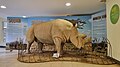 African Rhino taxidermy in Nairobi National Museum
 -
 Bee Section in Nairobi National Museum
 -
 Bird Maps in Nairobi National Museum
 -
 Kenya Shilling Security Features in Nairobi National Museum


Research Directorate
The National Museums of Kenya (NMK) serves as the national repository for Kenya's biological, cultural, and geological heritage under the National Museums and Heritage Act 2006. The institution manages a collection of approximately 7.5 million specimens, coordinated through the Directorate of National Repository and Research (DNRR).
Scientific Directorates and Departments
The DNRR is organized into specialized departments that facilitate taxonomic research, environmental monitoring, and the study of human origins.
- Earth Sciences Department: Manages approximately over 350,000 fossils, including a collection of 700 hominin specimens from the East African Rift. Key holdings include the Turkana Boy (Homo erectus) and Kenyanthropus platyops. Research focuses on palaeoclimatology and the reconstruction of Plio-Pleistocene ecosystems.[7]
- Zoology Department: Houses the largest faunal reference collection in East Africa. It is divided into sections for mammalogy, ornithology, herpetology, and ichthyology. The Entomology section alone contains approximately over 5 million specimens. The department operates a Molecular Genetics Laboratory used for species identification and wildlife forensics to support anti-poaching frameworks.
- Botany Department (East African Herbarium): Established in 1902, the herbarium (EAH) curates nearly 1 million plant vouchers. Research activities include plant taxonomy, systematics, and phytochemistry, with a focus on the documentation of indigenous medicinal flora and high-altitude biodiversity.[8]
- Cultural Anthropology Department: Manages ethnographic and archaeological collections documenting the technological and social history of Kenya's 45 ethnic groups. It houses the Joy Adamson collection, comprising over 600 ethnographic portraits painted between 1945 and 1955.
- Centre for Biodiversity: A cross-disciplinary unit that utilizes Geographic Information Systems (GIS) for ecological mapping. It integrates data from the biological departments to advise on national conservation policy and climate change adaptation.
- Resource Centre: Incorporates the library of the East Africa Natural History Society, one of the oldest scientific libraries in Africa. It maintains the national archives for botanical and zoological publications and is currently implementing a digitization program for rare manuscripts.
Functions as a National Repository
As a designated state repository, the NMK fulfills several statutory functions:
- Taxonomic Baseline: Providing reference material for the identification of East African flora and fauna.
- Bioprospecting Support: Maintaining the legal and scientific records of biological resources to protect national intellectual property.
- Education and Knowledge Transfer: Interpreting research data for the Competency-Based Curriculum (CBC) and facilitating STEAM learning through the Education Department.
Collections
The National Museums of Kenya (NMK) maintains extensive natural history and cultural heritage collections that support research, conservation, and public education. These collections are organized into two main domains: Natural History and Cultural Heritage. Information on the scope and focus of these collections is reflected in NMK’s institutional documentation, including its Nairobi National Museum exhibits and departmental descriptions.[9]
Natural History Collections
These collections document East Africa’s biodiversity and geological and evolutionary history, and are used as reference materials for scientific study.
- Palaeontology: NMK curates a large fossil collection that includes hominin and non-hominin specimens from across East Africa. Notable materials include Turkana Boy, one of the most complete Homo erectus skeletons discovered, Proconsul africanus, an early Miocene primate, and Paranthropus aethiopicus (commonly referred to as the "Black Skull").[10]
- Zoology:
- Entomology: The insect collections support research in biodiversity, agriculture, and ecology, including studies of pollinators and disease vectors.
- Ichthyology & Herpetology: The collections include preserved fish, reptiles, and amphibians from a variety of habitats, including freshwater ecosystems such as Rift Valley lakes.
- Mammalogy & Ornithology: The collections include mammal skins, skeletal material, and bird specimens used for comparative and taxonomic research. A notable exhibit is the taxidermy specimen of Ahmed of Marsabit, associated with Kenya’s wildlife conservation history.[11]
- Botany (East African Herbarium): The herbarium houses a large reference collection of plant specimens (herbarium vouchers) representing flora from across East Africa. The collection supports taxonomic research and includes specimens from diverse ecological zones, including montane environments such as Mount Kenya.
Cultural and Historical Collections
These collections preserve material culture and historical records documenting human societies in Kenya and the wider East African region.
- Archaeology: The archaeological collections include stone tools and associated materials from significant prehistoric sites such as Olorgesailie, known for extensive Acheulean assemblages, and Lomekwi 3, associated with some of the earliest known stone tools.[12]
- Ethnography: NMK maintains collections representing the material culture of Kenya’s diverse communities, including tools, clothing, ornaments, and ceremonial objects.
- The Joy Adamson Collection: Comprises ethnographic artworks depicting cultural attire and practices of Kenyan communities, produced during the mid-20th century and used as visual documentation of traditional lifeways.[13]
- History and Numismatics: The collections include archival photographs, historical documents, and currency specimens from different periods of Kenya’s history, supporting research into the country’s economic and political development.
Research Function
Research activities follow an integrated workflow including field collection, laboratory analysis, curation, and data management. Outputs are used to inform:
- Scientific publications in journals such as Nature and Science
- Museum exhibitions and educational outreach
- National policy and conservation initiatives
Institutional Integration
The research and collections framework is linked to NMK’s wider network of over 22 regional museums, national heritage sites, and specialized institutes. This distributed system enables coordinated management of heritage resources across Kenya while maintaining centralized standards for documentation and research.
The Kenya institute of primate's (KIPRE), a semi-autonomous unit associated with NMK, contributes to biomedical research and primatology, particularly in areas related to tropical diseases and comparative biology.[14]
The Centre for Biodiversity and related units also provide analytical support to government agencies and stakeholders through data-driven insights on environmental change and conservation planning.
Function within National Context
Within Kenya’s institutional framework, NMK operates under the National Museums and Heritage Act 2006 as:
- A national repository for biological and cultural collections
- A research institution supporting multiple scientific disciplines
- A conservation authority for UNESCO World Heritage Sites and national monuments.[15]
This integrated structure enables NMK to maintain continuity between collection, research, preservation, and dissemination of Kenya’s heritage.
Governance and Funding
The National Museums of Kenya (NMK) is a state corporation established under the National Museums and Heritage Act 2006. It operates as an autonomous agency under theMinistry of Tourism, Wildlife and Heritage, with a mandate to preserve, protect, and promote Kenya’s cultural and natural heritage.[16]
Institutionally, NMK is governed by a Board of Directors appointed in accordance with the provisions of the Act. The Board provides strategic direction and oversight, while day-to-day administration is managed by the Director General, who serves as the chief executive officer of the institution.
NMK’s operations are financed through a combination of government allocations and internally generated revenue. These resources support staff remuneration, maintenance of facilities, conservation activities, research programs, and public education. Additional income is derived from visitor admissions, service fees, and partnerships associated with institutional activities.
The institution’s administrative structure includes internal units responsible for research, collections management, regional museums, and the administration of heritage sites and monuments across the country.
Other Museums and Sites

In addition to the Nairobi National Museum, the National Museums of Kenya (NMK) manages a vast national network of regional museums, World Heritage sites, and gazetted monuments. Under the current strategic framework of the Ministry of Tourism and Wildlife, these sites are integrated into official tourism circuits to promote heritage-based tourism and scientific conservation.[16]
| Site Name | Location | Primary Status |
|---|---|---|
| Nairobi Circuit | ||
| Nairobi Gallery | Nairobi | National Monument |
| Uhuru Gardens | Nairobi | National Monument |
| Karen Blixen Museum | Nairobi | Historic house museum |
| Nairobi Railway Museum | Nairobi | Partnership Site (Kenya Railways) |
| Institute of Primate Research | Karen | Research Institute |
| East African Herbarium | Museum Hill | Research Institute |
| Coastal Circuit | ||
| Fort Jesus | Mombasa | World Heritage Site |
| Gedi Ruins | Gede | World Heritage Site |
| Lamu Museum | Lamu | World Heritage Site |
| Sacred Mijikenda Kaya Forests | Kilifi and Kwale | World Heritage Site |
| Rabai Museum | Rabai | National Monument |
| Malindi Museum | Malindi | Regional Museum |
| Jumba la Mtwana | Mtwapa | Archaeological Site |
| Takwa Ruins | Manda Island | Archaeological Site |
| Mnarani Ruins | Kilifi | Archaeological Site |
| Siyu Fort | Pate Island | National Monument |
| South Rift Circuit | ||
| Hyrax Hill | Nakuru | Prehistoric Site |
| Kariandusi | Gilgil | Prehistoric Site |
| Olorgesailie | Magadi | Prehistoric Site |
| Narok Museum | Narok | Regional Museum |
| Northern Circuit | ||
| Koobi Fora | Lake Turkana | World Heritage Site |
| Desert Museum | Loiyangalani | Regional Museum |
| Kenyatta House | Maralal | National Monument |
| Western and North Rift Circuits | ||
| Thimlich Ohinga | Migori | World Heritage Site |
| Kisumu Museum | Kisumu | Regional Museum |
| Kitale Museum | Kitale | Regional Museum |
| Kapenguria Museum | Kapenguria | National Monument |
| Kakapel Rock Art | Busia | National Monument |
| Kabarnet Museum | Kabarnet | Regional Museum |
| Central and Eastern Circuits | ||
| Nyeri Museum | Nyeri | National Monument |
| Meru Museum | Meru | Regional Museum |
Institutional framework
Under the National Museums and Heritage Act 2006, the institution operates as the primary regulatory body for the conservation and management of Kenya's diverse heritage assets. The National Museums of Kenya (NMK) oversees a decentralized network categorized as follows:
- UNESCO World Heritage Sites (8): Comprising five cultural sites (Fort Jesus, Lamu Old Town, Sacred Mijikenda Kaya Forests, Thimlich Ohinga, and Gedi Ruins) and three natural sites (Mount Kenya National Park, Lake Turkana National Parks, and the Kenya Lake System in the Great Rift Valley).
- Regional Museums (22): A national network of public museums situated in key administrative hubs, supported by a network of historical sites including the landmark Lamu Fort.
- Gazetted Monuments (100+): Legally protected sites of historical or architectural significance, such as the Vasco da Gama Pillar, the Portuguese Chapel, and the Mama Ngina Waterfront.
- Scientific Research Centers: Specialized facilities dedicated to biological and anthropological study, including the Institute of Primate Research (KIPRE), the East African Herbarium, and the Centre for Biodiversity.
Digital Heritage and Accessibility
NMK engages in documentation and dissemination of heritage resources through archival practices and digital platforms that support access to information on its collections and sites.
These efforts include digitization of records and collections, maintenance of institutional information systems, and the provision of online resources describing museums, artifacts, and heritage locations. Through these approaches, NMK facilitates access for researchers, educators, and the general public, complementing physical visits to museums and heritage sites.
The institution’s online presence provides information on museum locations, exhibitions, and heritage sites, supporting education, tourism, and awareness of Kenya’s cultural and natural heritage.
Notable people
The following individuals are associated with the development of palaeoanthropology, conservation, and museum practice in Kenya. Inclusion is based on documented contributions supported by reliable sources.
- Richard Leakey (1944–2022): Kenyan palaeoanthropologist and former Director of the National Museums of Kenya, known for major fossil discoveries and leadership in conservation and heritage management.[17]
- Louis Leakey (1903–1972): Pioneering palaeoanthropologist whose research in East Africa helped establish the region as a major center for human origins studies and influenced the development of Kenya’s museum and research institutions.[18]
- Joy Adamson (1910–1980): Naturalist and conservationist known for her work documenting wildlife in Kenya and contributing to global awareness of African biodiversity. Her ethnographic portraits of Kenyan communities are a permanent exhibit at the Nairobi National Museum.[19]
See also
- Kenya National Archives
- Bomas of Kenya
- List of museums in Kenya
- List of World Heritage Sites in Kenya
- List of sites and monuments in Kenya
- Culture of Kenya
Reference
- ↑ "About National Museums of Kenya". NMK. https://www.museums.or.ke/about-us/.
- ↑ "UNESCO World Heritage Sites in Kenya". UNESCO. https://whc.unesco.org/en/statesparties/ke.
- ↑ It descended to the East Africa Natural History Society, an international organization with outlets in a number of countries. In Kenya it is Nature Kenya.
- ↑ This section relies heavily on L. S. B. Leakey, By the Evidence: Memoirs, 1932–1951, Chapter 8.
- ↑ Bally, P.R.O. (1953). "Obituary - Molony". Journal of the East Africa Natural History Society XXII (1): 44–45. https://www.biodiversitylibrary.org/content/part/EANHS/XXII_No.1_93__44_1953_MolonyObit.pdf. Retrieved 19 January 2016.
- ↑ 6.0 6.1 NMK, "National Museums of Kenya – Museum in Change," 2006-03-31, Museums.or.ke, web: MuseumsOR-redo
- ↑ "Earth Sciences Department". National Museums of Kenya. https://www.museums.or.ke/earth-sciences/.
- ↑ "Botany Department and East African Herbarium". National Museums of Kenya. https://www.museums.or.ke/botany/.
- ↑ "Nairobi National Museum". National Museums of Kenya. https://nmk.go.ke/nairobi-national-museum/.
- ↑ "Human Evolution & Paleontology". National Museums of Kenya. https://nmk.go.ke/human-evolution-paleontology/.
- ↑ "Department of Zoology Collections". National Museums of Kenya. https://museums.or.ke/department-of-zoology/.
- ↑ "Olorgesailie Prehistoric Site". UNESCO. https://whc.unesco.org/en/tentativelists/6665/.
- ↑ "The Legacy of Joy Adamson". Google Arts & Culture / National Museums of Kenya. https://artsandculture.google.com/story/the-legacy-of-joy-adamson-national-museums-of-kenya/3wVB5WcjjvQfIA.
- ↑ "Kenya Institute of Primate Research". KIPRE. https://www.ipr.or.ke/.
- ↑ "Kenya: World Heritage Properties". UNESCO. https://whc.unesco.org/en/statesparties/ke.
- ↑ 16.0 16.1 "Museums and Heritage Sites". National Museums of Kenya. https://nmk.go.ke/museums-and-heritage-sites/.
- ↑ "Richard Leakey, trailblazing fossil hunter and conservationist, dies at 77". National Geographic. 2 January 2022. https://www.nationalgeographic.com/science/article/richard-leakey-obituary.
- ↑ "Louis Leakey". Encyclopaedia Britannica. https://www.britannica.com/biography/Louis-S-B-Leakey.
- ↑ "Joy Adamson". Encyclopaedia Britannica. https://www.britannica.com/biography/Joy-Adamson.
External links
- Official website of the National Museums of Kenya
- National Museums of Kenya (NMK) Corporate Portal
- UNESCO World Heritage Centre: Kenya
- NMK on Google Arts & Culture
- "Leakey Fights Church Effort to Hide Museum's Pre-Human Fossils". LiveScience. https://news.yahoo.com/s/livescience/20061203/sc_livescience/scientistfightschurchefforttohidemuseumsprehumanfossils.
 |  |
Categories: [National museums]
↧ Download as ZWI file | Last modified: 06/11/2026 21:01:39 | 14 views
☰ Source: https://handwiki.org/wiki/Biology:National_Museums_of_Kenya | License: CC BY-SA 3.0
 KSF
KSF