Behavioral Neuroscience
 From Handwiki
 | Part of a series on |
| Psychology |
|---|
 |
|
|
|
| Neuropsychology |
|---|
|
|
Behavioral neuroscience, also known as biological psychology,[1] biopsychology, or psychobiology,[2] is the application of the principles of biology to the study of physiological, genetic, and developmental mechanisms of behavior in humans and other animals.[3]
History
Behavioral neuroscience as a scientific discipline emerged from a variety of scientific and philosophical traditions in the 18th and 19th centuries. In philosophy, people like René Descartes proposed physical models to explain animal as well as human behavior. Descartes suggested that the pineal gland, a midline unpaired structure in the brain of many organisms, was the point of contact between mind and body. Descartes also elaborated on a theory in which the pneumatics of bodily fluids could explain reflexes and other motor behavior. This theory was inspired by moving statues in a garden in Paris.[4] Electrical stimulation and lesions can also show the affect of motor behavior of humans. They can record the electrical activity of actions, hormones, chemicals and effects drugs have in the body system all which affect ones daily behavior.
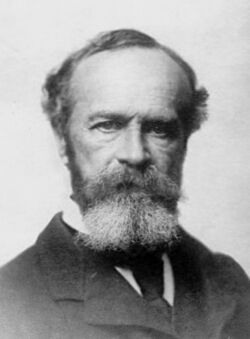
Other philosophers also helped give birth to psychology. One of the earliest textbooks in the new field, The Principles of Psychology by William James, argues that the scientific study of psychology should be grounded in an understanding of biology.
The emergence of psychology and behavioral neuroscience as legitimate sciences can be traced from the emergence of physiology from anatomy, particularly neuroanatomy. Physiologists conducted experiments on living organisms, a practice that was distrusted by the dominant anatomists of the 18th and 19th centuries.[5] The influential work of Claude Bernard, Charles Bell, and William Harvey helped to convince the scientific community that reliable data could be obtained from living subjects.
Even before the 18th and 19th century, behavioral neuroscience was beginning to take form as far back as 1700 B.C.[6] The question that seems to continually arise is: what is the connection between the mind and body? The debate is formally referred to as the mind-body problem. There are two major schools of thought that attempt to resolve the mind–body problem; monism and dualism.[4] Plato and Aristotle are two of several philosophers who participated in this debate. Plato believed that the brain was where all mental thought and processes happened.[6] In contrast, Aristotle believed the brain served the purpose of cooling down the emotions derived from the heart.[4] The mind-body problem was a stepping stone toward attempting to understand the connection between the mind and body.
Another debate arose about localization of function or functional specialization versus equipotentiality which played a significant role in the development in behavioral neuroscience. As a result of localization of function research, many famous people found within psychology have come to various different conclusions. Wilder Penfield was able to develop a map of the cerebral cortex through studying epileptic patients along with Rassmussen.[4] Research on localization of function has led behavioral neuroscientists to a better understanding of which parts of the brain control behavior. This is best exemplified through the case study of Phineas Gage.
The term "psychobiology" has been used in a variety of contexts, emphasizing the importance of biology, which is the discipline that studies organic, neural and cellular modifications in behavior, plasticity in neuroscience, and biological diseases in all aspects, in addition, biology focuses and analyzes behavior and all the subjects it is concerned about, from a scientific point of view. In this context, psychology helps as a complementary, but important discipline in the neurobiological sciences. The role of psychology in this questions is that of a social tool that backs up the main or strongest biological science. The term "psychobiology" was first used in its modern sense by Knight Dunlap in his book An Outline of Psychobiology (1914).[7] Dunlap also was the founder and editor-in-chief of the journal Psychobiology. In the announcement of that journal, Dunlap writes that the journal will publish research "...bearing on the interconnection of mental and physiological functions", which describes the field of behavioral neuroscience even in its modern sense.[7]
Relationship to other fields of psychology and biology
In many cases, humans may serve as experimental subjects in behavioral neuroscience experiments; however, a great deal of the experimental literature in behavioral neuroscience comes from the study of non-human species, most frequently rats, mice, and monkeys. As a result, a critical assumption in behavioral neuroscience is that organisms share biological and behavioral similarities, enough to permit extrapolations across species. This allies behavioral neuroscience closely with comparative psychology, evolutionary psychology, evolutionary biology, and neurobiology. Behavioral neuroscience also has paradigmatic and methodological similarities to neuropsychology, which relies heavily on the study of the behavior of humans with nervous system dysfunction (i.e., a non-experimentally based biological manipulation).
Synonyms for behavioral neuroscience include biopsychology, biological psychology, and psychobiology.[8] Physiological psychology is a subfield of behavioral neuroscience, with an appropriately narrower definition.
Research methods
The distinguishing characteristic of a behavioral neuroscience experiment is that either the independent variable of the experiment is biological, or some dependent variable is biological. In other words, the nervous system of the organism under study is permanently or temporarily altered, or some aspect of the nervous system is measured (usually to be related to a behavioral variable).
Disabling or decreasing neural function
- Lesions – A classic method in which a brain-region of interest is naturally or intentionally destroyed to observe any resulting changes such as degraded or enhanced performance on some behavioral measure. Lesions can be placed with relatively high accuracy "Thanks to a variety of brain 'atlases' which provide a map of brain regions in 3-dimensional "stereotactic coordinates.
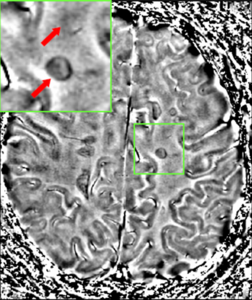 The part of the picture emphasized shows the lesion in the brain. This type of lesion can be removed through surgery.
- Surgical lesions – Neural tissue is destroyed by removing it surgically.
- Electrolytic lesions – Neural tissue is destroyed through the application of electrical shock trauma.
- Chemical lesions – Neural tissue is destroyed by the infusion of a neurotoxin.
- Temporary lesions – Neural tissue is temporarily disabled by cooling or by the use of anesthetics such as tetrodotoxin.
- Transcranial magnetic stimulation – A new technique usually used with human subjects in which a magnetic coil applied to the scalp causes unsystematic electrical activity in nearby cortical neurons which can be experimentally analyzed as a functional lesion.
- Synthetic ligand injection – A receptor activated solely by a synthetic ligand (RASSL) or Designer Receptor Exclusively Activated by Designer Drugs (DREADD), permits spatial and temporal control of G protein signaling in vivo. These systems utilize G protein-coupled receptors (GPCR) engineered to respond exclusively to synthetic small molecules ligands, like clozapine N-oxide (CNO), and not to their natural ligand(s). RASSL's represent a GPCR-based chemogenetic tool. These synthetic ligands upon activation can decrease neural function by G-protein activation. This can with Potassium attenuating neural activity.[9]
- Psychopharmacological manipulations – A chemical receptor antagonist induces neural activity by interfering with neurotransmission. Antagonists can be delivered systemically (such as by intravenous injection) or locally (intracerebrally) during a surgical procedure into the ventricles or into specific brain structures. For example, NMDA antagonist AP5 has been shown to inhibit the initiation of long term potentiation of excitatory synaptic transmission (in rodent fear conditioning) which is believed to be a vital mechanism in learning and memory.[10]
- Optogenetic inhibition – A light activated inhibitory protein is expressed in cells of interest. Powerful millisecond timescale neuronal inhibition is instigated upon stimulation by the appropriate frequency of light delivered via fiber optics or implanted LEDs in the case of vertebrates,[11] or via external illumination for small, sufficiently translucent invertebrates.[12] Bacterial Halorhodopsins or Proton pumps are the two classes of proteins used for inhibitory optogenetics, achieving inhibition by increasing cytoplasmic levels of halides (Cl−) or decreasing the cytoplasmic concentration of protons, respectively.[13][14]
Enhancing neural function
- Electrical stimulation – A classic method in which neural activity is enhanced by application of a small electric current (too small to cause significant cell death).
- Psychopharmacological manipulations – A chemical receptor agonist facilitates neural activity by enhancing or replacing endogenous neurotransmitters. Agonists can be delivered systemically (such as by intravenous injection) or locally (intracerebrally) during a surgical procedure.
- Synthetic Ligand Injection – Likewise, Gq-DREADDs can be used to modulate cellular function by innervation of brain regions such as Hippocampus. This innervation results in the amplification of γ-rhythms, which increases motor activity.[15]
- Transcranial magnetic stimulation – In some cases (for example, studies of motor cortex), this technique can be analyzed as having a stimulatory effect (rather than as a functional lesion).
- Optogenetic excitation – A light activated excitatory protein is expressed in select cells. Channelrhodopsin-2 (ChR2), a light activated cation channel, was the first bacterial opsin shown to excite neurons in response to light,[16] though a number of new excitatory optogenetic tools have now been generated by improving and imparting novel properties to ChR2[17]
Measuring neural activity
- Optical techniques – Optical methods for recording neuronal activity rely on methods that modify the optical properties of neurons in response to the cellular events associated with action potentials or neurotransmitter release.
- Voltage sensitive dyes (VSDs) were among the earliest method for optically detecting neuronal activity. VSDs commonly changed their fluorescent properties in response to a voltage change across the neuron's membrane, rendering membrane sub-threshold and supra-threshold (action potentials) electrical activity detectable.[18] Genetically encoded voltage sensitive fluorescent proteins have also been developed.[19]
- Calcium imaging relies on dyes[20] or genetically encoded proteins[21] that fluoresce upon binding to the calcium that is transiently present during an action potential.
- Synapto-pHluorin is a technique that relies on a fusion protein that combines a synaptic vesicle membrane protein and a pH sensitive fluorescent protein. Upon synaptic vesicle release, the chimeric protein is exposed to the higher pH of the synaptic cleft, causing a measurable change in fluorescence.[22]
- Single-unit recording – A method whereby an electrode is introduced into the brain of a living animal to detect electrical activity that is generated by the neurons adjacent to the electrode tip. Normally this is performed with sedated animals but sometimes it is performed on awake animals engaged in a behavioral event, such as a thirsty rat whisking a particular sandpaper grade previously paired with water in order to measure the corresponding patterns of neuronal firing at the decision point.[23]
- Multielectrode recording – The use of a bundle of fine electrodes to record the simultaneous activity of up to hundreds of neurons.
- fMRI – Functional magnetic resonance imaging, a technique most frequently applied on human subjects, in which changes in cerebral blood flow can be detected in an MRI apparatus and are taken to indicate relative activity of larger scale brain regions (i.e., on the order of hundreds of thousands of neurons).
- PET - Positron Emission Tomography detects particles called photons using a 3-D nuclear medicine examination. These particles are emitted by injections of radioisotopes such as fluorine. PET imaging reveal the pathological processes which predict anatomic changes making it important for detecting, diagnosing and characterising many pathologies[24]
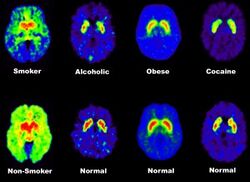 PET brain scans can show chemical differences in the brain between addicts and non-addicts. You can see the normal images in the top row come from non addict while people who have addicting disorders have scans that look more abnormal.
 - Electroencephalography – Or EEG; and the derivative technique of event-related potentials, in which scalp electrodes monitor the average activity of neurons in the cortex (again, used most frequently with human subjects). This technique uses different types of electrodes for recording systems such as needle electrodes and saline-based electrodes. EEG allows for the investigation of mental disorders, sleep disorders and physiology. It can monitor brain development and cognitive engagement.[25]
- Functional neuroanatomy – A more complex counterpart of phrenology. The expression of some anatomical marker is taken to reflect neural activity. For example, the expression of immediate early genes is thought to be caused by vigorous neural activity. Likewise, the injection of 2-deoxyglucose prior to some behavioral task can be followed by anatomical localization of that chemical; it is taken up by neurons that are electrically active.
- MEG – Magnetoencephalography shows the functioning of the human brain through the measurement of electromagnetic activity. Measuring the magnetic fields created by the electric current flowing within the neurons identifies brain activity associated with various human functions in real time, with millimeter spatial accuracy. Clinicians can noninvasively obtain data to help them assess neurological disorders and plan surgical treatments.
Genetic techniques
- QTL mapping – The influence of a gene in some behavior can be statistically inferred by studying inbred strains of some species, most commonly mice. The recent sequencing of the genome of many species, most notably mice, has facilitated this technique.
- Selective breeding – Organisms, often mice, may be bred selectively among inbred strains to create a recombinant congenic strain. This might be done to isolate an experimentally interesting stretch of DNA derived from one strain on the background genome of another strain to allow stronger inferences about the role of that stretch of DNA.
- Genetic engineering – The genome may also be experimentally-manipulated; for example, knockout mice can be engineered to lack a particular gene, or a gene may be expressed in a strain which does not normally do so (the 'transgenic'). Advanced techniques may also permit the expression or suppression of a gene to occur by injection of some regulating chemical.
Other research methods
Computational models - Using a computer to formulate real-world problems to develop solutions.[26] Although this method is often focused in computer science, it has begun to move towards other areas of study. For example, psychology is one of these areas. Computational models allow researchers in psychology to enhance their understanding of the functions and developments in nervous systems. Examples of methods include the modelling of neurons, networks and brain systems and theoretical analysis.[27] Computational methods have a wide variety of roles including clarifying experiments, hypothesis testing and generating new insights. These techniques play an increasing role in the advancement of biological psychology.[28]
Limitations and advantages
Different manipulations have advantages and limitations. Neural tissue destroyed as a primary consequence of a surgery, electric shock or neurotoxin can confound the results so that the physical trauma masks changes in the fundamental neurophysiological processes of interest. For example, when using an electrolytic probe to create a purposeful lesion in a distinct region of the rat brain, surrounding tissue can be affected: so, a change in behavior exhibited by the experimental group post-surgery is to some degree a result of damage to surrounding neural tissue, rather than by a lesion of a distinct brain region.[29][30] Most genetic manipulation techniques are also considered permanent.[30] Temporary lesions can be achieved with advanced in genetic manipulations, for example, certain genes can now be switched on and off with diet.[30] Pharmacological manipulations also allow blocking of certain neurotransmitters temporarily as the function returns to its previous state after the drug has been metabolized.[30]
Topic areas
In general, behavioral neuroscientists study similar themes and issues as academic psychologists, though limited by the need to use nonhuman animals. As a result, the bulk of literature in behavioral neuroscience deals with mental processes and behaviors that are shared across different animal models such as:
- Sensation and perception
- Motivated behavior (hunger, thirst, sex)
- Control of movement
- Learning and memory
- Sleep and biological rhythms
- Emotion
However, with increasing technical sophistication and with the development of more precise noninvasive methods that can be applied to human subjects, behavioral neuroscientists are beginning to contribute to other classical topic areas of psychology, philosophy, and linguistics, such as:
- Language
- Reasoning and decision making
- Consciousness
Behavioral neuroscience has also had a strong history of contributing to the understanding of medical disorders, including those that fall under the purview of clinical psychology and biological psychopathology (also known as abnormal psychology). Although animal models do not exist for all mental illnesses, the field has contributed important therapeutic data on a variety of conditions, including:
- Parkinson's disease, a degenerative disorder of the central nervous system that often impairs the sufferer's motor skills and speech.
- Huntington's disease, a rare inherited neurological disorder whose most obvious symptoms are abnormal body movements and a lack of coordination. It also affects a number of mental abilities and some aspects of personality.
- Alzheimer's disease, a neurodegenerative disease that, in its most common form, is found in people over the age of 65 and is characterized by progressive cognitive deterioration, together with declining activities of daily living and by neuropsychiatric symptoms or behavioral changes.
- Clinical depression, a common psychiatric disorder, characterized by a persistent lowering of mood, loss of interest in usual activities and diminished ability to experience pleasure.
- Schizophrenia, a psychiatric diagnosis that describes a mental illness characterized by impairments in the perception or expression of reality, most commonly manifesting as auditory hallucinations, paranoid or bizarre delusions or disorganized speech and thinking in the context of significant social or occupational dysfunction.
- Autism, a brain development disorder that impairs social interaction and communication, and causes restricted and repetitive behavior, all starting before a child is three years old.
- Anxiety, a physiological state characterized by cognitive, somatic, emotional, and behavioral components. These components combine to create the feelings that are typically recognized as fear, apprehension, or worry.
- Drug abuse, including alcoholism.
Awards
Nobel Laureates
The following Nobel Prize winners could reasonably be considered behavioral neuroscientists or neurobiologists.[by whom?] (This list omits winners who were almost exclusively neuroanatomists or neurophysiologists; i.e., those that did not measure behavioral or neurobiological variables.)
Kavli Prize in Neuroscience
- Ann Graybiel (1942)
- Cornelia Bargmann (1961)
- Winfried Denk (1957)
See also
References
- ↑ Breedlove, Watson, Rosenzweig, Biological Psychology: An Introduction to Behavioral and Cognitive Neuroscience, 6/e, ISBN:978-0-87893-705-9, p. 2
- ↑ Psychobiology, Merriam-Webster's Online Dictionary
- ↑ Thomas, R.K. (1993). "INTRODUCTION: A Biopsychology Festschrift in Honor of Lelon J. Peacock". Journal of General Psychology 120 (1): 5.
- ↑ 4.0 4.1 4.2 4.3 Carlson, Neil (2007). Physiology of Behavior (9th ed.). Allyn and Bacon. pp. 11–14. ISBN 978-0-205-46724-2.
- ↑ Shepherd, Gordon M. (1991). Foundations of the Neuron Doctrine. Oxford University Press. ISBN 0-19-506491-7.
- ↑ 6.0 6.1 "History of Neuroscience". Columbia University. http://www.columbia.edu/cu/psychology/courses/1010/mangels/neuro/history/history.html.
- ↑ 7.0 7.1 Dewsbury, Donald (1991). "Psychobiology". American Psychologist 46 (3): 198–205. doi:10.1037/0003-066x.46.3.198. PMID 2035930.
- ↑ S. Marc Breedlove, Mark Rosenzweig and Neil V. Watson (2007). Biological Psychology: An Introduction to Behavioral and Cognitive Neuroscience 6e. Sinauer Associates. ISBN:978-0-87893-705-9
- ↑ Zhu, Hu (2014). "Silencing synapses with DREADDs". Neuron 82 (4): 723–725. doi:10.1016/j.neuron.2014.05.002. PMID 24853931.
- ↑ Kim, Jeansok J.; Decola, Joseph P.; Landeira-Fernandez, Jesus; Fanselow, Michael S. (1991). "N-methyl-D-aspartate receptor antagonist APV blocks acquisition but not expression of fear conditioning". Behavioral Neuroscience 105 (1): 126–133. doi:10.1037/0735-7044.105.1.126. PMID 1673846.
- ↑ Schneider, M. Bret; Gradinaru, Viviana; Zhang, Feng; Deisseroth, Karl (2008). "Controlling Neuronal Activity". American Journal of Psychiatry 165 (5): 562. doi:10.1176/appi.ajp.2008.08030444. PMID 18450936.
- ↑ Zhang, Feng; Wang, Li-Ping; Brauner, Martin; Liewald, Jana F.; Kay, Kenneth; Watzke, Natalie; Wood, Phillip G.; Bamberg, Ernst et al. (2007). "Multimodal fast optical interrogation of neural circuitry". Nature 446 (7136): 633–639. doi:10.1038/nature05744. PMID 17410168. Bibcode: 2007Natur.446..633Z.
- ↑ Chow, B. Y. et al. "High-performance genetically targetable optical neural silencing by light-driven proton pumps." Nature. Vol 463. 7 January 2010
- ↑ Gradinaru, Viviana; Thompson, Kimberly R.; Deisseroth, Karl (2008). "ENpHR: A Natronomonas halorhodopsin enhanced for optogenetic applications". Brain Cell Biology 36 (1–4): 129–139. doi:10.1007/s11068-008-9027-6. PMID 18677566.
- ↑ Ferguson, Susan (2012). "Grateful DREADDs: Engineered Receptors Reveal How Neural Circuits Regulate Behavior". Neuropsychopharmacology 37 (1): 296–297. doi:10.1038/npp.2011.179. PMID 22157861.
- ↑ Zhang, Feng; Wang, Li-Ping; Boyden, Edward S.; Deisseroth, Karl (2006). "Channelrhodopsin-2 and optical control of excitable cells". Nature Methods 3 (10): 785–792. doi:10.1038/nmeth936. PMID 16990810.
- ↑ Gradinaru, Viviana; Zhang, Feng; Ramakrishnan, Charu; Mattis, Joanna; Prakash, Rohit; Diester, Ilka; Goshen, Inbal; Thompson, Kimberly R. et al. (2010). "Molecular and Cellular Approaches for Diversifying and Extending Optogenetics". Cell 141 (1): 154–165. doi:10.1016/j.cell.2010.02.037. PMID 20303157.
- ↑ Ebner, Timothy J.; Chen, Gang (1995). "Use of voltage-sensitive dyes and optical recordings in the central nervous system". Progress in Neurobiology 46 (5): 463–506. doi:10.1016/0301-0082(95)00010-S. PMID 8532849.
- ↑ Siegel, Micah S.; Isacoff, Ehud Y. (1997). "A Genetically Encoded Optical Probe of Membrane Voltage". Neuron 19 (4): 735–741. doi:10.1016/s0896-6273(00)80955-1. PMID 9354320.
- ↑ O'Donovan, Michael J.; Ho, Stephen; Sholomenko, Gerald; Yee, Wayne (1993). "Real-time imaging of neurons retrogradely and anterogradely labelled with calcium-sensitive dyes". Journal of Neuroscience Methods 46 (2): 91–106. doi:10.1016/0165-0270(93)90145-H. PMID 8474261.
- ↑ Heim, Nicola; Griesbeck, Oliver (2004). "Genetically Encoded Indicators of Cellular Calcium Dynamics Based on Troponin C and Green Fluorescent Protein". Journal of Biological Chemistry 279 (14): 14280–14286. doi:10.1074/jbc.M312751200. PMID 14742421.
- ↑ Miesenböck, Gero; De Angelis, Dino A.; Rothman, James E. (1998). "Visualizing secretion and synaptic transmission with pH-sensitive green fluorescent proteins". Nature 394 (6689): 192–195. doi:10.1038/28190. PMID 9671304. Bibcode: 1998Natur.394..192M.
- ↑ von Heimendahl, Moritz; Itskov, Pavel M.; Arabzadeh, Ehsan; Diamond, Mathew E. (2007). "Neuronal Activity in Rat Barrel Cortex Underlying Texture Discrimination". PLOS Biology 5 (11): e305. doi:10.1371/journal.pbio.0050305. PMID 18001152.
- ↑ Ocampo, T.; Knight, K.; Dunleavy, R.; Shah, S. N. (2015). "Techniques, benefits, and challenges of PET-MR". Radiologic Technology 86 (4): 393–412; quiz 413–6. PMID 25835405.
- ↑ Sanei, S., & Chambers, J. A. (2013). EEG signal processing. John Wiley & Sons.
- ↑ Otago, U. o., n/d. Computational Modelling. [Online] Available at: http://www.otago.ac.nz/courses/otago032670.pdf
- ↑ Churchland, P. S., & Sejnowski, T. J. (2016). The computational brain. MIT press.
- ↑ Brodland, G. Wayne (2015). "How computational models can help unlock biological systems". Seminars in Cell & Developmental Biology 47-48: 62–73. doi:10.1016/j.semcdb.2015.07.001. PMID 26165820.
- ↑ Kirby, Elizabeth D.; Jensen, Kelly; Goosens, Ki A.; Kaufer, Daniela (19 July 2012). "Stereotaxic Surgery for Excitotoxic Lesion of Specific Brain Areas in the Adult Rat". Journal of Visualized Experiments (65): 4079. doi:10.3791/4079. PMID 22847556.
- ↑ 30.0 30.1 30.2 30.3 Abel, Ted; Lattal, K.Matthew (2001). "Molecular mechanisms of memory acquisition, consolidation and retrieval". Current Opinion in Neurobiology 11 (2): 180–187. doi:10.1016/s0959-4388(00)00194-x. PMID 11301237.
External links
- Biological Psychology Links
- Theory of Biological Psychology (Documents No. 9 and 10 in English)
- IBRO (International Brain Research Organization)
Neuroscience | ||
|---|---|---|
Outline of neuroscience | ||
| Basic science |
|  |
| Clinical neuroscience |
| |
| Cognitive neuroscience |
| |
| Interdisciplinary fields |
| |
| Concepts |
| |
| ||
 Book
Book Category
Social sciences | |
|---|---|
| |
| Primary |
|
| Interdisciplinary |
|
| List |
|
| Other categorizations |
|
| |
 Commons
 Wikiversity
 |
Categories: [Branches of psychology] [Neuropsychology] [Psychoneuroimmunology]
↧ Download as ZWI file | Last modified: 10/10/2024 06:36:29 | 65 views
☰ Source: https://handwiki.org/wiki/Social:Behavioral_neuroscience | License: CC BY-SA 3.0
 KSF
KSF