Tim Kaine
 From Ballotpedia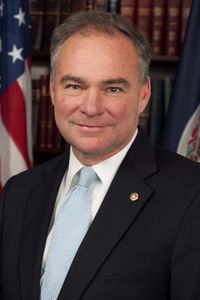
2013 - Present
2031
12
Tim Kaine (Democratic Party) is a member of the U.S. Senate from Virginia. He assumed office on January 3, 2013. His current term ends on January 3, 2031.
Kaine (Democratic Party) ran for re-election to the U.S. Senate to represent Virginia. He won in the general election on November 5, 2024.
Biography[edit]
Prior to his election to the Senate, Kaine served as governor of Virginia from 2006 to 2010.[1]
Career[edit]
Below is an abbreviated outline of Kaine's academic, professional, and political career:[2]
- 2013-Present: U.S. Senator from Virginia
- 2006-2010: Governor of Virginia
- 2002-2006: Lieutenant Governor of Virginia
- 1998-2001: Mayor of Richmond
Committee assignments[edit]
U.S. Senate[edit]
2023-2024
Kaine was assigned to the following committees:[Source]
- Senate Committee on Armed Services
- Subcommittee on Personnel
- Subcommittee on Readiness and Management Support
- Subcommittee on Seapower, Chairman
- Senate Committee on Budget
- Committee on Foreign Relations
- Subcommittee on Multilateral International Development, Multilateral Institutions, and International Economic, Energy, and Environmental Policy
- Subcommittee on Near East, South Asia, Central Asia, and Counterterrorism
- Subcommittee on State Department and USAID Management, International Operations, and Bilateral International Development
- Subcommittee on Western Hemisphere, Transnational Crime, Civilian Security, Democracy, Human Rights, and Global Women's Issues, Chairman
- Committee on Health, Education, Labor, and Pensions
- Subcommittee on Children and Families
2021-2022
Kaine was assigned to the following committees:[Source]
- Committee on Foreign Relations
- Subcommittee On Western Hemisphere, Transnational Crime, Civilian Security, Democracy, Human Rights, And Global Women's Issues, Chair
- Subcommittee On State Department And USAID Management, International Operations, And Bilateral International Development
- Subcommittee On Africa And Global Health Policy
- Committee on Health, Education, Labor, and Pensions
- Subcommittee on Children and Families
- Subcommittee on Primary Health and Retirement Security
- Senate Committee on Armed Services
- Emerging Threats and Capabilities
- Readiness and Management Support, Chair
- Seapower
- Senate Committee on Budget
2017-2018[edit]
At the beginning of the 115th Congress, Kaine was assigned to the following committees:[3]
- Committee on Armed Services
- Committee on the Budget
- Committee on Foreign Relations
- Committee on Health, Education, Labor, and Pensions
2015-2016[edit]
Kaine served on the following committees:[4]
- Special Committee on Aging
- Armed Services Committee
- Budget Committee
- Foreign Relations Committee
- Subcommittee on Europe and Regional Security Cooperation
- Subcommittee on Near East, South Asia, Central Asia, and Counterterrorism
- Subcommittee on State Department and USAID Management, International Operations, and Bilateral International Development, Ranking Member
- Subcommittee on Western Hemisphere, Transnational Crime, Civilian Security, Democracy, Human Rights and Global Women's Issues
2013-2014[edit]
Kaine served on the following Senate committees:[5]:
- Armed Services Committee
- Subcommittee on SeaPower
- Subcommittee on Readiness and Management Support
- Subcommittee on Personnel
- Budget Committee
- Foreign Relations Committee
- The Subcommittee on Western Hemisphere, Peace Corps and Global Narcotics Affairs
- The Subcommittee on International Operations and Organizations, Human Rights, Democracy and Global Women's Issues
- The Subcommittee on International Development and Foreign Assistance, Economic Affairs and International Environmental Protection, and Peace Corps Chairman
Key votes[edit]
- See also: Key votes
Ballotpedia monitors legislation that receives a vote and highlights the ones that we consider to be key to understanding where elected officials stand on the issues. To read more about how we identify key votes, click here.
Key votes: 118th Congress, 2023-2025[edit]
The 118th United States Congress began on January 3, 2023, and ended on January 3, 2025. At the start of the session, Republicans held the majority in the U.S. House of Representatives (222-212), and Democrats held the majority in the U.S. Senate (51-49). Joe Biden (D) was the president and Kamala Harris (D) was the vice president. We identified the key votes below using Congress' top-viewed bills list and through marquee coverage of certain votes on Ballotpedia.
| Key votes: 118th Congress, 2023-2025 | ||||||||
|---|---|---|---|---|---|---|---|---|
| Vote | Bill and description | Status | ||||||
 Yea Yea |
|
Passed (87-13)
| ||||||
| Yea |
|
Passed (87-11)
| ||||||
| Yea |
|
Passed (88-9)
| ||||||
| Yea |
|
Passed (63-36)
| ||||||
| Yea |
|
Passed (68-23)
| ||||||
 Nay Nay |
|
Failed (50-49)
| ||||||
| Nay |
|
Passed (50-46)
| ||||||
| Yea |
|
Passed (76-20)
| ||||||
| Yea |
|
Passed (75-22)
| ||||||
| Nay |
|
Passed (88-4)
| ||||||
| Yea |
|
Passed (51-48)
| ||||||
| Yea |
|
Passed (51-49)
| ||||||
| Yea |
|
Passed (79-18)
| ||||||
| Yea |
|
Failed (43-50)
| ||||||
| Yea |
|
Failed (51-44)
| ||||||
| Yea |
|
Passed (78-18)
| ||||||
| Yea |
|
Failed (48-44)
| ||||||
Key votes: Previous sessions of Congress[edit]
| Key votes (click "show" to expand or "hide" to contract) | |||||||||||||||||||||||||||||||||||||||||||||||||||||||||||||||||||||||||||||||||||||||||||||||||||||||||||||||||||||||||||||||||||||||||||||||||||||||||||||||||||||||||||||||||||||||||||||||||||||||||||||||||||||||||||||||||||||||||||||||||||||||||||||||||||||||||||||||||||||||||||||||||||||||||||||||||||||||||||||||||||||||||||||||||||||||||||||||||||||||||||||||||||||||||||||||
|---|---|---|---|---|---|---|---|---|---|---|---|---|---|---|---|---|---|---|---|---|---|---|---|---|---|---|---|---|---|---|---|---|---|---|---|---|---|---|---|---|---|---|---|---|---|---|---|---|---|---|---|---|---|---|---|---|---|---|---|---|---|---|---|---|---|---|---|---|---|---|---|---|---|---|---|---|---|---|---|---|---|---|---|---|---|---|---|---|---|---|---|---|---|---|---|---|---|---|---|---|---|---|---|---|---|---|---|---|---|---|---|---|---|---|---|---|---|---|---|---|---|---|---|---|---|---|---|---|---|---|---|---|---|---|---|---|---|---|---|---|---|---|---|---|---|---|---|---|---|---|---|---|---|---|---|---|---|---|---|---|---|---|---|---|---|---|---|---|---|---|---|---|---|---|---|---|---|---|---|---|---|---|---|---|---|---|---|---|---|---|---|---|---|---|---|---|---|---|---|---|---|---|---|---|---|---|---|---|---|---|---|---|---|---|---|---|---|---|---|---|---|---|---|---|---|---|---|---|---|---|---|---|---|---|---|---|---|---|---|---|---|---|---|---|---|---|---|---|---|---|---|---|---|---|---|---|---|---|---|---|---|---|---|---|---|---|---|---|---|---|---|---|---|---|---|---|---|---|---|---|---|---|---|---|---|---|---|---|---|---|---|---|---|---|---|---|---|---|---|---|---|---|---|---|---|---|---|---|---|---|---|---|---|---|---|---|---|---|---|---|---|---|---|---|---|---|---|---|---|---|---|---|---|---|---|---|---|---|---|---|---|---|---|---|---|---|---|---|---|---|---|---|---|---|---|---|---|---|---|---|---|---|---|---|---|---|---|---|---|---|---|---|---|---|---|---|---|---|---|---|---|---|---|
Key votes: 117th Congress, 2021-2023[edit]The 117th United States Congress began on January 3, 2021 and ended on January 3, 2023. At the start of the session, Democrats held the majority in the U.S. House of Representatives (222-213), and the U.S. Senate had a 50-50 makeup. Democrats assumed control of the Senate on January 20, 2021, when President Joe Biden (D) and Vice President Kamala Harris (D), who acted as a tie-breaking vote in the chamber, assumed office. We identified the key votes below using Congress' top-viewed bills list and through marquee coverage of certain votes on Ballotpedia.
Key votes: 116th Congress, 2019-2021[edit]The 116th United States Congress began on January 9, 2019, and ended on January 3, 2021. At the start of the session, Democrats held the majority in the U.S. House of Representatives (235-200), and Republicans held the majority in the U.S. Senate (53-47). Donald Trump (R) was the president and Mike Pence (R) was the vice president. We identified the key votes below using Congress' top-viewed bills list and through marquee coverage of certain votes on Ballotpedia.
Key votes: 115th Congress, 2017-2018[edit]
114th Congress[edit] The first session of the 114th Congress enacted into law six out of the 2,616 introduced bills (0.2 percent). Comparatively, the 113th Congress had 1.3 percent of introduced bills enacted into law in the first session. In the second session, the 114th Congress enacted 133 out of 3,159 introduced bills (4.2 percent). Comparatively, the 113th Congress had 7.0 percent of introduced bills enacted into law in the second session.[104][105] The Senate confirmed 18,117 out of 21,815 executive nominations received (83 percent). For more information pertaining to Kaine's voting record in the 114th Congress, please see the below sections.[106] Economic and fiscal[edit]Trade Act of 2015[edit]
2016 Budget proposal[edit]
Defense spending authorization[edit]
2015 budget[edit]
Foreign Affairs[edit]Iran nuclear deal[edit]
Domestic[edit]USA FREEDOM Act of 2015[edit]
Cyber security[edit]
Immigration[edit]
113th Congress[edit]The second session of the 113th Congress enacted into law 224 out of the 3215 introduced bills (7 percent). Comparatively, the 112th Congress had 4.2 percent of introduced bills enacted into law in the second session.[140] The Senate confirmed 13,949 out of 18,323 executive nominations received (76.1 percent). For more information pertaining to Kaine's voting record in the 113th Congress, please see the below sections.[141] National security[edit]Committee vote on Syria[edit]
The vote came after a three-hour briefing with top Obama administration officials, including Secretary of State John Kerry and James Clapper, the director of national intelligence.[142] Of the nine Democratic members and eight Republican members that made up the committee, seven Democrats and three Republicans voted in favor, while five Republicans and two Democrats opposed the authorization.[144] A single "present" vote was cast by Ed Markey (D). Kaine was one of the seven Democrats who approved the authorization.[145] John Brennan CIA nomination[edit]
Economy[edit]Farm bill[edit]
2014 Budget[edit]
No Budget, No Pay Act of 2013[edit]
Government shutdown[edit]
Immigration[edit]Mexico-U.S. border[edit]
Social issues[edit]Violence Against Women (2013)[edit]
| |||||||||||||||||||||||||||||||||||||||||||||||||||||||||||||||||||||||||||||||||||||||||||||||||||||||||||||||||||||||||||||||||||||||||||||||||||||||||||||||||||||||||||||||||||||||||||||||||||||||||||||||||||||||||||||||||||||||||||||||||||||||||||||||||||||||||||||||||||||||||||||||||||||||||||||||||||||||||||||||||||||||||||||||||||||||||||||||||||||||||||||||||||||||||||||||



Elections[edit]
2024[edit]
See also: United States Senate election in Virginia, 2024
General election
General election for U.S. Senate Virginia
Incumbent Tim Kaine defeated Hung Cao in the general election for U.S. Senate Virginia on November 5, 2024.
Candidate | % | Votes | ||
| ✔ | | Tim Kaine (D) | 54.4 | 2,417,115 |
 | Hung Cao (R) | 45.4 | 2,019,911 | |
| Other/Write-in votes | 0.2 | 8,509 | ||
| Total votes: 4,445,535 | |||
 = candidate completed the Ballotpedia Candidate Connection survey. = candidate completed the Ballotpedia Candidate Connection survey. | ||||
| If you are a candidate and would like to tell readers and voters more about why they should vote for you, complete the Ballotpedia Candidate Connection Survey. | ||||
Do you want a spreadsheet of this type of data? Contact our sales team. | ||||
Withdrawn or disqualified candidates
- Gary Barve (R)
- Tiger Xiong (Independent)
- Jonathan Hardin (Independent)
- Csaba Menezes Rusznak (Independent)
Democratic primary election
The Democratic primary election was canceled. Incumbent Tim Kaine advanced from the Democratic primary for U.S. Senate Virginia.
Republican primary election
Republican primary for U.S. Senate Virginia
Hung Cao defeated Scott Parkinson, Eddie Garcia, Chuck Smith, and Jonathan Walker Emord in the Republican primary for U.S. Senate Virginia on June 18, 2024.
Candidate | % | Votes | ||
| ✔ | | Hung Cao | 61.8 | 168,868 |
 | Scott Parkinson | 11.0 | 29,940 | |
 | Eddie Garcia | 9.8 | 26,777 | |
 | Chuck Smith | 8.8 | 24,108 | |
 | Jonathan Walker Emord | 8.6 | 23,614 | |
| Total votes: 273,307 | |||
| = candidate completed the Ballotpedia Candidate Connection survey. | ||||
| If you are a candidate and would like to tell readers and voters more about why they should vote for you, complete the Ballotpedia Candidate Connection Survey. | ||||
Do you want a spreadsheet of this type of data? Contact our sales team. | ||||
Withdrawn or disqualified candidates
- Kimberly Nadine Lowe (R)
- Craig Ennis (R)
- TJ Wallace (R)
- Gwendolyn Hickman (R)
- Ron Vitiello (R)
Polls[edit]
- See also: Ballotpedia's approach to covering polls
Polls are conducted with a variety of methodologies and have margins of error or credibility intervals.[157] The Pew Research Center wrote, "A margin of error of plus or minus 3 percentage points at the 95% confidence level means that if we fielded the same survey 100 times, we would expect the result to be within 3 percentage points of the true population value 95 of those times."[158] For tips on reading polls from FiveThirtyEight, click here. For tips from Pew, click here.
The links below show polls for this race aggregated by FiveThirtyEight and RealClearPolitics, where available. Click here to read about FiveThirtyEight's criteria for including polls in its aggregation.
Election campaign finance[edit]
| Name | Party | Receipts* | Disbursements** | Cash on hand | Date |
|---|---|---|---|---|---|
| Tim Kaine | Democratic Party | $21,763,526 | $21,462,964 | $2,820,225 | As of December 31, 2024 |
| Hung Cao | Republican Party | $9,832,460 | $9,517,135 | $407,806 | As of December 31, 2024 |
| Jonathan Walker Emord | Republican Party | $893,764 | $893,031 | $733 | As of December 31, 2024 |
| Eddie Garcia | Republican Party | $360,969 | $356,902 | $4,067 | As of December 31, 2024 |
| Scott Parkinson | Republican Party | $999,121 | $992,104 | $7,017 | As of December 31, 2024 |
| Chuck Smith | Republican Party | $573,144 | $573,144 | $0 | As of November 19, 2024 |
|
Source: Federal Elections Commission, "Campaign finance data," 2024. This product uses the openFEC API but is not endorsed or certified by the Federal Election Commission (FEC).
* According to the FEC, "Receipts are anything of value (money, goods, services or property) received by a political committee." |
|||||
As of Oct. 28, 2024, the two major party candidates had the 16th largest difference in terms of total money raised between major party Senate candidates and the 16th largest difference in terms of total spending. Click here to learn more.
Satellite spending[edit]
- See also: Satellite spending
Satellite spending describes political spending not controlled by candidates or their campaigns; that is, any political expenditures made by groups or individuals that are not directly affiliated with a candidate. This includes spending by political party committees, super PACs, trade associations, and 501(c)(4) nonprofit groups.[159][160][161]
If available, this section includes links to online resources tracking satellite spending in this election. To notify us of a resource to add, email us.
| By candidate | By election |
|---|---|
Race ratings[edit]
- See also: Race rating definitions and methods
Ballotpedia provides race ratings from four outlets: The Cook Political Report, Inside Elections, Sabato's Crystal Ball, and DDHQ/The Hill. Each race rating indicates if one party is perceived to have an advantage in the race and, if so, the degree of advantage:
- Safe and Solid ratings indicate that one party has a clear edge and the race is not competitive.
- Likely ratings indicate that one party has a clear edge, but an upset is possible.
- Lean ratings indicate that one party has a small edge, but the race is competitive.[162]
- Toss-up ratings indicate that neither party has an advantage.
Race ratings are informed by a number of factors, including polling, candidate quality, and election result history in the race's district or state.[163][164][165]
| Race ratings: U.S. Senate election in Virginia, 2024 | |||||||||
|---|---|---|---|---|---|---|---|---|---|
| Race tracker | Race ratings | ||||||||
| November 5, 2024 | October 29, 2024 | October 22, 2024 | October 15, 2024 | ||||||
| The Cook Political Report with Amy Walter | Solid Democratic | Solid Democratic | Solid Democratic | Solid Democratic | |||||
| Decision Desk HQ and The Hill | Likely Democratic | Likely Democratic | Likely Democratic | Likely Democratic | |||||
| Inside Elections with Nathan L. Gonzales | Solid Democratic | Solid Democratic | Solid Democratic | Solid Democratic | |||||
| Larry J. Sabato's Crystal Ball | Safe Democratic | Safe Democratic | Safe Democratic | Safe Democratic | |||||
| Note: Ballotpedia reviews external race ratings every week throughout the election season and posts weekly updates even if the media outlets have not revised their ratings during that week. | |||||||||
Endorsements[edit]
Ballotpedia did not identify endorsements for Kaine in this election.
2018[edit]
General election[edit]
Incumbent Tim Kaine defeated Corey Stewart and Matt Waters in the general election for U.S. Senate Virginia on November 6, 2018.
General election
General election for U.S. Senate Virginia
Candidate | % | Votes | ||
| ✔ | | Tim Kaine (D) | 57.0 | 1,910,370 |
 | Corey Stewart (R) | 41.0 | 1,374,313 | |
 | Matt Waters (L) | 1.8 | 61,565 | |
| Other/Write-in votes | 0.2 | 5,125 | ||
| Total votes: 3,351,373 | |||
| = candidate completed the Ballotpedia Candidate Connection survey. | ||||
| If you are a candidate and would like to tell readers and voters more about why they should vote for you, complete the Ballotpedia Candidate Connection Survey. | ||||
Do you want a spreadsheet of this type of data? Contact our sales team. | ||||
Democratic primary election[edit]
Incumbent Tim Kaine was the only candidate to file for the Democratic primary for U.S. Senator for Virginia. Therefore, the Democratic primary scheduled for June 12, 2018, was canceled.[166]
Republican primary election[edit]
Corey Stewart defeated Nick Freitas and E.W. Jackson in the Republican primary for U.S. Senate Virginia on June 12, 2018.
Republican primary election
Republican primary for U.S. Senate Virginia
Candidate | % | Votes | ||
| ✔ | | Corey Stewart | 44.9 | 136,610 |
 | Nick Freitas | 43.1 | 131,321 | |
 | E.W. Jackson | 12.0 | 36,508 | |
| Total votes: 304,439 | |||
| = candidate completed the Ballotpedia Candidate Connection survey. | ||||
| If you are a candidate and would like to tell readers and voters more about why they should vote for you, complete the Ballotpedia Candidate Connection Survey. | ||||
Do you want a spreadsheet of this type of data? Contact our sales team. | ||||
Withdrawn or disqualified candidates
- Ron Wallace (R)
- Ivan Raiklin (R)
- Bert Mizusawa (R)
2016[edit]
Kaine was the Democratic nominee for vice president in 2016. The Clinton/Kaine ticket lost to Donald Trump and Mike Pence. For more information on Kaine's policy positions, please see: Tim Kaine vice presidential campaign, 2016.
| U.S. presidential election, 2016 | |||||
|---|---|---|---|---|---|
| Party | Candidate | Vote % | Votes | Electoral votes | |
| Democratic | Hillary Clinton/Tim Kaine | 48.3% | 65,844,969 | 227 | |
| Republican |  Donald Trump/Mike Pence Donald Trump/Mike Pence |
46.2% | 62,979,984 | 304 | |
| Libertarian | Gary Johnson/Bill Weld | 3.3% | 4,492,919 | 0 | |
| Green | Jill Stein/Ajamu Baraka | 1.1% | 1,449,370 | 0 | |
| - | Other | 1.2% | 1,684,908 | 7 | |
| Total Votes | 136,452,150 | 538 | |||
| Election results via: Ballotpedia | |||||
Note: Trump and Clinton were projected to receive 306 and 232 electoral votes, respectively. Seven electors, however, cast votes for other candidates. Read about what happened here. The results listed above are based on reports from state secretary of state offices and election boards.
2012[edit]
Kaine ran in the 2012 election for the U.S. Senate, representing Virginia.[167] He ran unopposed in the Democratic primary and defeated George Allen (R) in the general election.[168]
On March 22, 2012, Sabato's Crystal Ball analyzed the eight races in the Senate in 2012 that would decide the political fate of which party would end up with control in 2013.[169] The seat, rated a toss-up, was one that Sabato's Crystal Ball believed was most likely to depend on the outcome of the presidential election in November.[169] According to the article, the "outcome of this race will largely be determined by which party claims Virginia’s 13 electoral votes in November."[169]
| Party | Candidate | Vote % | Votes | |
|---|---|---|---|---|
| Democratic | Timothy M. Kaine |
52.9% | 2,010,067 | |
| Republican | George F. Allen | 47% | 1,785,542 | |
| Write-In | N/A | 0.2% | 6,587 | |
| Total Votes | 3,802,196 | |||
| Source: Virginia State Board of Elections "Official Election Results, 2012 General Election" | ||||
Polls[edit]
| George Allen vs. Tim Kaine | |||||||||||||||||||
|---|---|---|---|---|---|---|---|---|---|---|---|---|---|---|---|---|---|---|---|
| Poll | George Allen | Tim Kaine | Some Other Candidate | Undecided | Margin of error | Sample size | |||||||||||||
| Washington Post Poll (October 26,2012) | 43% | 51% | 3% | 4% | +/-2.5 | 1,504 | |||||||||||||
| Rasmussen Reports (September 17,2012) | 45% | 47% | 2% | 6% | +/-4.5 | 500 | |||||||||||||
| Rasmussen Reports (August 23,2012) | 45% | 45% | 2% | 8% | +/-4.5 | 500 | |||||||||||||
| AVERAGES | 44.33% | 47.67% | 2.33% | 6% | +/-3.83 | 834.67 | |||||||||||||
| Note: The polls above may not reflect all polls that have been conducted in this race. Those displayed are a random sampling chosen by Ballotpedia staff. If you would like to nominate another poll for inclusion in the table, send an email to editor@ballotpedia.org. | |||||||||||||||||||
2005[edit]
Kaine served as Governor of Virginia from 2005 - 2009.
Cabinet[edit]
- Chief of Staff - William Leighty
- Secretary of Administration - Viola Baskerville
- Secretary of Agriculture and Forestry - Robert Bloxom
- Secretary of Commerce and Trade - Patrick Gottschalk
- Secretary of the Commonwealth - Katherine Hanley
- Secretary of Education - Thomas Morris
- Secretary of Finance - Jody Wagner
- Secretary of Health and Human Resources - Marilyn Tavenner
- Secretary of Natural Resources - Preston Bryant
- Secretary of Public Safety - John W. Marshall
- Secretary of Technology - Aneesh Chopra
- Secretary of Transportation - Pierce Homer
- Assistant for Commonwealth Preparedness - Robert P. Crouch
- Senior Advisor for Workforce - Daniel G. LeBlanc
2001[edit]
In 2001, Kaine was elected Lieutenant Governor of Virginia, serving under Governor Mark Warner. Kaine defeated Republican Jay Katzen.
| Lieutenant Governor of Virginia, 2001 | ||||
|---|---|---|---|---|
| Party | Candidate | Vote % | Votes | |
| Democratic | Tim Kaine |
50.3% | 925,974 | |
| Republican | Jay K. Katzen | 48.1% | 883,886 | |
| Libertarian | Gary A. Reams | 1.6% | 28,783 | |
| Write-In | Various | 0% | 490 | |
| Total Votes | 1,839,133 | |||
| Election results via Virginia State Board of Elections | ||||
Campaign themes[edit]
2024[edit]
Ballotpedia survey responses
See also: Ballotpedia's Candidate Connection
Tim Kaine did not complete Ballotpedia's 2024 Candidate Connection survey.
Campaign ads[edit]
| June 24, 2024 |
| June 24, 2024 |
View more ads here:
2018[edit]
Campaign website[edit]
Kaine's campaign website stated the following:
| “ |
Good Jobs and a Strong Economy When Tim was Governor, Virginia was ranked the best state for business — and it’s because we invest in our people, value our diversity, and grow the talented and educated workforce that makes our economy thrive. Tim understands that, to bring more jobs to Virginia, we must have a skilled workforce. He cosponsored the Apprenticeship and Jobs Training Act to give businesses incentives to hire individuals in apprenticeship programs in high-demand fields such as health care, technology or manufacturing. He also introduced the bipartisan JOBS Act to help expand employment in high-demand fields by allowing individuals to use Pell Grants for job training programs. Tim also wants to raise the minimum wage to $15 an hour, and he sponsored the Raise the Wage Act to do just that. He will keep fighting to ensure that 41 million workers, including nearly 786,000 Virginians, can see higher pay by raising the minimum wage. Health Care for All When President Trump and Republicans in Congress tried to repeal the Affordable Care Act, Tim fought back — standing up for the tens of millions of Americans and hundreds of thousands of Virginians who would have had their health care taken away. Since the ACA was signed into law, more than 400,000 Virginians have gained access to health insurance, and Tim will continue to oppose efforts to roll it back. He will never support eliminating protections for people with pre-existing conditions, and he will continue to ensure that plans provide “essential health benefits,” such as coverage for pregnancy, maternity, newborn care, mental health, and substance use disorders. Tim also has a plan called Medicare X, which would give all Virginians access to a plan similar to Medicare. This public option would give more Virginians a real choice when it comes to health insurance, at a lower cost. He opposes cuts to Medicare and believes Virginia should expand Medicaid so hundreds of thousands more Virginians can get access to care. Refusing to expand Medicaid would cost Virginia tens of thousands of jobs and tens of millions of dollars. It’s a no-brainer, yet the leading Republican candidates for Senate vocally oppose it. Tim will also continue to defend the Children’s Health Insurance Program. As Governor, Tim increased the number of children enrolled in CHIP, and more than 68,000 Virginia kids rely on this program for their health care. Earlier this year, after Republicans let CHIP funding lapse, Tim worked hard to help secure a six-year extension of the program. Tim has also led efforts in the Senate to combat drug addiction, including the opioid and heroin epidemic that threatens Virginia and the rest of the country. He believes new treatments, including medical marijuana, can help address this crisis, and he has fought to expand federal funding for states, like Virginia, to dedicate new resources for drug treatment and prevention. Civil Rights and Equal Justice Tim knows that diversity and inclusion strengthen our communities. That’s why he has been outspoken in opposing President Trump’s agenda to ban Muslims from entering America, deport millions of people who only know America as home, and empower white nationalists who would take Virginia and America backwards. He knows that even though marriage equality is the law of the land, LGBTQ Americans still face many battles in the fight for equality: that’s why he’s fighting to pass workplace protections for LGBTQ citizens, so that no Virginian ever loses their job again because of their sexuality or sexual orientation. He’s been a proud champion of voting rights, sponsoring legislation to restore key provisions of the Voting Rights Act and working to expand early voting and access to the ballot box for all Virginians. Tackling Gun Violence Tim is a gun owner and supports the Second Amendment, but he also believes we must take concrete steps to reduce gun violence. He supports universal background checks, banning assault weapons and high-capacity magazines, and improving our mental health system. This is personal for Tim, too. He was governor when the shooting at Virginia Tech took place — and after the shooting, Tim brought Democrats and Republicans together to strengthen the background check system and improve mental health. Tim authored the Responsible Transfer of Firearms Act, which would hold people responsible for selling or transferring a firearm to someone who is barred by federal law from possessing firearms, and he co-sponsored legislation that would close a loophole which currently allows gun sales to proceed if a background check is not completed after 72 hours. Supporting Veterans and Our Military The first bill Tim introduced in the Senate was the Troop Talent Act, which eases the transition of service members into the civilian workforce by helping them use the skills they developed in the military to obtain a workforce credential in order get a good job. There are more than 100,000 active duty and reserve members of the military in Virginia, and as co-chair of the Senate Military Family Caucus, Tim has authored bipartisan legislation to tackle military spouse unemployment and access to affordable child care for military families. Tim believes our country must fulfill its sacred promise to care for those who have served in uniform. That’s why he introduced legislation to improve veterans’ access to quality health care in a timely manner and opposes measures to privatize the VA. Women’s Equality Tim supports women’s constitutional rights to make their own health care decisions. He opposes efforts to restrict access to contraceptives and defund Planned Parenthood. He was an original co-sponsor of the Protecting Women’s Health from Corporate Interference Act, which would restore the contraceptive coverage requirement guaranteed by the Affordable Care Act. He supports equal pay for equal work and co-sponsored the Paycheck Fairness Act to ensure men and women are paid equally for the same work. Tim has also passed legislation to help prevent sexual assault and harassment in our schools, colleges, and the military, and he co-sponsored the reauthorization of the Violence Against Women Act. Strengthening Public Schools and Education As Mayor, Tim built four new schools in Richmond, the city’s first new schools in a generation, and increased education spending by 30 percent. As Governor, he worked with the legislature to expand the number of children enrolled in Pre-K by nearly 40 percent, a commitment to expanding and improving education that helped lead to Education Week naming Virginia the state where a child was most likely to have a successful life. In the Senate, Tim is on the key committee dealing with education issues — the Health, Education, Labor and Pensions Committee — where he has worked to ensure that students have the skills to be successful after high school. Tim believes in the power of career and technical education (CTE) to strengthen links between the classroom and the workplace and to help students gain the skills that will lead to productive, successful lives after graduation, which is why he introduced legislation to help schools recruit and train high-quality CTE teachers. Tim also introduced the PRE-K Act to help more states expand early childhood education, and he supports legislation to help students earn college credits in high school in order to cut the cost of earning a college degree. Higher Education and Job Training Ensuring that we have a skilled workforce will not only benefit students but drive new businesses and employers to Virginia. A longtime leader in promoting career and technical education, he is fighting for parity in how we view workforce programs and traditional four-year college, including by expanding Pell Grants to cover short-term job training programs. Tim also created the bipartisan Senate Career and Technical Education Caucus to help more Americans acquire the education and skills to help them find employment and enjoy successful careers, and he supports legislation to foster partnerships between community college and businesses to place more students in good jobs. Keeping America Safe and Strengthening Diplomacy As a member of the U.S. Senate Armed Services and Foreign Relations committees — and the father of a Marine — Tim knows how important it is to minimize the risk of unnecessary war and maximize the chance that our nation will decisively win any war we must fight. That’s why he’s been an outspoken critic of President Trump’s efforts to undercut diplomacy around the world, and advocated for the U.S. to stand by our diplomatic deals and honor our commitments to the global community. Fighting for Immigrant Communities Tim has been an outspoken opponent of President Trump’s attempts to ban immigration from Muslim countries, harshly restrict legal immigration, and threaten TPS recipients and Dreamers with deportation. Tim firmly believes immigrants enrich our society and bring skills and talents that help ensure we remain competitive in a global economy. That’s why he is a strong supporter of the Dream Act and has been working with his colleagues to find a solution to protect Dreamers and TPS recipients from deportation. Standing With Our Seniors On Medicare’s 49th anniversary, Tim spoke on the Senate floor about the importance of the program, calling it “one of the best programs that this nation has ever embraced.” He is also a sponsor of legislation to reduce the cost of prescription drugs for seniors by letting Medicare negotiate drug prices. Tim supports increasing funding for Alzheimer’s research, introduced an Alzheimer’s caregivers bill, and opposes federal cuts to the Meals on Wheels program. He has also worked closely with Senator Mark Warner to provide funding for the building of additional senior facilities in Virginia. Protecting Our Environment Tim opposes offshore drilling in Virginia. He is fighting the Trump administration’s attempt to ignore the voices of Virginians by rushing through the process to open the waters of our coastlines to drilling. Tim has also been critical of how the Federal Energy Regulatory Commission (FERC) approved the Mountain Valley and Atlantic Coast Pipelines and has called for FERC to rehear arguments and conduct another vote on the Atlantic Coast Pipeline. Tim will continue to fight the Trump administration’s decision to abandon the Clean Power Plan, a move that harms the transition toward clean and renewable energy. Virginia is uniquely threatened by sea level rise, which is why Tim has introduced legislation to make regions like Hampton Roads more resilient in the face of flooding and extreme weather events. He is also a longtime champion for restoring the Chesapeake Bay. [170] |
” |
| —Tim Kaine’s campaign website (2018)[171] | ||
2012[edit]
According to Kaine's website, some of his campaign themes included:
- Economy: "Small businesses and their owners remain the innovators and backbone of our economy...find ways to support the entrepreneurs and risk takers."
- Energy: "America’s long-term goal should be to expand the use of low-polluting forms of energy."
- Healthcare: "I support the Affordable Care Act as a first step to put patients in charge of their health care decisions and put the brakes on runaway health care costs that were crippling patients and businesses."[172]
Campaign finance summary[edit]
 Note: The finance data shown here comes from the disclosures required of candidates and parties. Depending on the election or state, this may represent only a portion of all the funds spent on their behalf. Satellite spending groups may or may not have expended funds related to the candidate or politician on whose page you are reading this disclaimer. Campaign finance data from elections may be incomplete. For elections to federal offices, complete data can be found at the FEC website. Click here for more on federal campaign finance law and here for more on state campaign finance law.
Notable endorsements[edit]
This section displays endorsements this individual made in elections within Ballotpedia's coverage scope.
Personal Gain Index[edit]

- See also: Personal Gain Index (U.S. Congress)
- See also: Personal Gain Index (U.S. Congress)
The Personal Gain Index (U.S. Congress) is a two-part measurement that illustrates the extent to which members of the U.S. Congress have prospered during their tenure as public servants.
It consists of two different metrics:
PGI: Change in net worth[edit]

Based on congressional financial disclosure forms and calculations made available by OpenSecrets.org, Kaine's net worth as of 2012 was estimated between $713,048 to $2,045,000. That averages to $1,379,024, which is lower than the average net worth of Democratic Senate members in 2012 of $13,566,333.90. Kaine ranked as the 59th most wealthy senator in 2012.[173] Between 2011 and 2012, Kaine‘s calculated net worth[174] increased by an average of 24 percent per year. Between 2004 and 2012, the average annual percentage increase for a member of Congress was 15.4 percent.[175]
| Tim Kaine Yearly Net Worth | |
|---|---|
| Year | Average Net Worth |
| 2011 | $1,109,502 |
| 2012 | $1,379,024 |
| Growth from 2011 to 2012: | 24% |
| Average annual growth: | 24%[176] |
| Comparatively, the American citizen experienced a median yearly decline in net worth of -0.94%.[177] | |
The data used to calculate changes in net worth may include changes resulting from assets gained through marriage, inheritance, changes in family estates and/or trusts, changes in family business ownership, and many other variables unrelated to a member's behavior in Congress.
PGI: Donation Concentration Metric[edit]
Filings required by the Federal Election Commission report on the industries that give to each candidate. Using campaign filings and information calculated by OpenSecrets.org, Ballotpedia calculated the percentage of donations by industry received by each incumbent over the course of his or her career (or 1989 and later, if elected prior to 1988). In the 113th Congress, Kaine was the chair of the Subcommittee on International Development and Foreign Assistance, Economic Affairs and International Environmental Protection, and Peace Corps. Kaine received the most donations from individuals and PACs employed by the Lawyers/Law Firms industry.
From 2011-2014, 30.56 percent of Kaine's career contributions came from the top five industries as listed below.[178]

| Tim Kaine Campaign Contributions | |
|---|---|
| Total Raised | $18,788,923 |
| Total Spent | $18,294,295 |
| Chair of the Subcommittee on International Development and Foreign Assistance, Economic Affairs and International Environmental Protection, and Peace Corps | |
| Top five industries that contributed to campaign committee | |
| Lawyers/Law Firms | $2,116,121 |
| Retired | $1,868,985 |
| Securities & Investment | $700,816 |
| Real Estate | $538,444 |
| Education | $516,615 |
| % total in top industry | 11.26% |
| % total in top two industries | 21.21% |
| % total in top five industries | 30.56% |
Analysis[edit]
Ideology and leadership[edit]
Based on an analysis of bill sponsorship by GovTrack, Kaine was a centrist Democratic follower as of August 26, 2014.[179] This was the same rating Kaine received in August 2013.[180]
Like-minded colleagues[edit]
The website OpenCongress tracks the voting records of each member to determine with whom he or she votes most and least often. The results include a member from each party.[181]
|
Kaine most often votes with: |
Kaine least often votes with: |


Lifetime voting record[edit]
According to the website GovTrack, Kaine missed 9 of 927 roll call votes from January 2013 to September 2015. This amounts to 1 percent, which is better than the median of 1.6 percent among current senators as of September 2015.[182]
National Journal vote ratings[edit]
- See also: National Journal vote ratings
Each year National Journal publishes an analysis of how liberally or conservatively each member of Congress voted in the previous year. Click the link above for the full ratings of all members of Congress.
2013[edit]
Kaine was one of two members of the Senate who ranked 35th in the liberal rankings in 2013.[183]
Voting with party[edit]
The website OpenCongress tracks how often members of Congress vote with the majority of the chamber caucus.
2014[edit]
Tim Kaine voted with the Democratic Party 92.5 percent of the time, which ranked 39th among the 53 Senate Democratic members as of August 2014.[184]
2013[edit]
Tim Kaine voted with the Democratic Party 91.7 percent of the time, which ranked 40th among the 53 Senate Democratic members as of July 2013.[185]
Personal[edit]
Note: Please contact us if the personal information below requires an update.
Kaine and his wife Anne have three children together.[186]
See also[edit]
2024 Elections



External links[edit]
|
Candidate U.S. Senate Virginia |
Officeholder U.S. Senate Virginia |
Footnotes[edit]
- ↑ Biography.com, "Tim Kaine Biography,” accessed August 1, 2013
- ↑ Biographical Directory of the United States Congress, "Kaine, Timothy Michael (Tim)," accessed July 22, 2016
- ↑ United States Senate, "Committee Assignments of the 115th Congress," accessed January 19, 2017
- ↑ United States Senate, "Committee Assignments of the 114th Congress," accessed February 17, 2015
- ↑ Congressional Quarterly, "Senate Committee List," accessed January 22, 2013
- ↑ Congress.gov, "H.R.2670 - National Defense Authorization Act for Fiscal Year 2024," accessed February 27, 2024
- ↑ Congress.gov, "H.R.6363 - Further Continuing Appropriations and Other Extensions Act, 2024," accessed February 27, 2024
- ↑ Congress.gov, "H.R.5860 - Continuing Appropriations Act, 2024 and Other Extensions Act," accessed February 27, 2024
- ↑ Congress.gov, "H.R.3746 - Fiscal Responsibility Act of 2023," accessed February 27, 2024
- ↑ Congress.gov, "H.J.Res.7 - Relating to a national emergency declared by the President on March 13, 2020." accessed February 23, 2024
- ↑ Congress.gov, "H.J.Res.44 - Providing for congressional disapproval under chapter 8 of title 5, United States Code, of the rule submitted by the Bureau of Alcohol, Tobacco, Firearms, and Explosives relating to "Factoring Criteria for Firearms with Attached 'Stabilizing Braces'"" accessed February 28, 2024
- ↑ Congress.gov, "H.J.Res.30 - Providing for congressional disapproval under chapter 8 of title 5, United States Code, of the rule submitted by the Department of Labor relating to 'Prudence and Loyalty in Selecting Plan Investments and Exercising Shareholder Rights'." accessed February 23, 2024
- ↑ Congress.gov, "Social Security Fairness Act of 2023." accessed February 13, 2025
- ↑ Congress.gov, "H.R.4366 - Consolidated Appropriations Act, 2024," accessed February 13, 2025
- ↑ Congress.gov, "FAA Reauthorization Act of 2024," accessed February 13, 2025
- ↑ Congress.gov, "H.R.863- Impeaching Alejandro Nicholas Mayorkas, Secretary of Homeland Security, for high crimes and misdemeanors." accessed February 13, 2025
- ↑ Congress.gov, "H.R.863- Impeaching Alejandro Nicholas Mayorkas, Secretary of Homeland Security, for high crimes and misdemeanors." accessed February 13, 2025
- ↑ Congress.gov, "H.R.815 - Making emergency supplemental appropriations for the fiscal year ending September 30, 2024, and for other purposes." accessed February 13, 2025
- ↑ Congress.gov, "S.4361 - Border Act of 2024" accessed February 13, 2025
- ↑ Congress.gov, "S.4445 - Right to IVF Act," accessed February 13, 2025
- ↑ Congress.gov, "H.R.9747 - Continuing Appropriations and Extensions Act, 2025" accessed February 13, 2025
- ↑ Congress.gov, "H.R.7024 - Tax Relief for American Families and Workers Act of 2024," accessed February 13, 2025
- ↑ Congress.gov, "H.R.3684 - Infrastructure Investment and Jobs Act," accessed April 15, 2022
- ↑ Congress.gov, "H.R.1319 - American Rescue Plan Act of 2021," accessed April 15, 2022
- ↑ Congress.gov, "H.R.5376 - Inflation Reduction Act of 2022," accessed January 20, 2023
- ↑ Congress.gov, "S.1605 - National Defense Authorization Act for Fiscal Year 2022," accessed April 15, 2022
- ↑ Congress.gov, "H.R.7776 - James M. Inhofe National Defense Authorization Act for Fiscal Year 2023," accessed January 20, 2023
- ↑ Congress.gov, "S.3373 - Sergeant First Class Heath Robinson Honoring our Promise to Address Comprehensive Toxics Act of 2022," accessed January 20, 2023
- ↑ Congress.gov, "H.R.4346 - Chips and Science Act," accessed January 20, 2023
- ↑ Congress.gov, "H.R.3755 - Women's Health Protection Act of 2021," accessed April 15, 2022
- ↑ Congress.gov, "H.R.2471 - Consolidated Appropriations Act, 2022," accessed January 20, 2023
- ↑ Congress.gov, "H.R.8404 - Respect for Marriage Act," accessed January 20, 2023
- ↑ Congress.gov, "H.R.6833 - Continuing Appropriations and Ukraine Supplemental Appropriations Act, 2023," accessed January 20, 2023
- ↑ Congress.gov, "S.937 - COVID-19 Hate Crimes Act," accessed April 15, 2022
- ↑ Congress.gov, "H.R.3076 - Postal Service Reform Act of 2022," accessed January 23, 2023
- ↑ Congress.gov, "S.2938 - Bipartisan Safer Communities Act," accessed January 20, 2023
- ↑ Congress.gov, "H.R.5305 - Extending Government Funding and Delivering Emergency Assistance Act," accessed January 23, 2023
- ↑ Congress.gov, "H.Res.24 - Impeaching Donald John Trump, President of the United States, for high crimes and misdemeanors.," accessed April 15, 2022
- ↑ Congress.gov, "H.R.350 - Domestic Terrorism Prevention Act of 2022," accessed January 23, 2023
- ↑ Congress.gov, "S.Con.Res.14 - A concurrent resolution setting forth the congressional budget for the United States Government for fiscal year 2022 and setting forth the appropriate budgetary levels for fiscal years 2023 through 2031.," accessed April 15, 2022
- ↑ Congress.gov, "H.R.5746 - Freedom to Vote: John R. Lewis Act," accessed January 20, 2023
- ↑ Congress.gov, "H.R.2617 - Consolidated Appropriations Act, 2023," accessed January 20, 2023
- ↑ Congress.gov, "H.R.748 - CARES Act," accessed March 22, 2024
- ↑ Congress.gov, "S.1790 - National Defense Authorization Act for Fiscal Year 2020," accessed April 27, 2024
- ↑ Congress.gov, "H.R.6201 - Families First Coronavirus Response Act," accessed April 27, 2024
- ↑ Congress.gov, "H.R.1865 - Further Consolidated Appropriations Act, 2020," accessed April 27, 2024
- ↑ Congress.gov, "H.R.6074 - Coronavirus Preparedness and Response Supplemental Appropriations Act, 2020," accessed April 27, 2024
- ↑ Congress.gov, "H.J.Res.31 - Consolidated Appropriations Act, 2019," accessed April 27, 2024
- ↑ Congress.gov, "S.47 - John D. Dingell, Jr. Conservation, Management, and Recreation Act," accessed April 27, 2024
- ↑ Congress.gov, "H.R.6395 - William M. (Mac) Thornberry National Defense Authorization Act for Fiscal Year 2021," accessed April 27, 2024
- ↑ Congress.gov, "H.R.6395 - William M. (Mac) Thornberry National Defense Authorization Act for Fiscal Year 2021," accessed April 27, 2024
- ↑ Congress.gov, "S.1 - Strengthening America's Security in the Middle East Act of 2019," accessed April 27, 2024
- ↑ Congress.gov, "H.R.8337 - Continuing Appropriations Act, 2021 and Other Extensions Act," accessed April 27, 2024
- ↑ Congress.gov, "H.R.1158 - Consolidated Appropriations Act, 2020," accessed April 27, 2024
- ↑ Congress.gov, "H.R.3055 - Further Continuing Appropriations Act, 2020, and Further Health Extenders Act of 2019," accessed April 27, 2024
- ↑ Congress.gov, "H.R.1327 - Never Forget the Heroes: James Zadroga, Ray Pfeifer, and Luis Alvarez Permanent Authorization of the September 11th Victim Compensation Fund Act," accessed April 27, 2024
- ↑ Congress.gov, "H.Res.755 - Impeaching Donald John Trump, President of the United States, for high crimes and misdemeanors.," accessed April 28, 2024
- ↑ Congress.gov, "H.Res.755 - Impeaching Donald John Trump, President of the United States, for high crimes and misdemeanors.," accessed April 28, 2024
- ↑ Congress.gov, “H.R.5430 - United States-Mexico-Canada Agreement Implementation Act,” accessed April 28, 2024
- ↑ Congress.gov, "S.151 - Pallone-Thune Telephone Robocall Abuse Criminal Enforcement and Deterrence Act" accessed April 28, 2024
- ↑ Congress.gov, "H.R.3401 - Emergency Supplemental Appropriations for Humanitarian Assistance and Security at the Southern Border Act, 2019,' accessed April 28, 2024
- ↑ Congress.gov, "H.R.2157 - Additional Supplemental Appropriations for Disaster Relief Act, 2019," accessed April 28, 2024
- ↑ Congress.gov, "H.J.Res.46 - Relating to a national emergency declared by the President on February 15, 2019.," accessed April 28, 2024
- ↑ Senate.gov, "On the Motion (Motion to Concur in the House Amendment with an Amendment)," December 18, 2018
- ↑ Senate.gov, "On the Conference Report (Conference Report to Accompany H.R. 2)," December 11, 2018
- ↑ Senate.gov, "On the Nomination (Confirmation Brett M. Kavanaugh, of Maryland, to be an Associate Justice of the Supreme Court of the United States)," October 6, 2018
- ↑ Senate.gov, "On the Cloture Motion (Motion to Invoke Cloture Re: Brett M. Kavanaugh to be an Associate Justice of the Supreme Court of the United States)," October 5, 2018
- ↑ Senate.gov, "On Passage of the Bill (H.R. 2, As Amended)," June 28, 2018
- ↑ Senate.gov, "On the Cloture Motion (Motion to Invoke Cloture on Amdt. No. 1959)," February 15, 2018
- ↑ Senate.gov, "On the Cloture Motion (Motion to Invoke Cloture on Amdt. No. 1958 As Modified)," February 15, 2018
- ↑ Senate.gov, "On the Cloture Motion (Motion to Invoke Cloture on Amdt. No. 1948)," February 15, 2018
- ↑ Senate.gov, "On the Cloture Motion (Motion to Invoke Cloture on Amdt. No. 1955)," February 15, 2018
- ↑ Senate.gov, "On Cloture on the Motion to Proceed (Motion to Invoke Cloture on the Motion to Proceed to the Consideration of S. 2311)," January 29, 2018
- ↑ Senate.gov, "On the Amendment (McConnell Amdt. No. 667)," July 28, 2017
- ↑ Senate.gov, "On the Amendment (Paul Amdt. No. 271 )," July 26, 2017
- ↑ Senate.gov, "On the Motion (Motion to Waive All Applicable Budgetary Discipline Re: Amdt. No. 270)," July 25, 2017
- ↑ Senate.gov, "On the Motion to Proceed (Motion to Proceed to H.R. 1628)," July 25, 2017
- ↑ U.S. Senate, "On the Nomination (Confirmation: Neil M. Gorsuch, of Colorado, to be an Associate Justice of the Supreme Court of the United States)," April 7, 2017
- ↑ U.S. Senate, "On the Cloture Motion (Upon Reconsideration, Motion to Invoke Cloture on the Nomination of Neil M. Gorsuch of Colorado, to be an Associate Justice of the Supreme Court of the United States)," April 6, 2017
- ↑ U.S. Senate, "On the Decision of the Chair (Shall the Decision of the Chair Stand as the Judgment of the Senate?)," April 6, 2017
- ↑ U.S. Senate, "On the Cloture Motion (Motion to Invoke Cloture on the Nomination of Neil M. Gorsuch, of Colorado, to be an Associate Justice of the Supreme Court of the United States)," April 6, 2017
- ↑ Senate.gov, "On the Conference Report (Conference Report to Accompany H.R. 6157)," September 18, 2018
- ↑ Senate.gov, "On the Conference Report (Conference Report to Accompany H.R. 5895)," September 12, 2018
- ↑ Senate.gov, "On Passage of the Bill (H. R. 6157 As Amended)," August 23, 2018
- ↑ Senate.gov, "On Passage of the Bill (H.R. 5895 As Amended)," June 25, 2018
- ↑ Senate.gov, "On the Motion (Motion to Concur in the House Amendment to the Senate Amendment to H.R. 1625)," March 23, 2018
- ↑ Senate.gov, "On the Motion (Motion to Concur in the House Amendment to the Senate Amendment to H.R. 1892 with an Amendment (SA 1930))," February 9, 2018
- ↑ Senate.gov, "On the Cloture Motion (Motion to Invoke Cloture on the Motion to Concur in the House Amendment to the Senate Amendment to H.R. 695)," February 8, 2018
- ↑ Senate.gov, "On the Motion (Motion to Concur in the House Amendment to the Senate Amendment with Further Amendment)," January 22, 2018
- ↑ Senate.gov, "On the Cloture Motion (Motion to Invoke Cloture: Motion to Concur in the House Amendment to the Senate Amendment to H.R. 195)," January 22, 2018
- ↑ Senate.gov, "On the Cloture Motion (Motion to Invoke Cloture: House Amendment to the Senate Amendment to H.R. 195)," January 19, 2018
- ↑ Senate.gov, "On the Motion (Motion to Concur in the House Amendment to the Senate Amendment to H.R. 1370)," December 21, 2017
- ↑ Senate.gov, "On the Motion to Recede from the Senate Amendment to H.R. 1 and Concur with Further Amendment ," December 20, 2017
- ↑ Senate.gov, "On the Joint Resolution (H.J. Res. 123)," December 7, 2017
- ↑ Senate.gov, "On Passage of the Bill (H.R. 1 As Amended )," December 2, 2017
- ↑ Senate.gov, "On the Concurrent Resolution (H. Con. Res. 71 As Amended)," October 19, 2017
- ↑ Senate.gov, "On the Motion (Motion to Concur in the House Amdt. to the Senate Amdt. with an Amdt. No. 808 to H.R. 601)," September 7, 2017
- ↑ U.S. Senate, "On the Motion (Motion to Concur in the House Amendment to the Senate Amendment to H.R. 244)," May 4, 2017
- ↑ Senate.gov, "On the Joint Resolution (S.J. Res. 54, As Amended), December 13, 2018
- ↑ Senate.gov, "On Passage of the Bill (H.R. 2810 As Amended)," September 18, 2017
- ↑ The Hill, "Senate sends $692B defense policy bill to Trump's desk," November 15, 2017
- ↑ Senate.gov, "On Passage of the Bill (H.R. 3364)," July 27, 2017
- ↑ Senate.gov, "On Passage of the Bill (S. 722 As Amended)," June 15, 2017
- ↑ Congressional Record, "Resume of Congressional Activity, First Session of the 113th Congress," accessed April 29, 2015
- ↑ Congressional Record, "Resume of Congressional Activity, Second Session of the 114th Congress," accessed January 5, 2017
- ↑ Congressional Record, "Resume of Congressional Activity, First Session of the One Hundred Fourteenth Congress," April 13, 2015
- ↑ Congress.gov, "HR 1314," accessed May 25, 2015
- ↑ Senate.gov, "H.R. 1314 (Ensuring Tax Exempt Organizations the Right to Appeal Act)," accessed May 25, 2015
- ↑ Senate.gov, "Roll Call for HR 2146," June 24, 2015
- ↑ The Hill, "Senate approves fast-track, sending trade bill to White House," June 24, 2015
- ↑ The Hill, "Obama signs trade bills," June 29, 2015
- ↑ Congress.gov, "S.Con.Res.11," accessed May 5, 2015
- ↑ Senate.gov, "On the Conference Report (Conference Report to Accompany S. Con. Res. 11)," accessed May 5, 2015
- ↑ The Hill, "Republicans pass a budget, flexing power of majority," accessed May 5, 2015
- ↑ The Hill, "Redone defense policy bill sails through House," accessed November 12, 2015
- ↑ Congress.gov, "S. 1356," accessed November 12, 2015
- ↑ Senate.gov, "On the Motion (Motion to Concur in the House Amendment to S. 1356)," accessed November 12, 2015
- ↑ Clerk.House.gov, "Final Vote Results for Roll Call 618," accessed November 12, 2015
- ↑ Senate.gov, "On the Cloture Motion (Motion to Invoke Cloture Re: Conference Report to Accompany H.R. 1735)," accessed October 6, 2015
- ↑ Clerk.House.gov, "Final Vote Results for Roll Call 239," accessed May 27, 2015
- ↑ Congress.gov, "H.R. 1735," accessed May 27, 2015
- ↑ Congress.gov, "HR 1314 - Bipartisan Budget Act of 2015," accessed November 1, 2015
- ↑ Senate.gov, "On the Motion (Motion to Concur in the House Amendment to the Senate Amendment to H.R. 1314)," accessed November 1, 2015
- ↑ Clerk.House.gov, "Final Vote Results for Roll Call 579," accessed November 1, 2015
- ↑ Congress.gov, "HR 1191," accessed May 8, 2015
- ↑ Senate.gov, "H.R. 1191," accessed May 8, 2015
- ↑ Senate.gov, "On the Cloture Motion (Motion to Invoke Cloture on McConnell Amdt. No. 2640 )," accessed September 10, 2015
- ↑ Congress.gov, "HJ Res 61," accessed September 10, 2015
- ↑ Senate.gov, "On the Cloture Motion (Motion to Invoke Cloture on McConnell Amdt. No. 2640 )," accessed September 16, 2015
- ↑ Congress.gov, "HJ Res 61," accessed September 10, 2015
- ↑ Senate.gov, "On the Cloture Motion (Motion to Invoke Cloture on McConnell Amdt. No. 2640 )," accessed September 17, 2015
- ↑ Congress.gov, "S.Amdt.2656 to S.Amdt.2640," accessed September 17, 2015
- ↑ Senate.gov, "On the Cloture Motion (Motion to Invoke Cloture on McConnell Amdt. No. 2656)," accessed September 17, 2015
- ↑ Congress.gov, "H.R.2048," accessed May 26, 2015
- ↑ Senate.gov, "On Passage of the Bill (H.R. 2048)," accessed June 2, 2015
- ↑ Congress.gov, "S 754," accessed November 1, 2015
- ↑ Senate.gov, "On Passage of the Bill (S. 754, As Amended)," accessed November 1, 2015
- ↑ Congress.gov, "S 2146," accessed November 2, 2015
- ↑ Senate.gov, "On Cloture on the Motion to Proceed (Motion to Invoke Cloture on the Motion to Proceed to S. 2146)," accessed November 2, 2015
- ↑ Congressional Record, "Resume of Congressional Activity, First Session of the 112th Congress," accessed September 5, 2013
- ↑ Congressional Record, "Resume of Congressional Activity, Second Session of the 113th Congress," accessed March 4, 2014
- ↑ 142.0 142.1 Politico, "Senate panel approves Syria measure," accessed September 5, 2013
- ↑ USA Today, "Senate committee approves Syria attack resolution," accessed September 5, 2013
- ↑ Cite error: Invalid
<ref>tag; no text was provided for refs namedsyriacommitteevote - ↑ Politico, "How Senate Foreign Relations Committee members voted on Syria," accessed September 5, 2013
- ↑ Project Vote Smart, "PN 48 - Nomination of John Brennan to be Director of the Central Intelligence Agency - Voting Record," accessed September 25, 2013
- ↑ Senate.gov, "H.R. 2642 (Federal Agriculture Reform and Risk Management Act of 2013)," accessed February 12, 2014
- ↑ NY Times, "Senate Passes Long-Stalled Farm Bill, With Clear Winners and Losers," accessed February 12, 2014
- ↑ 149.0 149.1 Politico, "Senate approves $1.1 trillion spending bill," accessed January 20, 2014
- ↑ 150.0 150.1 150.2 U.S. Senate, "January 16 Vote," accessed January 20, 2014
- ↑ Roll Call, "House Passes $1.1 Trillion Omnibus," accessed January 20, 2014
- ↑ Project Vote Smart, "HR 325 - To Ensure the Complete and Timely Payment of the Obligations of the United States Government Until May 19, 2013 - Voting Record," accessed September 25, 2013
- ↑ The Washington Post, "Reid, McConnell propose bipartisan Senate bill to end shutdown, extend borrowing," accessed October 16, 2013
- ↑ Senate.gov, "H.R. 2775 As Amended," accessed October 31, 2013
- ↑ Project Vote Smart, "S Amdt 1197 - Requires the Completion of the Fence Along the United States-Mexico Border - Voting Record," accessed September 25, 2013
- ↑ Project Vote Smart, "S 47 - Violence Against Women Reauthorization Act of 2013 - Voting Record," accessed September 25, 2013
- ↑ For more information on the difference between margins of error and credibility intervals, see explanations from the American Association for Public Opinion Research and Ipsos.
- ↑ Pew Research Center, "5 key things to know about the margin of error in election polls," September 8, 2016
- ↑ OpenSecrets.org, "Outside Spending," accessed December 12, 2021
- ↑ OpenSecrets.org, "Total Outside Spending by Election Cycle, All Groups," accessed December 12, 2021
- ↑ National Review.com, "Why the Media Hate Super PACs," December 12, 2021
- ↑ Inside Elections also uses Tilt ratings to indicate an even smaller advantage and greater competitiveness.
- ↑ Amee LaTour, "Email correspondence with Nathan Gonzalez," April 19, 2018
- ↑ Amee LaTour, "Email correspondence with Kyle Kondik," April 19, 2018
- ↑ Amee LaTour, "Email correspondence with Charlie Cook," April 22, 2018
- ↑ Virginia Department of Elections, "Certified Candidates in Ballot Order for June 12, 2018 Primary Elections," accessed January 15, 2019
- ↑ The Hill, "Kaine announcement launches premier Senate race of 2012," accessed January 6, 2012
- ↑ Cite error: Invalid
<ref>tag; no text was provided for refs namedcnnr - ↑ 169.0 169.1 169.2 Center for Politics, "Tilting the Toss Ups – the Eight Races That Will Decide the Senate," accessed April 9, 2012
- ↑ Note: This text is quoted verbatim from the original source. Any inconsistencies are attributable to the original source.
- ↑ Tim Kaine’s campaign website, “Issues,” accessed October 18, 2018
- ↑ Kaine for Virginia, "Issues," accessed October 17, 2012
- ↑ OpenSecrets, "Kaine, 2012," accessed January 14, 2014
- ↑ This figure represents the total percentage growth from either 2004 (if the member entered office in 2004 or earlier) or the member's first year in office (as noted in the chart below).
- ↑ This number was found by dividing each member's total net worth growth percentage by the number of years included in the calculation.
- ↑ This figure represents the total percentage growth divided by the number of years for which there are net worth figures for each member.
- ↑ This figure was calculated using median asset data from the Census Bureau. Please see the Congressional Net Worth data for Ballotpedia spreadsheet for more information on this calculation.
- ↑ OpenSecrets.org, "Sen. Tim Kaine," accessed October 2, 2014
- ↑ GovTrack, "Tim Kaine," accessed August 26, 2014
- ↑ GovTrack, "Tim Kaine," accessed August 1, 2013
- ↑ OpenCongress, "Rep. Tim Kaine," archived February 25, 2016
- ↑ GovTrack, "Sen. Timothy Kaine (D)," accessed September 28, 2015
- ↑ National Journal, "2013 Congressional Vote Ratings," accessed August 26, 2014
- ↑ OpenCongress, "Voting With Party," accessed July 2014
- ↑ OpenCongress, "Voting With Party," accessed July 2014
- ↑ Kaine for Virginia, "About," accessed October 17, 2012
| Political offices | ||
|---|---|---|
| Preceded by Jim Webb (D) |
U.S. Senate Virginia 2013-Present |
Succeeded by - |
| Preceded by - |
Governor of Virginia 2006-2010 |
Succeeded by - |
| Preceded by - |
Lieutenant Governor of Virginia 2002-2006 |
Succeeded by - |
| Preceded by - |
Mayor of Richmond |
Succeeded by - |

Categories: [Democratic Party] [Virginia] [Former Virginia governor] [Former Democratic governor] [113th Congress] [114th Congress] [115th Congress] [116th Congress] [U.S. Senate, Virginia] [DNC delegates Virginia, 2016] [DNC superdelegates, 2016] [DNC Clinton delegates, 2016]
↧ Download as ZWI file | Last modified: 05/08/2025 03:29:30 | 10 views
☰ Source: https://ballotpedia.org/Tim_Kaine | License: CC BY-SA 3.0
 KSF
KSF