Deference Is Required By Separation Of Powers
 From Ballotpedia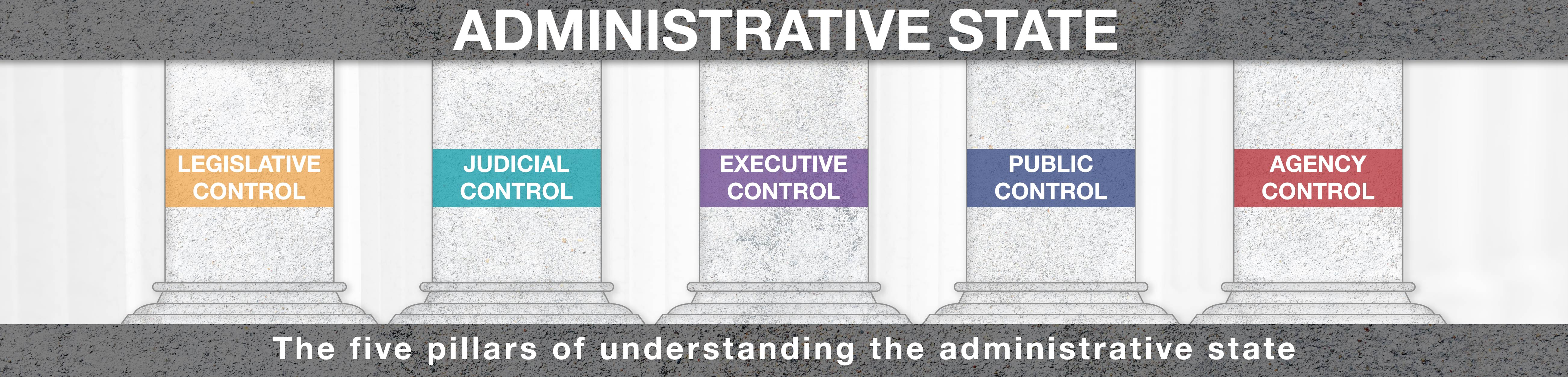
| What is deference in the context of the administrative state? Deference, or judicial deference, is a principle of judicial review in which a federal court yields to an agency's interpretation of a statute or regulation. The U.S. Supreme Court has developed several forms of deference in reviewing federal agency actions, including Chevron deference, Skidmore deference, and Auer deference. Learn about state-level responses to deference here. |
| Five Pillars of the Administrative State |
|---|

|
| Judicial control |
|
•Court cases |
| More pillars |
| •Agency control • Executive control •Legislative control • Public control |
| Click here for more coverage of the administrative state on Ballotpedia.
|
| Click here to access Ballotpedia's administrative state legislation tracker. |
This page captures one of the main arguments that have been advanced in favor of judicial deference as a doctrine.
Deference occurs when a federal court defers to an agency’s interpretation of (1) a statute Congress authorized the agency to administer or (2) the agency’s own regulations. The U.S. Supreme Court developed multiple deference doctrines throughout the 20th century, including Chevron deference, Skidmore deference, and Auer deference.[1][2]
Since 2015, the United States Supreme Court has reconsidered aspects of judicial deference, refining Chevron deference, limiting its application, and recognizing exceptions, according to administrative law scholar Michael Kagan. In Kisor v. Wilkie (2019), the court upheld Auer deference but narrowed its scope, reflecting what Kagan described as a "period of uncertainty" for judicial deference.[3][4]
On June 28, 2024, the Supreme Court overturned Chevron deference in Loper Bright Enterprises v. Raimondo and Relentless, Inc. v. Department of Commerce, ruling that federal courts may not defer to an agency’s interpretation of an ambiguous statute.[5]
There are six main types of argument in favor of judicial deference:
Deference is required by separation of powers[edit]
This argument says that separation of powers principles require judicial deference to administrative agencies when resolving ambiguous statutes involves making policy judgments. Separation of powers refers to the idea that the functions of government should be divided between the legislative, executive, and judicial branches. Since policy judgments are political questions, this argument says that the political branches, Congress and the president, must resolve them instead of judges. The argument is developed in the following claims.
Claim: Separation of powers requires deference[edit]
- T.J. McCarrick: “Perhaps most importantly, the Chevron framework also reinforces separation-of-powers norms. Though rules and adjudications “take ‘legislative’ and ‘judicial’ forms,” agency action in a zone of ambiguity is an exercise of executive power. But only such power as the legislature confers. 'Congress knows how to speak in plain terms when it wishes to circumscribe, and in capacious terms when it wishes to enlarge, agency discretion.' And when it comes to regulation, courts should not do for Congress what Congress can do for itself.”[6]
- Antonin Scalia rejected the idea that separation of powers principles require judicial deference to agencies, but he gave a clear summary of the idea in a speech from 1989. He says, ”[T]he constitutional principle of separation of powers requires Chevron. The argument goes something like this: When, in a statute to be implemented by an executive agency, Congress leaves an ambiguity that cannot be resolved by text or legislative history, the 'traditional tools of statutory construction,' the resolution of that ambiguity necessarily involves policy judgment. Under our democratic system, policy judgments are not for the courts but for the political branches; Congress having left the policy question open, it must be answered by the Executive.”[7]
Footnotes[edit]
- ↑ Yale Law Journal, "The Origins of Judicial Deference to Executive Interpretation," February 2017
- ↑ Blattmachr, J. (2006). Circular 230 Deskbook. New York, NY: Practising Law Institute. (pages 1-21)
- ↑ UNLV William S. Boyd School of Law Legal Studies Research Paper, "Loud and Soft Anti-Chevron Decisions," September 9, 2017
- ↑ SCOTUSblog, "Kisor v. Wilkie," accessed December 10, 2018
- ↑ SCOTUSblog, "Loper Bright Enterprises v. Raimondo," accessed July 3, 2024
- ↑ T.J. McCarrick, "In Defense of a Little Judiciary: A Textual and Constitutional Foundation for Chevron," San Diego Law Review (2018)
- ↑ Antonin Scalia, "Judicial Deference to Administrative Interpretations of Law," Duke Law Journal, Vol. 1989, No. 3 (1989)

Categories: [Deference, arguments for]
↧ Download as ZWI file | Last modified: 11/04/2025 20:08:28 | 11 views
☰ Source: https://ballotpedia.org/Arguments_in_favor_of_judicial_deference:_Deference_is_required_by_separation_of_powers | License: CC BY-SA 3.0
 KSF
KSF