Short description: In Islam, an angel of hell (Jahannam)
Part of a series on
Eschatology
Buddhist
Maitreya
Three Ages
Christian
— Biblical texts —
Book of Revelation
Book of Daniel
Olivet Discourse
Sheep and Goats
— Major figures —
Jesus
Two witnesses
Four Horsemen
Antichrist
— Different views —
Preterism
Idealism
Historicism
Futurism
— Millennialism —
Premillennialism
Amillennialism
Postmillennialism
— Other events —
Events of Revelation
Rapture
Seven Seals
Second Coming
Islamic eschatology
Hindu
Kalki
Kali Yuga
Shiva
Islamic
— Figures —
Beast of the Earth
Dhul-Qarnayn
Dhul-Suwayqatayn
Isa
Messiah
Second Coming
Israfil
Mahdi
Dajjal
Muhammad
Al-Qa'im
Sufyani
Yajuj and Majuj
— Events —
Death
Resurrection
Last Judgement
Jewish
Messianism
Book of Daniel
Kabbalah
Taoist
Li Hong
Zoroastrian
Frashokereti
Saoshyant
Inter-religious
End times
Apocalypticism
2012 phenomenon
Millenarianism
Last Judgment
Resurrection of the dead
Gog and Magog
Messianic Age
v
t
e
Part of a series on
Islam
Beliefs
Oneness of God
Prophets
Revealed books
Angels
Predestination
Day of Resurrection
Practices
Profession of faith
Prayer
Alms-giving
Fasting
Pilgrimage
Texts and sciences
Quran
Tafsir
Sunnah (Hadith, Sirah)
Aqidah(creed)
Theology
Sharia(law)
Fiqh(jurisprudence)
Qisas Al-Anbiya
History
Timeline
Muhammad
Ahl al-Bayt
Sahabah
Rashidun
Caliphate
Imamate
Spread of Islam
Succession to Muhammad
Denominations and branches
Sunni
Salafiya
Wahhabi
Modernism
Shia
Ismaili
Zaidiyyah
Alawites
Druze
Kharijites
Sufism
Orders
Theological branches
Culture and society
Academics
Animals
Art
Calendar
Children
Demographics
Denominations
Economics
Education
Exorcism
Feminism
Festivals
Finance
LGBT
Madrasa
Moral teachings
Mosque
Mysticism
Philosophy
Poetry
Politics
Proselytizing
Science
Slavery
Social welfare
Women
Related topics
Abrogation in Islam
Criticism of Islam
Muhammad
Quran
Islam and other religions
Islamism
Islam and violence
Islamophobia
Glossary
v
t
e
In Islamic belief, Maalik (Arabic: مَٰلِكُ)[1][2] denotes an angel in Hell/Purgatory (Arabic: جهنم) who administrates the Hellfire, assisted by 19 mysterious guards (Q 74:30) known as Zabaniyya (Arabic: الزبانية). In the Qur'an, Maalik is mentioned in Surah Az-Zukhruf 43:77 as the chief of angels of hell. The earliest codices offer various alternative spellings of this word including Script error: The function "transl" does not exist., meaning "angel", instead of a proper name.[3]
Contents
1In Qur'an
2In Hadith
3See also
4References
In Qur'an
In 43:77 and the following, the Qur'an describes Maalik telling the people in hell that they must remain there:
"Indeed, the wicked will be in the torment of Hell forever. It will never be lightened for them, and there they will be overwhelmed with despair. We did not wrong them, but it was they who were the wrongdoers. They will cry, “O Mâlik! Let your Lord finish us off.” He will answer, “You are definitely here to stay.” We certainly brought the truth to you, but most of you were resentful of the truth."
—Surah Az-Zukhruf 43:74-78
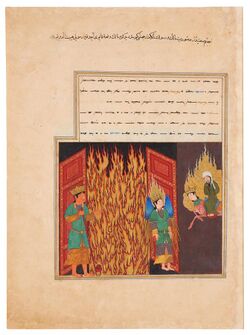
Muhammad requests Maalik to show him Hell during his heavenly journey. Miniature from "The David Collection Copenhagen"
Surah At-Tahrim 66:6 points out, that the punishments are carried out by God's command: "O believers! Protect yourselves and your families from a Fire whose fuel is people and stones, overseen by formidable and severe angels, who never disobey whatever Allah orders—always doing as commanded.".
In Hadith
Main page: Religion:Isra and Mi'raj
According to Islamic tradition, Muhammad met the angel Maalik during his heavenly journey. Therefore, Muhammad arrived in heaven and all the angels greeted him with a smile except Maalik. When Muhammad asked Jibra'il, why he remains taciturn therefore, he reveals Maalik as the guardian of Hell who never smiles. After that, Muhammad asked him to show Hell and Maalik opened its gates, showing him a glimpse of suffering for the inmates.[4][5]
According to Abbasid jurist Ibn Qutaybah, who's also known as Al-Qutb, the number of fingers Maalik had were equal to the sinners who would be thrown into hell.[6] Ibn Qutaybah also narrated that each of Maalik's fingers were so hot, that if one of them touched the sky; that finger will cause the sky to melt.[6] al-Suyuti also quoted that since his creation which spans a thousand years before hell's formation, Maalik's strength always grew infinitely over time as each day passed.[6] Ibn Hisham narrated that in several Hadiths, Muhammad has met Maalik on one occasion and described that the angel possessed a very disgustingly ugly face.[6] In one narration of Hadith, Maalik's true face is so ugly beyond comprehension, that if any human in their lifetime saw him, they would be killed in suffering and anguish just by merely bearing witness of Maalik's ugliness.[6]
Medieval Hagiographer Ibn Ishaq has narrated hadith about Isra Mi'raj, where during his journey to the sky, Muhammad noticed that among the angels who greeted him, Maalik was one of them, who, unlike the other angels, never showed a smile or any sign of joy.[7] According to various Hadiths quoted by Ibn Hisham in his book, Muhammad asked Jibril to see hell, which Jibril responded by asking Maalik to 'be his guest' and present to him the horrors of the hell.[7]
See also
List of angels in theology
Zabaniyah
Malik
Ridwan
Yama
References
↑"Surat Az-Zukhruf Ayat 77" (in Id). https://tafsirweb.com/9273-surat-az-zukhruf-ayat-77.html.
↑"AL-MALIK MEANING - 99 NAMES OF ALLAH:". https://myislam.org/99-names-of-allah/al-malik/.
↑Christian Lange Paradise and Hell in Islamic Traditions Cambridge University Press 2015 ISBN:978-1-316-41205-3 page 53
↑Alan E. Bernstein Hell and Its Rivals: Death and Retribution among Christians, Jews, and Muslims in the Early Middle Ages Cornell University Press 2017 ISBN:978-1-501-71248-7
↑Brooke Olson Vuckovic Heavenly Journeys, Earthly Concerns: The Legacy of the Mi'raj in the Formation of Islam Routledge 2004 ISBN:978-1-135-88524-3 page 37
↑ 6.06.16.26.36.4Imam Jalaluddin Abdurrahman As-Suyuthi (2021) (in id) (ebook). Misteri Alam Malaikat. Al-Kautsar. p. 72. ISBN 9789795929512. https://books.google.com/books?id=iDxQEAAAQBAJ. Retrieved 1 August 2023. "53 dalam kitab 'Uyun Al-Akhbar melansir dari Thawus bahwa Allahkmenciptakan Malik, dan menciptakan untuknya jari-jari sejumlah penghuni neraka."
↑ 7.07.1Mansur Abdul Hakim (2015) (in Malay). MALAIKAT MALIK A.S : PENJAGA NERAKA. 9789678605250. pp. 9-10; 15-16. https://www.google.co.id/books/edition/MALAIKAT_MALIK_A_S_PENJAGA_NERAKA/nA5wCgAAQBAJ?hl=id&gbpv=0. Retrieved 5 November 2023. "... malaikat yang lain.” Lalu aku bertanya kepada Jibril, “Wahai Jibril, siapakah malaikat ini yang berkata kepadaku seperti perkataan para malaikat, namun dia tidak ketawa kepadaku dan aku tidak melihat kegembiraan darinya seperti yang aku ..."
v
t
e
People and things in the Quran
Characters
Non-humans
Allāh ("The God")
Names of Allah found in the Quran, such as Karīm (Generous)
Beings in Paradise
Animals
Related
The baqarah (cow) of Israelites
The dhiʾb (wolf) that Jacob feared could attack Joseph
The fīl (elephant) of the Abyssinians
Ḥimār (Domesticated donkey)
The hud-hud (hoopoe) of Solomon
The kalb (dog) of the sleepers of the cave
The namlah (female ant) of Solomon
The nūn (fish or whale) of Jonah
The nāqat (she-camel) of Saleh
Non-related
ʿAnkabūt (Female spider)
Dābbat al-Arḍ (Beast of the Earth)
Ḥimār (Wild ass)
Naḥl (Honey bee)
Qaswarah ("Lion", "beast of prey" or "hunter")
Angels
Angels of Hell
Mālik
Zabāniyah
Angel of the Trumpet (Isrāfīl or Raphael)
Jibrīl (Gabriel)
Ar-Rūḥ ("The Spirit")
Ar-Rūḥ al-Amīn ("The Trustworthy Spirit")
Ar-Rūḥ al-Qudus ("The Holy Spirit")
Mīkāil (Michael)
Angel of Death (Azrael)
Bearers of the Throne
Riḍwān
Munkar and Nakir
Harut and Marut
Kirāman Kātibīn (Honourable Scribes)
Raqib
Atid
Others
Jinn
Jann
ʿIfrīt
Mārid ("Rebellious one")
Shayāṭīn (Demons)
Iblīs the (Chief) Al-Shayṭān
Qarīn
Ghilmān or Wildān
Ḥūr
Prophets
Mentioned
Ādam (Adam)
Al-Yasaʿ (Elisha)
Ayyūb (Job)
Dāwūd (David)
Dhūl-Kifl (Ezekiel?)
Hārūn (Aaron)
Hūd (Eber?)
Idrīs (Enoch?)
Ilyās (Elijah)
ʿImrān (Joachim the father of Maryam)
Isḥāq (Isaac)
Ismāʿīl (Ishmael)
Dhabih Ullah
Lūṭ (Lot)
Ṣāliḥ
Shuʿayb (Jethro, Reuel or Hobab?)
Sulaymān ibn Dāwūd (Solomon son of David)
ʿUzair (Ezra?)
Yaḥyā ibn Zakariyyā (John the Baptist the son of Zechariah)
Yaʿqūb (Jacob)
Isrāʾīl (Israel)
Yūnus (Jonah)
Dhūn-Nūn ("He of the Fish (or Whale)" or "Owner of the Fish (or Whale)")
Ṣāḥib al-Ḥūt ("Companion of the Whale")
Yūsuf ibn Ya‘qūb (Joseph son of Jacob)
Zakariyyā (Zechariah)
Ulul-ʿAzm
Muḥammad
Aḥmad
Other names and titles of Muhammad
ʿĪsā (Jesus)
Al-Masīḥ (The Messiah)
Ibn Maryam (Son of Mary)
Mūsā Kalīmullāh (Moses He who spoke to God)
Ibrāhīm Khalīlullāh (Abraham Friend of God)
Nūḥ (Noah)
Debatable ones
Dhūl-Qarnain
Luqmān
Maryam (Mary)
Ṭālūt (Saul or Gideon?)
Implied
Irmiyā (Jeremiah)
Isma'il Ṣādiq al-Waʿd (Fulfiller of the Promise)?
Ṣamūʾīl (Samuel)
Yūshaʿ ibn Nūn (Joshua, companion and successor of Moses)
People of Prophets
Good ones
Adam's immediate relatives
Martyred son
Wife
Believer of Ya-Sin
Family of Noah
Father Lamech
Mother Shamkhah bint Anush or Betenos
Luqman's son
People of Aaron and Moses
Egyptians
Believer (Hizbil or Hizqil ibn Sabura)
Imraʾat Firʿawn (Arabic: امْرَأَت فِرْعَوْن, Āsiyá bint Muzāḥim (Arabic: آسِيَا بِنْت مُزَاحِم) or Wife of Pharaoh, who adopted Moses)
Magicians of the Pharaoh
Wise, pious man
Moses' wife
Moses' sister-in-law
Mother
Sister
People of Abraham
Mother Abiona or Amtelai the daughter of Karnebo
Ishmael's mother
Isaac's mother
People of Jesus
Disciples (including Peter)
Mary's mother
Zechariah's wife
People of Joseph
Brothers (including Binyāmin (Benjamin) and Simeon)
Egyptians
ʿAzīz (Potiphar, Qatafir or Qittin)
Malik (King Ar-Rayyān ibn Al-Walīd))
Wife of ʿAzīz (Zulaykhah)
Mother
People of Solomon
Mother
Queen of Sheba
Vizier
Zayd (Muhammad's adopted son)
Evil ones
Āzar (possibly Terah)
Firʿawn (Pharaoh of Moses' time)
Hāmān
Jālūt (Goliath)
Qārūn (Korah, cousin of Moses)
As-Sāmirī
Abū Lahab
Slayers of Saleh's she-camel (Qaddar ibn Salif and Musda' ibn Dahr)
Implied or not specified
Abrahah[clarification needed]
Bal'am/Balaam
Barsisa
Caleb or Kaleb the companion of Joshua
Luqman's son
Nebuchadnezzar II
Nimrod
Rahmah the wife of Ayyub
Shaddad
Groups
Mentioned
Aṣḥāb al-Jannah
People of Paradise
People of the Burnt Garden
Aṣḥāb as-Sabt (Companions of the Sabbath)
Christian apostles
Ḥawāriyyūn (Disciples of Jesus)
Companions of Noah's Ark
Aṣḥāb al-Kahf war-Raqīm (Companions of the Cave and Al-Raqaim?
Companions of the Elephant
People of al-Ukhdūd
People of a township in Surah Ya-Sin
People of Yathrib or Medina
Qawm Lūṭ (People of Sodom and Gomorrah)
Nation of Noah
Tribes, ethnicities or families
Aʿrāb (Arabs or Bedouins)
ʿĀd (people of Hud)
Companions of the Rass
Qawm Tubbaʿ (People of Tubba)
People of Sabaʾ or Sheba
Quraysh
Thamūd (people of Saleh)
Aṣḥāb al-Ḥijr ("Companions of the Stoneland")
‘Ajam
Ar-Rūm (literally "The Romans")
Banī Isrāʾīl (Children of Israel)
Muʾtafikāt (The overthrown cities of Sodom and Gomorrah)
People of Ibrahim
People of Ilyas
People of Nuh
People of Shuaib
Ahl Madyan People of Madyan)
Aṣḥāb al-Aykah ("Companions of the Wood")
Qawm Yūnus (People of Jonah)
Ya'juj and Ma'juj/Gog and Magog
Ahl al-Bayt ("People of the Household")
Household of Abraham
Brothers of Yūsuf
Lot's daughters
Progeny of Imran
Household of Moses
Household of Muhammad ibn Abdullah ibn Abdul-Muttalib ibn Hashim
Daughters of Muhammad
Muhammad's wives
Household of Salih
People of Fir'aun
Current Ummah of Islam (Ummah of Muhammad)
Aṣḥāb Muḥammad (Companions of Muhammad)
Anṣār (Muslims of Medina who helped Muhammad and his Meccan followers, literally 'Helpers')
Muhajirun (Emigrants from Mecca to Medina)
People of Mecca
Wife of Abu Lahab
Children of Ayyub
Sons of Adam
Wife of Nuh
Wife of Lut
Yaʾjūj wa Maʾjūj (Gog and Magog)
Son of Nuh
Implicitly mentioned
Amalek
Ahl as-Suffa (People of the Verandah)
Banu Nadir
Banu Qaynuqa
Banu Qurayza
Iranian people
Umayyad Dynasty
Aus and Khazraj
People of Quba
Religious groups
Ahl al-Dhimmah
Kāfirūn (Disbelievers)
Zoroastrians
Munafiqun (Hypocrites)
Muslims
Believers
Ahl al-Kitāb (People of the Book)
Naṣārā (Christian(s) or People of the Injil)
Ruhban (Christian monks)
Qissis (Christian priest)
Yahūd (Jews)
Ahbār (Jewish scholars)
Rabbani/Rabbi
Sabians
Polytheists
Meccan polytheists at the time of Muhammad
Mesopotamian polytheists at the time of Abraham and Lot
Locations
Mentioned
Al-Arḍ Al-Muqaddasah ("The Holy Land")
'Blessed' Land
In the Arabian Peninsula (excluding Madyan)
Al-Aḥqāf ("The Sandy Plains," or "the Wind-curved Sand-hills")
Iram dhāt al-ʿImād (Iram of the Pillars)
Al-Madīnah (formerly Yathrib)
ʿArafāt
Al-Ḥijr (Hegra)
Badr
Ḥunayn
Makkah (Mecca)
Bakkah
Ḥaraman Āminan ("Sanctuary (which is) Secure")
Kaʿbah (Kaaba)
Maqām Ibrāhīm (Station of Abraham)
Safa and Marwa
Sabaʾ (Sheba)
ʿArim Sabaʾ (Dam of Sheba)
Rass
Al-Jannah (Paradise, literally "The Garden")
Jahannam (Hell)
In Mesopotamia:
Al-Jūdiyy
Munzalanm-Mubārakan ("Place-of-Landing Blessed")
Bābil (Babylon)
Qaryat Yūnus ("Township of Jonah," that is Nineveh)
Door of Hittah
Madyan (Midian)
Majmaʿ al-Baḥrayn
Miṣr (Mainland Egypt)
Salsabīl (A river in Paradise)
Sinai Region or Tīh Desert
Al-Wād Al-Muqaddas Ṭuwan (The Holy Valley of Tuwa)
Al-Wādil-Ayman (The valley on the 'righthand' side of the Valley of Tuwa and Mount Sinai)
Al-Buqʿah Al-Mubārakah ("The Blessed Place")
Mount Sinai or Mount Tabor
Religious locations
Bay'a (Church)
Miḥrāb
Monastery
Masjid (Mosque, literally "Place of Prostration")
Al-Mashʿar Al-Ḥarām ("The Sacred Grove")
Al-Masjid Al-Aqṣā (Al-Aqsa Mosque, literally "The Farthest Place-of-Prostration")
Al-Masjid Al-Ḥarām (The Sacred Mosque of Mecca)
Masjid al-Dirar
A Mosque in the area of Medina, possibly:
Masjid Qubāʾ (Quba Mosque)
The Prophet's Mosque
Salat (Synagogue)
Implied
Antioch
Antakya
Arabia
Al-Ḥijāz (literally "The Barrier")
Black Stone (Al-Ḥajar al-Aswad) & Al-Hijr of Isma'il
Cave of Hira
Ghār ath-Thawr (Cave of the Bull)
Hudaybiyyah
Ta'if
Ayla
Barrier of Dhul-Qarnayn
Bayt al-Muqaddas & 'Ariha
Bilād ar-Rāfidayn (Mesopotamia)
Canaan
Cave of Seven Sleepers
Dār an-Nadwa
Jordan River
Nile River
Palestine River
Paradise of Shaddad
Plant matter
Baṣal (Onion)
Fūm (Garlic or wheat)
Shaṭʾ (Shoot)
Sūq (Plant stem)
Zarʿ (Seed)
Fruits
ʿAdas (Lentil)
Baql (Herb)
Ḥabb dhul-ʿaṣf (Corn of the husk)
Qith-thāʾ (Cucumber)
Rummān (Pomegranate)
Tīn (Fig)
Ukul khamṭ (Bitter fruit or food of Sheba)
Zaytūn (Olive)
In Paradise
Forbidden fruit of Adam
Bushes, trees or plants
Plants of Sheba
Athl (Tamarisk)
Sidr (Lote-tree)
Līnah (Tender Palm tree)
Nakhl (Date palm)
Rayḥān (Scented plant)
Sidrat al-Muntahā
Zaqqūm
Holy books
Al-Injīl (The Gospel of Jesus)
Al-Qurʾān (The Book of Muhammad)
Ṣuḥuf-i Ibrāhīm (Scroll(s) of Abraham)
At-Tawrāt (The Torah)
Ṣuḥuf-i-Mūsā (Scroll(s) of Moses)
Tablets of Stone
Az-Zabūr (The Psalms of David)
Umm al-Kitāb ("Mother of the Book(s)")
Objects of people or beings
Heavenly Food of Christian Apostles
Noah's Ark
Staff of Musa
Tābūt as-Sakīnah (Casket of Shekhinah)
Throne of Bilqis
Trumpet of Israfil
Mentioned idols (cult images)
'Ansāb
Idols of Israelites:
Baʿal
The ʿijl (golden calf statue) of Israelites
Idols of Noah's people:
Nasr
Suwāʿ
Wadd
Yaghūth
Yaʿūq
Idols of Quraysh:
Al-Lāt
Al-ʿUzzā
Manāt
Jibt and Ṭāghūt
Celestial bodies
Maṣābīḥ (literally 'lamps'):
Al-Qamar (The Moon)
Kawākib (Planets)
Al-Arḍ (The Earth)
Nujūm (Stars)
Ash-Shams (The Sun)
Liquids
Māʾ (Water or fluid)
Nahr (River)
Yamm (River or sea)
Sharāb (Drink)
Events, incidents, occasions or times
Incident of Ifk
Laylat al-Qadr
Event of Mubahala
Sayl al-ʿArim (Flood of the Great Dam of Marib in Sheba)
The Farewell Pilgrimage
Treaty of Hudaybiyyah
Battles or military expeditions
Battle of al-Aḥzāb ("the Confederates")
Battle of Badr
Battle of Hunayn
Battle of Khaybar
Battle of Tabouk
Battle of Uhud
Conquest of Mecca
Days
Al-Jumuʿah (The Friday)
As-Sabt (The Sabbath or Saturday)
Days of battles
Days of Hajj
Doomsday
Months of the Islamic calendar
12 months:
Four holy months
Ash-Shahr Al-Ḥarām (The Sacred or Forbidden Month)
Ramaḍān
Pilgrimages
Al-Ḥajj (literally "The Pilgrimage", the Greater Pilgrimage)
Al-ʿUmrah (The Lesser Pilgrimage)
Times for Prayer or Remembrance
Times for Duʿāʾ ('Invocation'), Ṣalāh and Dhikr ('Remembrance', including Taḥmīd ('Praising'), Takbīr and Tasbīḥ):
Al-ʿAshiyy (The Afternoon or the Night)
Al-Ghuduww ("The Mornings")
Al-Bukrah ("The Morning")
Aṣ-Ṣabāḥ ("The Morning")
Al-Layl ("The Night")
Al-ʿIshāʾ ("The Late-Night")
Aẓ-Ẓuhr ("The Noon")
Dulūk ash-Shams ("Decline of the Sun")
Al-Masāʾ ("The Evening")
Qabl al-Ghurūb ("Before the Setting (of the Sun)")
Al-Aṣīl ("The Afternoon")
Al-ʿAṣr ("The Afternoon")
Qabl ṭulūʿ ash-Shams ("Before the rising of the Sun")
Al-Fajr ("The Dawn")
Implied
Event of Ghadir Khumm
Laylat al-Mabit
The first pilgrimage
Note: The names are sorted alphabetically. Standard form: Islamic name / Biblical name (title or relationship)
0.00
(0 votes)
Original source: https://en.wikipedia.org/wiki/Maalik. Read more
 From Handwiki


 KSF
KSF