What is a federal administrative adjudicator? Federal administrative adjudicators are federal government officials who preside over administrative hearings and proceedings in a process called adjudication. These officials can be divided into two categories: administrative law judges (ALJs) and non-ALJ adjudicators, sometimes referred to as administrative judges (AJs). Although many of these officials have the word judge in their job title, administrative adjudicators are part of the executive rather than the judicial branch. They are not judges as described in Article III of the Constitution. |
| Administrative State
|
|
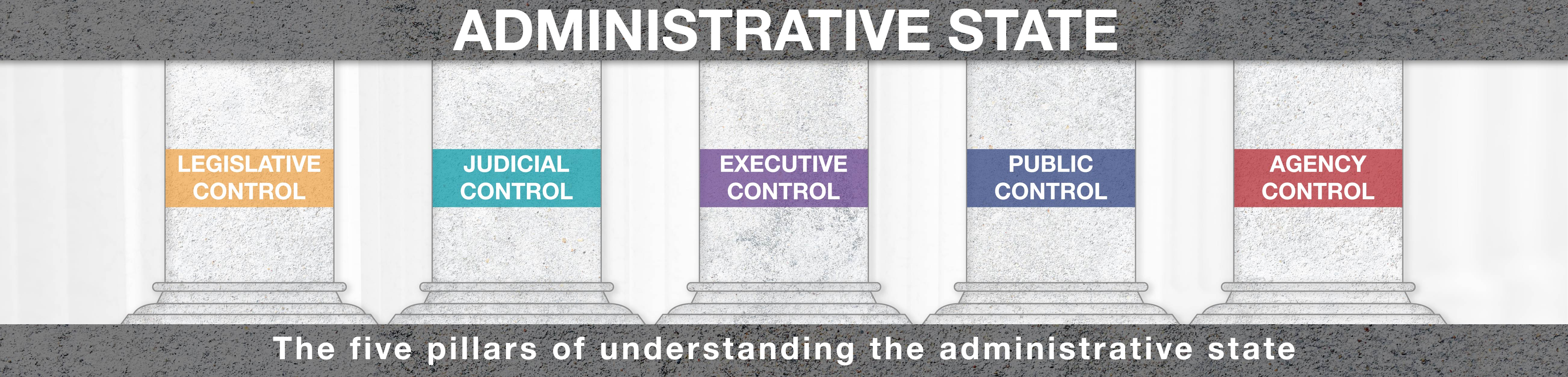
| Read more about the administrative state on Ballotpedia.
|
Regional judicial officer is a title used by some federal government agencies to refer to the administrative adjudicators they employ. Regional judicial officers are one type of non-ALJ adjudicator (sometimes collectively referred to as administrative judges). These adjudicators preside over administrative hearings and proceedings in a process called adjudication. They have a variety of responsibilities and titles depending on the agency that employs them and their caseload.[1]
Non-ALJs conduct informal adjudication proceedings, which may involve a hearing or a written process. Unlike administrative law judges (ALJs), non-ALJ adjudicators are not covered by the Administrative Procedure Act and their positions are not standardized across the government. Their work, titles, qualifications, and pay vary substantially. Non-ALJs conduct the majority of adjudication proceedings.[1]
There were more than 10,000 non-ALJ adjudicators working at various federal agencies at the time of a February 2018 study, which contained the most recent comprehensive data available as of March 2024. The largest employers of non-ALJs at the time of the 2018 study were the Patent and Trademark Office at the Department of Commerce (7,856 patent examiners), the Internal Revenue Service (714 non-ALJs), the Department of Veterans Affairs (630 non-ALJs), National Labor Relations Board (600 non-ALJs), and the Executive Office for Immigration Review at the Department of Justice (326 immigration judges and other non-ALJs).[1]
See also[edit]
- Concepts, terms, and definitions related to the administrative state
- The Administrative State Project
External links[edit]
- Search Google News for this topic
[edit]
- ↑ 1.0 1.1 1.2 Administrative Conference of the United Sates, "Non-ALJ Adjudicators in Federal Agencies: Status, Selection, Oversight, and Removal," February 14, 2018
| The Administrative State |
|---|
| | Main | The Administrative State Project main page • Administrative State Project Index • Glossary of administrative state terms • Quotes about the administrative state • Administrative state • Rulemaking • Deference • Adjudication • Nondelegation doctrine • Ballotpedia's administrative state legislation tracker |  | | | Pillars | Agency control • Executive control • Judicial control • Legislative control • Public control | | | Reporting | Changes to the Federal Register • Completed OIRA review of federal administrative agency rules • Federal agency rules repealed under the Congressional Review Act • Historical additions to the Federal Register, 1936-2016 | | | Laws | Administrative Procedure Act • Antiquities Act • Civil Service Reform Act • Clayton Antitrust Act • Communications Act of 1934 • Congressional Review Act • Electronic Freedom of Information Act • Federal Food, Drug, and Cosmetic Act of 1938 • Federal Housekeeping Statute • Federal Reserve Act • Federal Trade Commission Act of 1914 • Freedom of Information Act • Government in the Sunshine Act • Independent Offices Appropriations Act of 1952 • Information Quality Act • Interstate Commerce Act • National Labor Relations Act • Paperwork Reduction Act • Pendleton Act • Privacy Act of 1974 • Regulatory Flexibility Act • REINS Act • REINS Act (Wisconsin) • Securities Act of 1933 • Securities Exchange Act of 1934 • Sherman Antitrust Act • Small Business Regulatory Enforcement Fairness Act • Truth in Regulating Act • Unfunded Mandates Reform Act | | | Cases | Abbott Laboratories v. Gardner • A.L.A. Schechter Poultry Corp. v. United States • Association of Data Processing Service Organizations v. Camp • Auer v. Robbins • Chevron v. Natural Resources Defense Council • Citizens to Preserve Overton Park v. Volpe • Federal Trade Commission (FTC) v. Standard Oil Company of California • Field v. Clark • Food and Drug Administration v. Brown and Williamson Tobacco Corporation • Humphrey's Executor v. United States • Immigration and Naturalization Service (INS) v. Chadha • J.W. Hampton Jr. & Company v. United States • Lucia v. SEC • Marshall v. Barlow's • Massachusetts v. Environmental Protection Agency • Mistretta v. United States • National Federation of Independent Business (NFIB) v. Sebelius • National Labor Relations Board v. Noel Canning Company • National Labor Relations Board v. Sears, Roebuck & Co. • Panama Refining Co. v. Ryan • Securities and Exchange Commission v. Chenery Corporation • Skidmore v. Swift & Co. • United States v. Lopez • United States v. Western Pacific Railroad Co. • Universal Camera Corporation v. National Labor Relations Board • Vermont Yankee Nuclear Power Corp. v. Natural Resources Defense Council • Wayman v. Southard • Weyerhaeuser Company v. United States Fish and Wildlife Service • Whitman v. American Trucking Associations • Wickard v. Filburn • Wiener v. United States | | | Terms | Adjudication (administrative state) • Administrative judge • Administrative law • Administrative law judge • Administrative state • Arbitrary-or-capricious test • Auer deference • Barrier to entry • Bootleggers and Baptists • Chevron deference (doctrine) • Civil servant • Civil service • Code of Federal Regulations • Codify (administrative state) • Comment period • Compliance costs • Congressional Record • Coordination (administrative state) • Deference (administrative state) • Direct and indirect costs (administrative state) • Enabling statute • Ex parte communication (administrative state) • Executive agency • Federal law • Federal Register • Federalism • Final rule • Formal rulemaking • Formalism (law) • Functionalism (law) • Guidance (administrative state) • Hybrid rulemaking • Incorporation by reference • Independent federal agency • Informal rulemaking • Joint resolution of disapproval (administrative state) • Major rule • Negotiated rulemaking • Nondelegation doctrine • OIRA prompt letter • Organic statute • Pragmatism (law) • Precautionary principle • Promulgate • Proposed rule • Publication rulemaking • Regulatory budget • Regulatory capture • Regulatory dark matter • Regulatory impact analysis • Regulatory policy officer • Regulatory reform officer • Regulatory review • Rent seeking • Retrospective regulatory review • Risk assessment (administrative state) • Rulemaking • Separation of powers • Significant regulatory action • Skidmore deference • Statutory authority • Substantive law and procedural law • Sue and settle • Sunset provision • Unified Agenda of Federal Regulatory and Deregulatory Actions • United States Code • United States Statutes at Large | | | Bibliography |
- "Administrative Law - The 20th Century Bequeaths an 'Illegitimate Exotic' in Full and Terrifying Flower" by Stephen P. Dresch (2000)
- "Confronting the Administrative Threat" by Philip Hamburger and Tony Mills (2017)
- "Constitutionalism after the New Deal" by Cass R. Sunstein (1987)
- Federalist No. 23 by Alexander Hamilton (1787)
- "From Administrative State to Constitutional Government" by Joseph Postell (2012)
- "Interring the Nondelegation Doctrine" by Eric A. Posner and Adrian Vermeule (2002)
- "Rulemaking as Legislating" by Kathryn Watts (2015)
- "The Checks & Balances of the Regulatory State" by Paul R. Verkuil (2016)
- "The Myth of the Nondelegation Doctrine" by Keith E. Whittington and Jason Iuliano (2017)
- "The Progressive Origins of the Administrative State: Wilson, Goodnow, and Landis" by Ronald J. Pestritto (2007)
- "The Rise and Rise of the Administrative State" by Gary Lawson (1994)
- "The Study of Administration" by Woodrow Wilson (1887)
- "The Threat to Liberty" by Steven F. Hayward (2017)
- "Why the Modern Administrative State Is Inconsistent with the Rule of Law" by Richard A. Epstein (2008)
| | | Agencies | Administrative Conference of the United States • United States Civil Service Commission • U.S. Government Accountability Office • U.S. Office of Information and Regulatory Affairs • U.S. Office of Management and Budget |
|