Helene (Moon)
 From Handwiki
  High-resolution view of leading hemisphere, showing gullies and apparent dust (regolith) flows (Cassini, June 2011) | |
| Discovery [1] | |
|---|---|
| Discovered by | P. Laques J. Lecacheux |
| Discovery site | Pic du Midi Observatory |
| Discovery date | March 1, 1980 |
| Designations | |
Designation | Saturn XII |
| Pronunciation | /ˈhɛləniː/[2] |
| Named after | Helen of Troy (Ἑλένη Helenē) |
| |
| Adjectives | Helenean /hɛləˈniːən/[3] |
| Orbital characteristics | |
| 377600 km[4] | |
| Eccentricity | 0.007[4] |
| Orbital period | 2.736916 d[4] |
| Inclination | 0.199° (to Saturn's equator) |
| Satellite of | Saturn |
| Group | L4 Dione trojan |
| Physical characteristics | |
| Dimensions | 45.2 × 39.2 × 26.6 km (± 0.4 × 0.6 × 0.4 km)[5] |
| Mean diameter | 36.2±0.4 km[5] |
| Volume | 24840 km3[lower-alpha 1] |
| Mass | (7.1±0.2)×1015 kg[6] |
| Mean density | 0.2926±0.0217 g/cm3[6] |
| 0.0009 m/s2 at longest axis to 0.0027 m/s2 at poles | |
| 0.0065 km/s at longest axis to 0.0084 km/s at poles | |
| Rotation period | assumed synchronous |
| Axial tilt | zero |
| Albedo | 1.67±0.20 (geometric) [7] |
Helene /ˈhɛləniː/ is a moon of Saturn. It was discovered by Pierre Laques and Jean Lecacheux in 1980 from ground-based observations at Pic du Midi Observatory,[1] and was designated S/1980 S 6.[8] In 1988 it was officially named after Helen of Troy, who was the granddaughter of Cronus (Saturn) in Greek mythology.[9] Helene is also designated Saturn XII (12), which it was given in 1982, and Dione B,[10] because it is co-orbital with Dione and located in its leading Lagrangian point (L4). It is one of four known trojan moons.

Polydeuces · Helene · Dione · Saturn
Exploration
Helene was initially observed from Earth in 1980,[8] and Voyager flybys of Saturn in the early 1980s allowed much closer views. The Cassini–Huygens mission, which went into orbit around Saturn in 2004, provided still better views, and allowed more in-depth analysis of Helene, including views of the surface under different lighting conditions. Some of the closest images of Helene to date are from the Cassini spacecraft's 1800 km flyby on March 3, 2010, and another very successful imaging sequence occurred in June 2011. There were many other approaches over the course of the Cassini mission.
Geology
Images of Helene taken by the Cassini spacecraft, with resolutions of up to 42 meters per pixel, show a landscape characterized by broad 2–10km scale depressions with interior slopes no greater than 12°. These basins are likely the decayed remains of old impact craters.[11]
Thin, elongated km-scale raised grooves trace the slopes of many of Helene's basins, and likely represent mass flow features, indicating that the moon is undergoing active geologic processes such as mass-wasting and erosion. Digital elevation models suggest that the grooves have a positive relief of between 50 and 100 meters.
Simulation models show that the time series of surface activity on Helene is chaotic.
Surface material
Helene's surface material is of a relatively high reflectance, suggesting grain sizes between 1 and 100 micrometers. Small craters appear somewhat buried, suggesting recent accretional processes of some sort.
Stress-strain laboratory testing of impact-gardened lunar regolith samples show that at low packing densities they behave like Non-Newtonian “Bingham” materials, i.e., having the plastic quality of candle-wax and glaciers. This observation suggests that Helene's snow-like surface material may behave as a non-Newtonian mass flow and could be primarily responsible for the visible flow patterns seen on its low-gravity surface.[11]
Selected observations
Mostly raw greyscale images with near infrared or ultraviolet channels.
-
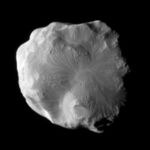 Flow-like features on Helene's leading hemisphere (Cassini, January 2011)
 -
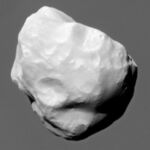 Image of Helene against the backdrop of Saturn's clouds (Cassini, March 3, 2010)
 -
 Helene's Saturn-facing side, lit by saturnshine (Cassini, March 2010)
 -
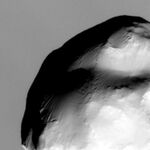 Close-up of Helene with Saturn in the background (Cassini, March 2010)
 -
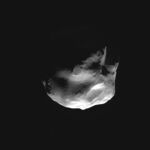 Cassini image from March 3, 2010
 -
 Cassini orbiter image from November 2008
 -
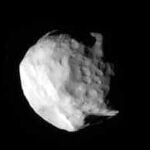 Cassini image taken July 2007
 -
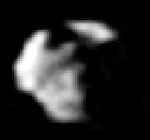 Voyager 2 image (August 1981)


Notes
References
Citations
- ↑ 1.0 1.1 Lecacheux1980.
- ↑ John Walker (1839) A Critical Pronouncing Dictionary and Expositor of the English Language;
also per Helena (3rd ed.), Oxford University Press, September 2005, http://oed.com/search?searchType=dictionary&q=Helena (Subscription or UK public library membership required.) - ↑ Clarified as Helenéan in Earle (1841) Marathon: and other poems, p. 76.
- ↑ 4.0 4.1 4.2 "Planetary Satellite Mean Orbital Parameters". Jet Propulsion Laboratory. https://ssd.jpl.nasa.gov/sats/elem/sep.html.
- ↑ 5.0 5.1 5.2 Thomas & Helfenstein 2020, p. 2.
- ↑ 6.0 6.1 Jacobson 2022, p. 6.
- ↑ Verbiscer et al. 2007.
- ↑ 8.0 8.1 IAUC 3496.
- ↑ IAUC 4609.
- ↑ Transactions of the International Astronomical Union, Vol. XVIIIA, 1982 (mentioned in IAUC 3872}}|IAUC 3872: Satellites of Jupiter and Saturn, September 30, 1983
- ↑ 11.0 11.1 Umurhan et al. 2015.
Sources
Sources
- Lecacheux, Jean. (July 1980). "A new satellite of Saturn: Dione B". Icarus 43 (1): 111–115. doi:10.1016/0019-1035(80)90093-7. Bibcode: 1980Icar...43..111L.
- Marsden, Brian G. (July 31, 1980). "Satellites of Saturn" (discovery). IAU Circular 3496. http://www.cbat.eps.harvard.edu/iauc/03400/03496.html. Retrieved 2011-12-23.
- Marsden, Brian G. (September 30, 1983). "Satellites of Jupiter and Saturn". IAU Circular 3872. http://www.cbat.eps.harvard.edu/iauc/03800/03872.html. Retrieved 2011-12-23.
- Marsden, Brian G. (June 8, 1988). "Satellites of Saturn and Uranus" (naming). IAU Circular 4609. http://www.cbat.eps.harvard.edu/iauc/04600/04609.html. Retrieved 2011-12-23.
- Thomas, P. C. (July 2010). "Sizes, shapes, and derived properties of the saturnian satellites after the Cassini nominal mission". Icarus 208 (1): 395–401. doi:10.1016/j.icarus.2010.01.025. Bibcode: 2010Icar..208..395T. http://www.ciclops.org/media/sp/2011/6794_16344_0.pdf. Retrieved 2015-09-04.
- Thomas, P. C.; Helfenstein, P. (July 2020). "The small inner satellites of Saturn: Shapes, structures and some implications". Icarus 344: 20. doi:10.1016/j.icarus.2019.06.016. 113355. Bibcode: 2020Icar..34413355T.
- Jacobson, Robert A. (November 2022). "The Orbits of the Main Saturnian Satellites, the Saturnian System Gravity Field, and the Orientation of Saturn's Pole". The Astronomical Journal 164 (5): 19. doi:10.3847/1538-3881/ac90c9. 199. Bibcode: 2022AJ....164..199J.</ref>
- Umurhan, O. M.; Howard, A. D.; Moore, J. M.; Schenk, P.; White, O. L. (2015). "Reconstructing Helene's Surface History – Plastics and Snow". 46th Lunar and Planetary Science Conference. https://www.hou.usra.edu/meetings/lpsc2015/pdf/2400.pdf. Retrieved 2021-02-12.</ref>
- Verbiscer, A.; French, R.; Showalter, M.; Helfenstein, P. (9 February 2007). "Enceladus: Cosmic Graffiti Artist Caught in the Act". Science 315 (5813): 815. doi:10.1126/science.1134681. PMID 17289992. Bibcode: 2007Sci...315..815V. (supporting online material, table S1)
External links
- Helene Profile by NASA's Solar System Exploration; see instead Cassini Solstice Mission: Helene
- The Planetary Society: Helene
- Helene has two faces —The Planetary Society : Helene Mini Atlas—Mar. 11, 2010
- Cassini catches Helene —The Planetary Society : Video & Views—Jun. 20, 2011
.jpg)
 |  |
Categories: [Moons of Saturn]
↧ Download as ZWI file | Last modified: 08/09/2026 17:52:48 | 13 views
☰ Source: https://handwiki.org/wiki/Astronomy:Helene_(moon) | License: CC BY-SA 3.0
 KSF
KSF