Cogito ergo sum Logic and rhetoric
|
|
| Key articles
|
- Logical fallacy
- Syllogism
- Argument
|
| General logic
|
- Argumentum ad populum
- Continuum fallacy
- Invincible authority
- Regression to the mean
- Logically Fallacious
- Traditional Square of Opposition
|
| Bad logic
|
- Appeal to consequences
- Argument from incredulity
- Ad iram
- Fallacy Files
- PIDOOMA
- Willful ignorance
v - t - e
|
An existential assumption (or existential fallacy) occurs whenever the conclusion of a syllogism requires that a class has at least one member, but one or more of the premises do not.
The fallacy is a syllogical fallacy and a formal fallacy.
Form[edit]
The syllogistic arguments AAI-1, EAO-1, AEO-2, EAO-2, AAI-3, IAI-3, AII-3, EAO-3, AAI-4, AEO-4 and EAO-4 all assume that one of the terms contains at least one element.
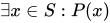
In predicate notation:
- P.
.
- C. Therefore,
.
Explanation[edit]
Universal statements, unlike the particulars, do not instantiate anything. For example, the statement, "All trespassers will be shot" (or rather, in standard form, "All trespassers are people who will be shot") does not say whether the trespassers exist or not. People will vow to shoot at any and all trespassers precisely because the statement does not guarantee the existence or non-existence of them. But when the trespassers do exist, they will be shot.
Particular statements (e.g. "Some dogs are fantastic pets.") do instantiate the subject term ("dogs"). In categorical logic, the precise definition of the word some is often taken to be at least one.
The fallacy occurs when there is a mismatch between the necessity of existence for the terms that are mentioned in both the premises and the conclusion. For example:
- P1: All animals are dangerous beings.
- P2: All unicorns are animals.
- C: Therefore, (necessarily,) some unicorns are dangerous beings. (Valid provided that the subject term, unicorns, exists)
This argument is not sound because the premises don't imply that conclusion is true, because the subject, a unicorn, is not guaranteed to exist as the conclusion claims it does (the word "some" means, again, at least one.) An informal version of the argument would read:
- P1: Grandma read from the Scroll, "The legend says all Animalia are very, very dangerous in their nature…
- P2: "Also, that all unicorns in the Aragon Forest will be Animalia!"
- C1: I interrupted her, asking, "So, there is a dangerous unicorn out there in the Aragon Forest?"
The grandma can say either yes or no. Maybe the last sighting of a unicorn was 1,000 years ago, or unicorns are abundant and active and killing humans right now downtown. As you can see, the premises cannot prove the conclusion out of the premises. The key thing to understand is that in a categorical syllogism, the word some means there is at least one instance of something. So, it is a declaration of the existence of something. The original argument declared that unicorns existed, and specified a particular type of unicorns and finally concluded that these particular unicorns were dangerous. The latter two parts were guaranteed by the premises; the first part, the existence of unicorns, was assumed. In the informal phrasing of the argument, the existential question in the conclusion line emphasized the fact that that was assumed.
See also[edit]
External links[edit]
- The Existential Fallacy, Fallacy Files
- Existential Fallacy, Stephen Downes
| Articles about logical fallacies
|
| Informal fallacies:
|
Appeal to tradition • Appeal to novelty • Appeal to nature • Argument from morality • Argumentum ad martyrdom • Big words • Certum est quia impossibile est • Morton's fork • Friend argument • Exception that proves the rule • Extended analogy • Hindsight bias • Race card • Moralistic fallacy • Release the data • Gish Gallop • Terrorism-baiting • Uncertainty tactic • Greece-baiting • Ham Hightail • Red-baiting • Gore's Law • Nazi analogies • Mistaking the map for the territory • Red herring • Quidquid latine dictum sit, altum videtur • Presentism • Sunk cost • Two wrongs make a right • Flying carpet fallacy • My enemy's enemy • Appeal to ancient wisdom • Danth's Law • Argumentum ad lunam • Balance fallacy • Golden hammer • Loaded question • Escape to the future • Word magic • Spider-Man fallacy • Sanctioning the devil • Appeal to mystery • Informal fallacy • Common sense • Post-designation • Hyperbole • Relativist fallacy • Due diligence • Straw man • Good old days • Appeal to probability • Infinite regress • Circular reasoning • Media was wrong before • Is–ought problem • Ad iram • Just asking questions • Pink-baiting • Appeal to faith • Appeal to fear • Appeal to bias • Appeal to confidence • Appeal to consequences • Appeal to emotion • Appeal to flattery • Appeal to gravity • Appeal to hate • Argument from omniscience • Argument from silence • Argumentum ad baculum • Argumentum ad fastidium • Association fallacy • Broken window fallacy • Category mistake • Confounding factor • Counterfactual fallacy • Courtier's Reply • Damning with faint praise • Definitional fallacies • Equivocation • Fallacy of accent • Fallacy of accident • Fallacy of amphiboly • Gambler's fallacy • Imprecision fallacy • Moving the goalposts • Nirvana fallacy • Overprecision • Pathos gambit • Pragmatic fallacy • Quote mining • Argumentum ad sarcina inserta • Science doesn't know everything • Slothful induction • Spotlight fallacy • Style over substance • Toupee fallacy • Genuine but insignificant cause • Argument from incredulity • Appeal to age • Argumentum ad nauseam • Phantom distinction • Appeal to common sense • Argumentum ad hysteria • Omnipotence paradox • Argument from etymology • Appeal to trauma •
|
|
|
Ad hoc:
|
No True Scotsman • Moving the goalposts • Escape hatch • Handwave • Special pleading • Slothful induction • Nirvana fallacy • God of the gaps • PIDOOMA • Ad hoc • Tone argument •
|
|
|
Arguments from ignorance:
|
Science doesn't know everything • Argument from incredulity • Argument from silence • Toupee fallacy • Appeal to censorship • Science was wrong before • Holmesian fallacy • Argument from omniscience • Willful ignorance • Argument from ignorance •
|
|
|
Causation fallacies:
|
Post hoc, ergo propter hoc • Correlation does not imply causation • Wrong direction • Counterfactual fallacy • Regression fallacy • Gambler's fallacy • Denying the antecedent • Genuine but insignificant cause •
|
|
|
Circular reasoning:
|
Infinite regress • Argument by assertion • Argumentum ad dictionarium • Appeal to faith • Circular reasoning • Self-refuting idea •
|
|
|
Emotional appeals:
|
Appeal to fear • Appeal to emotion • Appeal to confidence • Deepity • Argumentum ad baculum • Appeal to shame • Appeal to flattery • Tone argument • Appeal to money • Argumentum ad fastidium • Appeal to gravity • Appeal to consequences • Loaded language • Style over substance • Appeal to pity • Appeal to hate • Pathos gambit • Shaming • Degenerate •
|
|
|
Fallacies of ambiguity:
|
Fallacy of accent • Equivocation • Fallacy of amphiboly • Quote mining • Fallacy of ambiguity • Moral equivalence • Scope fallacy • Suppressed correlative • Not as bad as • Etymology • Continuum fallacy • Wronger than wrong • Definitional fallacies • Code word • Phantom distinction •
|
| Formal fallacies:
|
Confusion of the inverse • Denying the antecedent • Non sequitur • Affirmative conclusion from a negative premise • Not even wrong • Chewbacca Defense • Affirming a disjunct • Illicit process • Four-term fallacy • Negative conclusion from affirmative premises • Fallacy fallacy • Substituting explanation for premise • Enthymeme • Syllogism • Formal fallacy • Masked man fallacy • Self-refuting idea • Argument by gibberish • One single proof • Affirming the consequent • False dilemma • Conjunction fallacy •
|
| Fallacious arguments:
|
Bumblebee argument • Fatwa envy • Gotcha argument • Hoyle's fallacy • Intuition pump • Logic and Creation • Not Circular Reasoning • Peanut butter argument • Great Beethoven fallacy • Fallacy of unique founding conditions • Evil is the absence of God • Argument from first cause • How do you know? Were you there? • Argument from design • Argument from beauty • Appeal to nature • Solferino fallacy • Religious scientists • Nothing to hide • Argument from fine tuning • Creep shaming • "I used to be an atheist" • Atheism as a religion • Argumentum ad populum • Argument from morality • Anti-environmentalism • Appeal to bias • Apophasis • Argumentum ad nauseam • Appeal to censorship • Argumentum ad sarcina inserta • Blaming the victim • Bait-and-switch • Danth's Law • Chewbacca Defense • Canard • DARVO • Demonization • Escape hatch • Friend argument • Everyone is racist • Gish Gallop • Greece-baiting • Gore's Law • Ham Hightail • Just asking questions • Leading question • Loaded language • Linking to authority • Loaded question • Lying by omission • Motte and bailey • Nazi analogies • Moving the goalposts • One single proof • Pink-baiting • One-way hash argument • Pathos gambit • Quote mining • Poisoning the well • Quidquid latine dictum sit, altum videtur • Race card • Red-baiting • Red herring • Release the data • Science was wrong before • Shill gambit • Straw man • Silent Majority • Uncertainty tactic • Style over substance • Terrorism-baiting • Weasel word • What's the harm (logical fallacy) • Whataboutism • Bullshit • Logical fallacy • Banana argument • Scapegoat • How come there are still monkeys? • Anti-racist is a code word for anti-white • Ontological argument • Omnipotence paradox • Presuppositionalism • Just a joke •
|
| Conditional fallacies:
|
Slippery slope • What's the harm (logical fallacy) • Special pleading • Conditional fallacy • On the spot fallacy • Appeal to the minority • Argumentum ad populum • Galileo gambit • Professor of nothing •
|
|
|
Genetic fallacies:
|
Genetic fallacy •
|
|
|
|
Appeals to authority:
|
Ipse dixit • Appeal to confidence • Argumentum ad populum • Argument from authority • Linking to authority • Silent Majority • Invincible authority • Appeal to celebrity • Ultracrepidarianism • Appeal to the minority • Galileo gambit • Appeal to identity • Weasel word • Professor of nothing •
|
|
|
|
Ad hominem:
|
Ad iram • Argumentum ad cellarium • Bulverism • Poisoning the well • Blaming the victim • Tu quoque • Whataboutism • Nutpicking • Jonanism • Demonization • Shill gambit • Appeal to bias • Fallacy of opposition • Association fallacy • Damning with faint praise • Pathos gambit • Appeal to identity • Argumentum ad hominem • Nazi analogies • Not an argument • Nothing to hide • Scapegoat • 地下室论证 •
|
|
|
Imprecision fallacies:
|
Apex fallacy • Overprecision • Cherry picking • Overgeneralization • Texas sharpshooter fallacy • False analogy • Appeal to fiction • Spotlight fallacy • Pragmatic fallacy • Selection bias • Anecdotal evidence • Category mistake • Nutpicking • Imprecision fallacy • Confounding factor • Fallacy of accident • Neyman's bias •
|
| Valid logical methods:
|
Rapoport's Rules • Negative evidence • Reductio ad absurdum •
|
| Fallacy collections:
|
SeekFind • Nizkor Project • Fallacy Files • Your Logical Fallacy Is • Logically Fallacious •
|