Pre-Columbian Contact Hypotheses
 From Rationalwiki
 | Fiction over fact Pseudohistory |

|
| How it didn't happen |
Pre-Columbian contact hypotheses relates to a series of claims that the Americas were visited by people from other parts of the world before the arrival of Christopher Columbus in 1492. Conventionally, this excludes the arrival of early populations over the Bering Straits, the initial peopling of the Americas, and subsequent movements of aboriginal people around the Arctic. But, includes ocean-going voyages by Asians, Africans, Europeans, and Oceanians. Most of these theories exist in pseudohistory or pseudoscience and are often based on superficial similarities between Old World and New World art, architecture, and linguistics. Some of these proposed events may be true, but were simply unrecorded, or of such little impact they can't be definitely proven. Most of these claims are probably not true.
At present there are three instances in historical times in which contact was made between Old World and New World peoples supported by robust archeological, genetic, and even written evidence.
Recognized Pre-Columbian contacts[edit]
A few instances of Pre-Columbian contact in historic times are now generally acknowledged as having happened. The most well established were those of the Norse around 1000 AD which were considered more legendary than factual until archeological digs in the 1960s showed otherwise. There are a few primary sources that mention islands called "Markland" and "Vinland" in old Norse documents.[1] Likely, sometime after the Norse abandonment of North America Polynesian and Siberian people made contact with people in the Western hemisphere. Because none of those cultures involved had written languages little can be said about under what circumstances they met, other than that they did indeed meet somewhere somehow. In pre-historic times there now appears to have been a separate peopling of the Americas that occurred from the South Seas around 20,000 years ago.[2] Modern Amazonian peoples have a degree of Austronesian (though not necessarily Polynesian) ancestry.[3]
| People | Explorer | When | Where | According to | Evidence | Likelihood |
|---|---|---|---|---|---|---|
| Norsemen (Vikings) | Canada: Bjarni Herjólfsson spotted North America (or forested islands near it) in 986, Leif Eriksson, Thorvald Eiriksson, Thorfinn Karlsefni, Freydís Eiríksdóttir, and Gudrid Thorbjarnardóttir spotted North America (or forested islands near it) in 986, Leif Eriksson, Thorvald Eiriksson, Thorfinn Karlsefni, Freydís Eiríksdóttir, and Gudrid Thorbjarnardóttir
Greenland: Gunnbjörn Ulfsson found Greenland by accident around 900 CE, Snæbjörn Galti tried and failed to settle it in 978, Erik the Red |
986 - 1021 CE based on carbon dating at L'Anse Aux Meadows and Von Bremen's The Deeds Of The Bishops Of Hamburg. | Greenland and Newfoundland, Canada; possibly Labrador and Baffin Island | Corroborating Inuit and Norse folktales: The Saga Of The Greenlanders and The Saga Of Erik The Red (Norse) is widely known, but also The Tale of Ungortok, Chief Of Katortok and Meeting The Ancient Kavdlunait (Inuit).[4] Also see Adam of Bremen's The Deeds of the Bishops of Hamburg. | Smoking Gun: Ingstad found the ruins of a settlement in 1965 at L'Anse aux Meadows, Newfoundland. It included a smithy, carpentry workshop, and possibly weaving looms. L'Anse Aux Meadows was recognised by UNESCO as one of its proclaimed World Heritage Sites in 1978.
Possible: Patricia Sutherland's multiple Baffin Island/Tanfield Valley discoveries, most significantly whetstones that contained streaks of smelted iron (in 2012) and woven yarn (in 1999). There is further circumstantial evidence such as Deborah Sabo's discovery of a pre-Columbian Inuit carving on Baffin Island that depicts a European-like figure.[5] Total Bullshit: The Stone Tower in Rhode Island, the Dighton Rock petroglyphs, and the Narragansett Runestone are bullshit. Also the Vinland map |
Confirmed. What is under contention is to what extent and for how long the Norse presence was maintained. Outside of Greenland the only proven Norse settlement in the Americas is L'Anse Aux Meadows. All other locations are disputed. |
| Polynesians | ~1200-1300 CE | South America/ Western Pacific | An increasing number of historians, linguists and geneticists |
Smoking Gun: Recently, genetic tests have revealed that contact did happen between the southern Marquesas Islands and Colombia, and thereby indirectly between Rapa Nui and Colombia, though the direction of contact has not been firmly established.[7] Possible: The sweet potato seems to have arrived in the South Pacific islands before 1492; assertions that it floated across the Pacific have been disproven.[8] The similarity of the words for sweet potato in Quechua (k'umara) and the hypothesized Proto-Polynesian (kumala) may be evidence of linguistic borrowing.[9] Unlikely: There are claims about pre-Columbian chickens in South America, although more recent research makes that unlikely.[10] |
Confirmed. Where exactly and how this/these encounters happened is probably unanswerable. | |
| Siberians | 1100-1500 CE. Possibly much earlier, even dating back to the formation of the Bering Strait itself. | The Bering Strait Region either in or between modern Alaska and Siberia. The close proximity of Asia and North America here along with the numerous islands in between allows many possible places to meet. | Modern archeologists researching in Alaska. | Smoking Gun: Bronze and obsidian artifacts found in Alaska.[11] The Alaska natives were not in the bronze age and chemical analysis shows the obsidian pieces to have come from a river in Russia's far northeast. It is highly unlikely that these items were produced by Alaskans.[12]
Possible Oral traditions relating to trade and travel around the Bering Sea. |
Confirmed. The exact details of how these interactions took place is impossible to say with precision although some very rough dates have been proposed. Both regions were historically lightly populated and only a few artifacts have ever been found but it's likely contact occurred with some frequency given the short distances involved. |
Alleged "discoverers" of the Americas[edit]
The following claims are all considered much more dubious. This is not a complete list. A large number of other fringe theories on this topic exist including persecuted Roman Christians, ancient Greeks, Marco Polo,[13] Basque fisherman, Japanese sailors, and basically everyone who ever existed except Christopher Columbus finding their way to the Americas before 1492. Interestingly, they all waited until after his voyages to let us know they had already done it. Many theories appear to be born out of cultural pride (We were there first!), rather than genuine fact.
Art historian Alexander von Wuthenau claimed a wide range of pre-Columbian contacts based on his view of facial similarities between pre-Columbian stone artwork and people originating from outside the Americas: Africans, Semitic (Jews and Arabs), Japanese, Polynesians, and Phoenicians.[14] His analysis amounts to an pseudoscientific/pseudohistorical comparison because of convergent evolution.
| People | Explorer | When | Where | According to | Evidence | Likelihood |
|---|---|---|---|---|---|---|
| Paleolithic Europeans (Solutrean culture) | c. 20,000 BCE | Across pack ice in the north Atlantic to eastern Canada and USA | The Solutrean hypothesis proposed by Dennis Stanford, Bruce Bradley, and others. | Alleged similarity between Solutrean and Clovis spear points; there is also some genetic evidence. | Very unlikely; although some mainstream scientists do seem to believe it, it has largely been dismissed as a crackpot hypothesis. | |
| Ancient Egyptians | 2nd millennium BCE | Meso-America or the Andes, presumably | Thor Heyerdahl | Heyerdahl built a raft out of papyrus and sailed with it from Morocco to Barbados. Apparently that's proof. Oh, also both ancient Egypt and ancient Mexico built pyramids, so there you go. | No[15] | |
| Semitic peoples | ca. 600 BCE | Various sites in the northern USA |
|
Unfortunately the golden plates bearing the scriptures "mysteriously" disappeared, though even they wouldn't actually be evidence of contact necessarily. Los Lunas Decalogue Stone — a likely hoax |
No[16][17] | |
| Phoenicians | Around 4th century BCE | Cyrus H. Gordon, a scholar of the near east. | Allegedly Phoenician maps show North America.[18] Phoenician coins have been found in North America but are believed to have been hoaxes left in modern times. | Unlikely[18] | ||
| Irish | Saint Brendan
|
6th century | Supposedly sailed the Atlantic in search of paradise. | Legends | There are claims of Ogham (Celtic) writing in West Virginia which may be Welsh or Irish (but isn't). In 1976 Tim Severin successfully crossed the Atlantic in a replica boat, proving it might have been possible.[19] | Very unlikely[20] |
| Arab | Khashkhash Ibn Saeed Ibn Aswad[21] | 889 CE | Various stories exist: Old Chinese accounts of the Arabs refer to a mysterious land called Mulan Pi, which may or may not be connected but cannot be identified. Others have suggested an Atlantic crossing. | 10th century Arab historian Al-Masudi, Recep Tayyip Erdoğan.[22] | The treasures which Ibn Aswad supposedly returned with have disappeared. Columbus compared a landmark in Cuba to a Mosque in his logbook.[23] | Unlikely[24] |
| Welsh | Madoc | 12th century | Various sites across Ohio, Kentucky, West Virginia, etc., including Devil's Backbone, near Louisville, Kentucky. | Vague stories which may have been spread by the British to enhance their territorial claims. | There are claims of Ogham (Celtic) writing in West Virginia which may be Welsh or Irish (but isn't); also the alleged presence of Welsh Indians. | Very unlikely[25] |
| West Africans | Sultan of Mali (possibly Abubakari II). | c. 1300s CE | Sailing across the Atlantic to the Americas | Claimed by Harold G. Lawrence[26] Writers Gaoussou Diawara and Khadidjah Djire have advanced the theory.[27] | A 14th century Egyptian historian, Al Omari, mentioned an attempted oceanic voyage by an unnamed West African king to find the edge of the world.[28] Others have claimed as early as the 4th millennium BCE West Africans brought civilization across the Atlantic. Supposedly ancient Olmec statues show African facial features and that Central American natives used African religious symbolism and African linguistics.[29]
|
Very Unlikely[30] |
| Scots | Henry I Sinclair, Earl of Orkney[31] | Late 14th century | Greenland and North America | Various vague stories | None | Unlikely[32] |
| Chinese | Hui Shen | c. 5th century CE | The unidentified region of Fusang
|
Texts forming Classic of Mountains and Seas and other volumes of Chinese legend. | None | Unlikely (not least because the texts say he found horses, which by then were extinct in the Americas[33]). |
| unspecified | pre-Incan (<1476 CE) | northwestern Peru | Francisco A. Loayza | Pseudoarchaeological comparisons of pottery, and pseudolinguistic comparison of Chinese with Peruvian toponyms and indigenous words.[34] | Unlikely (see Zheng He below) | |
| Zheng He | 1421 | Gavin Menzies in his book 1421: The Year China Discovered the World. | None, basically, although Menzies claimed the Piri Reis map is proof. | Most historians reckon Menzies was talking rubbish.[35] See also 1421 Theory. | ||
| Portuguese | João Vaz Corte-Real and others | Late 15th century | Newfoundland and/or Caribbean | A few historians | The Portuguese navigator Corte-Real was granted land on the Azores for his reported discovery of the 'land of the codfish' in 1472.[36] Portuguese fishermen are known to have fished off the banks of Newfoundland in the 1490s. | Possible, but lacking evidence.[37] |
| French | Jean Cousin | 1488 | Brazil | French tradition | Only stories. It is claimed that Cousin sailed to Brazil in 1488; one of his alleged crew members, Alonzo Pinzón, is said to have later sailed with Christopher Columbus and been able to show him the way across the Atlantic. There are claims that Binot Paulmier de Gonneville, who visited Brazil in 1504, found French traders already there.[38] | Possible, but lacking evidence.[39] |
The other way[edit]
Occasionally it has been suggested that New World populations visited the Old World. These theories tend to be dismissed as lacking credible proof.
It has been claimed that Egyptian mummies show traces of cocaine, which originated in South America. However, these theories are far more popular with the producers of wacky TV programs than with actual Egyptologists.[40]
There are also suggestions of Inuit children or adults being brought back from North America or Greenland by Norsemen. This might have actually happened, with certain Icelander families possessing the C1 haplotype, one of the four haplotypes associated with the original peopling of the Americas.[41] Given the fact that a Norse colony existed in Greenland for several centuries, and it's known that at least one, albeit short-lived, Norse settlement existed in Newfoundland, the most probable origin of this specific haplotype lay with Native Americans brought over to Iceland. However, a European or Asian origin cannot be conclusively ruled out, so this conclusion is at most a tentative one.[41]
American Indian historian Jack Forbes argued in The American Discovery of Europe that American Indians traveled to Europe in the 1st century.
The elephant in the room: The Columbian exchange[edit]

The reconnection of two continents which had virtually no contact or knowledge of each other for more than 10,000 years changed the world's ecology, economy, and overall state of knowledge. Although Columbus wasn't the first to make contact with the New World, his voyages are correctly regarded as the most historically important because he stayed and permanently triggered two-way exchange between both hemispheres.[42] Within about one century of 1492, 75-90 per cent of all indigenous Americans had died of diseases previously unknown in the Americas including smallpox, plague, measles, mumps, yellow fever, typhus and whooping cough.[43][44] Syphilis was originaly thought to have come from the Americas to the Old World.[45] Newer evidence indicates that the Columbus and syphilis connection is unlikely since medieval DNA suggests Columbus didn't trigger a syphilis epidemic in Europe.[46] Wheat, oats, barley, cabbages, lemons, sugarcane, truffles, horses, cows, sheep, cats, pigs, and other lifeforms were introduced to the Americas. European, Asian, and African agriculture were all radically changed in the 16th century with the introduction of maize (Zea mays), peanuts, potatoes, tobacco and squash. Invasive species like rats traveled on ships along with their human companions.[47][48]
If there had been any intensive contact between the Old World and the New World before 1492, it would have been followed by a similar exchange of technologies, ideas, people, plants, animals, fungi, and diseases. The fact that it didn't happen is extremely strong evidence for the absence of any far-reaching outside influence on Pre-Columbian America and suggests any prior voyages would have been one-offs.
If you think a piece of pottery in Mexico that looks faintly Roman proves Roman colonization of Mexico, you'd have to explain why the Romans only exported ceramics, and not measles, horses, carrots, iron smelting, some genetic markers in modern Mexicans, and the Latin alphabet. The same goes for Egyptian, Chinese, or Phoenician failure to bring along oxen, plow cultivation, wheeled transportation or their own writing systems.
Historical maps[edit]
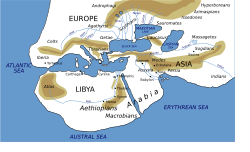
A map constructed from the writings of ancient Greek historian Herodotus.
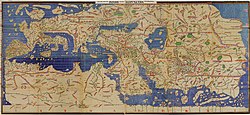
A 12th century map made by geographer Muhammad al-Idrisi. Note this image is flipped upside down, from our point of view.

A 14th century Arabic map depicting the known world.
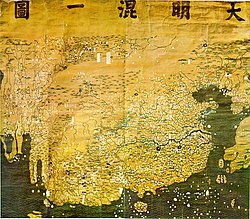
A Chinese map from about 1400 not depicting the Western Hemisphere.
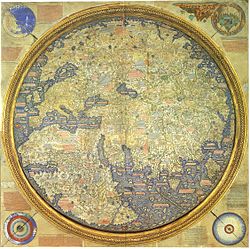
A map from 1459 showing the entire "known" world.
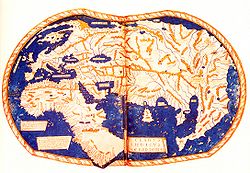
Almost there (1489).

What's that in the distance?
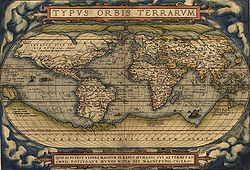
It's finally all coming together.


See also[edit]
External links[edit]
- See the Wikipedia article on Pre-Columbian trans-oceanic contact theories.
References[edit]
- ↑ The Vinland History of the Flat Island Book. Wisconsin Historical Society.
- ↑ "Earliest South American migrants had Indigenous Australian, Melanesian ancestry". www.science.org. Retrieved January 13, 2022.
- ↑ Thompson, Helen. "A DNA Search for the First Americans Links Amazon Groups to Indigenous Australians". Smithsonian Magazine. Retrieved January 13, 2022.
- ↑ Stories About the Ancient Kavdlunait
- ↑ Sabo, Deborah; Sabo, George (1978). A Possible Thule Carving of a Viking from Baffin Island, N.W.T. Canadian Journal of Archaeology / Journal Canadien d’Archéologie(2): 33–42
- ↑ Cummings, Mike. Analysis unlocks secret of the Vinland Map — it’s a fake. YaleNews. September 1, 2021.
- ↑ South Americans may have traveled to Polynesia 800 years ago: DNA suggests people from the Americas had a role in the peopling of Pacific islands by Bruce Bower (July 8, 2020 at 11:00 am) Science News.
- ↑ BATATAS, NOT POTATOES
- ↑ "Genetic relations of South American Indian languages". In Adelaar & Muysken, eds, The Languages of the Andes. Cambridge University Press, 2004. p. 41.
- ↑ Chicken DNA Challenges Theory That Polynesians Beat Europeans to Americas, Roff Smith, National Geographic, March 19, 2014
- ↑ "Evidence of Pre-Columbus Trade Found in Alaska House". livescience.com. Retrieved January 13, 2022.
- ↑ "Old World metals were traded on Alaska coast several hundred years before contact with Europeans". 2016. www.purdue.edu. Retrieved January 13, 2022.
- ↑ Did Marco Polo Go to Alaska?. Medievalists.net. 2014.
- ↑ Unexpected Faces in Ancient America, 1500 B.C.-A.D. 1500:The Historical Testimony of Pre-Columbian Artists by Alexander Von Wuthenau (1975) Crown Publishers. ISBN 0517516578.
- ↑ de Montellano, Bernard Ortiz, et al. They Were NOT Here before Columbus: Afrocentric Hyperdiffusionism in the 1990s. Ethnohistory, vol. 44, no. 2, 1997, pp. 199–234.
- ↑ "NOVA Online | Lost Tribes of Israel | Where are the Ten Lost Tribes? (2)". www.pbs.org. Retrieved 2022-05-09.
- ↑ "The Myth of the Ten Lost Tribes". Museum of the Jewish People. Retrieved 2022-05-09.
- ↑ 18.0 18.1 "Many historians however, remain doubtful. 'If the Phoenicians got to England — which we think they did — I wouldn't be surprised if the boat could get to America physically. But whether they could have done it without running out of food is a different matter,' maritime historian Sam Willis said." Transatlantic crossing: Did Phoenicians beat Columbus by 2000 years?, Sheena McKenzie, CNN, 28 February 2013
- ↑ Did St. Brendan Reach North America 500 Years Before the Vikings?, Andrew Howley, National Geographic, May 16, 2013
- ↑ Oleson, T. J. Saint Brendan, 2003. Accessed May 9, 2022.
- ↑ Voyages described in The Muslim Discovery of America, By Frederick William Dame, pp 59-60
- ↑ Muslims found Americas before Columbus says Turkey's Erdogan. BBC News
- ↑ The Log of Christopher Columbus. "its mountains are beautiful and high, like the Rock of the Lovers (pena de lo senamorados) and one of them has at the summit another little mount like a beautiful mosque."
- ↑ Erdogan says Muslims discovered Americas. 15 Nov 2014
- ↑ Fitzpatrick-Matthews, Keith. The medieval documents. 4 September 2011. Retrieved 022-05-09.
- ↑ "Mandinga Voyages Across the Atlantic" by Harold G. Lawrence, Harold G. Lawrence 8(2): 202-247.
- ↑ Africa's 'greatest explorer', BBC, 13 December, 2000.
- ↑ Levtzion, Nehemia; Hopkins, J. F. P., eds. (2000). Corpus of Early Arabic Sources for West African History. Markus Wiener Publishers. ISBN 978-1-55876-241-1.
- ↑ Barton, Paul A. "The Olmecs: An African Presence in Early America". February 28, 2001. Retrieved 29 January 2022.
- ↑ Haslip‐Viera, Gabriel; de Montellano, Bernard Ortiz; Barbour, Warren (1997-06). "Robbing Native American Cultures: Van Sertima's Afrocentricity and the Olmecs". Current Anthropology. 38 (3): 419–441.
- ↑ The Sinclair Voyage to America, Renaissance Magazine, 1999
- ↑ Oleson, T. J. ZENO, NICOLÒ and ANTONIO. 2003. Accessed May 9, 2022.
- ↑ Fusang, Wikipedia
- ↑ Chinos Llegaron Antes de Colon by Francisco A. Loayza (1948)
- ↑ "Whole websites sprang up devoted to debunking his claims. Scholars called him a fantasist." — Gavin Menzies: mad as a snake - or a visionary?, Daily Telegraph, 1 Aug 2008
- ↑ Claiming the Azores – The Flemish Connection to Newfoundland Crossing the Ocean Sea.
- ↑ Diffie, Bailey Wallys; Shafer, Boyd C.; Winius, George Davison (1977). Foundations of the Portuguese empire, 1415-1580 (2 ed.).
- ↑ See the Wikipedia article on Jean Cousin (navigator).
- ↑ Wintroub, Michael. A savage mirror: power, identity, and knowledge in early modern France. p.21-22.
- ↑ What's up with the "cocaine mummies"?, The Straight Dope, 26 January 2001
- ↑ 41.0 41.1 Ebenesersdóttir, S.S., Sigurðsson, Á., Sánchez-Quinto, F., Lalueza-Fox, C., Stefánsson, K. and Helgason, A. (2011), A new subclade of mtDNA haplogroup C1 found in icelanders: Evidence of pre-columbian contact?. Am. J. Phys. Anthropol., 144: 92-99. https://doi.org/10.1002/ajpa.21419
- ↑ "Who really discovered America?". columbuslandfall.com. Retrieved January 22, 2022.
- ↑ Koch, Alexander, Chris Brierley, Mark M. Maslin, and Simon L. Lewis. "Earth system impacts of the European arrival and Great Dying in the Americas after 1492." Quaternary Science Reviews 207 (2019): 13-36.
- ↑ Crosby, Alfred W. "Virgin soil epidemics as a factor in the aboriginal depopulation in America." The William and Mary Quarterly: A Magazine of Early American History (1976): 289-299.
- ↑ Harper, Kristin N., Molly K. Zuckerman, Megan L. Harper, John D. Kingston, and George J. Armelagos. "The origin and antiquity of syphilis revisited: An Appraisal of Old World pre‐Columbian evidence for treponemal infection." American journal of physical anthropology 146, no. S53 (2011): 99-133.
- ↑ Medieval DNA suggests Columbus didn't trigger syphilis epidemic in Europe: Skeletons provide first DNA evidence that diverse strains of syphilis circulated in Europe before 1492 by Charlotte Hartley (13 Aug 2020) Science.
- ↑ Crosby, Alfred W. The columbian exchange. University of California Press, 2016.
- ↑ Nunn, Nathan, and Nancy Qian. "The Columbian exchange: A history of disease, food, and ideas." Journal of Economic Perspectives 24, no. 2 (2010): 163-88.
Categories: [History] [Native Americans] [Pseudohistory]
↧ Download as ZWI file | Last modified: 11/07/2025 08:11:24 | 26 views
☰ Source: https://rationalwiki.org/wiki/Pre-Columbian_contact_hypotheses | License: CC BY-SA 3.0
 KSF
KSF