April 5, 2022
 From Ballotpedia
Oregon groups ask state supreme court to reconsider campaign finance ballot measures
In a March 22 filing, three Oregon nonprofit groups asked the Oregon Supreme Court to reconsider its decision on a series of campaign finance ballot measures. On March 18, the court rejected the groups’ request to overturn Secretary of State Shemia Fagan’s (D) decision barring the initiatives from appearing on the general election ballot. If the court rejects the groups’ request, the petitioners would have to start the initiative process over.
Background
Honest Elections Oregon, Portland Forward, and the League of Women Voters Oregon filed three versions of the Oregon Campaign Finance Contribution Limits Initiative on Dec. 6, 2021. The initiatives would limit campaign contributions from individuals, multicandidate committees, political parties, legislative caucus committees, and membership organizations (e.g. unions). Groups would have to disclose the identity of every donor who contributed more than $5,000 in all political advertisements and communications and would also have to identify the people or entities who paid for them. One of the three initiatives would also establish a public campaign financing system where private contributions would be matched with public funds.
On Feb. 9, Oregon Attorney General Ellen Rosenblum (D) certified the language of the three ballot initiatives. The certification came a day after Fagan rejected the measures, saying they did not include the entire text of the legislation they would modify. Rosenblum’s decision did not undo Fagan’s decision, but it allowed the initiative sponsors to challenge the ruling before the state supreme court without having to start over with new language.
Oregon Supreme Court ruling
In its March 18 opinion, the Oregon Supreme Court refused to overturn Fagan’s decision. “This is not a case in which exceptional circumstances persuade us that the issue that [the petition backers] raise is so novel and significant, and that immediate resolution is so imperative, that we should exercise our discretionary mandamus jurisdiction on an expedited basis.” The justices also said the measures’ supporters “could have begun the initiative process earlier, so that, if the secretary identified deficiencies, [the groups] could have taken timely steps to contest or cure them within the same election cycle.”
Fagan said of the ruling: “Whether by legislators or through the public initiative process, making law takes time, and the Constitution sets the rule of law,” adding, “[t]here are no shortcuts.” Honest Elections Oregon co-founder Jason Kafoury said, “It’s a sad day for our local democracy. It means millionaires, and billionaires will continue to write six- and seven-figure checks, but hopefully we’ll get this fixed in the next couple of years.” Portland Forward President James Ofsink said, “Secretary Fagan’s interpretation of the Oregon Constitution denies Oregonians their only chance this year to vote on getting big money out of Oregon politics. Moving the bar also creates a high degree of uncertainty for future initiative petitioners.”
What comes next
The justices gave the petitioners the option to file a request for reconsideration, which they did on March 22. In the filing, the groups said, “Future initiative proponents have no guidance as to what form of drafting the ‘full text’ requirement demands. Such uncertainty chills the speech of all those who wish to participate.” If the court reverses its decision, the groups would have to gather 112,020 valid signatures by July 8 in order for the state to certify the initiatives for the November ballot. Otherwise, the petitioners would need to start the initiative process over. Kafoury said if the groups are unable to “move forward with ballot title challenges at the Supreme Court, then we’re toast.”
Senate Majority Leader Rob Wagner (D) said if the measures do not move forward, he would work towards passing campaign finance legislation in the legislature. “I think it’s absolutely legislators’ responsibility to get this done and to send something out to the voters. We’ll see what happens this election cycle but we can’t give up on this. The voters are really clear that they expect reform,” Wagner said. House Speaker Dan Rayfield (D) said, “When we got that news [the measures were rejected] midway through the session, there was no way to really formulate the type of momentum that you need, and thread the needle on a topic that frankly, all 90 members have a different opinion of what that should look like. We’ve been trying to do that for years to try and get that done.”
Between 2010 and 2020, the average ballot initiative certification rate in Oregon was 8.3%. Between 1985 and 2020, 148 initiatives made the ballot and 35.8% were approved.
About the Oregon Supreme Court
In 2020, Ballotpedia published a study on how state supreme court justices decided the cases that came before them. The Oregon Supreme Court decided 88.7% of all cases it decided in 2020 in unanimous rulings, according to our 2020 study Ballotpedia Courts: Determiners and Dissenters. Ballotpedia Courts: State Partisanship, also published in 2020, studied the partisan affiliation of state supreme court justices. It found that the Oregon Supreme Court included four Mild Democrat justices and three Strong Democrat justices.
What we’ve been reading
- The City, “State Board of Elections Begins Enforcing Campaign Finance Disclosure Laws, March 14, 2022
- The Independent, “Cowboys for Trump co-founder charged with campaign violation,” March 19, 2022
- Maine Beacon, “Local campaign finance transparency bill faces hurdles over $1 million technology cost,” March 23, 2022
The big picture
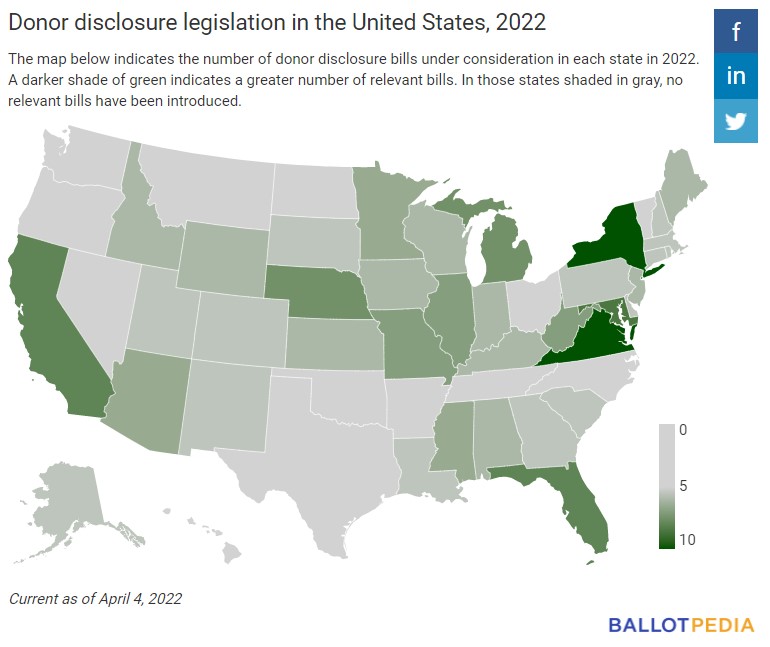
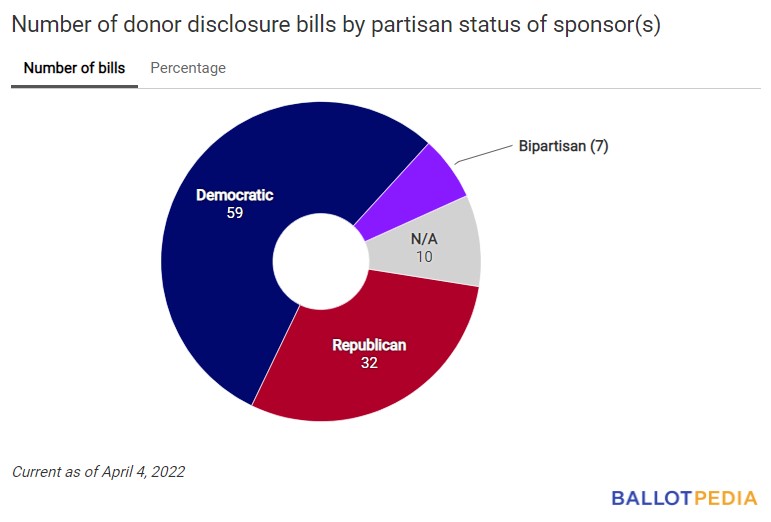
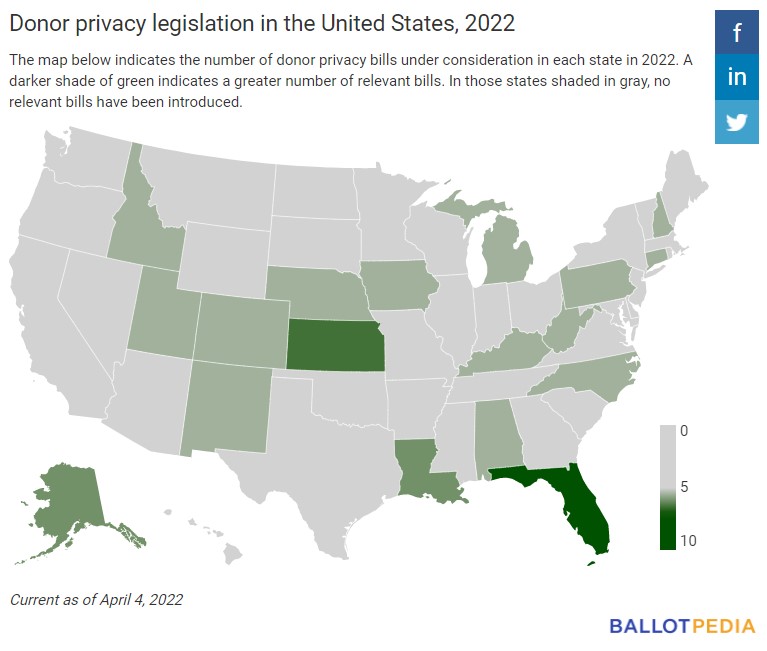
Number of relevant bills by state: We're currently tracking 133 pieces of legislation dealing with donor disclosure and privacy. Of these bills, 108 are primarily focused on disclosure, and 25 are primarily focused on privacy. To reflect this distinction, the charts in this section and the recent legislative actions below are divided between disclosure legislation and privacy legislation. On the maps below, a darker shade of green indicates a greater number of relevant bills. Click here for a complete list of all the bills we're tracking.
Donor disclosure legislation
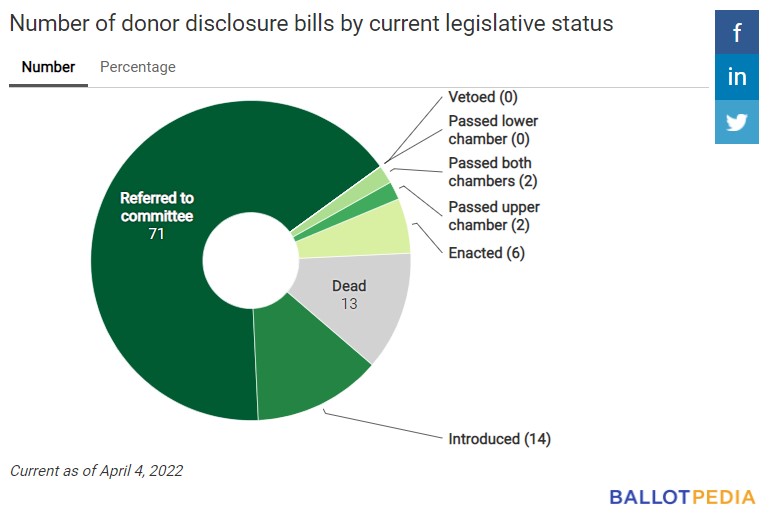
Number of relevant bills by current legislative status:
Number of relevant bills by partisan status of sponsor(s):
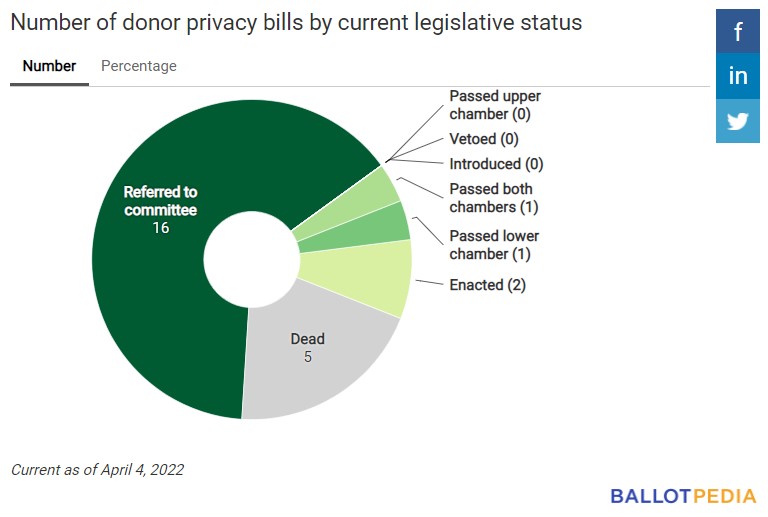
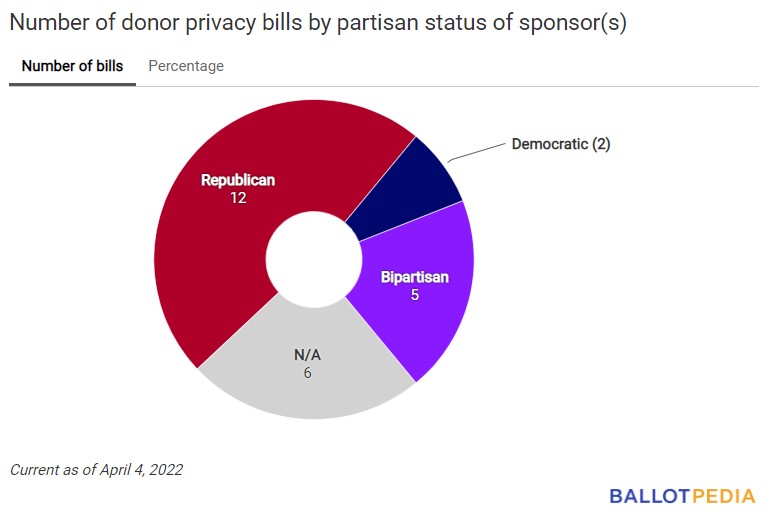
Donor privacy legislation
Number of relevant bills by current legislative status:
Number of relevant bills by partisan status of sponsor(s):
Recent legislative actions
For complete information on all of the bills we are tracking, click here.
Donor disclosure legislation
- California SB1360: This bill would require certain political advertisements to identify the top contributors to the campaign committee paying for the advertisement with no minimum contribution threshold.
- Democratic sponsorship
- This bill was referred to committee on March 31.
- California SB1439: This bill would require parties in a license, permit, or other entitlement proceeding to disclose donations of more than $250 made within a year of a decision. It would also require parties in these proceedings to disclose any planned contributions in the year after a decision.
- Democratic sponsorship
- This bill was referred to committee on March 28.
- Connecticut SB00431: This bill would require committees to report referendum spending as an independent expenditure. It would also require committees to disclose donors for certain types of referendum spending.
- Democratic sponsorship
- This bill was referred to committee on March 29.
- Delaware HB366: This bill would require political committees' contribution and expense report, provided to the Department of Elections, to include the primary employer and job title of each person contributing to the committee.
- Democratic sponsorship
- This bill was referred to committee on March 31.
- Kentucky HB740: This bill would require a candidate exempt from filing a campaign finance report to file a 30 day post-election report of receipts and disbursements. It would also require a candidate who is exempt from filing for the primary who advances to the regular election to refile for the filing exemption.
- Republican sponsorship
- This bill was referred to committee on March 30.
- Maine LD1754: This bill would exempt political action and ballot question committees already registered with the commission from filing the major contributor report. It would also clarify the enforcement provisions regarding potential violations and the factors the commission must consider for each potential violation.
- Democratic sponsorship
- This bill was enacted on March 29.
- Maine LD1782: This bill would prohibit a ballot question committee from making contributions to a candidate or political action committee if the contributed funds are derived from a business.
- Democratic sponsorship
- This bill passed the upper chamber on March 31.
- New Hampshire SB348: This bill would prohibit contributions made on behalf of another individual, from a labor union or affiliate of a labor union, or from an anonymous source. It would also establish maximum limits on contributions made by any single individual or entity.
- Republican sponsorship
- This bill was referred to committee on April 1.
Donor privacy legislation
- Colorado HB1156: This bill would exempt candidates from having to file an annual personal disclosure statement if they file their personal disclosure statement within 180 days of Jan. 10.
- Bipartisan sponsorship
- This bill was referred to committee on March 29.
- Connecticut HB05222: This bill would repeal the requirement for paid solicitors to submit the text of planned solicitations and remove the ability of the Department of Consumer Protection to inspect contribution records upon request.
- Unknown sponsorship
- This bill was referred to committee on March 30.
- Kansas HB2495: This bill would prohibit a state agency from requesting or releasing the personal information of donors to 501(c) organizations.
- Unknown sponsorship
- This bill passed the lower chamber on March 29.
- Kentucky HB241: This bill would allow the Transportation Cabinet and the Energy and Environment Cabinet to receive, accept, and solicit contributions from a governmental agency, individual, nonprofit organization, or private business for the Adopt-a- Highway Litter Program or other statewide litter programs. These contributions would be treated as restricted funds and would not be subject to state disclosure restrictions.
- Republican sponsorship
- This bill passed both chambers on March 30.
- West Virginia HB4419: This bill would remove restrictions on candidate and campaign caucus committees' donations to their affiliated state party executive committees or a caucus campaign committee.
- Republican sponsorship
- This bill was enacted on March 30.
Categories: [Donor disclosure tracking] [The Disclosure Digest - 2022] [On-site_newsletters]
↧ Download as ZWI file | Last modified: 03/07/2026 21:49:09 | 2 views
☰ Source: https://ballotpedia.org/The_Disclosure_Digest:_April_5,_2022 | License: CC BY-SA 3.0
 KSF
KSF