Hejaz
 From Handwiki
 Hejaz ٱلْحِجَاز Al-Ḥijāz | |
|---|---|
Region | |
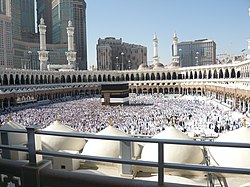 Islam's holiest site, that is Al-Masjid al-Haram, which surrounds the Kaaba (middle), in Mecca. Mecca is the city of Muhammad's birth and ancestry, and an annual point of pilgrimage for millions of Muslims. | |
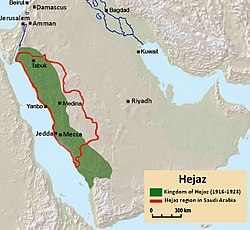 Map of the Hejaz showing the cities of Mecca, Medina, Jeddah, Yanbu and Tabuk. The Saudi region is outlined in red and the 1923 Kingdom is in green. | |
| Coordinates: [ ⚑ ] 23°N 40°E / 23°N 40°E | |
| Country |  Saudi Arabia Saudi Arabia |
| Regions | Al-Bahah, Mecca, Medina, Tabuk |
The Hejaz (/hiːˈdʒæz, hɪˈ-/, also US: /hɛˈ-/; Arabic: ٱلْحِجَاز, acw) is a region that includes the majority of the west coast of Saudi Arabia, covering the cities of Mecca, Medina, Jeddah, Tabuk, Yanbu, Taif and Baljurashi. It is thus known as the "Western Province",[1] and it is bordered in the west by the Red Sea, in the north by Jordan, in the east by the Najd, and in the south by the Region of 'Asir.[2] Its largest city is Jeddah, which is the second-largest city in Saudi Arabia, with Mecca and Medina, respectively, being the fourth- and fifth-largest cities in the country.[3]
As the location of the cities of Mecca[4] and Medina,[5][6][7] respectively the first and second holiest sites in Islam, the Hejaz is significant in the Arabo-Islamic historical and political landscape. This region is the most populated in Saudi Arabia,[8] and Arabic is the predominant language, as in the rest of Saudi Arabia, with Hejazi Arabic being the most widely spoken dialect here. Some Hejazis are of ethnically diverse origins,[3] although the vast majority are of Arab origin.[9]
According to Islamic tradition, this region is the birthplace of the Islamic prophet Muhammad, who was born in Mecca, which is locally considered to have been founded by his ancestors Abraham, Ishmael, and Hagar.[10][11] The area became part of his empire through the early Muslim conquests, and it formed part of successive caliphates, first the Rashidun Caliphate, followed by the Umayyad Caliphate, and finally the Abbasid Caliphate. The Ottoman Empire held partial control over the area; after its dissolution, an independent Kingdom of Hejaz existed briefly in 1925 before being conquered by the neighbouring Sultanate of Nejd, creating the Kingdom of Hejaz and Nejd.[12] In September 1932, the Kingdom of Hejaz and Nejd joined the Saudi dominions of Al-Hasa and Qatif, creating the unified Kingdom of Saudi Arabia.[13][14]
Etymology
The name of the region is derived from a verb ḥajaza (حَجَز), from the Arabic root ḥ-j-z (ح-ج-ز), meaning "to separate",[15] and it is so called as it separates the land of the Najd in the east from the land of Tihāmah in the west.
History
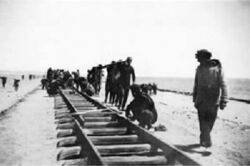
Prehistoric and ancient times
.jpg)
One or possibly two megalithic dolmen have been found in Hejaz.[16]
The Hejaz includes both the Mahd adh-Dhahab ("Cradle of the Gold") ( [ ⚑ ] 23°30′13″N 40°51′35″E / 23.50361°N 40.85972°E) and a water source, now dried out, that used to flow 600 miles (970 km) north east to the Persian Gulf via the Wādi Al-Rummah and Wādi Al-Bātin system. Archaeological research led by of Boston University and the University of Qassim indicates that the river system was active in 2500–3000 BCE.[17]
According to Al-Masudi the northern part of Hejaz was a dependency of ancient Israel ,[18] and according to Butrus al-Bustani the Jews in Hejaz established a sovereign state.[19] The German orientalist Ferdinand Wüstenfeld believed that the Jews established a state in northern Hejaz.[20]
The Midianites of the Bible lived in Hejaz.[21]
Era of Abraham and Ishmael
According to Arab and Islamic sources, the civilization of Mecca started after Ibrāhīm (Abraham) brought his son Ismāʿīl (Ishmael) and wife Hājar (Hagar) here, for the latter two to stay. The Adnanites were a tribal confederation of the Ishmaelite Arabs, who trace their lineage back to Ishmael son of the Islamic prophet and patriarch Abraham and his wife Hagar through Adnan, who originate from the Hejaz. [22] Some people from the Yemeni tribe of Jurhum settled with them, and Isma'il reportedly married two women, one after divorcing another, at least one of them from this tribe, and helped his father to construct or re-construct the Ka'bah ('Cube'),[23][24][25] which would have social, religious, political and historical implications for the site and region.[10][11]
For example, in Arab or Islamic belief, the tribe of Quraysh would descend from Isma'il ibn Ibrahim, be based in the vicinity of the Ka'bah,[26] and include Muhammad ibn Abdullah ibn Abdul-Muttalib ibn Hashim ibn Abd Manaf. From the Period of Jāhiliyyah ('Ignorance') to the days of Muhammad, the often-warring Arab tribes would cease their hostilities during the time of Pilgrimage, and go on pilgrimage to Mecca, as inspired by Ibrahim.[25] It was during such an occasion that Muhammad met some Madanis who would allow him to migrate to Medina, to escape persecution by his opponents in Mecca.[27][28][29][30][31][32]
Era of Saleh
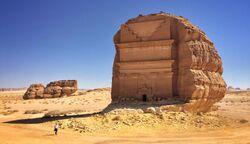
Saudi Arabia's and Hejaz's first World Heritage Site that was recognized by the United Nations Educational, Scientific and Cultural Organization is that of Al-Hijr. The name Al-Ḥijr ("The Land of Stones" or "The Rocky Place") occurs in the Qur'an,[33] and the site is known for having structures carved into rocks, similar to Petra.[34][35] Construction of the structures is credited to the people of Thamud. The location is also called Madāʾin Ṣāliḥ ("Cities of Saleh"),[36][37][38][39][40][41] as it is speculated to be the city in which the Islamic prophet Saleh was sent to the people of Thamud. After the disappearance of Thamud from Mada'in Saleh, it came under the influence of other people, such as the Nabataeans, whose capital was Petra. Later, it would lie in a route used by Muslim Pilgrims going to Mecca.[42][43][44][45]
Era of Muhammad
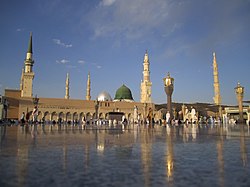
As the land of Mecca[4] and Medina,[5][6][7] the Hejaz was where Muhammad was born, and where he founded a Monotheistic Ummah of followers, bore patience with his foes or struggled against them, migrated from one place to another, preached or implemented his beliefs, lived and died. Given that he had both followers and enemies here, a number of battles or expeditions were carried out in this area, like those of Al-Aḥzāb ("The Confederates"), Badr[46] and Ḥunayn. They involved both Makkan companions, such as Hamza ibn Abd al-Muttalib, Ubayda ibn al-Harith and Sa'd ibn Abi Waqqas, and Madani companions.[5][31][32][47][48] The Hejaz fell under Muhammad's influence as he emerged victorious over his opponents, and was thus a part of his empire.[10][27][29][30][49][50][51]
Subsequent history
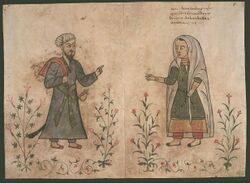
Due to the presence of the two holy cities in the Hejaz, the region was ruled by numerous empires. The Hejaz was at the center of the Rashidun Caliphate, in particular whilst its capital was Medina from 632 to 656 ACE. The region was then under the control of regional powers, such as Egypt and the Ottoman Empire, throughout much of its later history. After the Ottomans lost control of it, Hejaz became an independent state.
Brief independence
After the end of the Ottoman suzerainty and control in Arabia, in 1916, Hussein bin Ali became the leader of an independent State of Hejaz.[52] In 1924, Ali bin Hussein succeeded as the King of Hejaz. Then Ibn Saud succeeded Hussein as the King of Hejaz and Nejd. Ibn Saud ruled the two as separate units, known as the Kingdom of Hejaz and Nejd from 1926 to 1932.
In modern Saudi Arabia
On 23 September 1932, the two kingdoms of the Hejaz and Nejd were united as the Kingdom of Saudi Arabia.[53] This day is commemorated as the Saudi National Day.[54]
Culture
Religion
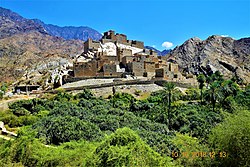
The cultural setting of Hejaz is greatly influenced by that of Islam, especially as it contains its 2 holiest cities, Mecca and Medina. Moreover, the Quran is considered the constitution of Saudi Arabia, and the Sharia is the main legal source. In Saudi Arabia, Islam is not just adhered politically by the government but also it has a great influence on the people's culture and everyday life.[55][56] The society is in general deeply religious, conservative, traditional, and family-oriented. Many attitudes and traditions are centuries-old, derived from Arab civilization and Islamic heritage.
Cuisine
Hejazi cuisine has mostly Arabian dishes like the rest of Saudi Arabia, Some dishes are native to the Hejaz, like Saleeg.[57] Other Dishes were imported from other cultures through Saudis of different origins, like Mantu (منتو), Yaghmush (يَغْمُش) and Ruz Bukhāri (رُز بُخاري) from Central Asia, Burēk (بُريك) and Šurēk شُريك and Kabab almīru (كباب الميرو) from Turkey and the Balkans, Mandi (مَنْدي) and Mutabbag (مُطَبَّق) from Yemen, Biryāni برياني and Kābli (كابلي) rice dishes from South Asia. Grilled meat dishes such as shawarma and kebab are well-known in Hejaz. The Hejazi dishes are known for their spice.
Geography
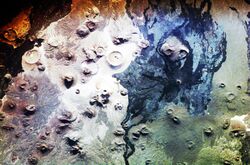
The region is located along the Red Sea Rift. It is also known for its darker, more volcanic sand. Depending on the previous definition, the Hejaz includes some of the mountains of the Sarat range, which topographically separate the Najd from Tehamah. Bdellium plants are also abundant in the Hejaz. Saudi Arabia, and in particular the Hejaz, is home to more than 2000 dormant volcanoes.[58] Lava fields in the Hejaz, known locally by their Arabic name of ḥarrāt (حَرَّات, singular: ḥarrah (حَرَّة)), form one of Earth's largest alkali basalt regions, covering some 180,000 km2 (69,000 sq mi), an area greater than the state of Missouri.[59]
Flags
.svg.png)
Flag of the Rashidun Caliphate (632–661)

Flag of the Umayyad Caliphate (661–750)

Flag of the Abbasid Caliphate (750–1258)

Flag of the Fatimid Caliphate (909–1171)

Flag of the Ayyubid dynasty (1171–1254)

Flag of the Mamluk Sultanate (1254–1517)
.svg.png)
Flag of the Ottoman Empire (1517–1916)
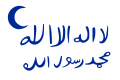
Sheikdom of Upper Asir (1916-1920)

Provisional flag of the Kingdom of Hejaz from 1916 to 1917
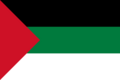
Flag of the Kingdom of Hejaz (1917–1920)
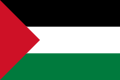
Flag of the Kingdom of Hejaz and the Sharifian Caliphate (1920 to 1926)
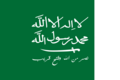
Flag of the Kingdom of Hejaz and Nejd (1926 to 1932)
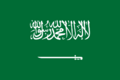
Flag of the Kingdom of Saudi Arabia (1973–present)
Cities
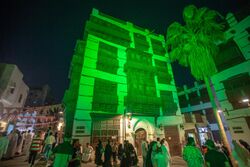
Al Bahah Region:
- Al-Bāḥah[60]
Medina:
- Al-Madīnah Al-Munawwarah (Medina)[2]
- Badr[61]
- Yanbuʿ al-Baḥr (Yanbu)[2]
Mecca Province:
- Aṭ-Ṭāʾif[62]
- Jiddah (Jeddah)[2]
- Makkah (Mecca)[2]
- Rābigh[63][64]
Tabuk Region:
- Tabūk[65]
- Umluj
International touristic development
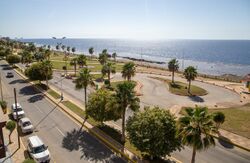
As a component of Saudi Vision 2030, a touristic destination with an area of 28,000 square kilometres (11,000 square miles) is under development,[66] between the towns of Umluj ( [ ⚑ ] 25°3′0″N 37°15′54.36″E / 25.05°N 37.2651°E) and Al-Wajh ( [ ⚑ ] 26°14′11.76″N 36°28′8.04″E / 26.2366°N 36.4689°E), on the coast of the Red Sea. The project will involve "the development of 22 of the 90+ islands"[67] that lie along the coast to create a "fully integrated luxury mixed-use destination",[68] and will be "governed by laws on par with international standards".[69]
Demographics
The Hejaz is the most populated region in Saudi Arabia,[8] containing 35% of the population of Saudi Arabia.[70] Most people of Hejaz are Sunnis with a Shia minority in the cities of Medina, Mecca and Jeddah. Many consider themselves more cosmopolitan because Hejaz was for centuries a part of the great empires of Islam from the Umayyads to the Ottomans.[71] People of Hejaz, who feel particularly connected to the holy places of Mecca and Medina, have probably the most strongly articulated identity of any regional grouping in Saudi Arabia.[72]
Gallery
.jpg)
Mountains near At-Ta'if, 2012
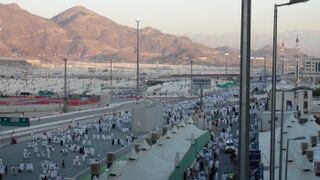
The camp of Mina on the outskirts of Mecca, where Muslim pilgrims gather for the Hajj (Greater Pilgrimage). Masjid Al-Khayf is visible to the right.
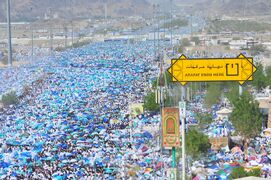
Muslim pilgrims gathering at the plain of Mount Arafat
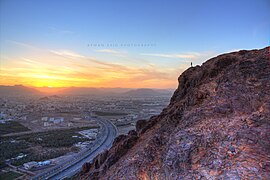
Mount Uhud in the area of Medina
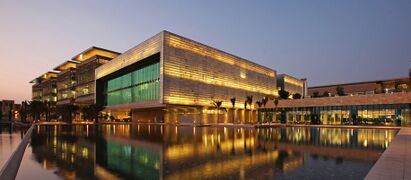
King Abdullah University of Science and Technology (KAUST) campus at night
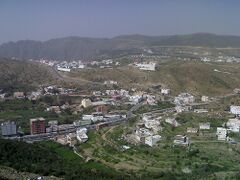
Al-Bahah City, located 2,155 m (7,070 ft) above sea level
Notable Hejazis
- Salih of Thamud[34][lower-alpha 1]
Al-Abwa'
- Musa al-Kazim ibn Jaʿfar al-Sadiq, descendant of Muhammad[73]
Mecca
Pre–6th century CE
- Qusai ibn Kilab ibn Murrah ibn Ka'b ibn Lu'ayy ibn Ghalib ibn Fihr ibn Malik ibn An-Nadr ibn Kinanah[74] ibn Khuzaymah ibn Mudrikah ibn Ilyas ibn Mudar ibn Nizar ibn Ma'ad ibn Adnan the descendant of Isma'il ibn Ibrahim ibn Azar ibn Nahor ibn Serug ibn Reu ibn Peleg ibn Eber ibn Shelakh,[75][76] Chief of the Tribe of Quraysh, and an ancestor of Muhammad[77]
- Qusai's son Abd-al-Dar[78][79] the father of Uthman the father of Abdul-Uzza the father of Barrah the maternal grandmother of Muhammad
- Abd Manaf ibn Qusai, paternal ancestor of Muhammad[80]
- Abdul-Uzza, son of Qusai, and an ancestor of Barrah bint Abdul-Uzza
- Hashim, son of Abd Manaf, paternal great-grandfather of Muhammad, and the progenitor of Banu Hashim in the tribe of Quraysh
- Abdul-Muttalib ibn Hashim, paternal grandfather of Muhammad
- Hubbah bint Hulail ibn Hubshiyyah ibn Salul ibn Kaʿb ibn Amr al-Khuzaʿi, wife of Qusai, and an ancestor of Muhammad
- Atikah bint Murrah ibn Hilal ibn Falij ibn Dhakwan, wife of Abd Manaf, and an ancestor of Muhammad[80]
Since
- Muhammad ibn Abdullah ibn Abdul-Muttalib ibn Hashim[31][32]
- Abu Bakr[31][32] Abdullah ibn Uthman Abu Quhafah ibn Amir ibn Amr ibn Ka'b ibn Sa'd ibn Taym ibn Murrah ibn Ka'b, father-in-law of Muhammad, and Caliph
- Umar[31][32] ibn Al-Khattab ibn Nufayl ibn Abdul-Uzza the descendant of Adi ibn Ka'b ibn Lu'ayy, father-in-law of Muhammad, and Caliph
- Ali ibn Abi Talib,[31][32] cousin and son-in-law of Muhammad, and Caliph
- Hamzah, son of Abdul-Muttalib, and a paternal uncle of Muhammad, and other Muhajirun[5] or Makkan followers of Muhammad, including Ubaydah and Sa'd[31][32][47]
- Abu Talib, son of Abdul-Muttalib,[31][32] chief of Banu Hashim, paternal uncle of Muhammad, and the father of Ali
- Abd al-Muttalib ibn Hashim,[31][32] Chief of Bani Hashim, and the paternal grandfather of Muhammad
- Khadija bint Khuwaylid[81] ibn Asad ibn Abdul-Uzza ibn Qusai, and other Meccan wives of Muhammad
- Fatimah,[81] other daughters of Muhammad, and other Muhajir women
- Umm Ammar Sumayyah bint Khayyat, wife of Yasir ibn Amir ibn Malik al-Ansi, believed to be the first martyr from the followers of Muhammad
- Aminah[31][32][77] bint Wahb ibn Abd Manaf ibn Zuhrah ibn Kilab ibn Murrah, wife of Abdullah, and the mother of Muhammad
Medina
Pre–6th century CE
- Salmah, daughter of Amr, wife of Hashim, and a great-grandmother of Muhammad[80]
Since
- Caliph Al-Hasan,[31][32] and other sons of Ali and grandsons of Muhammad born in Medina[81]
- Caliph Umar ibn Abdul-Aziz ibn Marwan ibn Al-Hakam ibn Abi al-'As ibn Umayyah ibn Abd Shams ibn Abd Manaf ibn Qusai, great-grandson of Umar ibn Al-Khattab
- Al-Hasan of Basra
- Muhammad al-Baqir ibn Ali Zaynul-Abidin, grandson of Hasan and Husayn the grandsons of Muhammad[81]
- Zayd ibn Ali Zaynul-Abidin ibn Husayn ibn Fatimah bint Muhammad, half-brother of Muhammad al-Baqir
- Ansari women[31][32]
- Ja'far al-Sadiq ibn Muhammad al-Baqir[81]
- Malik the son of Anas ibn Malik ibn Abi Amir al-Asbahi (not Anas the companion of Muhammad)
- Ali al-Rida ibn Musa al-Kadhim ibn Ja'far al-Sadiq[81]
- Fatima bint Musa ibn Ja'far al-Maʿsumah of Qum,[82] sister of Ali al-Ridha
- Abu Ali Muhammad al-Jawad ibn Ali al-Ridha[81]
Ta'if
6th–7th centuries CE
- Uthman ibn Affan[31][32] ibn Abu al-'As ibn Umayyah ibn Abd Shams ibn Abd Manaf, son-in-law of Muhammad, and Caliph
- Urwah ibn Mas'ud,[27] chief of Banu Thaqif
- Nafi ibn al-Harith, physician[83]
Since
- Sharif Ali ibn Ajlan ibn Rumaithah ibn Muhammad, son-in-law and successor of Sultan Ahmad of Brunei, father of Sultan Sulaiman, and a descendant of Muhammad[84]
See also
- Al Baydha Project
- Desert of Paran
- Hejaz Vilayet
- Hejazi turban
- Hijazi script
- Midian
- Relationship between the Hijaz, Shaam and Yemen
- Sharifate of Mecca
- History of the Jews in Saudi Arabia
Explanatory notes
- ↑ Quran: 7:73–79;[36] 11:61–69;[37] 26:141–158;[38] 54:23–31;[39] 89:6–13;[40] 91:11–15.[41]
References
- ↑ Mackey, p. 101. "The Western Province, or the Hejaz[...]"
- ↑ 2.0 2.1 2.2 2.3 2.4 Hopkins, Daniel J. (2001). Merriam-Webster's Geographical Dictionary. Merriam-Webster. p. 479. ISBN 0-87779-546-0. https://books.google.com/books?id=Co_VIPIJerIC&pg=PA479. Retrieved 17 March 2013.
- ↑ 3.0 3.1 Leatherdale, Clive (1983). Britain and Saudi Arabia, 1925–1939: The Imperial Oasis. Psychology Press. p. 12. ISBN 9780714632209. https://books.google.com/books?id=Lt0-U4cUj9sC&pg=PA12.
- ↑ 4.0 4.1 Quran 48:22-29
- ↑ 5.0 5.1 5.2 5.3 Quran 9:25-129
- ↑ 6.0 6.1 Quran 33:09-73
- ↑ 7.0 7.1 Quran 63:1-11
- ↑ 8.0 8.1 "Mecca: Islam's cosmopolitan heart". http://www.opendemocracy.net/faith-europe_islam/mecca_3882.jsp. "The Hijaz is the largest, most populated, and most culturally and religiously diverse region of Saudi Arabia, in large part because it was the traditional host area of all the pilgrims to Mecca, many of whom settled and intermarried there."
- ↑ Minahan, James (1996) (in en). Nations Without States: A Historical Dictionary of Contemporary National Movements. Greenwood Press. pp. 229. ISBN 978-0-313-28354-3. https://books.google.com/books?id=2yFnAAAAMAAJ.
- ↑ 10.0 10.1 10.2 Lings, Martin (1983). Muhammad: His Life Based on the Earliest Sources. Islamic Texts Society. ISBN 978-0-946621-33-0.
- ↑ 11.0 11.1 Glassé, Cyril (1991). "Kaaba". The Concise Encyclopedia of Islam. HarperSanFrancisco. ISBN 0-0606-3126-0. https://books.google.com/books?id=dlPuAAAAMAAJ.
- ↑ Yamani, M. (2009), Cradle of Islam: the Hijaz and the quest for an Arabian identity, I.B. Tauris, ISBN 978-1-84511-824-2 (Pbk. ed.)
- ↑ Al-Rasheed, M. A History of Saudi Arabia. Cambridge, England, UK: Cambridge University Press , 2002. [verification needed]
- ↑ A Brief overview of Hejaz - Hejaz history [verification needed]
- ↑ Rutter, Eldon (February 1931). "The Hejaz". The Geographical Journal 77 (2): 97–108. doi:10.2307/1784385.
- ↑ Gajus Scheltema (2008). Megalithic Jordan: an introduction and field guide. ACOR. ISBN 978-9957-8543-3-1. https://books.google.com/books?id=aqUbAQAAMAAJ. Retrieved 5 October 2012.
- ↑ Sullivan, Walter (1993-03-30). "Science Watch; Signs of Ancient River". The New York Times. https://www.nytimes.com/1993/03/30/science/science-watch-signs-of-ancient-river.html.
- ↑ Ibn Khaldun, "Kitāb al-ʻIbar wa-Dīwān al-Mubtadaʼ wa-l-Khabar", Dar Al-Fikr publication. Beirut. 1988. volume 2 page 342
- ↑ al-Bustani, Butrus. "Daerat Al-Maaref". Dar Al-Marifa Publication. Beirut. volume 11 page 672
- ↑ Wolfensohn, Israel. "Tarikh Al-Yahood Fi Belad Al-Arab". Al-Nafezah Publication. Cairo. 2006. page 68
- ↑ Rothenberg, "Egyptian Chariots, Midianites from Hijaz/ Midian (Northwest Arabia) and Amalekites from the Negev in the Timna Mines: Rock drawings in the Ancient Copper Mines of the Arabah – new aspects of the region's history II," Institute for Archaeo-Metallurgical Studies, newsletter no. 23 (2003), p. 12.
- ↑ "Family Tree of Muhammad". 26 December 2018. https://slife.org/family-tree-of-muhammad/.
- ↑ Quran 2:127 -Yusuf Ali
- ↑ Quran 3:96 -Yusuf Ali
- ↑ 25.0 25.1 Quran 22:25-37
- ↑ Quran 106:1-4
- ↑ 27.0 27.1 27.2 Ibn Ishaq, Muhammad (1955). Guillaume, Alfred. ed. Ibn Ishaq's Sirat Rasul Allah – The Life of Muhammad. Oxford: Oxford University Press. pp. 88–589. ISBN 978-0-1963-6033-1. https://archive.org/stream/TheLifeOfMohammedGuillaume/The_Life_Of_Mohammed_Guillaume#page/n67/mode/1up.
- ↑ Karen Armstrong (2002). Islam: A Short History. Random House Publishing. p. 11. ISBN 0-8129-6618-X.
- ↑ 29.0 29.1 Firestone, Reuven (1990). Journeys in Holy Lands: The Evolution of the Abraham-Ishmael Legends in Islamic Exegesis. Albany, New York: State University of New York Press. ISBN 978-0-7914-0331-0. https://books.google.com/books?id=O69zjVnjL10C.
- ↑ 30.0 30.1 al-Tabari (1987). Brinner, William M.. ed. The History of al-Tabari Vol. 2: Prophets and Patriarchs. Albany, NY: State University of NY Press. ISBN 978-0-87395-921-6. https://books.google.com/books?id=BQNtV--kD5sC&pg=frontcover.
- ↑ 31.00 31.01 31.02 31.03 31.04 31.05 31.06 31.07 31.08 31.09 31.10 31.11 31.12 Mubarakpuri, S. R. (2002). "The Compensatory ‘Umrah (Lesser Pilgrimage)". Ar-Raḥīq Al-Makhtūm ("The Sealed Nectar"). Darussalam. pp. 127–47. ISBN 9960-899-55-1. http://www.witness-pioneer.org/vil/Books/SM_tsn/ch6s4.html. Retrieved 2014-10-06.
- ↑ 32.00 32.01 32.02 32.03 32.04 32.05 32.06 32.07 32.08 32.09 32.10 32.11 32.12 Haykal, Husayn (1976), The Life of Muhammad, Islamic Book Trust, pp. 217–18, ISBN 978-983-9154-17-7, https://books.google.com/books?id=fOyO-TSo5nEC
- ↑ Quran 15:80-84
- ↑ 34.0 34.1 Butler, J. W. S.; Schulte-Peevers, A.; Shearer, I. (2010-10-01). Oman, UAE & Arabian Peninsula. Lonely Planet. pp. 316–333. ISBN 9781741791457. https://books.google.com/books?id=D8hmZIAaTGQC&pg=PA316.
- ↑ "Al-Hijr Archaeological Site (Madâin Sâlih)". UNESCO. https://whc.unesco.org/en/list/1293.
- ↑ 36.0 36.1 Quran 7:73-79
- ↑ 37.0 37.1 Quran 11:61-69
- ↑ 38.0 38.1 Quran 26:141-158
- ↑ 39.0 39.1 Quran 54:23-31
- ↑ 40.0 40.1 Quran 89:6-13
- ↑ 41.0 41.1 Quran 91:11-15
- ↑ Kesting, Piney. "Saudi Aramco World (May/June 2001): Well of Good Fortune". http://www.saudiaramcoworld.com/issue/200103/well.of.good.fortune.htm.
- ↑ "ICOMOS Evaluation of Al-Hijr Archaeological Site (Madâin Sâlih) World Heritage Nomination". World Heritage Center. https://whc.unesco.org/archive/advisory_body_evaluation/1293.pdf.
- ↑ "Information at nabataea.net". http://nabataea.net/medain.html.
- ↑ Quran 3:110-128
- ↑ 47.0 47.1 Sahih al-Bukhari, 5:57:74
- ↑ Witness Pioneer "Pre-Badr Missions and Invasions"
- ↑ "Muhammad". Encyclopedia of Islam and the Muslim world.
- ↑ Holt (1977), p. 57
- ↑ Lapidus (2002), pp. 31–32
- ↑ Hourani, Albert (2005). A History of the Arab Peoples. Faber & Faber. pp. 315–319. ISBN 978-0-571-22664-1.
- ↑ "History of Arabia". Encyclopædia Britannica. https://www.britannica.com/EBchecked/topic/31568/history-of-Arabia.
- ↑ "History of Saudi Arabia. ( The Saudi National Day 23, Sep )". https://www.pmu.edu.sa/News/News.aspx?ID=866.
- ↑ "Saudi Arabia – Religion". https://www.britannica.com/place/Saudi-Arabia.
- ↑ "Islam | The Embassy of The Kingdom of Saudi Arabia". https://www.saudiembassy.net/islam.
- ↑ "Saleeg — a Saudi dish that won't let you down" (in en). 2013-09-11. https://www.arabnews.com/news/464223.
- ↑ "The Tourists Guide To The 10 Amazing Volcanoes in Saudi Arabia" (in en). https://insidesaudi.com/the-tourists-guide-to-the-10-amazing-volcanoes-in-saudi-arabia/.
- ↑ "VOLCANIC ARABIA: It started with tremors" (in en). https://archive.aramcoworld.com/issue/200602/volcanic.arabia.htm.
- ↑ "Al-Baha City Profile". The Saudi Network. http://www.the-saudi.net/saudi-arabia/baha/Al Baha City - Saudi Arabia.htm.
- ↑ بـتـصـرف عـن مـجـلـة الأمـانـة الـعـدد عـشـرون شـوال 1419 تـصـدر عـن أمـانـة الـمـديـنـة الـمـنـورة إمـارة مـنـطـقـة الـمـديـنـة الـمـنـورة
- ↑ "Brief about Ta'if City" (in ar). Taif Municipality. http://www.taifcity.gov.sa/pages/نبذة-عن-الطائف-57.aspx.
- ↑ "Rābigh". GeoNames. http://www.geonames.org/103035/rabigh.html.
- ↑ "Al-Juhfah | Hajj & Umrah Planner" (in en-GB). http://hajjumrahplanner.com/al-juhfah/.
- ↑ "Tabouk City Profile, Saudi Arabia" (in en). http://www.the-saudi.net/saudi-arabia/tabouk/Tabouk - Saudi Arabia.htm.
- ↑ "Construction underway on Saudi Red Sea project site". Zawya. 27 February 2019. https://www.zawya.com/mena/en/business/story/Construction_underway_on_Saudi_Red_Sea_project_site-SNG_138916601/.
- ↑ "Red Sea project master plan wins approval". The Saudi Gazette. 17 September 2017. http://saudigazette.com.sa/article/557422.
- ↑ "Hospitality is 'anchor' of Red Sea project". Arab News. 27 January 2019. http://www.arabnews.com/node/1441476/saudi-arabia.
- ↑ "Saudi Arabia to allow women in bikinis at new beach resort". The USA Today. 4 August 2017. https://www.usatoday.com/story/news/2017/08/04/saudi-arabia-allow-women-wear-bikinis-new-beach-resort/538407001/.
- ↑ "Saudi Arabia Population Statistics 2011 (Arabic)". p. 11. http://www.relooney.info/SI_Milken-Arabia/0-Important_14.pdf.
- ↑ Riedel, Bruce (2011). "Brezhnev in the Hejaz". The National Interest 115. http://www.relooney.info/SI_Milken-Arabia/0-Important_14.pdf. Retrieved April 23, 2012.
- ↑ Beranek, Ondrej (January 2009). "Divided We Survive: A Landscape of Fragmentation in Saudi Arabia". Middle East Brief 33: 1–7. https://www.brandeis.edu/crown/publications/meb/MEB33.pdf. Retrieved 29 June 2019.
- ↑ "The Infallibles Taken from Kitab al Irshad By Sheikh al Mufid". al-islam.org. http://www.al-islam.org/masoom/bios/7thimam.html.
- ↑ Maqsood, Ruqaiyyah Waris. "The Prophet's Line Family No 3 – Qusayy, Hubbah, and Banu Nadr to Quraysh". Ruqaiyyah Waris Maqsood Dawah. http://www.ruqaiyyah.karoo.net/articles/prophfamily3.htm.
- ↑ Book of Genesis, Chapters 10, 11, 16, 17, 21 and 25
- ↑ 1 Chronicles, Chapter 1
- ↑ 77.0 77.1 Ibn Hisham. The Life of the Prophet Muhammad. 1. p. 181.
- ↑ "SUNY Press :: History of al-Tabari Vol. 39, The". Archived from the original on September 12, 2006. https://web.archive.org/web/20060912005228/http://www.sunypress.edu/details.asp?id=53377.
- ↑ "Adab of Islam". Masud. http://www.masud.co.uk/ISLAM/nuh/adab_of_islam.htm.
- ↑ 80.0 80.1 80.2 Maqsood, Ruqaiyyah Waris. "The Prophet's Family Line No. 4 – Amr (Hashim), the Founder of the Hashimites". Ruqaiyyah Waris Maqsood Dawah. http://www.ruqaiyyah.karoo.net/articles/prophfamily4.htm.
- ↑ 81.0 81.1 81.2 81.3 81.4 81.5 81.6 Chittick, William C. (1981). A Shi'ite Anthology. SUNY Press. ISBN 978-0-87395-510-2. https://books.google.com/books?id=rMnFZOHkurcC&pg=PA138.
- ↑ Jaffer, Masuma (2003). Lady Fatima Masuma (a) of Qom. Qum, Iran: Jami'at al-Zahra: Islamic Seminary for Women. http://www.al-islam.org/masumaqum/. Retrieved June 5, 2018.
- ↑ Browne, Edward G. (2002), Islamic Medicine, Goodword Books, p. 11, ISBN 81-87570-19-9
- ↑ "Pusat Sejarah Brunei" (in ms). www.history-centre.gov.bn. http://www.history-centre.gov.bn/sultanbrunei.htm.
Further reading
- Mackey, Sandra (2002). The Saudis: Inside the Desert Kingdom (Updated ed.). New York: W. W. Norton and Company. ISBN 0-393-32417-6. PBK, first edition: 1987.
External links
Earth's primary regions | |||||||||||||||||
|---|---|---|---|---|---|---|---|---|---|---|---|---|---|---|---|---|---|
| |||||||||||||||||
 Book
Book Category
 |  |
Categories: [Historical regions]
↧ Download as ZWI file | Last modified: 08/15/2024 20:59:43 | 3 views
☰ Source: https://handwiki.org/wiki/Place:Hejaz | License: CC BY-SA 3.0
 KSF
KSF