Yogi
 From Handwiki
A yogi is a practitioner of Yoga,[1] including a sannyasin or practitioner of meditation in Indian religions.[2] The feminine form, sometimes used in English, is yogini.
Yogi has since the 12th century CE also denoted members of the Nath siddha tradition of Hinduism,[3] and in Hinduism, Buddhism and Jainism, a practitioner of tantra.[4][5] In Hindu mythology, the god Shiva and the goddess Parvati are depicted as an emblematic yogi–yogini pair.[6]
Etymology
| Part of a series on |
| Hinduism |
|---|
 |
|
|

In Classical Sanskrit, the word yogi (Sanskrit: masc Script error: The function "transl" does not exist., योगी; fem Script error: The function "transl" does not exist.) is derived from yogin, which refers to a practitioner of yoga. Yogi is technically male, and yoginī is the term used for female practitioners.[4] The two terms are still used with those meanings today, but the word yogi is also used generically to refer to both male and female practitioners of yoga and related meditative practices belonging to any religion or spiritual method.
The term yogini is also used for divine goddesses and enlightened mothers, all revered as aspects of the mother goddess, Devi.[7]
A yogi should not be confused with someone practicing asceticism and excessive self-mortification.[2]:297
Hinduism
In Hinduism the term yogi refers to an adherent of yoga.[1]
Textual references
The earliest evidence of yogis and their spiritual tradition, states Karel Werner,[8] is found in the Keśin hymn 10.136 of the Rigveda,[note 1] though with the terminology of Rudra who evolved into Shiva worshipped as the lord of Yoga in later Hinduism.[8] The Hindu scripture Rigveda uses words of admiration for the Yogis, whom it refers to as Kesin, and describes them as follows (abridged):[8]
Carrying within oneself fire and poison, heaven and earth, ranging from enthusiasm and creativity to depression and agony, from the heights of spiritual bliss to the heaviness of earth-bound labor. This is true of man in general and the [Vedic] Keśin in particular, but the latter has mastered and transformed these contrary forces and is a visible embodiment of accomplished spirituality. He is said to be light and enlightenment itself. The Keśin does not live a normal life of convention. His hair and beard grow longer, he spends long periods of time in absorption, musing and meditating and therefore he is called "sage" (muni). They wear clothes made of yellow rags fluttering in the wind, or perhaps more likely, they go naked, clad only in the yellow dust of the Indian soil. But their personalities are not bound to earth, for they follow the path of the mysterious wind when the gods enter them. He is someone lost in thoughts: he is miles away.
—Karel Werner (1977), "Yoga and the Ṛg Veda: An Interpretation of the Keśin Hymn"[8]
The term yogin appears in Katyayana Shrauta-sutra and chapter 6 of Maitri Upanishad, where the implied context and meaning is "a follower of the Yoga system, a contemplative saint".[9]
The term sometimes refers to a person who belongs to the Natha tradition.[3] They usually belong to Shaiva tradition, but some Natha belong to the Vaishnava tradition.[10] In both cases, states David Lorenzen, they practice yoga and their principal god tends to be Nirguna, that is a god that is without form and semi-monistic,[10] influenced in the medieval era by the Advaita Vedanta school of Hinduism, Madhyamaka school of Buddhism, as well as Tantra and Yogic practices.[11][12]
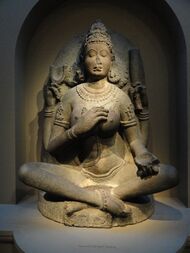
The Yoga-Bhashya (400 CE),[13] the oldest extant commentary on the Yoga-Sutra offers the following fourfold classification of yogis:[14][15]
- Prathama-kalpika (neophyte/beginner, devotional)
- Madhu-bhumika (one who has begun to enjoy the spiritual pursuits without effort)
- Prajna-jyoti (the advanced practitioner who knows spiritual concepts)
- Atikranta- bhavaniya (those who have attained what can be taught, achieved siddhas, and are on their personal path to ultimate insights)
Sexuality
A yogi or yogini aspires to Brahmacharya (Sanskrit: ब्रह्मचर्य), which means celibacy if single, or non-cheating on one's partner.[16][17]
There have been two parallel views, in Hindu texts, on sexuality for a yogi and yogini. One view asserts restraint in sexual activity, towards monk- and nun-like asexuality, as transmutation away from worldly desires and onto a spiritual path.[18] It is not considered, states Stuart Sovatsky, as a form of moralistic repression but a personal choice that empowers the yoga practitioner to redirect his or her energies.[18] The second view, found particularly in Tantra traditions according to David Gordon White, asserts that sexuality is an additional means for a yogi or yogini to journey towards and experience the bliss of "one realized god-consciousness for oneself".[19] In the second view, sexuality is a yogic practice,[20] and one broadly revered through the lingam–yoni iconography of Shiva–Parvati, the divine yogi–yogini in Hindu mythology.[21]
Ethical duties
—Akshaya Banerjea, Philosophy of Gorakhnath[2]
A yogi or yogini lives by other voluntary ethical precepts called Yamas and Niyamas.[22][23] These include:[24][25][26]
- Ahiṃsā (अहिंसा): nonviolence, non-harming other living beings[27]
- Satya (सत्य): truthfulness, non-falsehood[16][27]
- Asteya (अस्तेय): not stealing[27]
- Dayā (दया): kindness, compassion[28]
- Ārjava (आर्जव): non-hypocrisy, sincerity[29]
- Kṣamā (क्षमा): forgiveness[28]
- Dhṛti (धृति): fortitude
- Mitāhāra (मितहार): moderation in diet both in terms of quantity and quality
- Śauca (शौच): purity, cleanliness
- Tapas: austerity, persistence and perseverance in one's purpose[30][31]
- Santoṣa: contentment, acceptance of others and of one's circumstances as they are, optimism for self[32]
- Dāna: generosity, charity, sharing with others[33]
Nath siddha
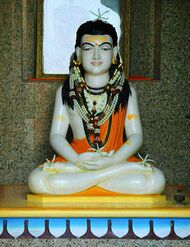
According to David White,
[S]iddha means 'realized, perfected one',[note 2] a term generally applied to a practitioner (sādhaka, sadhu) who has, through his practice (sadhana), realized his dual goal of superhuman powers (siddhis, 'realizations', 'perfections') and bodily immortality (jivanmukti).[35]
Respect
Archeological evidence suggests that in some contexts and regions, yogi of the Nath Siddha tradition were respected and recognized in India. For example, inscriptions suggest a general of the Yadava king Ramacandra donated a village to a yogi in 13th-century.[36] Near Mangalore, that later became a hub of Nath yogis, a monastery and temple was dedicated to yogis in the 10th century.[36]
David Lorenzen states that the Nath yogis have been very popular with the rural population in South Asia, with medieval era "tales and stories about Nath yogis such as Gorakhnath, Matsyendra, Jalandhar, Gopichand, Bharthari, Kanhapa and Chaurangi" continuing to be remembered in contemporary times, in the Deccan, western and northern states of India and in Nepal.[10]
Persecution
In some contexts, adds White, the term yogi has also been a pejorative term used in medieval India for a Nath siddha, particularly on the part of India's social, cultural and religious elites.[3] The term siddha has become a broad sectarian appellation, applying to Saiva-devotees in the Deccan (Maheśvara siddhas), alchemists in Tamil Nadu (siddhars or sittars), a group of early Buddhist tantrikas from Bengal (mahasiddhas, siddhacaryas), the alchemists of medieval India (rasa siddha), and a mainly north Indian group known as the Nath siddhas.[35] The Nath siddhas are the only still existing representatives of the medieval Tantric tradition, which had disappeared due to its excesses.[37] While the Nath siddhas enjoyed persistent popular success, they attracted the scorn of the elite classes.[37]
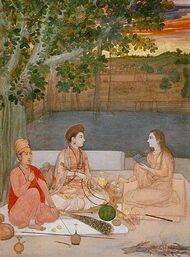
According to White, the term yogi, has "for at least eight hundred years, been an all-purpose term employed to designate those Saiva specialists whom orthodox Hindus have considered suspect, heterodox, and even heretical in their doctrine and practice".[1] The yoga as practiced by these Yogis, states White, is more closely identified in the eyes of those critics with black magic, sorcery and sexual perversions than with yoga in the conventional sense of the word.[39]
The Nath Yogis were targets of Islamic persecution in the Mughal Empire. The texts of Yogi traditions from this period, state Shail Mayaram, refer to oppressions by Mughal officials such as governor. The Mughal documents confirm the existence of Nath Yogis in each pargana (household neighborhoods), and their persecution wherein Nath Yogis were beheaded by Aurangzeb.[40]
Resistance to persecution
According to David Lorenzen, the religious groups in Hinduism that militarized and took up arms following the Muslim conquest of India, to resist persecution, appeared among the Nath or Kanphata yogis, often called simply yogis or jogis.[41]
The warrior ascetics were institutionalized as a religious order by Gorakhnath and were expanding in the 13th century, after the establishment of the first Islamic Sultanate in India. They interacted and cooperated with fakirs of Sufi Muslims.[42] The yogis feature prominently in Delhi Sultanate and Mughal Empire period official documents, states David White, both in terms of impressing the ruling elite in the Muslim administration and awards of receiving land grants in some cases such as by Akbar, as well as those yogis who targeted the elite merchants and disrupted the business of administrative Islamic elites in urban areas.[42][43] In other cases, yogis from the Shaivism, Vaishnavism and Shaktism traditions of Hinduism marshaled armed resistance against the Mughal and British colonial armies.[42][43]
Cultural contributions: founding Hindu temples
The history of Nath yogis has been diverse, such as in the 11th and 12th centuries, when Buddhists in South India converted to Nath siddha traditions and helped establish Shiva Hindu temples and monasteries.[44]
See also
- List of yoga schools
- List of Hindu gurus and sants
- Ngagpa
- Rishi
Notes
- ↑ Sanskrit Original: (Wikisource of the Keśin hymn); Rigveda 10.136, 2nd millennium BCE
- ↑ Compare Siddhartha Gautama, one of the names of Buddha.
References
- ↑ 1.0 1.1 1.2 White 2012, p. 8.
- ↑ 2.0 2.1 2.2 A. K. Banerjea (2014), Philosophy of Gorakhnath with Goraksha-Vacana-Sangraha, Motilal Banarsidass, ISBN:978-8120805347, pp. xxiii, 297–299, 331
- ↑ 3.0 3.1 3.2 White 2012, p. 8-9.
- ↑ 4.0 4.1 Rita Gross (1993), Buddhism After Patriarchy, SUNY Press, ISBN:978-0791414033, pages 85–88
- ↑ David Gordon White (2013), Tantra in Practice, Motilal Banarsidass, ISBN:978-8120817784, pp. xiii–xv
- ↑ Stella Kramrisch (1994), The Presence of Siva, Princeton University Press, ISBN:978-0691019307, pp. 305–309, 356
- ↑ Vidya Dehejia and Thomas B. Coburn (1999), Devi: The Great Goddess, Smithsonian Institution, ISBN:978-3791321295, p. 386
- ↑ 8.0 8.1 8.2 8.3 Werner, Karel (1977). "Yoga and the Ṛg Veda: An Interpretation of the Keśin Hymn (RV 10, 136)". Religious Studies 13 (3): 289–302. doi:10.1017/S0034412500010076. "The Yogis of Vedic times left little evidence of their existence, practices and achievements. And such evidence as has survived in the Vedas is scanty and indirect. Nevertheless, the existence of accomplished Yogis in Vedic times cannot be doubted.".
- ↑ yogin , Monier Williams Sanskrit-English Dictionary (2008 revision), Cologne Digital Sanskrit Lexicon, Germany
- ↑ 10.0 10.1 10.2 David N. Lorenzen and Adrián Muñoz (2012), Yogi Heroes and Poets: Histories and Legends of the Naths, SUNY Press, ISBN:978-1438438900, pp. x–xi
- ↑ David Lorenzen (2004), Religious Movements in South Asia, 600–1800, Oxford University Press, ISBN:978-0195664485, pp. 310–311
- ↑ David N. Lorenzen and Adrián Muñoz (2012), Yogi Heroes and Poets: Histories and Legends of the Naths, SUNY Press, ISBN:978-1438438900, pp. 24–25
- ↑ Rosen 2012, p. 72.
- ↑ Feuerstein 2000, p. 343.
- ↑ SH Aranya (1983), Yoga Philosophy of Patanjali, SUNY Press, ISBN:978-0873957281, pp. 334–337
- ↑ 16.0 16.1 Arti Dhand (2002), "The dharma of ethics, the ethics of dharma: Quizzing the ideals of Hinduism", Journal of Religious Ethics, 30(3), pp. 347–372
- ↑ Yajnavalkya tells Gargi in verse 1.55 of Yoga Yajnavalkya that one who copulates (मैथुन) only with and always with one's sexual partner is a Brahmachari; see "योगयाज्ञवल्क्य १-५५ " (Sanskrit text of "Yoga Yajnavalkya"), SanskritDocuments Archives (2009)
- ↑ 18.0 18.1 Stuart Sovatsky (1987), "The pleasures of celibacy", Yoga Journal, March/April Issue, pp. 41–47
- ↑ White 2012, pp. 1–6.
- ↑ Machelle Seibel and Hari Kaur Khalsa (2002), A Woman's Book of Yoga, Penguin, ISBN:978-1583331378, pp. 108–109
- ↑ Wendy Doniger O'Flaherty (1981), Siva: The Erotic Ascetic, Oxford University Press, ISBN:978-0195202502, pp. 262–263
- ↑ K. N. Aiyar (1914), Thirty Minor Upanishads, Kessinger Publishing, ISBN:978-1164026419, chapter 22, pp. 173–176
- ↑ Lorenzen, David (1972). The Kāpālikas and Kālāmukhas. University of California Press. pp. 186–190. ISBN 978-0520018426. https://archive.org/details/kapalikaskalamuk0000lore/page/186.
- ↑ "योगयाज्ञवल्क्य प्रथमोऽध्याय " (Sanskrit text of "Yoga Yajnavalkya"), SanskritDocuments Archives (2009)
- ↑ Āgāśe, K. S. (1904). Pātañjalayogasūtrāṇi. Puṇe, India: Ānandāśrama. p. 102. https://archive.org/stream/patanjaliyoga/yoga_sutras_three_commentaries#page/n111/mode/2up.
- ↑ Svātmārāma; Sinh, Pancham (1997). The Hatha Yoga Pradipika (5th ed.). Forgotten Books. p. 14. ISBN 9781605066370. https://books.google.com/books?id=9sBFttVx6ukC. "अथ यम-नियमाः अहिंसा सत्यमस्तेयं बरह्यछर्यम कश्हमा धृतिः दयार्जवं मिताहारः शौछम छैव यमा दश १७"
- ↑ 27.0 27.1 27.2 James Lochtefeld, "Yama (2)", The Illustrated Encyclopedia of Hinduism, Vol. 2: N–Z, Rosen Publishing. ISBN:9780823931798, p. 777
- ↑ 28.0 28.1 Stuart Sovatsky (1998), Words from the Soul: Time East/West Spirituality and Psychotherapeutic Narrative, State University of New York, ISBN:978-0791439494, p. 21
- ↑ J Sinha, Indian Psychology, p. 142, at Google Books, Volume 2, Motilal Banarsidas, OCLC 1211693, p. 142
- ↑ W. O. Kaelber (1976). "'Tapas', Birth, and Spiritual Rebirth in the Veda", History of Religions, 15(4), pp. 343–386
- ↑ S. A. Bhagwat (2008), "Yoga and Sustainability". Journal of Yoga, Fall/Winter 2008, 7(1): 1–14
- ↑ N. Tummers (2009), Teaching Yoga for Life, ISBN:978-0736070164, p 16–17
- ↑ William Owen Cole (1991), Moral Issues in Six Religions, Heinemann, ISBN:978-0435302993, pp. 104–105
- ↑ Akshaya Kumar Banerjea (1983). Philosophy of Gorakhnath with Goraksha-Vacana-Sangraha. Motilal Banarsidass. pp. xxi. ISBN 978-81-208-0534-7. https://books.google.com/books?id=Ljn1koKa0CQC.
- ↑ 35.0 35.1 White 2012, p. 2.
- ↑ 36.0 36.1 White 2012, p. 94.
- ↑ 37.0 37.1 White 2012, p. 7.
- ↑ Alf Hiltebeitel; Kathleen M. Erndl (2000). Is the Goddess a Feminist?: The Politics of South Asian Goddesses. New York University Press. pp. 40–41. ISBN 978-0-8147-3619-7. https://books.google.com/books?id=sQJzTr4c-g4C.
- ↑ White 2012, p. 9.
- ↑ Shail Mayaram (2003), Against History, Against State, Columbia University Press, ISBN:978-0231127301, pp. 40–41, 39
- ↑ David Lorenzen (2006), Who Invented Hinduism?, Yoda Press, ISBN:978-8190227261, pp. 51–63
- ↑ 42.0 42.1 42.2 David Gordon White (2011), Sinister Yogis, University of Chicago Press, ISBN:978-0226895147, pp. 198–207
- ↑ 43.0 43.1 William Pinch (2012), Warrior Ascetics and Indian Empires, Cambridge University Press, ISBN:978-1107406377, pp. 4–9, 28–34, 61–65, 150–151, 189–191, 194–207
- ↑ White 2012, pp. 94–101.
Sources
- Feuerstein, Georg (2000), The Shambhala Encyclopedia of Yoga, Shambhala Publications
- Rosen, Richard (2012), Original Yoga: Rediscovering Traditional Practices of Hatha Yoga, Shambhala Publications, ISBN 9780834827400, https://books.google.com/books?id=6ZeOYkgOQTUC&q=Yoga-Bhashya
- White, David Gordon (2012), The Alchemical Body: Siddha Traditions in Medieval India, University of Chicago Press, ISBN 9780226149349, https://books.google.com/books?id=pQuqAAAAQBAJ
External links
Yoga | |||||||||||||||
|---|---|---|---|---|---|---|---|---|---|---|---|---|---|---|---|
| Yoga physiology |
| ||||||||||||||
| Hinduism |
| ||||||||||||||
| Buddhism |
| ||||||||||||||
| Yoga as exercise |
| ||||||||||||||
| |||||||||||||||
 Book
Book Commons
 Wikiquote
 Wikisource texts
 Category
 |  |
Categories: [Asceticism]
↧ Download as ZWI file | Last modified: 04/22/2025 17:17:53 | 9 views
☰ Source: https://handwiki.org/wiki/Philosophy:Yogi | License: CC BY-SA 3.0
 KSF
KSF