Pandora (Moon)
 From Handwiki
  View of Pandora's western hemisphere.[lower-alpha 1] | |
| Discovery | |
|---|---|
| Discovered by | Stewart A. Collins D. Carlson Voyager 1 |
| Discovery date | October, 1980 |
| Designations | |
Designation | Saturn XVII |
| Pronunciation | /pænˈdɔːrə/ |
| Named after | Πανδώρα Pandōra |
| Adjectives | Pandoran[1] |
| Orbital characteristics [2] | |
| Epoch December 31, 2003 (JD 2453005.5) | |
Semi-major axis | 141720±10 km |
| Eccentricity | 0.0042 |
| Orbital period | 0.628504213 d |
| Inclination | 0.050°±0.004° to Saturn's equator |
| Satellite of | Saturn |
| Group | Possible outer shepherd moon of the F Ring |
| Physical characteristics | |
| Dimensions | 103.0 × 79.0 × 63.0 km (± 0.6 × 0.6 × 0.4 km)[3](p2) |
| Mean diameter | 80.0±0.6 km[3](p2) |
| Volume | 268990±860 km3[4](p4) |
| Mass | (1.357±0.002)×1017 kg[lower-alpha 2] |
| Mean density | 0.5045±0.0017 g/cm3[4](p4) |
surface gravity | 0.0022–0.0061 m/s2[3](p3) |
escape velocity | 0.019 km/s at longest axis to 0.024 km/s at poles |
| Rotation period | synchronous |
| Axial tilt | zero |
| Albedo | 0.6 |
| Physics | ≈ 78 K |
Pandora is an inner satellite of Saturn. It was discovered in 1980 from photos taken by the Voyager 1 probe, and was provisionally designated S/1980 S 26.[5] In late 1985 it was officially named after Pandora from Greek mythology.[6] It is also designated Saturn XVII.[7]
Pandora was thought to be an outer shepherd satellite of the F Ring. However, recent studies indicate that it does not play such a role, and that only Prometheus, the inner shepherd, contributes to the confinement of the narrow ring.[8][9] It is more heavily cratered than nearby Prometheus, and has at least two large craters 30 kilometres (19 mi) in diameter. The majority of craters on Pandora are shallow as a result of being filled with debris. Ridges and grooves are also present on moon's surface.[10]
The orbit of Pandora appears to be chaotic, as a consequence of a series of four 118:121 mean-motion resonances with Prometheus.[11] The most appreciable changes in their orbits occur approximately every 6.2 years,[2] when the periapsis of Pandora lines up with the apoapsis of Prometheus and the moons approach to within about 1,400 kilometres (870 mi). Pandora also has a 3:2 mean-motion resonance with Mimas.[2]
From its very low density and relatively high albedo, it seems likely that Pandora is a very porous icy body. There is much uncertainty in these values, however, so this remains to be confirmed.
Gallery
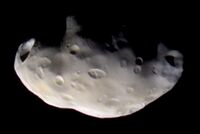
View of the moon, taken during Cassini's September 2005 flyby.
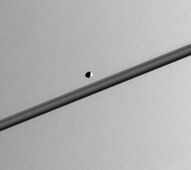
Pandora as seen from the Cassini probe in 2005; the rings of Saturn are in the background.
_PIA_12690.png)
Cassini captured this close view of Saturn's moon Pandora during the spacecraft's flyby on June 3, 2010.
Voyager 2 image of Pandora (August 1981).
References
Notes
- ↑ This view was taken by Cassini, during the spacecraft's close flyby on December 18, 2016. The image was taken from a distance of 40,500 kilometres (25,200 miles); the closest approach by the spacecraft during its 14-year tenure in the Saturn system.
- ↑ Calculated from the standard gravitational parameter GM = (9.058±0.011)×10−3 km3·s–2 given by Lainey et al. (2023), divided by the gravitational constant G = 6.6743×10⁻² km3·kg–1·s–2.[4]
Citations
- ↑ Robert Kolvoord (1990) Saturn's F ring: imaging and simulation, p. 104
- ↑ 2.0 2.1 2.2 Spitale Jacobson et al. 2006.
- ↑ 3.0 3.1 3.2 Thomas & Helfenstein 2020.
- ↑ 4.0 4.1 4.2 Lainey et al. 2023.
- ↑ IAUC 3532.
- ↑ IAUC 4157.
- ↑ USGS: Planet and Satellite Names and Discoverers.
- ↑ "On the masses and motions of mini-moons: Pandora's not a "shepherd," but Prometheus still is". Planetary Society. 2014-07-05. http://www.planetary.org/blogs/emily-lakdawalla/2014/07010001-ringmoons-shepherds.html.
- ↑ Cuzzi, J. N.; Whizin, A. D.; Hogan, R. C.; Dobrovolskis, A. R.; Dones, L.; Showalter, M. R.; Colwell, J. E.; Scargle, J. D. (April 2014). "Saturn's F Ring core: Calm in the midst of chaos". Icarus 232: 157–175. doi:10.1016/j.icarus.2013.12.027. ISSN 0019-1035. Bibcode: 2014Icar..232..157C.
- ↑ Solar System, NASA: Pandora.
- ↑ Renner et al. 2005.
Sources
- Marsden, Brian G. (October 31, 1980). "Satellites of Saturn" (discovery). IAU Circular 3532. http://www.cbat.eps.harvard.edu/iauc/03500/03532.html. Retrieved 2011-12-29.
- Marsden, Brian G. (January 3, 1986). "Satellites of Saturn and Pluto" (naming the moon). IAU Circular 4157. http://www.cbat.eps.harvard.edu/iauc/04100/04157.html. Retrieved 2011-12-29.
- Renner, Stéfan F.; Sicardy, Bruno; French, Richard G. (March 2005). "Prometheus and Pandora: Masses and orbital positions during the Cassini tour". Icarus 174 (1): 230–240. doi:10.1016/j.icarus.2004.09.005. Bibcode: 2005Icar..174..230R.
- "Saturn: Moons: Pandora". Solar System Exploration: Planets. NASA. 4 Apr 2011. http://solarsystem.nasa.gov/planets/profile.cfm?Object=Sat_Pandora.
- Spitale, J. N.; Jacobson, R. A.; Porco, C. C.; Owen, W. M. Jr. (2006). "The orbits of Saturn's small satellites derived from combined historic and Cassini imaging observations". The Astronomical Journal 132 (2): 692–710. doi:10.1086/505206. Bibcode: 2006AJ....132..692S.
- Thomas, P. C. (July 2010). "Sizes, shapes, and derived properties of the saturnian satellites after the Cassini nominal mission". Icarus 208 (1): 395–401. doi:10.1016/j.icarus.2010.01.025. Bibcode: 2010Icar..208..395T. http://www.ciclops.org/media/sp/2011/6794_16344_0.pdf.
- USGS/IAU (July 21, 2006). "Planet and Satellite Names and Discoverers". Gazetteer of Planetary Nomenclature. USGS Astrogeology. http://planetarynames.wr.usgs.gov/Page/Planets#SaturnianSystem.
- Thomas, P. C.; Helfenstein, P. (July 2020). "The small inner satellites of Saturn: Shapes, structures and some implications". Icarus 344: 20. doi:10.1016/j.icarus.2019.06.016. 113355. Bibcode: 2020Icar..34413355T.
- Lainey, V.; Rambaux, N.; Cooper, N.; Dahoumane, R.; Zhang, Q. (February 2023). "Characterising the interior of five inner Saturnian moons using Cassini ISS data". Astronomy & Astrophysics 670: 6. doi:10.1051/0004-6361/202244757. L25. Bibcode: 2023A&A...670L..25L.
External links
- Pandora at NASA's Solar System Exploration
- Pandora at The Planetary Society
Saturn | ||
|---|---|---|
| ||
| Geography |
| .jpg) |
| Moons |
| |
| Astronomy |
| |
| Exploration |
| |
| Related |
| |
 |  |
Categories: [Moons of Saturn]
↧ Download as ZWI file | Last modified: 08/13/2024 06:39:08 | 7 views
☰ Source: https://handwiki.org/wiki/Astronomy:Pandora_(moon) | License: CC BY-SA 3.0
 KSF
KSF