Mutual Liberty
 From Handwiki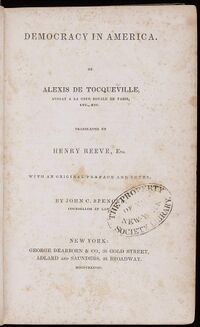
Cover of the book Democracy in America, in which the concept was introduced.
Mutual liberty is an idea first developed by Alexis de Tocqueville in his 1835 work Democracy in America.[1] He referred to the general nature of United States society during the 19th century. It appeared to him, on the surface, that every citizen had the opportunity to participate in the country's civic activities.
John Stuart Mill expanded the notion. He posited that the most proper occasion for mutual liberty was in a community governed by the consent of the governed and argued that only in a republic may members of all political factions participate.[2]
References
- ↑ Alexis de Tocqueville, Democracy in America (New York: Bantam Books, 2000), 9–15.
- ↑ John Stuart Mill, On Liberty and Utilitarianism (New York: Bantam Books, 1993), 12–16.
External links
- John Stuart Mill in the Stanford Encyclopedia of Philosophy
- In Search of Tocqueville's Democracy in America, information and resources about Alexis de Tocqueville.
 |  |
Categories: [Liberalism] [Philosophy of law] [Social concepts] [Free will]
↧ Download as ZWI file | Last modified: 07/29/2024 10:32:21 | 12 views
☰ Source: https://handwiki.org/wiki/Philosophy:Mutual_liberty | License: CC BY-SA 3.0
✘
ZWI is not signed. [what is this?]
ZWI viewer
by the  KSF
KSF
KSF