Amaya (Web Editor)
 From Handwiki
 | |
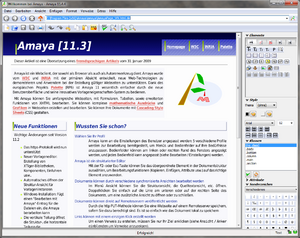 Amaya 11.3 under Windows 7 | |
| Developer(s) | W3C, INRIA |
|---|---|
| Initial release | July 1996[1] |
| Final release | 11.4.4 (January 18, 2012) [±] |
| Written in | C |
| Operating system | Windows, OS X, Linux |
| Platform | IA-32, x86-64 |
| Available in | English, French, German, Spanish, Italian, Hungarian, Georgian, Norwegian, Portuguese, Russian, Japanese, Chinese, Finnish, Dutch, Slovak, Ukrainian[2][3] |
| Type | HTML editor, web browser |
| License | W3C |
| Website | www |
Amaya (formerly Amaya World)[4] is a discontinued free and open source WYSIWYG web authoring tool[5] with browsing abilities.
It was created by a structured editor project at the INRIA, a French national research institution, and later adopted by the World Wide Web Consortium (W3C) as their testbed for web standards;[6] a role it took over from the Arena web browser.[7][8][9] Since the last release in January 2012, INRIA and the W3C have stopped supporting the project and active development has ceased.[10][11]
Amaya has relatively low system requirements, even in comparison with other web browsers from the era of its active development period, so it has been considered a "lightweight" browser.[12]
History
Amaya originated as a direct descendant of the Grif WYSIWYG[13] SGML editor created in the early 1980s,[14] and of the HTML editor Symposia, itself based on Grif, both developed and sold by French software company Grif SA.
The last change of code of Amaya was on 22 Feb 2013.[15]
Features
- Access keys
- Caret navigation
- Page zooming
- Password management
- Spell checking
- Transport protocols
- Support for CSS, MathML, SVG, RDF and Xpointer
- Displays free and open image formats such as PNG and SVG, as well as a subset of SVG animation
A test bed application
It was used as a test-bed for new web technologies that were not supported in major browsers.[12][16]
Amaya was the first client that supported the RDF annotation schema using XPointer.[17][18][19][20] The browser was available for Linux,[21] Windows (NT and 95),[21] Mac OS X, AmigaOS, SPARC / Solaris,[21] AIX,[21] OSF/1.[21]
Naming and logo

Amaya was formerly called Tamaya.[22] Tamaya is the name of the type of tree represented in the logo, but it was later discovered that Tamaya is also a trademark used by a French company, so the developers chose to drop the first letter to make it "Amaya".[23]
See also
- Arena (web browser)
- Libwww
- Web design program
References
- ↑ "About Thot". INRIA. http://opera.inrialpes.fr/Thot/AboutThot.html.
- ↑ Vatton, Irène (9 December 2009). "Amaya Binary Releases". World Wide Web Consortium. http://www.w3.org/Amaya/User/BinDist.html.
- ↑ "Amaya Frequently Asked Questions Section I.7. Can I change the dialogue language?". World Wide Web Consortium. https://www.w3.org/Amaya/User/FAQ.html#1.8..
- ↑ "Internet Browsers". 24 March 2009. http://www.harrold.org/rfhextra/browsers.html.
- ↑ Dubie, Bill; Sciuto, Dave (30 November 2006). "Amaya a win for Web coding". Seacoast online. http://archive.seacoastonline.com/news/11302006/business-b-11.30_shareware.html.
- ↑ "History of the Web". Oxford Brookes University. 2002. http://www.w3c.rl.ac.uk/primers/history/origins.htm.
- ↑ Lafon, Yves; Lie, Håkon Wium (15 June 1996). "Welcome to Arena". World Wide Web Consortium. https://www.w3.org/Arena/Status.html.
- ↑ Bowers, Neil. Weblint: Just Another Perl Hack.
- ↑ Bos, Bert; Lie, Håkon Wium (April 1997). Cascading style sheets: designing for the Web. Addison Wesley Longman. p. 263. ISBN 9780201419986. https://archive.org/details/cascadingstylesh00lieh. Retrieved 9 June 2010.
- ↑ Laurent Carcone (9 April 2013). "Re: When will the next release be posted?". https://lists.w3.org/Archives/Public/www-amaya/2013AprJun/0003.html.
- ↑ "Welcome to Amaya". W3C. https://www.w3.org/Amaya/Overview.html. "The application was jointly developed by W3C and the WAM project (Web, Adaptation and Multimedia) at INRIA. It is no more developed."
- ↑ 12.0 12.1 Klimkiewicz, Kamil (18 January 2003). "Lightweight Web Browsers". freshmeat. http://freshmeat.net/articles/view/695/#Amaya.
- ↑ Quint, Antoine (21 November 2001). "SVG: Where Are We Now?". XML.com. http://www.xml.com/pub/a/2001/11/21/svgtools.html.
- ↑ "W3C Alumni". World Wide Web Consortium. 11 June 2010. https://www.w3.org/People/Alumni.html.
- ↑ move write password call
- ↑ Vincent Quint; Irène Vatton (20 February 1997). "An Introduction to Amaya". World Wide Web Consortium. http://www.w3.org/TR/NOTE-amaya.
- ↑ Dumbill, Edd (9 May 2001). "Reports from WWW10". XML.com. http://www.xml.com/pub/a/2001/05/09/www10/index.html.
- ↑ "Annotea Project". World Wide Web Consortium. 2 March 2001. http://annotest.w3.org/.
- ↑ Dodds, Leigh (13 November 2000). "Annotate the Web with Amaya and RDF". XMLhack. http://www.xmlhack.com/read.php?item=888.
- ↑ "W3C Annotea Project Supports Collaboration on the Web.". Coverpages. 9 March 2001. http://xml.coverpages.org/ni2001-03-09-c.html.
- ↑ 21.0 21.1 21.2 21.3 21.4 Evans, Peter (7 September 2003). "Optimized for no one, but pretty much OK with . . .". http://hoary.org/browse/.
- ↑ Bert Bos (11 March 1996). "Re: tamaya tigers". World Wide Web Consortium. https://www.w3.org/Arena/bert.html.
- ↑ "Amaya Frequently Asked Questions". World Wide Web Consortium. 26 February 2009. http://www.w3.org/Amaya/User/FAQ.html#1.9.
External links
HTML editors | |||||||||
|---|---|---|---|---|---|---|---|---|---|
| |||||||||
| Open-source |
| ||||||||
| Freeware |
| ||||||||
| Commercial software |
| ||||||||
| Discontinued |
| ||||||||
| Helper tools |
| ||||||||
| |||||||||
 Category
 Comparison
 List
List
 |  |
Categories: [Free HTML editors] [Free software programmed in C] [Free web browsers] [MacOS web browsers] [POSIX web browsers] [Windows web browsers] [Software that uses wxWidgets]
↧ Download as ZWI file | Last modified: 04/11/2024 16:02:28 | 2 views
☰ Source: https://handwiki.org/wiki/Software:Amaya_(web_editor) | License: CC BY-SA 3.0
 KSF
KSF