Universal Parabolic Constant
 From Handwiki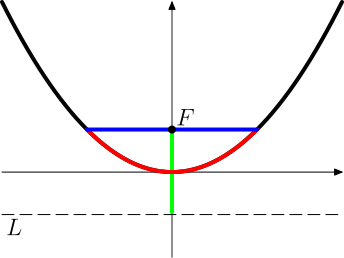
The universal parabolic constant is a mathematical constant.
It is defined as the ratio, for any parabola, of the arc length of the parabolic segment formed by the latus rectum to the focal parameter. The focal parameter is twice the focal length. The ratio is denoted P.[1][2][3] In the diagram, the latus rectum is pictured in blue, the parabolic segment that it forms in red and the focal parameter in green. (The focus of the parabola is the point F and the directrix is the line L.)
The value of P is[4]
- [math]\displaystyle{ P = \ln(1 + \sqrt2) + \sqrt2 = 2.29558714939\dots }[/math]
(sequence A103710 in the OEIS). The circle and parabola are unique among conic sections in that they have a universal constant. The analogous ratios for ellipses and hyperbolas depend on their eccentricities. This means that all circles are similar and all parabolas are similar, whereas ellipses and hyperbolas are not.
Derivation
Take [math]\displaystyle{ y = \frac{x^2}{4f} }[/math] as the equation of the parabola. The focal parameter is [math]\displaystyle{ p=2f }[/math] and the semilatus rectum is [math]\displaystyle{ \ell=2f }[/math]. [math]\displaystyle{ \begin{align} P & := \frac{1}{p}\int_{-\ell}^\ell \sqrt{1+\left(y'(x)\right)^2}\, dx \\ & = \frac{1}{2f}\int_{-2f}^{2f}\sqrt{1+\frac{x^2}{4f^2}}\, dx \\ & = \int_{-1}^{1}\sqrt{1+t^2}\, dt & (x = 2 f t) \\ & = \operatorname{arsinh}(1) + \sqrt{2}\\ & = \ln(1+\sqrt{2}) + \sqrt{2}. \end{align} }[/math]
Properties
P is a transcendental number.
- Proof. Suppose that P is algebraic. Then [math]\displaystyle{ \!\ P - \sqrt2 = \ln(1 + \sqrt2) }[/math] must also be algebraic. However, by the Lindemann–Weierstrass theorem, [math]\displaystyle{ \!\ e^{\ln(1+ \sqrt2)} = 1 + \sqrt2 }[/math] would be transcendental, which is not the case. Hence P is transcendental.
Since P is transcendental, it is also irrational.
Applications
The average distance from a point randomly selected in the unit square to its center is[5]
- [math]\displaystyle{ d_\text{avg} = {P \over 6}. }[/math]
- Proof.
- [math]\displaystyle{ \begin{align} d_\text{avg} & := 8\int_{0}^{1 \over 2}\int_{0}^{x}\sqrt{x^2+y^2}\, dy\, dx \\ & = 8\int_{0}^{1 \over 2}{1 \over 2}x^2(\ln(1 + \sqrt2) + \sqrt2)\, dx \\ & = 4P\int_{0}^{1 \over 2}x^2\, dx \\ & = {P \over 6} \end{align} }[/math]
References and footnotes
- ↑ Sylvester Reese and Jonathan Sondow. "Universal Parabolic Constant". http://mathworld.wolfram.com/.html., a Wolfram Web resource.
- ↑ Reese, Sylvester. "Pohle Colloquium Video Lecture: The universal parabolic constant". http://gaia.adelphi.edu/cgi-bin/makehtmlmov-css.pl?rtsp://gaia.adelphi.edu:554/General_Lectures/Pohle_Colloquiums/pohle200502.mov,pohle200502.mov,256,200.
- ↑ Sondow, Jonathan (2013). "The parbelos, a parabolic analog of the arbelos". Amer. Math. Monthly 120 (10): 929–935. doi:10.4169/amer.math.monthly.120.10.929. American Mathematical Monthly, 120 (2013), 929-935.
- ↑ See Parabola. Use [math]\displaystyle{ p=2f }[/math], the length of the semilatus rectum, so [math]\displaystyle{ h=f }[/math] and [math]\displaystyle{ q=f\sqrt{2} }[/math]. Calculate [math]\displaystyle{ 2s }[/math] in terms of [math]\displaystyle{ f }[/math], then divide by [math]\displaystyle{ 2f }[/math], which is the focal parameter.
- ↑ Weisstein, Eric W.. "Square Point Picking". http://mathworld.wolfram.com/SquarePointPicking.html., a Wolfram Web resource.
 |  |
Categories: [Mathematical constants] [Conic sections] [Parabolas] [Real transcendental numbers]
↧ Download as ZWI file | Last modified: 12/13/2023 04:35:10 | 3 views
☰ Source: https://handwiki.org/wiki/Universal_parabolic_constant | License: CC BY-SA 3.0
 ZWI signed:
 KSF
KSF