Imidazoles
 From Britannica 11th Edition (1911)
 Imidazoles, or Glyoxalines, organic chemical compounds
containing the ring system 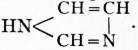 Imidazole itself was
first prepared by H. Debus (Ann. 1858, 107, p. 254) by the action of
ammonia on glyoxal, 2C2H2O2 + 2NH3 = C3H4N2 + H2CO2 + 2H2O.
The compounds of this series may be prepared by the condensation
of ortho-diketones with ammonia and aldehydes
Imidazole itself was
first prepared by H. Debus (Ann. 1858, 107, p. 254) by the action of
ammonia on glyoxal, 2C2H2O2 + 2NH3 = C3H4N2 + H2CO2 + 2H2O.
The compounds of this series may be prepared by the condensation
of ortho-diketones with ammonia and aldehydes

from thioimidazolones by oxidation with dilute nitric acid (W. Marckwald, Ber., 1892, 25, p. 2361); by distillation of hydrobenzamide and similarly constituted bodies; and by the action of phosphorus pentachloride on symmetrical dimethyloxamide, a methylchlorglyoxaline being formed (O. Wallach, Ann., 1877, 184, p. 500).
The glyoxalines are basic in character, and the imide hydrogen is replaceable by metals and alkyl groups. They are stable towards reducing agents, and acidyl groups are only introduced with difficulty.
Imidazole (glyoxaline), C3H4N2, crystallizes in thick prisms which melt at 88-89° C. and boil at 253° C., and are readily soluble in alcohol and in water. It is unaffected by chromic acid, but potassium permanganate oxidizes it to formic acid. It forms salts with acids.
Lophine (triphenylglyoxaline), 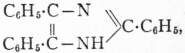 is formed
by the dry distillation of hydrobenzamide, or by saturating an
alcoholic solution of benzil and benzaldehyde (at a temperature of
40° C.) with ammonia. It crystallizes in needles which melt at
275° C. It is a weak base. When heated to 300° C. with hydriodic
acid and hydrochloric acid, in the presence of some red phosphorus,
it yields benzoic acid.
is formed
by the dry distillation of hydrobenzamide, or by saturating an
alcoholic solution of benzil and benzaldehyde (at a temperature of
40° C.) with ammonia. It crystallizes in needles which melt at
275° C. It is a weak base. When heated to 300° C. with hydriodic
acid and hydrochloric acid, in the presence of some red phosphorus,
it yields benzoic acid.
The keto-glyoxalines are known as imidazolones and are prepared
by the action of acids on acetalyl thioureas (W. Marckwald, Ber.,
1892, 25, p. 2357). Benzimidazole, 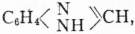 is the simplest
representative of the benzoglyoxalines and is prepared by the
condensation of formic acid with ortho-phenylene diamine. It
forms rhombic crystals which melt at 170° C. It is basic in character,
and on oxidation with potassium permanganate yields a
small amount of glyoxaline dicarboxylic acid,
is the simplest
representative of the benzoglyoxalines and is prepared by the
condensation of formic acid with ortho-phenylene diamine. It
forms rhombic crystals which melt at 170° C. It is basic in character,
and on oxidation with potassium permanganate yields a
small amount of glyoxaline dicarboxylic acid, 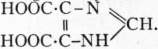 (E. Bamberger, Ann., 1893, 273, p. 338).
↧ Download as ZWI file | Last modified: 11/17/2022 15:23:43 | 36 views
☰ Source: https://oldpedia.org/article/britannica11/Imidazoles | License: Public domain in the USA. Project Gutenberg License
 ZWI signed:
 KSF
KSF