Atlas (Moon)
 From Handwiki
 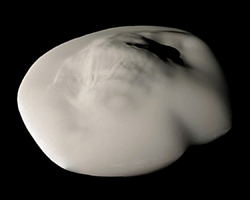 Color photo taken by Cassini on 12 April 2017 | |
| Discovery | |
|---|---|
| Discovered by | Terrile, Voyager 1 |
| Discovery date | October, 1980 |
| Designations | |
Designation | Saturn XV |
| Pronunciation | /ˈætləs/ |
| Named after | Ἄτλας Ātlās |
Alternative names | S/1980 S 28 |
| Adjectives | Atlantean /ætlænˈtiːən/[1] |
| Orbital characteristics [2] | |
| Epoch December 31, 2003 (JD 2453005.5) | |
| Mean orbit radius | 137670±10 km |
| Eccentricity | 0.0012 |
| Orbital period | 0.6016947883 d |
| Inclination | 0.003°±0.004° |
| Satellite of | Saturn |
| Group | Outer shepherd moon of the A Ring |
| Physical characteristics | |
| Dimensions | 40.8 × 35.4 × 18.6 km (± 0.2 × 0.4 × 0.6 km)[3](p2) |
| Mean diameter | 29.8±0.4 km[3](p2) |
| Volume | 13950±50 km3[4](p4) |
| Mass | (5.490±0.042)×1015 kg[lower-alpha 1] |
| Mean density | 0.3935±0.0033 g/cm3[4](p4) |
surface gravity | 0.0001–0.0017 m/s2[3](p3) |
escape velocity | 0.006 km/s at longest axis to 0.009 km/s at poles |
| Rotation period | synchronous |
| Axial tilt | zero |
| Albedo | 0.4 |
| Physics | ≈ 81 K |
Atlas is an inner satellite of Saturn which was discovered by Richard Terrile in 1980 from Voyager photos and was designated S/1980 S 28.[5] In 1983 it was officially named after Atlas of Greek mythology, because it "holds the rings on its shoulders" like the Titan Atlas held the sky up above the Earth.[6] It is also designated Saturn XV.
Atlas is the closest satellite to the sharp outer edge of the A ring, and was long thought to be a shepherd satellite for this ring. However, now it is known that the outer edge of the ring is instead maintained by a 7:6 orbital resonance with the larger but more distant moons Janus and Epimetheus.[7] In 2004 a faint, thin ring, temporarily designated R/2004 S 1, was discovered in the Atlantean orbit.[8]
High-resolution images taken in June 2005 by Cassini revealed Atlas to have a roughly spherical centre surrounded by a large, smooth equatorial ridge. The most likely explanation for this unusual and prominent structure is that ring material swept up by the moon accumulates on the moon, with a strong preference for the equator due to the ring's thinness. The size of the equatorial ridge is comparable with the expected Roche lobe of the moon, which means that for any additional particles impacting the equator, the centrifugal force will nearly overcome Atlas's tiny gravity, and they will probably be lost.[7]
Atlas is significantly perturbed by Prometheus and to a lesser degree by Pandora, leading to excursions in longitude of up to 600 km (~0.25°) away from the precessing Keplerian orbit with a rough period of about 3 years. Because the orbits of Prometheus and Pandora are chaotic, it is suspected that Atlas's may be as well.[2]
Gallery
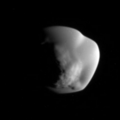
Atlas from above its south pole (June 12, 2007)
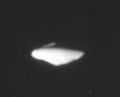
Atlas - Cassini
(June 8, 2005).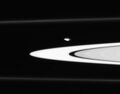
Atlas - A and F rings
(June 30, 2006).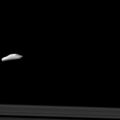
Atlas near the A ring
(December 6, 2015).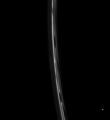
Atlas near the F ring
(May 9, 2005).
Notes
- ↑ Calculated from the standard gravitational parameter GM = (3.664±0.028)×10−4 km3·s–2 given by Lainey et al. (2023), divided by the gravitational constant G = 6.6743×10⁻² km3·kg–1·s–2.[4]
References
Citations
- ↑ Atlantean (3rd ed.), Oxford University Press, September 2005, http://oed.com/search?searchType=dictionary&q=Atlantean (Subscription or UK public library membership required.)
- ↑ 2.0 2.1 Spitale Jacobson et al. 2006.
- ↑ 3.0 3.1 3.2 Thomas & Helfenstein 2020.
- ↑ 4.0 4.1 4.2 Lainey et al. 2023.
- ↑ IAUC 3539.
- ↑ IAUC 3872.
- ↑ 7.0 7.1 Lakdawalla 2007.
- ↑ IAUC 8401.
Sources
- Green, Daniel W. E. (September 9, 2004). "S/2004 S 3, S/2004 S 4, and R/2004 S 1". IAU Circular 8401: 1. Bibcode: 2004IAUC.8401....1P. http://www.cbat.eps.harvard.edu/iauc/08400/08401.html. Retrieved 2011-12-30.
- Lakdawalla, Emily (June 13, 2007). "Funny little Atlas". The Planetary Society weblog. http://www.planetary.org/blog/article/00001003/.
- Marsden, Brian G. (November 13, 1980). "1980 S 28" (discovery). IAU Circular 3539: 2. Bibcode: 1980IAUC.3539....2M. http://www.cbat.eps.harvard.edu/iauc/03500/03539.html. Retrieved 2011-12-30.
- Marsden, Brian G. (September 30, 1983). "Satellites of Jupiter and Saturn" (naming the moon). IAU Circular 3872. http://www.cbat.eps.harvard.edu/iauc/03800/03872.html. Retrieved 2011-12-30.
- Spitale, J. N.; Jacobson, R. A.; Porco, C. C.; Owen, W. M. Jr. (2006). "The orbits of Saturn's small satellites derived from combined historic and Cassini imaging observations". The Astronomical Journal 132 (2): 692–710. doi:10.1086/505206. Bibcode: 2006AJ....132..692S.
- Thomas, P. C. (July 2010). "Sizes, shapes, and derived properties of the saturnian satellites after the Cassini nominal mission". Icarus 208 (1): 395–401. doi:10.1016/j.icarus.2010.01.025. Bibcode: 2010Icar..208..395T. http://www.ciclops.org/media/sp/2011/6794_16344_0.pdf. Retrieved 2015-09-04.
- Thomas, P. C.; Helfenstein, P. (July 2020). "The small inner satellites of Saturn: Shapes, structures and some implications". Icarus 344: 20. doi:10.1016/j.icarus.2019.06.016. 113355. Bibcode: 2020Icar..34413355T.
- Lainey, V.; Rambaux, N.; Cooper, N.; Dahoumane, R.; Zhang, Q. (February 2023). "Characterising the interior of five inner Saturnian moons using Cassini ISS data". Astronomy & Astrophysics 670: 6. doi:10.1051/0004-6361/202244757. L25. Bibcode: 2023A&A...670L..25L.
External links
- Atlas Profile by NASA's Solar System Exploration
- The Planetary Society: Atlas
- NASA factsheet
Saturn | ||
|---|---|---|
| ||
| Geography |
| .jpg) |
| Moons |
| |
| Astronomy |
| |
| Exploration |
| |
| Related |
| |
 |  |
Categories: [Moons of Saturn]
↧ Download as ZWI file | Last modified: 11/30/2024 04:17:41 | 9 views
☰ Source: https://handwiki.org/wiki/Astronomy:Atlas_(moon) | License: CC BY-SA 3.0
 KSF
KSF