Zanthoxylum Zanthoxyloides
 From Handwiki
| Zanthoxylum zanthoxyloides | |
|---|---|

| |
Scientific classification 
| |
| Kingdom: | Plantae |
| Clade: | Tracheophytes |
| Clade: | Angiosperms |
| Clade: | Eudicots |
| Clade: | Rosids |
| Order: | Sapindales |
| Family: | Rutaceae |
| Genus: | Zanthoxylum |
| Species: | Z. zanthoxyloides
|
| Binomial name | |
| Zanthoxylum zanthoxyloides (Lam.) Zepern. & Timler, 1981
| |
| Synonyms | |
|
Fagara zanthoxyloides Lam.
| |
Zanthoxylum zanthoxyloides, also called Senegal prickly-ash or artar root,[1] is a plant species in the genus Zanthoxylum.
The plant contains isomeric divanilloylquinic acids (3,4-O-divanilloylquinic acid or burkinabin A, 3,5-O-divanilloylquinic acid or burkinabin B and 4,5-O-divanilloylquinic acid or burkinabin C).[2] Burkinabin C, a type of hydrolysable tannin can be found in the root bark of F. zanthoxyloides.[3] It also contains fagaronine, a benzophenanthridine alkaloid.[4]
A study by Williams, Soelberg and Jäger (2016) showed than ethanolic extracts of Z. zanthoxyloides have in vitro anthelmintic properties against the nematode Ascaris suum, a swine parasite that is closely related to the human parasite A. lumbricoides. The half maximal effective concentration (EC50) values were 94 μg/mL and 132 μg/mL, for roots and root bark, respectively. The authors concluded that these results encourage further investigation of the use of this plant as complementary treatment options for ascariasis.[5]

Spines
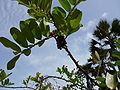
Fruits
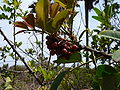
Fruits


References
- ↑ Zanthoxylum zanthoxyloides on www.henriettes-herb.com
- ↑ Ouattara, B.; Jansen, O.; Angenot, L.; Guissou, I.P.; Frédérich, M.; Fondu, P.; Tits, M. (2009). "Antisickling properties of divanilloylquinic acids isolated from Fagara zanthoxyloides Lam (Rutaceae)". Phytomedicine 16 (2–3): 125–9. doi:10.1016/j.phymed.2008.10.013. PMID 19110407.
- ↑ Ouattara, B; Angenot, L; Guissou, P; Fondu, P; Dubois, J; Frédérich, M; Jansen, O; Van Heugen, JC et al. (2004). "LC/MS/NMR analysis of isomeric divanilloylquinic acids from the root bark of Fagara zanthoxyloides Lam". Phytochemistry 65 (8): 1145–51. doi:10.1016/j.phytochem.2004.02.025. PMID 15110696.
- ↑ Dupont, C; Couillerot, E; Gillet, R; Caron, C; Zeches-Hanrot, M; Riou, JF; Trentesaux, C (2005). "The benzophenanthridine alkaloid fagaronine induces erythroleukemic cell differentiation by gene activation". Planta Medica 71 (6): 489–94. doi:10.1055/s-2005-864147. PMID 15971117.
- ↑ Williams, Andrew R.; Soelberg, Jens; Jäger, Anna K. (2016). "Anthelmintic properties of traditional African and Caribbean medicinal plants: identification of extracts with potent activity against Ascaris suum in vitro". Parasite 23: 24. doi:10.1051/parasite/2016024. ISSN 1776-1042. PMID 27301442.

External links
See also Wikidata entry Q9097481.
 |  |
Categories: [Zanthoxylum]
↧ Download as ZWI file | Last modified: 09/30/2022 21:55:32 | 4 views
☰ Source: https://handwiki.org/wiki/Biology:Zanthoxylum_zanthoxyloides | License: CC BY-SA 3.0
 ZWI signed:
 KSF
KSF