Abstract Art
 From Conservapedia
 Definitions:
- Painting, sculpture, or graphic art in which the portrayal of things from the visible world plays no part. Encyclopædia Britannica.
- An abstract genre of art; artistic content depends on internal form rather than pictorial representation The Free Dictionary.
- Art with no defined meaning. Its purpose is to let the viewer interpret its meaning for him/herself. Urban Dictionary.
- Art that does not depict recognizable scenes or objects, but instead is made up of forms and colours that exist for their own expressive sake. (like the spontaneous, "free" expression, as in the Action Painting of Jackson Pollock.) The Oxford Dictionary of Art.
In Western art history, the break from the notion that a painting had to represent something happened in the early 20th century. Impressionism, Fauvism, Cubism and other art movements of the time all contributed by breaking the "rules" of art followed since The Renaissance.[1]
in 1910. Wassily Kandinsky wrote an essay called Concerning the Spiritual in Art, which described his journey from painting naturalistic landscapes to painting abstract works. In it, he writes that painting, like music, should not be a description of the external world, but rather contains its own reality, which comes from the 'inner necessity' of the artist - the inner artistic vision.[2]

Last Judgement, 1912 by Wassily Kandinsky.
Constantin Brancusi's "The kiss" (1908) is one of the first abstract sculptures. This Romanian artist was a pioneer of modern abstract sculpture.
.jpg)
Some history[edit]

The roots of abstract art may be found in native cultures and later in some works of Romanticism, Impressionism, Fauvism and Expressionism Schools' artists. Paul Cézanne's Post-Impressionism works, aimed to make a construction of reality based on an special view that modulated color in flat areas, became the basis of a new trend in visual art and a catalyst for the abstract art of the 20th century. He is often seen as anticipating cubist. Today's perception of abstract art dates back to 1910, when Pablo Picasso and Georges Braque invented cubism which within half a decade, led to the pure abstract art created by Piet Mondrian and Russian styles such as constructivism and suprematism. [3] Russian-born French Wassily Kandinsky is considered one of the fathers of abstract art. Around 1914 and 1915, Henri Matisse, with expressive use of strong colors and free and imaginative drawing, comes very close to a pure abstraction idea as in The Yellow Curtain.
Between 1910 and 1920, abstract art developed in America, Europe and Russia through the efforts of Cubists like Duchamp and Lipchitz, Dadaists, Volticists and Futurists like Kasomir and Piet Mondrian. Artists experimented with an increased zeal, liberated in their creation from the conventional forms.
The principal abstract art movements were Cubism (notably France), Futurism (Italy), Vorticism (Britain), De Stijl (Netherlands), Rayonism, Constructivism, and Suprematism (Russia), Abstract Expressionism (USA) and Art Informel (Europe).[4] Also important are Lyrical Abstraction and Color Field.
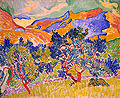
Derain, Mountains at Collioure 1905.
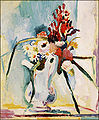
Matisse, Fleurs dans un Verre 1906.
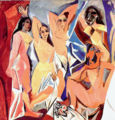
Picasso, Les Demoiselles de Avignon, 1907.
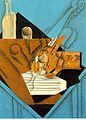
Gris, Musician's Table, 1914.
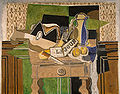
Braque, Still Life: Le Jour, 1929.


Matisse, The Yellow Curtain, 1914-15.
Pablo Picasso (1881 - 1973) not only revolutionized painting but also the art of sculpture in the early 20th century.
Abstract sculpture may be exemplified in works by Julio González (1876 - 1942), Hans Arp (1887-1966), Constantin Brancusi (1876-1957), Joan Miró (1893 – 1983), Alexander Calder (1898-1976), Henry Moore (1898-1986), Salvador Dalí (1904–1989) and Alexandra Wejchert (1921-1995).
The explorations of Julio González, a Spanish abstract sculptor, led to abstract configurations of welded metal that can be seen in the works of Americans such as David Smith, Theodore Roszack, Seymour Lipton, and Herbert Ferber. [5] and Mexicans like Enrique Carbajal (Sebastian).

Julio González, Woman with Hair in a Bun, ca. 1930.
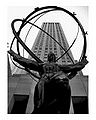
Lee Lawrie, Statue of Atlas in Rockefeller Center, 1936.
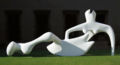
Henry Moore, Reclining Figure, 1951.
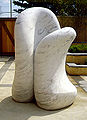
Autin Wright, Free Form III, 1998.
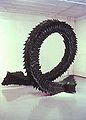
Chakaia Booker, Spirit-Hunter, 2001.


Critics[edit]
Notable critics of abstract art from a traditionalist perspective are Tom Wolfe (The Painted Word), Paul Johnson (Art: A New History), and Louis Torres & Michelle Kamhi (What Art Is).
See also[edit]

External links[edit]
- Abstract art paintings, famous artists.
- Abstract Sculptures
- Repository of Abstract Art
- Abstract Sculpture:Henry Moore and Jean Arp
- Abstract art sculptures
- Abstract Art Ideas.
- Introduction to the Artistic Style of Abstract Art.
- Abstract Art: An Introduction.

Pollock, Blue Poles, 1953.
References[edit]


Categories: [Art] [Artistic Movements]
↧ Download as ZWI file | Last modified: 02/14/2023 03:21:23 | 22 views
☰ Source: https://www.conservapedia.com/Abstract_art | License: CC BY-SA 3.0
 ZWI signed:
 KSF
KSF