Short description: Philosophical view combining theism with agnosticism
Part of a series on
Irreligion
Irreligion
Secular humanism
Freethought
Post-theism
Nontheism
Anti-clericalism
Antireligion
Criticism of religion
Parody religion
Atheism
History
Demographics
Discrimination/Persecution
Criticism
Lists of atheists
Forms and variations
Implicit and explicit
Negative and positive
New
State
Christian
India
Hindu
Jewish
Aspects
Anti-clericalism
Antireligion
Antitheism
Relationship between atheism and religion
Existence of God
Agnosticism
Strong
Weak
Atheistic
Theistic (Christian)
Apatheism
Ancient India
Secular Buddhism
List of agnostics
Deism
Christian Deism
Ietsism
Pandeism
Natural Theology
Spinozism
Theophilanthropy
Deus otiosus
Deistic evolution
List of deists
Nontheism
Criticism of religion
Secular humanism
Freethought
Flying Spaghetti Monster
Ignosticism
Inconsistent revelations
Invisible Pink Unicorn
Nontheistic religions
Pantheism
Parody religion
Post-theism
Russell's teapot
Theological noncognitivism
Transtheism
Naturalism
Humanistic
Metaphysical
Methodological
Religious
Spiritual
People
Lists of agnostics
atheists
deists
humanists
pantheists
Books
Breaking the Spell
Ethics
The End of Faith
The God Delusion
God Is Not Great
The System of Nature
Letter to a Christian Nation
Why I Am Not a Christian
Why I Am Not a Muslim
Secularist organizations
Atheist Alliance International
Freedom From Religion Foundation
Reason Rally
World Pantheist Movement
Related topics
Secularism
Laïcité
Parody religion
Irreligion by country
v
t
e
Agnostic theism, agnostotheism, or agnostitheism is the philosophical view that encompasses both theism and agnosticism. An agnostic theist believes in the existence of one or more gods, but regards the basis of this proposition as unknown or inherently unknowable. The agnostic theist may also or alternatively be agnostic regarding the properties of the god or gods that they believe in.
Contents
1Views of agnostic theism
2See also
3References
4External links
Views of agnostic theism
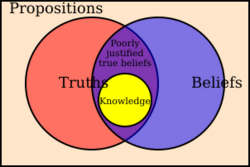
Agnostic theism is belief but without knowledge, as shown in purple and blue (see: Epistemology).
There are numerous beliefs that can be included in agnostic theism, such as fideism, the doctrine that knowledge depends on faith or revelation; not all agnostic theists are fideists. Since agnosticism is in the philosophical rather than religious sense an epistemological position on knowledge regarding the divine and does not forbid belief in the existence of one or more deities, it is considered to be compatible with both atheistic and theistic positions.[1]
The classical philosophical understanding of knowledge is that knowledge is justified true belief. The founder of logotherapy, Viktor Frankl, may have well exemplified this definition. Seidner expands upon this example and stresses Frankl's characterization of unconscious.[2] Agnostic theism could be interpreted as an admission that it is not possible to justify one's belief in a god sufficiently for it to be considered known. This may be because they consider faith a requirement of their religion, or because of the influence of plausible-seeming scientific or philosophical criticism.
Christian agnostics practice a distinct form of agnosticism that applies only to the attributes of the Christian god. They hold that it is difficult or impossible to be sure of anything beyond the basic tenets of the Christian faith. They believe that the Christian god exists, that Jesus has a special relationship with him and is in some way divine, and that God might perhaps be worshipped. This belief system has deep roots in Judaism and the early days of the Christian Church.[3]
See also
Agnostic atheism
Christian agnosticism
Cosmological argument
Deism
Doubt: Philosophy and ethics
Epistemology: Belief
Faith
Fideism
Ietsism
Ignosticism
Negative theology
Numinous
Secular theology
Sola fide
Truth
Unitarian Universalism
Unknown God
References
↑Hall, Ronald L., ed (December 1999). "Some Uncertainties about Agnosticism". International Journal for Philosophy of Religion (Berlin and New York City: Springer Verlag) 46 (3): 171–188. doi:10.1023/A:1003792325966. ISSN 1572-8684.
↑Seidner, Stanley S. (June 10, 2009) "A Trojan Horse: Logotherapeutic Transcendence and its Secular Implications for Theology" . Mater Dei Institute.
↑Weatherhead, Leslie (1972). The Christian Agnostic. Abingdon Press. ISBN 978-0-687-06977-4.
External links
Epistemology - from Stanford Encyclopedia of Philosophy
AGNOSTICISM - from Dictionary of the History of Ideas
v
t
e
Irreligion
Irreligion
Nontheism
Antireligion
Post-theism
Anti-clericalism
Criticism of religion
Parody religion
Secular humanism
Freethought
Atheism
Lists of atheists
Demographics
Religion
History
Anti-clericalism
State
New
Criticism
Discrimination/Persecution
Implicit and explicit
Negative and positive
Existence of God
Antitheism
Christian atheism
Hindu atheism
Jewish atheism
Agnosticism
List of agnostics
Strong
Weak
Agnostic atheism
Agnostic theism
Christian
Apatheism
Ignosticism
Secular Buddhism
Nontheism
Criticism of religion
Secular humanism
Freethought
Flying Spaghetti Monster
Inconsistent revelations
Invisible Pink Unicorn
Nontheistic religions
Parody religion
Post-theism
Russell's teapot
Theological noncognitivism
Transtheism
Naturalism
Humanistic
Metaphysical
Methodological
Religious
People
Atheists
Agnostics
Humanists
Pantheists
Deists
Books
Breaking the Spell
The End of Faith
The God Delusion
God Is Not Great
Letter to a Christian Nation
The System of Nature
Why I Am Not a Christian
Why I Am Not a Muslim
Organizations
American Atheists
American Humanist Association
Atheist Alliance International
British Humanist Association
Center for Inquiry
Freedom From Religion Foundation
International Humanist and Ethical Union
Rational Response Squad
Reason Rally
Recovering from Religion
World Pantheist Movement
Brazilian Association of Atheists and Agnostics
Related topics
Countries by irreligion
Secularism
Parody or mock religions
v
t
e
Theism
Deity
Divinity
Male
Female
List
God
Existence
Gender
Agnostic theism
Alatrism
Animism
Antitheism
Apatheism
Atheism
Agnostic
Christian
Evangelical
Implicit/Explicit
Jewish
Negative/Positive
Scientific or New atheism
State atheism
Binitarianism
Classical theism
Deism
Ceremonial
Christian
Pandeism
Polydeism
Dipolar theism
Dystheism
Egotheism
Misotheism
Henotheism
Ietsism
Kathenotheism
Liberal theism
Monolatry
Monotheism
Ethical
Post-monotheism
Mysticism
Nontheism
Post-theism
Open theism
Panentheism
Pantheism
Classical
Hylotheism
Naturalistic
Philosophical theism
Physitheism
Euhemerism/Anthropotheism
Polytheism
Skeptical theism
Spiritualism
Transtheism
Trinitarianism
Tritheism
Unitarianism
Religion portal
0.00
(0 votes)
Original source: https://en.wikipedia.org/wiki/Agnostic theism. Read more