Judicial Restraint
 From Ballotpedia


Judicial restraint is a theory of judicial interpretation—a theory of how judges interpret laws. Like most abstract theories, definitions vary slightly according to different sources. In general, judicial restraint is the concept of a judge not injecting his or her own preferences into legal proceedings and rulings.[1][2]
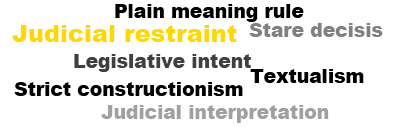
Judges are said to exercise judicial restraint if they are hesitant to strike down laws that are not obviously unconstitutional. It is considered the opposite of judicial activism (also referred to as "legislating from the bench"). In deciding questions of constitutional law, judicially restrained jurists believe that it is important to defer to legislative intent, stare decisis, the Plain Meaning Rule, and a generally strict and textualist view of judicial interpretation.
Advocates of judicial restraint argue that judges do not have the authority to act as policy makers. Among judicial restraint advocates are Thomas Jefferson, Learned Hand and Hugo Black. Opponents argue that activism is a necessity when the other branches of government do not act to bring about social change. Some opponents of judicial restraint include William J. Brennan and Ronald Dworkin.
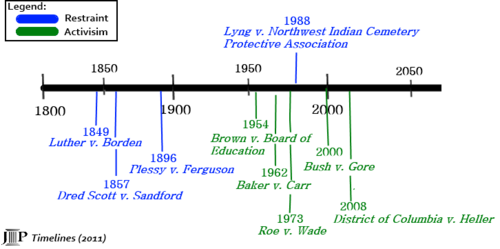
Throughout the United States' history, several court cases have become clear examples of both judicial restraint and judicial activism, including Dred Scott v. Sandford and Brown v. Board of Education, respectively. (Click here for more famous cases.)
Definitions[edit]
Judicial restraint is a complex concept, and the definition of the term itself varies slightly according to different sources. Additionally, the theory includes complicated terms and rules such as "stare decisis" and "Plain Meaning Rule." Such definitions and terms are listed below.
Judicial restraint[edit]
The term "judicial restraint" has a number of definitions. Some of these are listed below:
Auburn University[edit]
The Glossary of Political Economy Terms, published by Auburn University, gives the following definition of judicial restraint:
| “ | The view that the Supreme Court (and other lesser courts) should not read the judges' own philosophies or policy preferences into the constitution and laws and should whenever reasonably possible construe the law so as to avoid second guessing the policy decisions made by other governmental institutions such as Congress, the President and state governments within their constitutional spheres of authority. On such a view, judges have no popular mandate to act as policy makers and should defer to the decisions of the elected 'political' branches of the Federal government and of the states in matters of policy making so long as these policymakers stay within the limits of their powers as defined by the US Constitution and the constitutions of the several states.[3] | ” |
| —Auburn University, Glossary of Political Economy Terms | ||
Eastern Michigan University[edit]
The Fundamentals of Judicial Philosophy, published by Eastern Michigan University, gives another definition:
| “ | A jurist (judge or justice) who adheres to a philosophy of restraint can be characterized as one who believes that democracy has intrinsic, not just instrumental, value; that the judiciary is the least powerful of the three branches of government; and reveres the values of stability and predictability in lawmaking.[3] | ” |
| —Eastern Michigan University, Fundamentals of Judicial Philosophy | ||
Marquette University Law School[edit]
Nationally renowned legal expert Rick Esenberg wrote the following about judicial restraint:
| “ | A judge exercising restraint must act on external and legitimate sources of authority. Judicial restraint, for our purposes, is the notion that judges ought to base their decisions upon a source of authority that is outside of themselves and their own notions of the just. More fundamentally, this source should be rooted, at some point, in the formal consent of the governed, as opposed to the judge's preferred political or moral philosophy. In other words, the exercise of judicial authority ought to be based upon, or fairly inferable from, some language in the constitution or statutes.[2][3] | ” |
| —Rick Esenberg | ||
Related terms[edit]
Legislative intent[edit]
 |
|---|
- Main article: Legislative intent
...is a legislature's practice of enacting new legislation on the grounds of judicial precedence. The term also refers to the legislature’s intentions in enacting a bill into law—frequently determined by studying the details of the legislative history.
Stare decisis[edit]
- Main article: Stare decisis
...is Latin for "to stand by that which is decided." The term is used to describe the legal principle dictating that precedents (previously argued cases and court decisions) are to be consulted in determining verdicts for subsequent cases.
As a general rule, when a point of law has been settled by decision, it forms a precedent which is not later—and certainly not lightly—to be departed from in future decisions. Stare decisis is not always relied upon, however, and courts sometimes find it necessary to overrule precedents when cases have been hastily decided or when they stand contrary to principle.
Plain Meaning Rule[edit]
- Main article: Plain Meaning Rule
...also known as the literal rule, is an approach to judicial interpretation favored by judges who believe that statutes and laws should be interpreted to mean what the ordinary meaning of the language suggests. In other words, the law is to be read and interpreted in a common-sense, ordinary way, without elaborate or sophisticated interpretations that are at odds with what the plain meaning of the law says. Textualists favor the Plain Meaning Rule.
Strict constructionism[edit]
- Main article: Strict constructionism
...is a legal theory that promotes the limitation of judicial interpretation only to the written letter of the law.
Textualism[edit]
- Main article: Textualism
...is a theory of statutory interpretation favored by judges who believe that the original meaning of a statute's text—rather than a historical source that is pulled in an attempt to determine underlying legislative intent—is the best source for interpreting that statute.[4] Textualism is consistent with the Plain Meaning Rule, which says that interpreters of statutes should interpret a statute according to its "plain meaning."
Judicial interpretation[edit]
- Main article: Judicial interpretation
...refers to how a judge interprets laws. There is much variation in judicial interpretation across the states, with some judges favoring judicial restraint (advocating for interpretations that hold up to the Plain Meaning Rule) and others favoring judicial activism ("legislating from the bench").
Other theories of judicial interpretation, in addition to judicial restraint and activism, include:
Famous cases[edit]
Restraint[edit]
The following cases are examples of judicial restraint:
- Luther v. Borden (1849)[5]
- Chief justice: Roger B. Taney
- Associate justices: John McLean, James M. Wayne, John Catron, John McKinley, Peter V. Daniel, Samuel Nelson, Levi Woodbury, Robert C. Grier
- Dred Scott v. Sandford (1857) - Declared that slaves were not protected by the Constitution and could never become citizens.
- Chief justice: Roger B. Taney
- Associate justices: John McLean, James M. Wayne, John Catron, Peter V. Daniel, Samuel Nelson, Robert C. Grier, Benjamin R. Curtis, John A. Campbell
- Plessy v. Ferguson (1896) - Upheld the constitutionality of "separate but equal," perpetuating segregation.
- Chief justice: Melville Fuller
- Associate justices: Stephen J. Field, John M. Harlan, Horace Gray, David J. Brewer, Henry B. Brown, George Shiras Jr., Edward D. White, Rufus W. Peckham
- Lyng v. Northwest Indian Cemetery Protective Association (1988) - Declared that "a fundamental and longstanding principle of judicial restraint requires that courts avoid reaching constitutional questions in advance of the necessity of deciding them."[5]
- Chief justice: William Rehnquist
- Associate justices: Byron R. White, John Paul Stevens, Sandra Day O'Connor, Antonin Scalia, William J. Brennan Jr., Thurgood Marshall, Harry A. Blackmun, Anthony M. Kennedy
Activism[edit]
The following cases are some in which judicial restraint was not practiced, or where judicial activism was practiced.
- Brown v. Board of Education (1954) - Overturned Plessy v. Ferguson, ruling segregation unconstitutional.
- Chief justice: Earl Warren
- Associate justices: Hugo Black, Stanley F. Reed, Felix Frankfurter, William O. Douglas, Robert H. Jackson, Harold H. Burton, Tom C. Clark, Sherman Minton
- Baker v. Carr (1962) - Decided that redistricting presented justiciable questions, allowing federal courts to intervene.
- Chief justice: Earl Warren
- Associate justices: Hugo Black, Felix Frankfurter, William O. Douglas, Tom C. Clark, John M. Harlan II, William J. Brennan Jr., Charles E. Whittaker, Potter Stewart
- Roe v. Wade (1973) - Ruled that the right to privacy granted by the 14th Amendment applied to a woman's decision to have an abortion, making it easier for women to acquire abortions.
- Chief justice: Warren Burger
- Associate justices: Harry Blackmun, William J. Brennan, Thurgood Marshall, Potter Stewart, William Rehnquist, Lewis F. Powell Jr., William O. Douglas, Byron R. White,
- Bush v. Gore (2000) - Ruled the Florida Supreme Court's method for recounting ballots as having violated the Equal Protection Clause of the Fourteenth Amendment in a presidential election, essentially deciding the 2000 presidential election in favor of George W. Bush.
- Chief justice: William Rehnquist
- Associate justices: John P. Stevens, Sandra Day O'Connor, Antonin Scalia, Anthony Kennedy, David Souter, Clarence Thomas, Ruth Bader Ginsburg, Stephen Breyer
- District of Columbia v. Heller (2008) - Declared the Washington, D.C., ban on private ownership of handguns unconstitutional in violation of the 2nd Amendment, effectively extending the 2nd Amendment to individuals.
- Chief justice: John G. Roberts
- Associate justices: John P. Stevens, Antonin Scalia, Anthony Kennedy, David Souter, Clarence Thomas, Ruth Bader Ginsburg, Stephen Breyer, Samuel Alito
Opinions on judicial restraint[edit]
Arguments in favor[edit]
Those in favor of judicial restraint argue that:
- The power to make the laws is the power of the legislative branch alone; courts have no constitutional right to do so.
- Federal judges are not elected officials and therefore do not necessarily speak for the people.
- Judges are not equipped with the background necessary to enforce social judgments as they see fit.
Advocates[edit]

Thomas Jefferson[edit]
In an 1825 letter to Edward Livingston, Thomas Jefferson expressed strong views in favor of judicial restraint:
| “ | One single object... [will merit] the endless gratitude of society: that of restraining the judges from usurping legislation. And with no body of men is this restraint more wanting than with the judges of what is commonly called our General Government.[6][3] | ” |
| —Thomas Jefferson | ||
Learned Hand[edit]
Billings Learned Hand was a judge who served on the United States District Court for the Southern District of New York from 1909 to 1924 and on the United States Court of Appeals for the 2nd Circuit from 1924 to 1961. He was also a judicial philosopher and a leading proponent of judicial restraint.[7] According to the New York Times, Hand "was committed to neither a conservative nor a liberal agenda, but to a creed of judicial restraint he had learned at Harvard Law School from J.B. Thayer and had reinforced by his own experience of democracy."[8]
Hugo Black[edit]
Hugo Black was an associate justice on the U.S. Supreme Court from 1937 to 1971 and a strong supporter of judicial restraint. He believed that the power of making laws should be reserved for the legislature and wrote that "power corrupts, and unrestricted power will tempt Supreme Court justices just as history tells us it has tempted other judges."[9][10]
Arguments opposed[edit]
Those opposed to judicial restraint (and favoring judicial activism) argue that:
- Judicial activism is necessary to correct injustices and promote needed social change.
- Activism is an acceptable last resort when the executive and legislative branches refuse to act.
- Activism is necessary to actively interpret the constitution as new conditions arise.
Opponents[edit]
William J. Brennan[edit]
William Brennan served as an associate justice on the U.S. Supreme Court from 1956 to 1990. He was known for his strong belief in the Bill of Rights and the belief that the Constitution must be adapted to keep up with a changing world. Among statements describing his constitutional interpretation is the following:
| “ | Successive generations of Americans have continued to respect these fundamental choices and adopt them as their own guide to evaluating quite different historical practices. Each generation has the choice to overrule or add to the fundamental principles enunciated by the Framers; the Constitution can be amended or it can be ignored.[11][3] | ” |
| —Former Associate Justice William Brennan, U.S. Supreme Court | ||
Ronald Dworkin[edit]
Dworkin was a philosopher who studied constitutional law. He is best known for his "theory of law as integrity, in which judges interpret the law in terms of consistent and communal moral principles, especially justice and fairness." He believed in an interpretivist approach to law and morality.[12]
Other theories[edit]
In addition to judicial activism and judicial restraint, other theories of judicial interpretation include:
See also[edit]
- Judicial philosophy
- Judicial activism • Judicial empathy • Judicial minimalism • Judicial restraint • Plain Meaning Rule • Strict constructionism • Legislative intent • Living Constitution • Judicial interpretation • Judicial accountability • Judicial supremacy • Judicial independence • Originalism • Stare decisis • Textualism
External links[edit]
Additional reading[edit]
- Bloomberg Law Reports, "Judicial Restraint in the Early," November 30, 2011
- CNN.com, "Rehnquist's Legacy one of Restraint," September 4, 2011
- Spokane Daily Chronicle, "Court bill would wipe out judicial restraint," March 23, 1937
Footnotes[edit]
- ↑ USLegal.com, "Judicial restraint law & legal definition," accessed December 7, 2011
- ↑ 2.0 2.1 Wisconsin Policy Research Institute, "The Wisconsin Interest," January 8, 2009
- ↑ 3.0 3.1 3.2 3.3 3.4 Note: This text is quoted verbatim from the original source. Any inconsistencies are attributable to the original source.
- ↑ Legal Workshop, "Choosing Interpretive Methods: A Positive Theory of Judges and Everyone Else," June 22, 2009
- ↑ 5.0 5.1 Legal Information Institute, "Luther v. Border," accessed December 18, 2015
- ↑ University of Virginia Library, "Thomas Jefferson," accessed December 18, 2015
- ↑ Encyclopedia Britannica, "Learned Hand," accessed December 18, 2015
- ↑ New York Times, "Master of Restraint," May 1, 1994
- ↑ Laws, "Hugo Black," accessed December 18, 2015
- ↑ New York Times, "Justice vs. Justice," October 15, 1989
- ↑ TeachingAmericanHistory.org, "Constitutional Interpretation," accessed December 18, 2015
- ↑ Stanford Encyclopedia of Philosophy, "Legal Positivism," January 3, 2003
| |||||||


Categories: [Philosophy of law] [Judicial terms and definitions]
↧ Download as ZWI file | Last modified: 04/02/2026 11:55:41 | 19 views
☰ Source: https://ballotpedia.org/Judicial_restraint | License: CC BY-SA 3.0
 KSF
KSF