Annona Montana
 From Handwiki
| Annona montana | |
|---|---|
| |
Conservation status
| |
 Least Concern (IUCN 3.1)[1] | |
Scientific classification 
| |
| Kingdom: | Plantae |
| Clade: | Tracheophytes |
| Clade: | Angiosperms |
| Clade: | Magnoliids |
| Order: | Magnoliales |
| Family: | Annonaceae |
| Genus: | Annona |
| Species: | A. montana
|
| Binomial name | |
| Annona montana Macfad.
| |
| Synonyms | |
|
Annona marcgravii Mart.[2] | |
.jpg/250px-Annona_montana,_aticum_-_Flickr_-_Tarciso_Leão_(3).jpg)
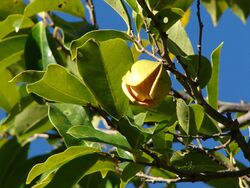
Annona montana, the mountain soursop, is a tree and its edible fruit in the Annonaceae family native to Central America, the Amazon, and islands in the Caribbean. It has fibrous fruits.[4] A. montana may be used as a rootstock for cultivated Annonas.[5]
Etymology and common names
The Latin specific epithet montana refers to mountains or "coming from mountains".[6]
- English: mountain soursop, mountain sop, wild soursop
- Czech: mountain soursop
- German: Schleimapfel
- Spanish: guanábana cimarrona, guanábana, guanábana de loma, guanábana de monte, guanábana de perro, taragus, turagua
- French: corossolier bâtard
- Hungarian: hegyi annóna
- Portuguese: araticum, araticum açú, araticum apé
- Slovak: anona[7][8]
Description
The tree is similar to Annona muricata, but has a more spreading crown and glossy leaves. It is slightly hardier and bears fruit throughout the year.[9] It tolerates brief temperature drops down to 24 °F (−4 °C) when full grown.[10] Its pollen is shed as permanent tetrads.[11] The fruits are nearly round, with dark green skin covered with many short fleshy spines, and are about 15 centimetres (5.9 in) long. Yellow, fibrous pulp – which is aromatic – is sour and bitter, containing many light-brown, plump seeds.[9] There is history of its use as a traditional medicine.[9]
Distribution
A. montana grows wild at altitudes from 0 metres (0 ft) to 650 metres (2,130 ft).[9] Its natural distribution is:
- Caribbean: West Indies
- Central America: Costa Rica, Panama
- South America: Bolivia, Colombia, Ecuador, Peru, Venezuela, Brazil [2][12]
- United States: Southern Florida[9]
See also
- List of plants of Amazon Rainforest vegetation of Brazil
References
- ↑ Verspagen, N.; Erkens, R.H.J. (2020). "Annona montana". IUCN Red List of Threatened Species 2020: e.T142423951A142423971. doi:10.2305/IUCN.UK.2020-2.RLTS.T142423951A142423971.en. https://www.iucnredlist.org/species/142423951/142423971. Retrieved 19 November 2021.
- ↑ 2.0 2.1 {{citation | mode = cs1 | title = Annona montana | work = Germplasm Resources Information Network (GRIN) | url = | publisher = [[Organization:Agricultural Research ServAgricultural Research Service (ARS), United States Department of Agriculture (USDA) | access-date = 2008-04-18 }}
- ↑ W3tropicos. "Annona montana Macfad.". Missouri Botanical Garden Press. http://www.tropicos.org/Name/1600684.
- ↑ Cassidy, Frederic Gomes (2002). "Mountain Witch". A Dictionary of Jamaican English. University of the West Indies Press. ISBN 976-640-127-6. https://books.google.com/books?id=_lmFzFgsTZYC&pg=PA308.
- ↑ Llamas, Kirsten Albrecht (2003). "Annonaceae". Tropical Flowering Plants: A Guide to Identification and Cultivation. University of the West Indies Press. ISBN 0-88192-585-3. https://books.google.com/books?id=WxW4Scq6kU8C&pg=PA60.
- ↑ Archibald William Smith A Gardener's Handbook of Plant Names: Their Meanings and Origins, p. 239, at Google Books
- ↑ Food and Agriculture Organization of the United Nations (2007-11-21). "Thesaurus, FAO". AGROVOC. United Nations. http://www.fao.org/aims/ag_intro.htm?termid=12675.
- ↑ Bioversity International. "Result set for: Annonaceae Annona montana". New World Fruits Database. http://www.bioversityinternational.org/Information_Sources/Species_Databases/New_World_Fruits_Database/qryall3.asp?intIDSpecies=96.
- ↑ 9.0 9.1 9.2 9.3 9.4 Morton, Julia F (1999-04-02). "Wild Custard Apple". New Crops. Department of Horticulture and Landscape Architecture, Purdue University. pp. 86–88. http://www.hort.purdue.edu/newcrop/morton/wild_custard_apple_ars.html.
- ↑ "Mountain Soursop - Annona montana". http://www.tradewindsfruit.com/mountain_soursop.htm.
- ↑ Tsou, C.-H.; Fu, Y.-L. (2002). "Tetrad pollen formation in Annona (Annonaceae): proexine formation andbinding mechanism". American Journal of Botany 89 (5): 734–747. doi:10.3732/ajb.89.5.734. ISSN 0002-9122. PMID 21665673.
- ↑ "Annona montana". http://tropical.theferns.info/viewtropical.php?id=Annona+montana.
Wikidata ☰ Q311448 entry
 |  |
Categories: [Annona]
↧ Download as ZWI file | Last modified: 11/05/2025 12:19:30 | 8 views
☰ Source: https://handwiki.org/wiki/Biology:Annona_montana | License: CC BY-SA 3.0
 KSF
KSF