35 Arietis
 From Handwiki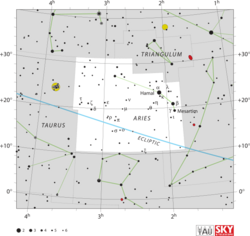
 | |
| Observation data Equinox J2000.0]] (ICRS) | |
|---|---|
| Constellation | Aries |
| Right ascension | 02h 43m 27.11185s[1] |
| Declination | +27° 42′ 25.7233″[1] |
| Apparent magnitude (V) | 4.64[2] |
| Characteristics | |
| Spectral type | B3 V[3] |
| U−B color index | –0.62[4] |
| B−V color index | –0.14[4] |
| Astrometry | |
| Radial velocity (Rv) | +13[5] km/s |
| Proper motion (μ) | RA: 2.06[1] mas/yr Dec.: –10.37[1] mas/yr |
| Parallax (π) | 9.51 ± 0.85[1] mas |
| Distance | 340 ± 30 ly (105 ± 9 pc) |
| Details | |
| Mass | 5.7 ± 0.3[6] M☉ |
| Radius | 2.2–3.9[7] R☉ |
| Luminosity | 870[8] L☉ |
| Temperature | 17,520[9] K |
| Rotational velocity (v sin i) | 90[10] km/s |
| Age | 5.5 ± 4.7[6] Myr |
| Other designations | |
BD+27° 424, FK5 94, HD 16908, HIP 12719, HR 801, SAO 75532.[2] | |
| Database references | |
| SIMBAD | data |
35 Arietis (abbreviated 35 Ari) is a binary star[11] in the northern constellation of Aries. 35 Arietis is the Flamsteed designation. It is approximately 340 light-years (100 parsecs) distant from the Earth, based upon an annual parallax shift of 9.51 mas.[1] This star is visible to the naked eye with an apparent visual magnitude of 4.64.[2]
This is a single-lined spectroscopic binary system, with the presence of a companion being demonstrated by shifts in the spectrum of the primary component.[12] The pair orbit each other with a period of 490.0 days and an eccentricity of 0.14.[11] The primary is a B-type main-sequence star with a stellar classification of B3 V.[3] With a mass around 5.7 times that of the Sun, it is radiating 870[8] times the Sun's luminosity. This energy is being emitted from the outer atmosphere at an effective temperature of 17,520 K,[9] causing it to shine with the blue-white hue of a B-type star.[13]
This star was formerly located in the obsolete constellation Musca Borealis.
References
- ↑ 1.0 1.1 1.2 1.3 1.4 1.5 van Leeuwen, Floor (November 2007), "Validation of the new Hipparcos reduction", Astronomy and Astrophysics 474 (2): 653–664, doi:10.1051/0004-6361:20078357, Bibcode: 2007A&A...474..653V. Note: see VizieR catalogue I/311.
- ↑ 2.0 2.1 2.2 "35 Ari -- Star", SIMBAD (Centre de Données astronomiques de Strasbourg), http://simbad.u-strasbg.fr/simbad/sim-id?Ident=35+Arietis, retrieved 2012-08-15.
- ↑ 3.0 3.1 Borgman, J. (December 1960), "Seven-Colour Photometry of O, B and A Stars", Bulletin of the Astronomical Institutes of the Netherlands 15: 255, Bibcode: 1960BAN....15..255B.
- ↑ 4.0 4.1 Crawford, D. L.; Barnes, J. V.; Golson, J. C. (1971), "Four-color, Hbeta, and UBV photometry for bright B-type stars in the northern hemisphere", The Astronomical Journal 76: 1058, doi:10.1086/111220, Bibcode: 1971AJ.....76.1058C.
- ↑ Evans, D. S. (June 20–24, 1966). "The Revision of the General Catalogue of Radial Velocities". in Batten, Alan Henry; Heard, John Frederick. University of Toronto: International Astronomical Union. 1967. pp. 57–63. Bibcode: 1967IAUS...30...57E.
- ↑ 6.0 6.1 Tetzlaff, N.; Neuhäuser, R.; Hohle, M. M. (January 2011), "A catalogue of young runaway Hipparcos stars within 3 kpc from the Sun", Monthly Notices of the Royal Astronomical Society 410 (1): 190–200, doi:10.1111/j.1365-2966.2010.17434.x, Bibcode: 2011MNRAS.410..190T.
- ↑ Pasinetti Fracassini, L. E. et al. (February 2001), "Catalogue of Apparent Diameters and Absolute Radii of Stars (CADARS) - Third edition - Comments and statistics", Astronomy and Astrophysics 367 (2): 521–524, doi:10.1051/0004-6361:20000451, Bibcode: 2001A&A...367..521P.
- ↑ 8.0 8.1 Hohle, M. M.; Neuhäuser, R.; Schutz, B. F. (April 2010), "Masses and luminosities of O- and B-type stars and red supergiants", Astronomische Nachrichten 331 (4): 349, doi:10.1002/asna.200911355, Bibcode: 2010AN....331..349H.
- ↑ 9.0 9.1 Zorec, J. et al. (July 2009), "Fundamental parameters of B supergiants from the BCD system. I. Calibration of the (λ_1, D) parameters into Teff", Astronomy and Astrophysics 501 (1): 297–320, doi:10.1051/0004-6361/200811147, Bibcode: 2009A&A...501..297Z.
- ↑ Abt, Helmut A.; Levato, Hugo; Grosso, Monica (July 2002), "Rotational Velocities of B Stars", The Astrophysical Journal 573 (1): 359–365, doi:10.1086/340590, Bibcode: 2002ApJ...573..359A.
- ↑ 11.0 11.1 Eggleton, P. P.; Tokovinin, A. A. (September 2008), "A catalogue of multiplicity among bright stellar systems", Monthly Notices of the Royal Astronomical Society 389 (2): 869–879, doi:10.1111/j.1365-2966.2008.13596.x, Bibcode: 2008MNRAS.389..869E.
- ↑ van Rensbergen, W.; De Loore, C.; Jansen, K. (February 2006), "Evolution of interacting binaries with a B type primary at birth", Astronomy and Astrophysics 446 (3): 1071–1079, doi:10.1051/0004-6361:20053543, Bibcode: 2006A&A...446.1071V.
- ↑ "The Colour of Stars", Australia Telescope, Outreach and Education (Commonwealth Scientific and Industrial Research Organisation), December 21, 2004, http://outreach.atnf.csiro.au/education/senior/astrophysics/photometry_colour.html, retrieved 2012-01-16.
External links
- Image 35 Arietis
Constellation of Aries | |||||||||||||
|---|---|---|---|---|---|---|---|---|---|---|---|---|---|
| |||||||||||||
| Stars |
| ||||||||||||
| |||||||||||||
| |||||||||||||
| Galaxies |
| ||||||||||||
| |||||||||||||
| |||||||||||||
 Category Category | |||||||||||||
 |  |
Categories: [Aries (constellation)] [B-type main-sequence stars] [Flamsteed objects] [Spectroscopic binaries] [Durchmusterung objects] [Bright Star Catalogue objects] [Hipparcos objects] [Henry Draper Catalogue objects]
↧ Download as ZWI file | Last modified: 08/26/2025 16:23:47 | 9 views
☰ Source: https://handwiki.org/wiki/Astronomy:35_Arietis | License: CC BY-SA 3.0
 KSF
KSF