Messier 93
 From Handwiki
 | Messier 93 | |
|---|---|
 Open cluster Messier 93 in Puppis | |
| Observation data (J2000.0 epoch) | |
| Constellation | Puppis |
| Right ascension | 07h 44m 30.0s[1] |
| Declination | −23° 51′ 24″[1] |
| Distance | 3.38 kly (1.037 kpc)[1] |
| Apparent magnitude (V) | 6.0[2] |
| Apparent dimensions (V) | 10′[3] |
| Physical characteristics | |
| Mass | 723[4] M☉ |
| Radius | 5[3] |
| Estimated age | 387.3 Myr[1] |
| Other designations | NGC 2447, Cr 160, OCl 649.0 [5] |
Messier 93 or M93, also known as NGC 2447, is an open cluster in the modestly southern constellation Puppis, the imagined poop deck of the legendary Argo.
Observational history and appearance
It was discovered by Charles Messier then added to his catalogue of comet-like objects in 1781.[lower-alpha 1][6] Caroline Herschel, the younger sister of William Herschel, independently discovered it in 1783, thinking it had not yet been catalogued by Messier.[7]
Walter Scott Houston (died 1993) described its appearance:[8]
Some observers mention the cluster as having the shape of a starfish. With a fair-sized telescope, this is its appearance on a dull night, but [a four-inch refractor] shows it as a typical star-studded galactic cluster.
Properties
It has a Trumpler class of I 3 r, indicating it is strongly concentrated (I) with a large range in brightness (3) and is rich in stars (r).[9]
M93 is about 3,380[1] light-years from the solar radius and has a great spatial radius of 5 light-years,[3] a tidal radius of 13.1±2.3 ly,[4] and a core radius of 4.2 ly.[10] Its age is estimated at 387.3 million years.[1] It is nearly on the galactic plane and has an orbit that varies between 28–29 kly (8.5–8.9 kpc) from the Galactic Center over a period of 242.7±7.9 Myr.[1]
Fifty-four variable stars have been found in M93, including one slowly pulsating B-type star, one rotating ellipsoidal variable, seven Delta Scuti variables, six Gamma Doradus variables, and one hybrid δ[lower-alpha 2] Sct/γ Dor[lower-alpha 3] pulsator.[11] Four spectroscopic binary systems within include a yellow straggler component.[12]
Gallery
-
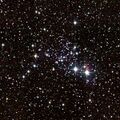 Messier 93 atlas image
 -
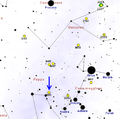 Finder chart for M93


See also
References
- ↑ 1.0 1.1 1.2 1.3 1.4 1.5 1.6 Wu, Zhen-Yu et al. (November 2009), "The orbits of open clusters in the Galaxy", Monthly Notices of the Royal Astronomical Society 399 (4): 2146–2164, doi:10.1111/j.1365-2966.2009.15416.x, Bibcode: 2009MNRAS.399.2146W.
- ↑ "Messier 93". https://messier.seds.org/m/m093.html.
- ↑ 3.0 3.1 3.2 Finlay, Warren H. (2014), Concise Catalog of Deep-Sky Objects: Astrophysical Information for 550 Galaxies, Clusters and Nebulae, The Patrick Moore Practical Astronomy Series (2nd ed.), Springer, p. 120, ISBN 978-3319031705, https://books.google.com/books?id=eJDIAwAAQBAJ&pg=PA120
- ↑ 4.0 4.1 Piskunov, A. E. et al. (January 2008), "Tidal radii and masses of open clusters", Astronomy and Astrophysics 477 (1): 165–172, doi:10.1051/0004-6361:20078525, Bibcode: 2008A&A...477..165P.
- ↑ "NGC 2447". SIMBAD. Centre de données astronomiques de Strasbourg. http://simbad.u-strasbg.fr/simbad/sim-basic?Ident=NGC+2447.
- ↑ Frommert, Hartmut; Kronberg, Christine (September 2, 2007), "Messier 93", SEDS Messier pages (Students for the Exploration and Development of Space (SEDS)), http://www.messier.seds.org/m/m093.html, retrieved 2018-12-07.
- ↑ Hoskin, Michael (February 1, 2016), "Gazing at the starry heavens", Astronomy & Geophysics 57 (1): 1.22–1.25, doi:10.1093/astrogeo/atw038, Bibcode: 2016A&G....57a1.22H
- ↑ Houston, Walter Scott (2005). Deep-Sky Wonders. Sky Publishing Corporation. ISBN 978-1-931559-23-2.
- ↑ Maitzen, H. M. (November 1993), "Photoelectric Search for Peculiar Stars in Open Clusters - Part Fourteen - NGC1901 NGC2169 NGC2343 CR:132 NGC2423 and NGC2447", Astronomy and Astrophysics Supplement 102 (1): 1, Bibcode: 1993A&AS..102....1M.
- ↑ Piskunov, A. E. et al. (June 2007), "Towards absolute scales for the radii and masses of open clusters", Astronomy and Astrophysics 468 (1): 151–161, doi:10.1051/0004-6361:20077073, Bibcode: 2007A&A...468..151P.
- ↑ Eyer, L.; Eggenberger, P.; Greco, C.; Saesen, S.; Anderson, R. I.; Mowlavi, N. (September 2010), "Time resolved surveys of stellar clusters", JENAM 2010, Joint European and National Astronomy Meeting held 6-10 September, 2010 in Lisbon Portugal, pp. 212, 212, Bibcode: 2010jena.confE.212E.
- ↑ da Silveira, M. D. et al. (June 2018), "Red giants and yellow stragglers in the young open cluster NGC 2447", Monthly Notices of the Royal Astronomical Society 476 (4): 4907–4931, doi:10.1093/mnras/sty265, Bibcode: 2018MNRAS.476.4907D
External links
- SEDS: Open Star Cluster M93
- Messier 93 on WikiSky: DSS2, SDSS, GALEX, IRAS, Hydrogen α, X-Ray, Astrophoto, Sky Map, Articles and images
- Gray, Meghan. "M93 – Open Cluster". Deep Sky Videos. Brady Haran. http://www.deepskyvideos.com/videos/messier/M93_open_cluster.html.
Coordinates:  07h 44.6m 00s, −23° 52′ 00″
| List |
|  |
|---|---|---|
| See also | ||


 |  |
Categories: [Open clusters] [Orion–Cygnus Arm] [Puppis] [Messier objects] [NGC objects]
↧ Download as ZWI file | Last modified: 03/08/2026 08:21:08 | 6 views
☰ Source: https://handwiki.org/wiki/Astronomy:Messier_93 | License: CC BY-SA 3.0
 KSF
KSF