Acrasidae
 From Handwiki
| Acrasid slime molds | |
|---|---|
| |
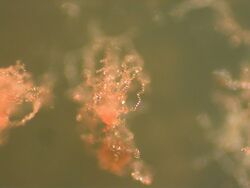
| Acrasis rosea | |
Scientific classification 
| |
| Domain: | Eukaryota |
| Clade: | Discoba |
| Superphylum: | Discicristata |
| Phylum: | Percolozoa |
| Class: | Heterolobosea |
| Order: | Acrasida |
| Family: | Acrasidae van Tieghem 1880 ex Hartog 1906 |
| Genera | |
| |
| Synonyms | |
| |
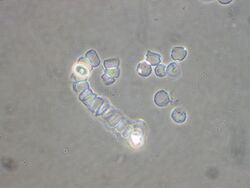
The family Acrasidae (ICZN, or Acrasiomycota, ICBN) is a family[1] of slime molds which belongs to the excavate group Percolozoa. The name element acrasio- comes from the Greek akrasia, meaning "acting against one's judgement". This group consists of cellular slime molds.
Some would also consider it as a kingdom unto itself, but the debate is as yet unsettled.
The terms "Acrasiomycota" or "Acrasiomycetes" have been used when the group was classified as a fungus ("-mycota"). In some classifications, Dictyostelium was placed in Acrasiomycetes, an artificial group of cellular slime molds, which was characterized by the aggregation of individual amoebae into a multicellular fruiting body, making it an important factor that related the acrasids to the dictyostelids.[2]
Reproduction
When resources such as water or food become limiting, the amoeba will release pheromones such as acrasin to aggregate amoebal cells in preparation for movement as a large (thousands of cells) grex or pseudopod. When in the grex, the amoeboids reproduce, resulting in fruit-like structures called spores, which develop into unicellular molds of the same species.
References
- ↑ "Evidence for the Heterolobosea from phylogenetic analysis of genes encoding glyceraldehyde-3-phosphate dehydrogenase". J. Eukaryot. Microbiol. 43 (6): 475–85. 1996. doi:10.1111/j.1550-7408.1996.tb04507.x. PMID 8976605. https://zenodo.org/record/1230683/files/article.pdf.
- ↑ Cavender J.C.; Spiegl F.; Swanson A. (2002). "Taxonomy, slime molds, and the questions we ask". The Mycological Society of America 94 (6): 968–979. PMID 21156570.
- C.J. Alexopolous, Charles W. Mims, M. Blackwell et al., Introductory Mycology, 4th ed. (John Wiley and Sons, Hoboken NJ, 2004) ISBN:0-471-52229-5
Wikidata ☰ {{{from}}} entry
 |  |
Categories: [Percolozoa] [Excavata families]
↧ Download as ZWI file | Last modified: 07/02/2023 19:50:38 | 5 views
☰ Source: https://handwiki.org/wiki/Biology:Acrasidae | License: CC BY-SA 3.0
 ZWI signed:
 KSF
KSF