Inverse Hyperbolic Functions
 From Encyclopediaofmath
Functions inverse to the hyperbolic functions. The inverse hyperbolic functions are the inverse hyperbolic sine, cosine and tangent: $ \sinh ^ {-1} x $,
$ \cosh ^ {-1} x $,
$ \mathop{\rm tanh} ^ {-1} x $;
other notations are: $ { \mathop{\rm arg} \sinh } x $,
$ { \mathop{\rm arg} \cosh } x $,
$ { \mathop{\rm arg} \mathop{\rm tanh} } x $.
The inverse hyperbolic functions of a real variable $ x $ are defined by the formulas
$$ \sinh ^ {-1} x = \ \mathop{\rm ln} ( x + \sqrt {x ^ {2} + 1 } ) ,\ \ - \infty < x < + \infty , $$
$$ \cosh ^ {-1} x = \ \pm \mathop{\rm ln} ( x + \sqrt {x ^ {2} - 1 } ) ,\ \ x \geq 1 , $$
$$ \mathop{\rm tanh} ^ {-1} x = \frac{1}{2} \mathop{\rm ln} \frac{1 + x }{1 - x } ,\ | x | < 1 . $$
The inverse hyperbolic functions are single-valued and continuous at each point of their domain of definition, except for $ \cosh ^ {-1} x $, which is two-valued. In studying the properties of the inverse hyperbolic functions, one of the continuous branches of $ \cosh ^ {-1} x $ is chosen, that is, in the formula above only one sign is taken (usually plus). For the graphs of these functions see the figure.
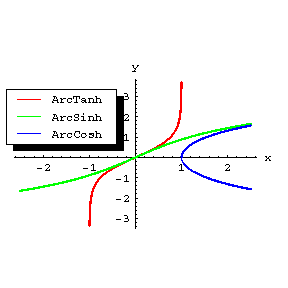
Figure: i052370a
There a number of relations between the inverse hyperbolic functions. For example,
$$ \sinh ^ {-1} x = \ \mathop{\rm tanh} ^ {-1} \ \frac{x}{\sqrt {x ^ {2} + 1 } } ,\ \ \mathop{\rm tanh} ^ {-1} x = \ \sinh ^ {-1} \ \frac{x}{\sqrt {1 - x ^ {2} } } . $$
The derivatives of the inverse hyperbolic functions are given by the formulas
$$ ( \sinh ^ {-1} x ) ^ \prime = \ \frac{1}{\sqrt {x ^ {2} + 1 } } ,\ \ ( \cosh ^ {-1} x ) ^ \prime = \pm \frac{1}{\sqrt {x ^ {2} - 1 } } , $$
$$ ( \mathop{\rm tanh} ^ {-1} x ) ^ \prime = \frac{1}{ {1 - x ^ {2} } } . $$
The inverse hyperbolic functions of a complex variable $ z $ are defined by the same formulas as those for a real variable $ x $, where $ \mathop{\rm ln} z $ is understood to be the many-valued logarithmic function. The inverse hyperbolic functions of a complex variable are the analytic continuations to the complex plane of the corresponding functions of a real variable.
The inverse hyperbolic functions can be expressed in terms of the inverse trigonometric functions by the formulas
$$ \sinh ^ {-1} z = - i { \mathop{\rm arc} \sin } i z , $$
$$ \cosh ^ {-1} z = i { \mathop{\rm arc} \cos } z , $$
$$ \mathop{\rm tanh} ^ {-1} z = - i { \mathop{\rm arc} \mathop{\rm tan} } i z . $$
Comments[edit]
The notations $ { \mathop{\rm arc} \sinh } x $, $ { \mathop{\rm arc} \cosh } x $ and $ { \mathop{\rm arc} \mathop{\rm tanh} } x $ are also quite common.
References[edit]
| [a1] | M.R. Spiegel, "Complex variables" , Schaum's Outline Series , McGraw-Hill (1974) |
| [a2] | M. Abramowitz, I.A. Stegun, "Handbook of mathematical functions" , Dover, reprint (1972) |
↧ Download as ZWI file | Last modified: 12/27/2025 05:17:33 | 3 views
☰ Source: https://encyclopediaofmath.org/wiki/Inverse_hyperbolic_functions | License: CC BY-SA 3.0
 KSF
KSF