Fact Check#Was Economic Growth Sluggish During The Obama Presidency
 From Ballotpedia
 Fact check: Was economic growth sluggish during the Obama presidency?

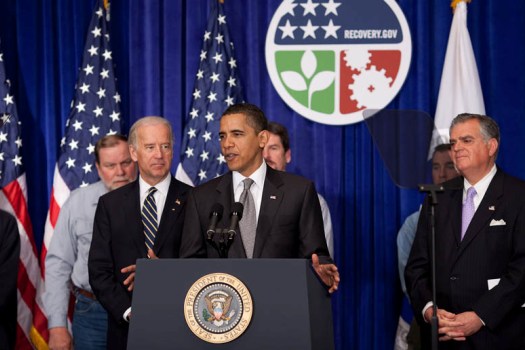
Former President Barack Obama
March 22, 2017
By Sara Reynolds
A C-SPAN survey of 91 presidential historians rated former President Barack Obama as the nation’s 12th-best president and eighth-best in economic management.[1][2] An editorial in The Oklahoman challenged the rankings, saying that "the sluggish growth of the Obama years is one of the major strikes against his presidency."[1]
Was growth sluggish during the Obama presidency?
Sluggish is a subjective term. Comparing gross domestic product (GDP), total employed persons, and quarterly wages and salaries during the previous 11 periods of economic expansion, Ballotpedia found that:
- In the expansion that began under President Obama in June 2009 and through 2016, GDP grew by an average of 2.1 percent annually, the lowest rate among expansion periods since 1949.[3][4][5]
- In the same period, total jobs grew 8.6 percent, from 140 million to 152 million. Greater job growth occurred in five other expansion periods.[6]
- Quarterly wages and salaries increased 18 percent (when adjusted for inflation), from $7.1 trillion in the second quarter of 2009 to $8.4 trillion in the third quarter of 2016 (the most recent data). Wages and salaries increased by a greater percentage in five other expansion periods since 1949 (the range of growth was 18.3 percent to 59.2 percent).[7][8][5]
Background
C-SPAN has conducted three Historians Surveys of Presidential Leadership since 2000. Participants are asked to rate each president on 10 leadership qualities using a scale from one (not effective) to 10 (very effective). C-SPAN describes the participants as "historians and other professional observers of the presidency."[9][10] In the 2017 survey, President Obama was ranked eighth in economic management, behind Presidents Washington, Lincoln, Clinton, Theodore Roosevelt, Franklin Roosevelt, Eisenhower, and Kennedy.[2]
Economies experience cyclical expansions and contractions (also known as recessions). Obama's presidency ran from January 20, 2009, to January 20, 2017.[11] He took office amid a recession that lasted from December 2007 to June 2009. The economy has been in a period of expansion since then.[12]
According to the National Bureau of Economic Research, there have been 11 expansion periods since 1949. The current expansion, now in its 93rd month, is the third-longest since 1949. The longest post-war expansion ran 120 months, from 1991 to 2001, followed by 106 months of economic expansion between 1961 and 1969.[13][14][12]
GDP
According to the Commerce Department’s Bureau of Economic Analysis, in the current expansion period (covering the Obama presidency), the growth rate for GDP has averaged 2.1 percent annually when adjusted for inflation. This is the lowest growth rate among the 11 previous expansion periods. Average annual GDP growth was less than 3 percent in only one expansion period since 1949, from Q4 2001 to Q4 2007 (in calendar years).[3][4][15][5]
Total Employment
The number of employed persons grew 8.6 percent, from 140 million to 152 million, during the expansion period that ran through the Obama administration.[6][16] This employment growth ranked sixth among the previous 11 expansion periods. Total employment grew most during the expansion period of February 1961 (Q1) to December 1969 (Q4), growing the least from July 1980 (Q3) to July 1981 (Q3).[17][6][18]
| Total employed citizens, seasonally adjusted | ||||
|---|---|---|---|---|
| Length of expansion (in months) | Start of expansion | End of expansion | Percent change | |
| 1949 Q4 - 1953 Q2 | 45 | 57.3 million | 61.4 million | 7.2% |
| 1954 Q2 - 1957 Q3 | 39 | 59.9 million | 64.0 million | 6.8% |
| 1958 Q2 - 1960 Q2 | 24 | 62.6 million | 66.0 million | 5.3% |
| 1961 Q1 - 1969 Q4 | 106 | 65.6 million | 78.7 million | 20.1% |
| 1970 Q4 - 1973 Q4 | 36 | 78.7 million | 86.3 million | 9.8% |
| 1975 Q1 - 1980 Q1 | 58 | 85.2 million | 99.9 million | 17.2% |
| 1980 Q3 - 1981 Q3 | 12 | 98.8 million | 100.7 million | 1.9% |
| 1982 Q4 - 1990 Q3 | 92 | 99.1 million | 118.8 million | 19.9% |
| 1991 Q1 - 2001 Q1 | 120 | 117.7 million | 137.8 million | 17.1% |
| 2001 Q4 - 2007 Q4 | 73 | 136.2 million | 146.3 million | 7.4% |
| 2009 Q2 - 2017 Q1 | 93 | 140.0 million | 152.1 million | 8.6% |
|
Note: Numbers may not add up due to rounding. | ||||
Wages
Quarterly wages and salaries increased 18 percent, from $7.1 trillion to $8.4 trillion (in 2017 dollars) during the Obama administration.[7][19] That rate of growth ranks fifth among the previous 11 expansion periods.[7][8]
| Quarterly wages and salaries, seasonally adjusted | |||
|---|---|---|---|
| Start of expansion | End of expansion | Percent change | |
| 1949 Q4 - 1953 Q2 | $1.3 trillion | $1.8 trillion | 34.2% |
| 1954 Q2 - 1957 Q3 | $1.8 trillion | $2.1 trillion | 18.3% |
| 1958 Q2 - 1960 Q2 | $2.0 trillion | $2.2 trillion | 12.5% |
| 1961 Q1 - 1969 Q4 | $2.2 trillion | $3.5 trillion | 59.2% |
| 1970 Q4 - 1973 Q4 | $3.5 trillion | $4.0 trillion | 15.6% |
| 1975 Q1 - 1980 Q1 | $3.6 trillion | $3.9 trillion | 10.3% |
| 1980 Q3 - 1981 Q3 | $4.0 trillion | $4.1 trillion | 0.7% |
| 1982 Q4 - 1990 Q3 | $4.0 trillion | $5.1 trillion | 27.5% |
| 1991 Q1 - 2001 Q1 | $4.9 trillion | $6.8 trillion | 38.6% |
| 2001 Q4 - 2007 Q4 | $6.8 trillion | $7.6 trillion | 12.0% |
| 2009 Q2 - 2017 Q1 | $7.1 trillion | $8.4 trillion | 18.0% |
|
Numbers have been adjusted using the U.S. Department of Labor CPI Inflation Calculator. | |||
Conclusion
A C-SPAN survey of 91 presidential historians rated Obama as the nation's 12th-best president and eighth-best in economic management.[2] The Oklahoman responded to the survey results in an editorial: "Yet the sluggish growth of the Obama years is one of the major strikes against his presidency."[1]
Sluggish is a subjective term. In the expansion period that began under President Obama, GDP growth has averaged 2.1 percent per year, the slowest rate among the 11 expansion periods since 1949.[3][4] Total employment grew 8.6 percent, from 140 million in June 2009 to 152 million in December 2016, and quarterly wages and salaries increased 18 percent, from $7.1 to $8.4 trillion (in 2017 dollars). Employment and wages grew more during five of the 11 economic expansions since 1949.[6][7][8]
See also
- Fact check/Did federal debt fall over President Trump's first month in office?
- Fact check/Is Donald Trump right that the debt has doubled under President Barack Obama?
- Barack Obama
Sources and Notes[edit]
- ↑ 1.0 1.1 1.2 The Oklahoman, "Oklahoma ScissorTales: Legislature dealing with Real ID law, finally," February 25, 2017
- ↑ 2.0 2.1 2.2 C-SPAN, "Presidential Historians Survey 2017," accessed March 8, 2017
- ↑ 3.0 3.1 3.2 United States Department of Commerce, Bureau of Economic Analysis, "National Economic Accounts," accessed March 8, 2017
- ↑ 4.0 4.1 4.2 Annual growth rate calculated using Moneychimp.com, "Return Rate (Discount Rate / CAGR) Calculator," accessed March 11, 2017
- ↑ 5.0 5.1 5.2 The Bureau of Economic Analysis provides statistics in calendar years. For example, quarter 1 of 2016 would be January, February, and March of 2016. Confirmed by Ballotpedia: Sara Reynolds, "Phone communication with Jeff Newman, Bureau of Economic Analysis economist," March 22, 2017
- ↑ 6.0 6.1 6.2 6.3 United States Department of Labor, Bureau of Labor Statistics, "Labor Force Statistics from the Current Population Survey, Employment Level," accessed March 16, 2017
- ↑ 7.0 7.1 7.2 7.3 United States Department of Commerce, Bureau of Economic Analysis, "Wages and Salaries by Industry (SQ7, SQyH, SQ7N)," accessed March 16, 2017
- ↑ 8.0 8.1 8.2 Numbers have been adjusted using the U.S. Department of Labor CPI Inflation Calculator.
- ↑ C-SPAN, "Presidential Historians Survey: Methodology," accessed March 20, 2017
- ↑ Here are the 10 qualities, in the words of the survey: public persuasion, crisis leadership, economic management, moral authority, international relations, administrative skills, relations with Congress, vision/setting an agenda, pursued equal justice for all, and performance within the context of his times. See: C-SPAN, "Presidential Historians Survey: Methodology," accessed March 20, 2017
- ↑ Ballotpedia, "Barack Obama," accessed March 14, 2017
- ↑ 12.0 12.1 The National Bureau of Economic Research, "US Business Cycle Expansions and Contractions," accessed March 11, 2017
- ↑ Presidents George H.W. Bush, Bill Clinton, and George W. Bush were in office during the March 1991 to March 2001 expansion period. Presidents John F. Kennedy, Lyndon Johnson, and Richard Nixon were in office during the expansion period from February 1961 to December 1969.
- ↑ The data on economic expansions appeared in the Wall Street Journal on July 29, 2016. Ballotpedia confirmed the data with the National Bureau of Economic Research. See: Wall Street Journal, "Seven Years Later, Recovery Remains the Weakest of the Post-World War II Era," July 29, 2016
- ↑ The Bureau of Economic Analysis provides quarterly, seasonally adjusted GDP data dating back to 1947. 1949 is the first expansion year with quarterly data.
- ↑ The expansion that began in June 2009 is ongoing.
- ↑ Presidents John F. Kennedy, Lyndon Johnson, and Richard Nixon were in office during the expansion period from February 1961 to December 1969. Presidents Jimmy Carter and Ronald Reagan were in office during the expansion from July 1980 to July 1981.
- ↑ Employment-level statistics are seasonally adjusted and represent employed people age 16 and older.
- ↑ The Bureau of Economic Analysis defines wages and salaries as the "remuneration receivable by employees (including corporate officers) from employers for the provision of labor services. It includes commissions, tips, and bonuses; employee gains from exercising stock options; and pay-in-kind. Judicial fees paid to jurors and witnesses are classified as wages and salaries. Wages and salaries are measured before deductions, such as social security contributions, union dues, and voluntary employee contributions to defined contribution pension plans."

Launched in October 2015 and active through October 2018, Fact Check by Ballotpedia examined claims made by elected officials, political appointees, and political candidates at the federal, state, and local levels. We evaluated claims made by politicians of all backgrounds and affiliations, subjecting them to the same objective and neutral examination process. As of 2025, Ballotpedia staff periodically review these articles to revaluate and reaffirm our conclusions. Please email us with questions, comments, or concerns about these articles. To learn more about fact-checking, click here.
Contact
More Fact Checks

October 30, 2018
August 24, 2018



|

|
Categories: [Fact Check March 2017] [Fact Check federal] [Fact Check economy] [Fact Check President]
↧ Download as ZWI file | Last modified: 11/08/2025 08:27:47 | 37 views
☰ Source: https://ballotpedia.org/Fact_check/Was_economic_growth_sluggish_during_the_Obama_presidency | License: CC BY-SA 3.0
 KSF
KSF