Rhea (Moon)
 From Handwiki
  Cassini mosaic of Rhea | |||||||||
| Discovery | |||||||||
|---|---|---|---|---|---|---|---|---|---|
| Discovered by | G. D. Cassini[1] | ||||||||
| Discovery date | December 23, 1672[1] | ||||||||
| Designations | |||||||||
Designation | Saturn V | ||||||||
| Pronunciation | /ˈriː.ə/[2] | ||||||||
| Named after | Ῥέᾱ Rheā | ||||||||
| Adjectives | Rhean /ˈriː.ən/[3] | ||||||||
| Orbital characteristics [4] | |||||||||
| 527108 km | |||||||||
| Eccentricity | 0.0012583 | ||||||||
| Orbital period | 4.518212 d | ||||||||
| Average Orbital speed | 8.48 km/s[lower-alpha 1] | ||||||||
| Inclination | 0.345° (to Saturn's equator) | ||||||||
| Satellite of | Saturn | ||||||||
| Physical characteristics | |||||||||
| Dimensions | 1532.4 × 1525.6 × 1524.4 km [5] | ||||||||
| Mean radius | 763.5±0.5 km[6] | ||||||||
| Surface area | 7337000 km2 | ||||||||
| Mass | (2.3064854±0.0000522)×1021 kg[6] (~3.9×10⁻⁴ Earths) | ||||||||
| Mean density | 1.2372±0.0029 g/cm3[6] | ||||||||
| 0.264 m/s2 | |||||||||
| inertia factor | 0.3911±0.0045[7] (disputed/unclear[8]) | ||||||||
| 0.635 km/s | |||||||||
| Rotation period | 4.518212 d (synchronous) | ||||||||
| Axial tilt | zero | ||||||||
| Albedo | 0.949±0.003 (geometric) [9] | ||||||||
| |||||||||
| Apparent magnitude | 10 [10] | ||||||||
Rhea (/ˈriː.ə/) is the second-largest moon of Saturn and the ninth-largest moon in the Solar System, with a surface area that is comparable to the area of Australia . It is the smallest body in the Solar System for which precise measurements have confirmed a shape consistent with hydrostatic equilibrium.[11] It was discovered in 1672 by Giovanni Domenico Cassini.
Discovery

Rhea was discovered by Giovanni Domenico Cassini on 23 December 1672.[1] It was the second moon of Saturn that Cassini discovered, and the third moon discovered around Saturn overall.[1]
Name
Rhea is named after the Titan Rhea of Greek mythology, the "mother of the gods" and wife of Kronos, the Greek counterpart of the god Saturn. It is also designated Saturn V (being the fifth major moon going outward from the planet, after Mimas, Enceladus, Tethys, and Dione).[12][13]
Cassini named the four moons he discovered (Tethys, Dione, Rhea, and Iapetus) Sidera Lodoicea (the stars of Louis) to honor King Louis XIV.[1] Astronomers fell into the habit of referring to them and Titan as Saturn I through Saturn V.[1] Once Mimas and Enceladus were discovered, in 1789, the numbering scheme was extended to Saturn VII, and then to Saturn VIII with the discovery of Hyperion in 1848.[13]
Rhea was not named until 1847, when John Herschel (son of William Herschel, discoverer of the planet Uranus, and two other moons of Saturn, Mimas and Enceladus) suggested in Results of Astronomical Observations made at the Cape of Good Hope that the names of the Titans, sisters and brothers of Kronos (Saturn, in Roman mythology), be used.[14][1]
Physical characteristics
Size, mass, and internal structure

Rhea is an icy body with a density of about 1.236 g/cm3. This low density indicates that it is made of ~25% rock (density ~3.25 g/cm3) and ~75% water ice (density ~0.93 g/cm3). Although Rhea is the ninth-largest moon, it is only the tenth-most massive moon. Indeed, Oberon, the second-largest moon of Uranus, has almost the same size, but is significantly denser than Rhea (1.63 vs 1.24) and thus more massive, although Rhea is slightly larger by volume. [lower-alpha 2]
Before the Cassini-Huygens mission, it was assumed that Rhea had a rocky core.[15] However, measurements taken during a close flyby by the Cassini orbiter in 2005 cast this into doubt. In a paper published in 2007 it was claimed that the axial dimensionless moment of inertia coefficient was 0.4.[lower-alpha 3][16] Such a value indicated that Rhea had an almost homogeneous interior (with some compression of ice in the center) while the existence of a rocky core would imply a moment of inertia of about 0.34.[15] In the same year another paper claimed the moment of inertia was about 0.37.[lower-alpha 4] Rhea being either partially or fully differentiated would be consistent with the observations of the Cassini probe.[17] A year later yet another paper claimed that the moon may not be in hydrostatic equilibrium meaning that the moment of inertia cannot be determined from the gravity data alone.[18] In 2008 an author of the first paper tried to reconcile these three disparate results. He concluded that there is a systematic error in the Cassini radio Doppler data used in the analysis, but after restricting the analysis to a subset of data obtained closest to the moon, he arrived at his old result that Rhea was in hydrostatic equilibrium and had a moment of inertia of about 0.4, again implying a homogeneous interior.[8]
The triaxial shape of Rhea is consistent with a homogeneous body in hydrostatic equilibrium rotating at Rhea's angular velocity.[19] Modelling in 2006 suggested that Rhea could be barely capable of sustaining an internal liquid-water ocean through heating by radioactive decay; such an ocean would have to be at about 176 K, the eutectic temperature for the water–ammonia system.[20] More recent indications are that Rhea has a homogeneous interior and hence that this ocean does not exist.[8]


Surface features
Rhea's features resemble those of Dione, with dissimilar leading and trailing hemispheres, suggesting similar composition and histories. The temperature on Rhea is 99 K (−174 °C) in direct sunlight and between 73 K (−200 °C) and 53 K (−220 °C) in the shade.

Rhea has a rather typical heavily cratered surface,[21] with the exceptions of a few large Dione-type chasmata or fractures (wispy terrain) on the trailing hemisphere (the side facing away from the direction of motion along Rhea's orbit)[22] and a very faint "line" of material at Rhea's equator that may have been deposited by material deorbiting from its rings.[23] Rhea has two very large impact basins on its anti-Cronian hemisphere (facing away from Saturn), which are about 400 and 500 km across.[22] The more northerly and less degraded of the two, called Tirawa, is roughly comparable to the basin Odysseus on Tethys.[21] There is a 48 km-diameter impact crater at 112°W that is prominent because of an extended system of bright rays.[22] This crater, called Inktomi, is nicknamed "The Splat", and may be one of the youngest craters on the inner moons of Saturn.[22] No evidence of any endogenic activity has been discovered.[22]
_away.jpg)
Its surface can be divided into two geologically different areas based on crater density; the first area contains craters which are larger than 40 km in diameter, whereas the second area, in parts of the polar and equatorial regions, has only craters under that size. This suggests that a major resurfacing event occurred some time during its formation. The leading hemisphere is heavily cratered and uniformly bright. As on Callisto, the craters lack the high relief features seen on the Moon and Mercury. It has been theorized that these cratered plains are up to four billion years old on average.[24] On the trailing hemisphere there is a network of bright swaths on a dark background and few visible craters. It had been thought that these bright areas might be material ejected from ice volcanoes early in Rhea's history when its interior was still liquid. However, observations of Dione, which has an even darker trailing hemisphere and similar but more prominent bright streaks, show that the streaks are actually ice cliffs resulting from extensive fracturing of the moon's surface.[citation needed] The extensive dark areas are thought to be deposited tholins, which are a mix of complex organic compounds generated on the ice by pyrolysis and radiolysis of simple compounds containing carbon, nitrogen and hydrogen.[25]
The January 17, 2006 distant flyby by the Cassini spacecraft yielded images of the wispy hemisphere at better resolution and a lower Sun angle than previous observations. Images from this and subsequent flybys showed that Rhea's streaks in fact are tectonically formed ice cliffs (chasmata) similar to those of Dione.
Formation
The moons of Saturn are thought to have formed through co-accretion, a similar process to that believed to have formed the planets in the Solar System. As the young giant planets formed, they were surrounded by discs of material that gradually coalesced into moons. However, a proposed model for the formation of Titan may also shine a new light on the origin of Rhea and Iapetus. In this model, Titan was formed in a series of giant impacts between pre-existing moons, and Rhea and Iapetus are thought to have formed from part of the debris of these collisions.[26]
Atmosphere
On November 27, 2010, NASA announced the discovery of a tenuous atmosphere—an exosphere. It consists of oxygen and carbon dioxide in proportion of roughly 5 to 2. The surface density of the exosphere is from 105 to 106 molecules in a cubic centimeter depending on local temperature. The main source of oxygen is radiolysis of water ice at the surface by ions supplied by the magnetosphere of Saturn. The source of the carbon dioxide is less clear, but it may be related to oxidation of the organics present in ice or to outgassing of the moon's interior.[27][28]
Possible ring system
On March 6, 2008, NASA announced that Rhea may have a tenuous ring system. This would mark the first discovery of rings around a moon. The rings' existence was inferred by observed changes in the flow of electrons trapped by Saturn's magnetic field as Cassini passed by Rhea.[29][30][31] Dust and debris could extend out to Rhea's Hill sphere, but were thought to be denser nearer the moon, with three narrow rings of higher density. The case for a ring was strengthened by the subsequent finding of the presence of a set of small ultraviolet-bright spots distributed along Rhea's equator (interpreted as the impact points of deorbiting ring material).[32] However, when Cassini made targeted observations of the putative ring plane from several angles, no evidence of ring material was found, suggesting that another explanation for the earlier observations is needed.[33][34]
Exploration
The first images of Rhea were obtained by Voyager 1 & 2 spacecraft in 1980–1981.
There were five close targeted fly-bys by the Cassini orbiter: at a distance of 500 km on November 26, 2005, at a distance of 5,750 km on August 30, 2007, at a distance of 100 km on March 2, 2010, and at 69 km flyby on January 11, 2011[35] and a last flyby at 992 km on March 9, 2013.[36] Rhea has been also imaged many times from long to moderate distances by the orbiter.
Gallery
-
 An artist's impression of Rhea's rings
 -
 Cassini color image of Rhea - large crater Powehiwehi (right center) - chasmata stretch vertically above (past crater Wakonda, near the terminator) - Onokoro Catenae (lower left).
 -
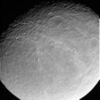 Image of the wispy hemisphere, showing ice cliffs - Powehiwehi (upper center); chasmata stretch from upper left to right center - Onokoro Catenae (lower right).
 -
.jpg/100px-PIA08148_(Rhea-Splat).jpg) View of Rhea's leading hemisphere with crater Inktomi and its prominent ray system just below center; impact basin Tirawa is at upper left
View of Rhea's leading hemisphere with crater Inktomi and its prominent ray system just below center; impact basin Tirawa is at upper left -
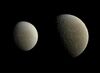 Enhanced-color views of Rhea taken by Cassini on 9 February 2015
 -
 Rhea's horizon viewed on 10 February 2015.


.jpg)


See also
- Former classification of planets
- List of natural satellites
- Rhea in fiction
- Rings of Rhea
- Subsatellite
- Moons of Saturn
Notes
- ↑ Calculated on the basis of other parameters.
- ↑ The moons more massive than Rhea are: the Moon, the four Galilean moons, Titan, Triton, Titania, and Oberon. Oberon, Uranus's second-largest moon, has a radius that is ~0.4% smaller than Rhea's, but a density that is ~26% greater. See JPLSSD.
- ↑ More precisely, 0.3911.[16]
- ↑ More precisely, 0.3721.[17]
References
- ↑ 1.0 1.1 1.2 1.3 1.4 1.5 1.6 Tillman, Nola Taylor (2016-06-29). "Rhea: Saturn's dirty snowball moon". http://www.space.com/20577-rhea-saturn-s-dirty-snowball-moon.html.
- ↑ Consulmagno, G.; Ryche, H. (Feb 9, 1982). "Pronouncing the names of the moons of Saturn". EOS 63 (6): 146–147. doi:10.1029/EO063i006p00146. https://www.vaticanobservatory.org/wp-content/uploads/2019/12/Consolmagno-Reiche-Pronouncing-Moons-of-Saturn.pdf. Retrieved Nov 30, 2022.
- ↑ Moore et al. (1984) "The Geomorphology of Rhea", Proceedings of the fifteenth Lunar and Planetary Science, Part 2, p C-791–C-794
- ↑ Natural Satellites Ephemeris Service Minor Planet Center
- ↑ Roatsch, T.; Jaumann, R.; Stephan, K.; Thomas, P. C. (2009). "Cartographic Mapping of the Icy Satellites Using ISS and VIMS Data". Saturn from Cassini-Huygens. pp. 763–781. doi:10.1007/978-1-4020-9217-6_24. ISBN 978-1-4020-9216-9.
- ↑ 6.0 6.1 6.2 Jacobson, Robert. A. (1 November 2022). "The Orbits of the Main Saturnian Satellites, the Saturnian System Gravity Field, and the Orientation of Saturn's Pole*". The Astronomical Journal 164 (5): 199. doi:10.3847/1538-3881/ac90c9. Bibcode: 2022AJ....164..199J.
- ↑ Anderson, J. D.; Schubert, G. (2007). "Saturn's satellite Rhea is a homogeneous mix of rock and ice". Geophysical Research Letters 34 (2): L02202. doi:10.1029/2006GL028100. Bibcode: 2007GeoRL..34.2202A.
- ↑ 8.0 8.1 8.2 Anderson, John D. (July 2008). "Rhea's Gravitational Field and Internal Structure". 37th COSPAR Scientific Assembly. Held 13–20 July 2008, in Montréal, Canada. p. 89. Bibcode: 2008cosp...37...89A.
- ↑ Verbiscer, A.; French, R.; Showalter, M.; Helfenstein, P. (9 February 2007). "Enceladus: Cosmic Graffiti Artist Caught in the Act". Science 315 (5813): 815. doi:10.1126/science.1134681. PMID 17289992. Bibcode: 2007Sci...315..815V. (supporting online material, table S1)
- ↑ Observatorio ARVAL (April 15, 2007). "Classic Satellites of the Solar System". Observatorio ARVAL. http://www.oarval.org/ClasSaten.htm.
- ↑ Thomas, P.C. (2010). "Sizes, shapes, and derived properties of the saturnian satellites after the Cassini nominal mission". Icarus. http://www.ciclops.org/media/sp/2011/6794_16344_0.pdf.
- ↑ "In Depth | Rhea". NASA Science. December 19, 2019. https://solarsystem.nasa.gov/moons/saturn-moons/rhea/in-depth/.
- ↑ 13.0 13.1 "Planet and Satellite Names and Discoverers". Gazetteer of Planetary Nomenclature. USGS Astrogeology. July 21, 2006. https://planetarynames.wr.usgs.gov/Page/Planets.
- ↑ As reported by William Lassell, Monthly Notices of the Royal Astronomical Society, Vol. 8, No. 3, pp. 42–43 (January 14, 1848)
- ↑ 15.0 15.1 Anderson, J. D.; Rappaport, N. J.; Giampieri, G. et al. (2003). "Gravity field and interior structure of Rhea". Physics of the Earth and Planetary Interiors 136 (3–4): 201–213. doi:10.1016/S0031-9201(03)00035-9. Bibcode: 2003PEPI..136..201A.
- ↑ 16.0 16.1 Anderson, J. D.; Schubert, J. (2007). "Saturn's satellite Rhea is a homogeneous mix of rock and ice". Geophysical Research Letters 34 (2): L02202. doi:10.1029/2006GL028100. Bibcode: 2007GeoRL..3402202A.
- ↑ 17.0 17.1 Iess, L.; Rappaport, N.; Tortora, P.; Lunine, Jonathan I.; Armstrong, J.; Asmar, S.; Somenzi, L.; Zingoni, F. (2007). "Gravity field and interior of Rhea from Cassini data analysis". Icarus 190 (2): 585. doi:10.1016/j.icarus.2007.03.027. Bibcode: 2007Icar..190..585I.
- ↑ MacKenzie, R. A.; Iess, L.; Tortora, P.; Rappaport, N. J. (2008). "A non-hydrostatic Rhea". Geophysical Research Letters 35 (5): L05204. doi:10.1029/2007GL032898. Bibcode: 2008GeoRL..3505204M.
- ↑ Thomas, P. C.; Burns, J. A.; Helfenstein, P.; Squyres, S.; Veverka, J.; Porco, C.; Turtle, E. P.; McEwen, A. et al. (October 2007). "Shapes of the saturnian icy satellites and their significance". Icarus 190 (2): 573–584. doi:10.1016/j.icarus.2007.03.012. Bibcode: 2007Icar..190..573T. http://www.geoinf.fu-berlin.de/publications/denk/2007/ThomasEtAl_SaturnMoonsShapes_Icarus_2007.pdf. Retrieved 15 December 2011.
- ↑ Hussmann, Hauke; Sohl, Frank; Spohn, Tilman (November 2006). "Subsurface oceans and deep interiors of medium-sized outer planet satellites and large trans-neptunian objects". Icarus 185 (1): 258–273. doi:10.1016/j.icarus.2006.06.005. Bibcode: 2006Icar..185..258H. https://www.researchgate.net/publication/225019299.
- ↑ 21.0 21.1 Moore, Jeffrey M.; Schenk, Paul M.; Bruesch, Lindsey S.; Asphaug, Erik; McKinnon, William B. (October 2004). "Large impact features on middle-sized icy satellites". Icarus 171 (2): 421–443. doi:10.1016/j.icarus.2004.05.009. Bibcode: 2004Icar..171..421M. http://planets.oma.be/ISY/pdf/article_Icy.pdf.
- ↑ 22.0 22.1 22.2 22.3 22.4 Wagner, R.J.; Neukum, G. et al. (2008). "Geology of Saturn's Satellite Rhea on the Basis of the High-Resolution Images from the Targeted Flyby 049 on Aug. 30, 2007". Lunar and Planetary Science XXXIX (1391): 1930. Bibcode: 2008LPI....39.1930W.
- ↑ Schenk, Paul M.; McKinnon, W. B. (2009). "Global Color Variations on Saturn's Icy Satellites, and New Evidence for Rhea's Ring". American Astronomical Society 41: 3.03. Bibcode: 2009DPS....41.0303S.
- ↑ "Rhea - Overview | Planets - NASA Solar System Exploration". https://solarsystem.nasa.gov/planets/rhea.
- ↑ A spectroscopic study of the surfaces of Saturn's large satellites: H2O ice, tholins, and minor constituents (PDF). Dale P. Cruikshank, Tobias. Owen, Cristina Dalle Ore, Thomas R. Geballe, Ted L. Roush, Catherine de Bergh, Scott A. Sandford, Francois Poulet, Gretchen K. Benedix, Joshua P. Emery. Icarus, 175, pages: 268–283, 2 March 2005.
- ↑ "Giant impact scenario may explain the unusual moons of Saturn". Space Daily. 2012. http://www.spacedaily.com/reports/Giant_impact_scenario_may_explain_the_unusual_moons_of_Saturn_999.html.
- ↑ "Cassini Finds Ethereal Atmosphere at Rhea". NASA. http://www.nasa.gov/mission_pages/cassini/whycassini/cassini20101126.html.
- ↑ Teolis, B. D.; Jones, G. H.; Miles, P. F.; Tokar, R. L.; Magee, B. A.; Waite, J. H.; Roussos, E.; Young, D. T. et al. (2010). "Cassini Finds an Oxygen-Carbon Dioxide Atmosphere at Saturn's Icy Moon Rhea". Science 330 (6012): 1813–1815. doi:10.1126/science.1198366. PMID 21109635. Bibcode: 2010Sci...330.1813T.
- ↑ Saturn's Moon Rhea Also May Have Rings , NASA, June 3, 2006
- ↑ Jones, G. H. et al. (2008-03-07). "The Dust Halo of Saturn's Largest Icy Moon, Rhea". Science 319 (5868): 1380–1384. doi:10.1126/science.1151524. PMID 18323452. Bibcode: 2008Sci...319.1380J.
- ↑ Lakdawalla, E. (2008-03-06). "A Ringed Moon of Saturn? Cassini Discovers Possible Rings at Rhea". The Planetary Society web site. Planetary Society. http://planetary.org/news/2008/0306_A_Ringed_Moon_of_Saturn_Cassini.html.
- ↑ Lakdawalla, E. (5 October 2009). "Another possible piece of evidence for a Rhea ring". The Planetary Society Blog. Planetary Society. http://planetary.org/blog/article/00002137/.
- ↑ Matthew S. Tiscareno; Joseph A. Burns; Jeffrey N. Cuzzi; Matthew M. Hedman (2010). "Cassini imaging search rules out rings around Rhea". Geophysical Research Letters 37 (14): L14205. doi:10.1029/2010GL043663. Bibcode: 2010GeoRL..3714205T.
- ↑ Kerr, Richard A. (2010-06-25). "The Moon Rings That Never Were". ScienceNow. http://news.sciencemag.org/sciencenow/2010/06/the-moon-rings-that-never-were.html. Retrieved 2010-08-05.
- ↑ Cook, Jia-Rui C. (13 January 2011). "Cassini Solstice Mission: Cassini Rocks Rhea Rendezvous". saturn.jpl.nasa.gov. NASA/JPL. http://saturn.jpl.nasa.gov/news/cassinifeatures/feature20110113/.
- ↑ "NASA craft snaps last close-up photos of icy Saturn moon". saturn.jpl.nasa.gov. NASA/JPL. http://science.nbcnews.com/_news/2013/03/16/17340546-nasa-craft-snaps-last-close-up-photos-of-icy-saturn-moon?lite.
External links
- Rhea Profile at NASA's Solar System Exploration site
- The Planetary Society: Rhea
- Cassini images of Rhea
- Images of Rhea at JPL's Planetary Photojournal
- Movie of Rhea's rotation from the National Oceanic and Atmospheric Administration site
- Rhea global and polar basemaps (March 2012) from Cassini images
- Rhea altlas (released December 2010) from Cassini images
- Rhea nomenclature and Rhea map with feature names from the USGS planetary nomenclature page
- Google Rhea 3D, interactive map of the moon
- Saturn's moon Rhea has thin atmosphere
.jpg)
| Star |  | |
|---|---|---|
| Exoplanet | ||
| Planet | ||
| Dwarf planet | ||
| Satellite | ||
| See also | ||
 |  |
Categories: [Moons of Saturn]
↧ Download as ZWI file | Last modified: 08/14/2026 23:58:55 | 4 views
☰ Source: https://handwiki.org/wiki/Astronomy:Rhea_(moon) | License: CC BY-SA 3.0
 KSF
KSF