Machine Learning In Physics
 From Handwiki
 | Part of a series on |
| Quantum mechanics |
|---|
| [math]\displaystyle{ i \hbar \frac{\partial}{\partial t} | \psi (t) \rangle = \hat{H} | \psi (t) \rangle }[/math] |
|
Applying classical methods of machine learning to the study of quantum systems is the focus of an emergent area of physics research. A basic example of this is quantum state tomography, where a quantum state is learned from measurement.[1] Other examples include learning Hamiltonians,[2][3] learning quantum phase transitions,[4][5] and automatically generating new quantum experiments.[6][7][8][9] Classical machine learning is effective at processing large amounts of experimental or calculated data in order to characterize an unknown quantum system, making its application useful in contexts including quantum information theory, quantum technologies development, and computational materials design. In this context, it can be used for example as a tool to interpolate pre-calculated interatomic potentials[10] or directly solving the Schrödinger equation with a variational method.[11]
Applications of machine learning to physics
Noisy data
The ability to experimentally control and prepare increasingly complex quantum systems brings with it a growing need to turn large and noisy data sets into meaningful information. This is a problem that has already been studied extensively in the classical setting, and consequently, many existing machine learning techniques can be naturally adapted to more efficiently address experimentally relevant problems. For example, Bayesian methods and concepts of algorithmic learning can be fruitfully applied to tackle quantum state classification,[12] Hamiltonian learning,[13] and the characterization of an unknown unitary transformation.[14][15] Other problems that have been addressed with this approach are given in the following list:
- Identifying an accurate model for the dynamics of a quantum system, through the reconstruction of the Hamiltonian;[16][17][18]
- Extracting information on unknown states;[19][20][21][12][22][1]
- Learning unknown unitary transformations and measurements;[14][15]
- Engineering of quantum gates from qubit networks with pairwise interactions, using time dependent[23] or independent[24] Hamiltonians.
- Improving the extraction accuracy of physical observables from absorption images of ultracold atoms (degenerate Fermi gas), by the generation of an ideal reference frame.[25]
Calculated and noise-free data
Quantum machine learning can also be applied to dramatically accelerate the prediction of quantum properties of molecules and materials.[26] This can be helpful for the computational design of new molecules or materials. Some examples include
- Interpolating interatomic potentials;[27]
- Inferring molecular atomization energies throughout chemical compound space;[28]
- Accurate potential energy surfaces with restricted Boltzmann machines;[29]
- Automatic generation of new quantum experiments;[6][7]
- Solving the many-body, static and time-dependent Schrödinger equation;[11]
- Identifying phase transitions from entanglement spectra;[30]
- Generating adaptive feedback schemes for quantum metrology and quantum tomography.[31][32]
Variational circuits
Variational circuits are a family of algorithms which utilize training based on circuit parameters and an objective function.[33] Variational circuits are generally composed of a classical device communicating input parameters (random or pre-trained parameters) into a quantum device, along with a classical Mathematical optimization function. These circuits are very heavily dependent on the architecture of the proposed quantum device because parameter adjustments are adjusted based solely on the classical components within the device.[34] Though the application is considerably infantile in the field of quantum machine learning, it has incredibly high promise for more efficiently generating efficient optimization functions.
Sign problem
Machine learning techniques can be used to find a better manifold of integration for path integrals in order to avoid the sign problem.[35]
Fluid dynamics
Physics discovery and prediction
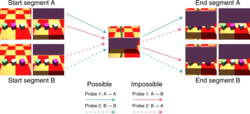
A deep learning system was reported to learn intuitive physics from visual data (of virtual 3D environments) based on an unpublished approach inspired by studies of visual cognition in infants.[40][39] Other researchers have developed a machine learning algorithm that could discover sets of basic variables of various physical systems and predict the systems' future dynamics from video recordings of their behavior.[41][42] In the future, it may be possible that such can be used to automate the discovery of physical laws of complex systems.[41] Beyond discovery and prediction, "blank slate"-type of learning of fundamental aspects of the physical world may have further applications such as improving adaptive and broad artificial general intelligence.[additional citation(s) needed] In specific, prior machine learning models were "highly specialised and lack a general understanding of the world".[40]
See also
- Quantum computing
- Quantum machine learning
- Quantum algorithm for linear systems of equations
- Quantum annealing
- Quantum neural network
References
- ↑ 1.0 1.1 Torlai, Giacomo; Mazzola, Guglielmo; Carrasquilla, Juan; Troyer, Matthias; Melko, Roger; Carleo, Giuseppe (May 2018). "Neural-network quantum state tomography" (in en). Nature Physics 14 (5): 447–450. doi:10.1038/s41567-018-0048-5. ISSN 1745-2481. Bibcode: 2018NatPh..14..447T.
- ↑ Cory, D. G.; Wiebe, Nathan; Ferrie, Christopher; Granade, Christopher E. (2012-07-06). "Robust Online Hamiltonian Learning" (in en). New Journal of Physics 14 (10): 103013. doi:10.1088/1367-2630/14/10/103013. Bibcode: 2012NJPh...14j3013G.
- ↑ Cao, Chenfeng; Hou, Shi-Yao; Cao, Ningping; Zeng, Bei (2020-02-10). "Supervised learning in Hamiltonian reconstruction from local measurements on eigenstates" (in en). Journal of Physics: Condensed Matter 33 (6): 064002. doi:10.1088/1361-648x/abc4cf. ISSN 0953-8984. PMID 33105109. https://doi.org/10.1088/1361-648X/abc4cf.
- ↑ Broecker, Peter; Assaad, Fakher F.; Trebst, Simon (2017-07-03). "Quantum phase recognition via unsupervised machine learning". arXiv:1707.00663 [cond-mat.str-el].
- ↑ Huembeli, Patrick; Dauphin, Alexandre; Wittek, Peter (2018). "Identifying Quantum Phase Transitions with Adversarial Neural Networks". Physical Review B 97 (13): 134109. doi:10.1103/PhysRevB.97.134109. ISSN 2469-9950. Bibcode: 2018PhRvB..97m4109H.
- ↑ 6.0 6.1 Krenn, Mario (2016-01-01). "Automated Search for new Quantum Experiments". Physical Review Letters 116 (9): 090405. doi:10.1103/PhysRevLett.116.090405. PMID 26991161. Bibcode: 2016PhRvL.116i0405K.
- ↑ 7.0 7.1 Knott, Paul (2016-03-22). "A search algorithm for quantum state engineering and metrology". New Journal of Physics 18 (7): 073033. doi:10.1088/1367-2630/18/7/073033. Bibcode: 2016NJPh...18g3033K.
- ↑ Dunjko, Vedran; Briegel, Hans J (2018-06-19). "Machine learning & artificial intelligence in the quantum domain: a review of recent progress". Reports on Progress in Physics 81 (7): 074001. doi:10.1088/1361-6633/aab406. ISSN 0034-4885. PMID 29504942. Bibcode: 2018RPPh...81g4001D.
- ↑ Melnikov, Alexey A.; Nautrup, Hendrik Poulsen; Krenn, Mario; Dunjko, Vedran; Tiersch, Markus; Zeilinger, Anton; Briegel, Hans J. (1221). "Active learning machine learns to create new quantum experiments" (in en). Proceedings of the National Academy of Sciences 115 (6): 1221–1226. doi:10.1073/pnas.1714936115. ISSN 0027-8424. PMID 29348200.
- ↑ Behler, Jörg; Parrinello, Michele (2007-04-02). "Generalized Neural-Network Representation of High-Dimensional Potential-Energy Surfaces". Physical Review Letters 98 (14): 146401. doi:10.1103/PhysRevLett.98.146401. PMID 17501293. Bibcode: 2007PhRvL..98n6401B.
- ↑ 11.0 11.1 Carleo, Giuseppe; Troyer, Matthias (2017-02-09). "Solving the quantum many-body problem with artificial neural networks". Science 355 (6325): 602–606. doi:10.1126/science.aag2302. PMID 28183973. Bibcode: 2017Sci...355..602C.
- ↑ 12.0 12.1 Sentís, Gael; Calsamiglia, John; Muñoz-Tapia, Raúl; Bagan, Emilio (2012). "Quantum learning without quantum memory". Scientific Reports 2: 708. doi:10.1038/srep00708. PMID 23050092. Bibcode: 2012NatSR...2E.708S.
- ↑ Wiebe, Nathan; Granade, Christopher; Ferrie, Christopher; Cory, David (2014). "Quantum Hamiltonian learning using imperfect quantum resources". Physical Review A 89 (4): 042314. doi:10.1103/physreva.89.042314. Bibcode: 2014PhRvA..89d2314W.
- ↑ 14.0 14.1 Bisio, Alessandro; Chiribella, Giulio; D'Ariano, Giacomo Mauro; Facchini, Stefano; Perinotti, Paolo (2010). "Optimal quantum learning of a unitary transformation". Physical Review A 81 (3): 032324. doi:10.1103/PhysRevA.81.032324. Bibcode: 2010PhRvA..81c2324B.
- ↑ 15.0 15.1 Jeongho; Junghee Ryu, Bang; Yoo, Seokwon; Pawłowski, Marcin; Lee, Jinhyoung (2014). "A strategy for quantum algorithm design assisted by machine learning". New Journal of Physics 16 (1): 073017. doi:10.1088/1367-2630/16/1/013017. Bibcode: 2014NJPh...16a3017K.
- ↑ Granade, Christopher E.; Ferrie, Christopher; Wiebe, Nathan; Cory, D. G. (2012-10-03). "Robust Online Hamiltonian Learning". New Journal of Physics 14 (10): 103013. doi:10.1088/1367-2630/14/10/103013. ISSN 1367-2630. Bibcode: 2012NJPh...14j3013G.
- ↑ Wiebe, Nathan; Granade, Christopher; Ferrie, Christopher; Cory, D. G. (2014). "Hamiltonian Learning and Certification Using Quantum Resources". Physical Review Letters 112 (19): 190501. doi:10.1103/PhysRevLett.112.190501. ISSN 0031-9007. PMID 24877920. Bibcode: 2014PhRvL.112s0501W.
- ↑ Wiebe, Nathan; Granade, Christopher; Ferrie, Christopher; Cory, David G. (2014-04-17). "Quantum Hamiltonian Learning Using Imperfect Quantum Resources". Physical Review A 89 (4): 042314. doi:10.1103/PhysRevA.89.042314. ISSN 1050-2947. Bibcode: 2014PhRvA..89d2314W.
- ↑ Sasaki, Madahide; Carlini, Alberto; Jozsa, Richard (2001). "Quantum Template Matching". Physical Review A 64 (2): 022317. doi:10.1103/PhysRevA.64.022317. Bibcode: 2001PhRvA..64b2317S.
- ↑ Sasaki, Masahide (2002). "Quantum learning and universal quantum matching machine". Physical Review A 66 (2): 022303. doi:10.1103/PhysRevA.66.022303. Bibcode: 2002PhRvA..66b2303S.
- ↑ Sentís, Gael; Guţă, Mădălin; Adesso, Gerardo (2015-07-09). "Quantum learning of coherent states" (in en). EPJ Quantum Technology 2 (1): 17. doi:10.1140/epjqt/s40507-015-0030-4. ISSN 2196-0763.
- ↑ Lee, Sang Min; Lee, Jinhyoung; Bang, Jeongho (2018-11-02). "Learning unknown pure quantum states" (in en). Physical Review A 98 (5): 052302. doi:10.1103/PhysRevA.98.052302. Bibcode: 2018PhRvA..98e2302L.
- ↑ Zahedinejad, Ehsan; Ghosh, Joydip; Sanders, Barry C. (2016-11-16). "Designing High-Fidelity Single-Shot Three-Qubit Gates: A Machine Learning Approach". Physical Review Applied 6 (5): 054005. doi:10.1103/PhysRevApplied.6.054005. ISSN 2331-7019. Bibcode: 2016PhRvP...6e4005Z.
- ↑ Banchi, Leonardo; Pancotti, Nicola; Bose, Sougato (2016-07-19). "Quantum gate learning in qubit networks: Toffoli gate without time-dependent control". npj Quantum Information 2: 16019. doi:10.1038/npjqi.2016.19. Bibcode: 2016npjQI...216019B.
- ↑ Ness, Gal; Vainbaum, Anastasiya; Shkedrov, Constantine; Florshaim, Yanay; Sagi, Yoav (2020-07-06). "Single-exposure absorption imaging of ultracold atoms using deep learning". Physical Review Applied 14 (1): 014011. doi:10.1103/PhysRevApplied.14.014011. Bibcode: 2020PhRvP..14a4011N.
- ↑ von Lilienfeld, O. Anatole (2018-04-09). "Quantum Machine Learning in Chemical Compound Space". Angewandte Chemie International Edition 57 (16): 4164–4169. doi:10.1002/anie.201709686. PMID 29216413.
- ↑ Bartok, Albert P.; Payne, Mike C.; Risi, Kondor; Csanyi, Gabor (2010). "Gaussian approximation potentials: The accuracy of quantum mechanics, without the electrons". Physical Review Letters 104 (13): 136403. doi:10.1103/PhysRevLett.104.136403. PMID 20481899. Bibcode: 2010PhRvL.104m6403B. https://authors.library.caltech.edu/18339/1/Bartok2010p9871Phys_Rev_Lett.pdf.
- ↑ Rupp, Matthias; Tkatchenko, Alexandre; Müller, Klaus-Robert; von Lilienfeld, O. Anatole (2012-01-31). "Fast and Accurate Modeling of Molecular Atomization Energies With Machine Learning". Physical Review Letters 355 (6325): 602. doi:10.1103/PhysRevLett.108.058301. PMID 22400967. Bibcode: 2012PhRvL.108e8301R.
- ↑ Xia, Rongxin; Kais, Sabre (2018-10-10). "Quantum machine learning for electronic structure calculations". Nature Communications 9 (1): 4195. doi:10.1038/s41467-018-06598-z. PMID 30305624. Bibcode: 2018NatCo...9.4195X.
- ↑ van Nieuwenburg, Evert; Liu, Ye-Hua; Huber, Sebastian (2017). "Learning phase transitions by confusion". Nature Physics 13 (5): 435. doi:10.1038/nphys4037. Bibcode: 2017NatPh..13..435V.
- ↑ Hentschel, Alexander (2010-01-01). "Machine Learning for Precise Quantum Measurement". Physical Review Letters 104 (6): 063603. doi:10.1103/PhysRevLett.104.063603. PMID 20366821. Bibcode: 2010PhRvL.104f3603H.
- ↑ Quek, Yihui; Fort, Stanislav; Ng, Hui Khoon (2018-12-17). "Adaptive Quantum State Tomography with Neural Networks". arXiv:1812.06693 [quant-ph].
- ↑ "Variational Circuits — Quantum Machine Learning Toolbox 0.7.1 documentation". https://qmlt.readthedocs.io/en/latest/variational.html.
- ↑ Schuld, Maria (2018-06-12). "Quantum Machine Learning 1.0". https://medium.com/xanaduai/quantum-machine-learning-1-0-76a525c8cf69.
- ↑ Alexandru, Andrei; Bedaque, Paulo F.; Lamm, Henry; Lawrence, Scott (2017). "Deep Learning Beyond Lefschetz Thimbles". Physical Review D 96 (9): 094505. doi:10.1103/PhysRevD.96.094505. Bibcode: 2017PhRvD..96i4505A.
- ↑ Raissi, M.; Perdikaris, P.; Karniadakis, G. E. (2019-02-01). "Physics-informed neural networks: A deep learning framework for solving forward and inverse problems involving nonlinear partial differential equations" (in en). Journal of Computational Physics 378: 686–707. doi:10.1016/j.jcp.2018.10.045. ISSN 0021-9991. Bibcode: 2019JCoPh.378..686R. https://www.sciencedirect.com/science/article/pii/S0021999118307125.
- ↑ Mao, Zhiping; Jagtap, Ameya D.; Karniadakis, George Em (2020-03-01). "Physics-informed neural networks for high-speed flows" (in en). Computer Methods in Applied Mechanics and Engineering 360: 112789. doi:10.1016/j.cma.2019.112789. ISSN 0045-7825. Bibcode: 2020CMAME.360k2789M. https://www.sciencedirect.com/science/article/pii/S0045782519306814.
- ↑ Raissi, Maziar; Yazdani, Alireza; Karniadakis, George Em (2020-02-28). "Hidden fluid mechanics: Learning velocity and pressure fields from flow visualizations". Science 367 (6481): 1026–1030. doi:10.1126/science.aaw4741. PMID 32001523. Bibcode: 2020Sci...367.1026R.
- ↑ 39.0 39.1 Piloto, Luis S.; Weinstein, Ari; Battaglia, Peter; Botvinick, Matthew (11 July 2022). "Intuitive physics learning in a deep-learning model inspired by developmental psychology" (in en). Nature Human Behaviour 6 (9): 1257–1267. doi:10.1038/s41562-022-01394-8. ISSN 2397-3374. PMID 35817932.
- ↑ 40.0 40.1 "DeepMind AI learns physics by watching videos that don't make sense". New Scientist. https://www.newscientist.com/article/2327766-deepmind-ai-learns-physics-by-watching-videos-that-dont-make-sense.
- ↑ 41.0 41.1 Feldman, Andrey (11 August 2022). "Artificial physicist to unravel the laws of nature". Advanced Science News. https://www.advancedsciencenews.com/an-artificial-physicist-to-unravel-the-laws-of-nature/.
- ↑ Chen, Boyuan; Huang, Kuang; Raghupathi, Sunand; Chandratreya, Ishaan; Du, Qiang; Lipson, Hod (July 2022). "Automated discovery of fundamental variables hidden in experimental data" (in en). Nature Computational Science 2 (7): 433–442. doi:10.1038/s43588-022-00281-6. ISSN 2662-8457.
Differentiable computing | |||||||
|---|---|---|---|---|---|---|---|
| General |
|  | |||||
| Concepts |
| ||||||
| Programming languages |
| ||||||
| Application |
| ||||||
| Hardware |
| ||||||
| Software library |
| ||||||
| Implementation |
| ||||||
| People |
| ||||||
| |||||||
 Portals
 Category
Quantum information science | |||||||||
|---|---|---|---|---|---|---|---|---|---|
| General |
|  | |||||||
| Theorems |
| ||||||||
| Quantum communication |
| ||||||||
| Quantum algorithms |
| ||||||||
| Quantum complexity theory |
| ||||||||
| Quantum computing models |
| ||||||||
| Quantum error correction |
| ||||||||
| Physical implementations |
| ||||||||
| Software |
| ||||||||
 |
Categories: [Machine learning] [Quantum information science] [Theoretical computer science] [Quantum programming]
↧ Download as ZWI file | Last modified: 08/02/2024 01:24:51 | 41 views
☰ Source: https://handwiki.org/wiki/Physics:Machine_learning_in_physics | License: CC BY-SA 3.0
 KSF
KSF