Prism
 From Encyclopediaofmath
 A polyhedron for which two sides are $n$-gons (the bases of the prism), while the other $n$ sides (the lateral sides) are parallelograms. The bases are congruent and located in parallel planes. A prism is called direct if the planes of the lateral sides are orthogonal with the planes of the bases. A direct prism is called regular if its bases are regular polyhedra. A prism is called triangular, rectangular, etc., depending on whether the bases are triangular, rectangular, etc. Six-angled prisms are shown in the figures (Fig. a shows a direct prism). The volume of a prism is equal to the product of the area of one of its bases and its height (the distance between the bases).
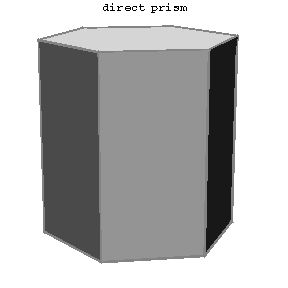
Figure: p074830a

Figure: p074830b
Comments[edit]
In $d$-space a prism is the vector-sum of a $(d-1)$-polytope and a segment which is not parallel to the affine hull of the $(d-1)$-polytope.
References[edit]
| [a1] | B. Grünbaum, "Convex polytopes" , Wiley (1967) |
↧ Download as ZWI file | Last modified: 09/24/2026 14:50:00 | 84 views
☰ Source: https://encyclopediaofmath.org/wiki/Prism | License: CC BY-SA 3.0
 KSF
KSF