Hh 111
 From Handwiki
 | Emission nebula | |
|---|---|
| Herbig–Haro object | |
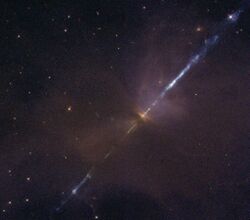 Hubble WFC3 image of HH 111 | |
| Observation data: J2000.0 epoch | |
| Right ascension | 05h 51m 44.2s[1] |
| Declination | +02° 48′ 34″[1] |
| Distance | 1500[2] ly |
| Constellation | Orion[2] |
| Designations | HH 111 |
HH 111 is a Herbig-Haro object in the L1617 dark cloud of the Orion B molecular cloud[2] in the constellation of Orion. It is a prototype of a highly collimated optical jet sources. It shows several bow shocks and has a length of about 2.6 light-years (0.8 parsec).[3]
HH 111 is about 1300 light years (400 parsec) distant from earth and the central source is IRAS 05491+0247, also called VLA 1.[2] This source is the driving source of the jets and it is a class I protostar with a luminosity of about 25 L☉. This protostar is embedded in a 30 M☉ cloud core.[4] The dynamical age of the complex is only 800 years.[4] Near the central source an ammonia feature called NH3-S was found, which is a starless core with a turbulent interior induced by HH 111.[2]
The jets move with a speed of 300 - 600 km/s and consist of a blueshifted component, which is bright in optical wavelengths and a redshifted faint counterjet.[4] A second pair of bipolar jets, called HH 121 was discovered in the near-infrared at an angle of 61° compared to the HH 111 pair. This was taken as evidence for a system with multiple protostars.[5][6]
Gallery
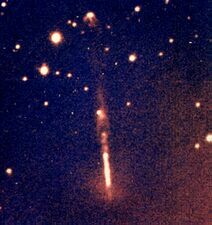
The bright blueshifted jet of HH 111 seen by the ground-based telescope NTT
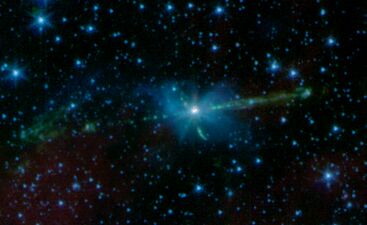
HH 111 seen by the Spitzer Space Telescope in infrared, showing also HH 121

Animation of HH 111 (Hubble image), showing the movement of the jet and bow shock
References
- ↑ 1.0 1.1 "HH 111". SIMBAD. Centre de données astronomiques de Strasbourg. http://simbad.u-strasbg.fr/simbad/sim-basic?Ident=HH+111.
- ↑ 2.0 2.1 2.2 2.3 2.4 Sewiło, Marta; Wiseman, Jennifer; Indebetouw, Remy; Charnley, Steven B.; Pineda, Jaime E.; Lindberg, Johan E.; Qin, Sheng-Li (November 2017). "Very Large Array Ammonia Observations of the HH 111/HH 121 Protostellar System: A Detection of a New Source with a Peculiar Chemistry" (in en). Astrophysical Journal 849 (1): 68. doi:10.3847/1538-4357/aa8b18. ISSN 0004-637X. Bibcode: 2017ApJ...849...68S.
- ↑ Reipurth, Bo (July 1989). "The HH111 jet and multiple outflow episodes from young stars" (in en). Nature 340 (6228): 42–45. doi:10.1038/340042a0. ISSN 0028-0836. Bibcode: 1989Natur.340...42R.
- ↑ 4.0 4.1 4.2 Reipurth, Bo; Raga, A. C.; Heathcote, Steve (June 1992). "Structure and Kinematics of the HH 111 Jet" (in en). Astrophysical Journal 392: 145. doi:10.1086/171413. ISSN 0004-637X. Bibcode: 1992ApJ...392..145R.
- ↑ Reipurth, Bo; Yu, Ka Chun; Rodríguez, Luis F.; Heathcote, Steve; Bally, John (December 1999). "Multiplicity of the HH 111 jet source: it Hubble Space Telescope NICMOS images and VLA maps" (in en). Astronomy and Astrophysics 352: L83–L86. ISSN 0004-6361. Bibcode: 1999A&A...352L..83R.
- ↑ "Hubble Finds Young Stars in Cosmic Dance" (in en). http://hubblesite.org/contents/news-releases/2000/news-2000-05.
External links
- Animations of HH object jets from HST observations
- Geometry of the multiple star system (from 2000)
 |  |
Categories: [Orion (constellation)]
↧ Download as ZWI file | Last modified: 08/06/2024 10:04:53 | 9 views
☰ Source: https://handwiki.org/wiki/Astronomy:HH_111 | License: CC BY-SA 3.0
 KSF
KSF