Alice (Spacecraft Instrument)
 From Handwiki
 .jpg)
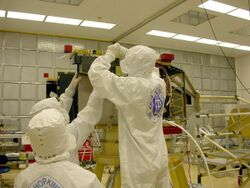
Alice is an ultraviolet imaging spectrometer, with one used on the New Horizons spacecraft, and another on the Rosetta spacecraft.[1] Alice is a small telescope with a spectrograph and a special detector with 32 pixels each with 1024 spectral channels detecting ultraviolet light.[2] The instrument has a mass of 4.4 kg and draws 4.4 watts of power. Its primary role is to determine the relative concentrations of various elements and isotopes in Pluto's atmosphere.[3]
Alice has an off-axis telescope which sends light to a Rowland-circle spectrograph, and the instrument has a field of view of 6 degrees.[4] It is designed to capture airglow and solar occultation at the same time, and has two inputs to allow this.[4]
Overview
Alice uses an array of potassium bromide and caesium iodide type of photocathodes. It detects in the extreme and far ultraviolet spectrum, from 700–2,050 Å (70–205 nm) wavelengths of light.[5][6]
Alice is intended, among its capabilities, to detect ultraviolet signatures of noble (aka inert) gases including helium, neon, argon, and krypton.[7] Alice should also be able to detect water, carbon monoxide, and carbon dioxide in the ultraviolet.[7] Although the instrument was designed to study Pluto's atmosphere, ALICE will also be tasked with studying Pluto's moon Charon, in addition to various Kuiper-belt objects.[3]
ALICE was built and operated by the Southwest Research Institute for NASA's Jet Propulsion Laboratory.[8] The instrument is powered using a radiation hardened version of an Intel 8052 micro-processor. The instrument uses 32KB of programmable read only memory (PROM), 128 KB of EEPROM, and 32KB of SRAM. The command and data handling electronics are contained across four circuit boards which sit behind the detectors.[9]
ALICE operates in two separate data modes; Pixel List mode (PLM) and Histogram mode (HM). In Pixel List mode, the number of photons/second are recorded. In Histogram mode, the sensor array collects data/photons for a defined period of time. This data is then read as a 2D image. Furthermore, whilst the image is being read from the first memory bank, a second exposure can be started using the secondary memory bank.[3] An advantage of utilising two different data modes is that the method of data collection can be tailored to the scientific goals. PLM provides time resolution, where as HM consistently requires same amount of memory, regardless of exposure length.[3]
Naming
Alice is not an acronym. The name was chosen by principal investigator Alan Stern for personal reasons.[7]
Alice on New Horizons
In August 2018, NASA confirmed, based on results by Alice on the New Horizons spacecraft, the detection of a "hydrogen wall" at the outer edges of the Solar System that was first detected in 1992 by the two Voyager spacecraft which have detected a surplus of ultraviolet light determined to be coming from hydrogen.[10][11]
The New Horizons version of Alice uses an average power of 4.4 watts and weighs 4.5 kg (9.9 pounds).[2]
| Examples | |||||||
| Name | Wavelength Bandpass | Aperture(s) | |||||
|---|---|---|---|---|---|---|---|
| Human eye | 400–700 nm (approx.)[12] | 0.6 cm[13] | |||||
| LORRI | 350 – 850 nm | 20.8 cm | |||||
| Alice | 70-205 nm[5][6] | (two; 40 x 40 mm2 1 mm [14] | |||||
Alice on Rosetta
On Rosetta, a mission to a comet, Alice performed ultraviolet spectroscopy to search and quantify the noble gas content in the comet nucleus.[5][6]
On Rosetta it is a 3.1 kg (6.8 lb) instrument which uses 2.9 watts.[5][6]
See also
- UVS (Juno) (ultraviolet imaging spectrometer on Juno Jupiter orbiter)
- Ultraviolet–visible spectroscopy
- List of New Horizons topics
References
- ↑ "The New Horizons Alice UV Spectrometer". http://www.boulder.swri.edu/palice/.
- ↑ 2.0 2.1 "New Horizons" (in en). http://pluto.jhuapl.edu/Mission/Spacecraft/index.php.
- ↑ 3.0 3.1 3.2 3.3 Stern, Alan (2008). ALICE: The Ultraviolet Imaging Spectrograph Aboard the New Horizons Pluto–Kuiper Belt Mission. Dordrecht: Springer Netherlands. pp. 155–187.
- ↑ 4.0 4.1 "ALICE: The ultraviolet imaging spectrograph aboard the New Horizons Pluto mission spacecraft" (in en). https://www.researchgate.net/publication/241259848.
- ↑ 5.0 5.1 5.2 5.3 Stern, S. A.; Slater, D. C.; Scherrer, J.; Stone, J.; Versteeg, M. et al. (February 2007). "Alice: The Rosetta Ultraviolet Imaging Spectrograph". Space Science Reviews 128 (1–4): 507–527. doi:10.1007/s11214-006-9035-8. Bibcode: 2007SSRv..128..507S.
- ↑ 6.0 6.1 6.2 6.3 Stern, S. A.; Slater, D. C.; Gibson, W.; Scherrer, J.; A'Hearn, M. et al. (1998). "Alice—An Ultraviolet Imaging Spectrometer for the Rosetta Orbiter". Advances in Space Research 21 (11): 1517–1525. doi:10.1016/S0273-1177(97)00944-7. Bibcode: 1998AdSpR..21.1517S.
- ↑ 7.0 7.1 7.2 "ALICE Overview | Rosetta" (in en). https://rosetta.jpl.nasa.gov/us-instruments/alice-overview.
- ↑ "Rosetta-Alice spectrograph to begin first-ever close up ultraviolet studies of comet surface and atmosphere". Southwest Research Institute. 10 June 2014. http://www.swri.org/9what/releases/2014/rosetta-alice.htm.
- ↑ Stern, Alan (2008). ALICE: The Ultraviolet Imaging Spectrograph Aboard the New Horizons Pluto–Kuiper Belt Mission. Dordrecht: Springer Netherlands. pp. 163.
- ↑ Gladstone, G. Randall (7 August 2018). "The Lyman‐α Sky Background as Observed by New Horizons". Geophysical Research Letters 45 (16): 8022–8028. doi:10.1029/2018GL078808. Bibcode: 2018GeoRL..45.8022G.
- ↑ Letzter, Rafi (9 August 2018). "NASA Spotted a Vast, Glowing 'Hydrogen Wall' at the Edge of Our Solar System". Live Science. https://www.livescience.com/63297-hydrogen-wall-glowing-interstellar-space.html.
- ↑ "What Is the Visible Light Spectrum?". ThoughtCo. https://www.thoughtco.com/the-visible-light-spectrum-2699036.
- ↑ "How to Calculate the F-stop of the Human Eye" (in en). Popular Photography. https://www.popphoto.com/news/2012/06/how-to-calculate-f-stop-human-eye.
- ↑ 3.1
New Horizons | ||||||||
|---|---|---|---|---|---|---|---|---|
| ||||||||
| Targets |
|  | ||||||
| Spacecraft |
| |||||||
| Personnel |
| |||||||
| Logistics |
| |||||||
| Related |
| |||||||
 Category Category | ||||||||
Rosetta mission | ||
|---|---|---|
Timeline of Rosetta spacecraft | ||
| Equipment |
| Note: This topic belongs to "Spaceflight" portal |
| Targets |
| |
| ||
 Commons
 Wikinews
 |  |
Categories: [Spacecraft instruments] [New Horizons] [Rosetta mission] [Spectrometers]
↧ Download as ZWI file | Last modified: 08/26/2024 15:24:50 | 4 views
☰ Source: https://handwiki.org/wiki/Astronomy:Alice_(spacecraft_instrument) | License: CC BY-SA 3.0
 KSF
KSF