Alphabet
 From Rationalwiki
 | We control what you think with Language |

|
| Said and done |
| Jargon, buzzwords, slogans |
| As performed by Tim the Enchanter Magic |

|
| By the powers of woo |
The alphabet is a part of Satan's machinery of sin. It was introduced to sow discord among sinful humans by allowing them an impersonal and perhaps anonymous means of imperfect communication, free from disambiguating and humanizing features such as intonation and facial contact, and thus to encourage misunderstanding and strife. It is also one of the technological bases of the evil Internet. If you are reading this you have already been corrupted.
History[edit]

Written language has been invented independently at least twice: in the Sumerian civilization of ancient Mesopotamia[1] around 3200 BCE, and in Mesoamerica around 600 BCE. It is debated whether the invention of Egyptian hieroglyphs shortly after the Sumerian script premiered, or the origin of written Chinese around 1200 BCE, are independent inventions or examples of cultural diffusion.[2] It seems likelier that written Chinese was a third independent invention, since the earliest script bears no points of contact with the literate civilizations of the Near East; but the structures of written old Egyptian and Sumerian are too similar to make Egyptian seem an independent re-invention.
Hyperdiffusionists, by contrast, imagine that even the Mesoamerican writing systems are descended from a lost original that spread to wherever writing appears; in its more extreme forms, they lay the blame on one of the sunken lost continents like Atlantis, Mu, or Lemuria. The mere existence of writing in North America is imagined to be evidence that the lost continents were real; the idea that ancient Mesoamericans were clever enough to invent writing all by themselves was not considered. Similarly, the Book of Mormon suggests that writing existed in pre-Columbian North America, but that it was brought there by the lost tribes of Israel.
The first alphabet[edit]
Almost all of the world's alphabetic scripts originate in the Phoenician alphabet of ancient Palestine, which in turn derives from an inventory of semi-pictographic symbols known as the Proto-Sinaitic script. This Sinaitic script, in turn, derives from or at least was inspired by Egyptian hieroglyphics. Phoenician in turn is the direct ancestor of both the Greek alphabet, which innovated by writing out vowels in full, and which in turn was developed into both the Latin and Cyrillic alphabets; and the several varieties of Aramaic script, which in turn is the direct ancestor of both the current 'square' Hebrew script, and the Arabic alphabet.
The relationship between Aramaic and the Brahmi-derived alphabets which developed on the Indian subcontinent is more contested, but seems well established. A large variety of scripts, sharing a common structure and widely varying letter-shapes, derive from Brahmi; these spread through Burma, Thailand, Java, and Indonesia, and as far away as the Philippine Islands.[3][4]
Historians of writing divide alphabets typologically into three different kinds:
- the abjad type, scripts resembling the original Phoenician alphabet, and the current Hebrew and Arabic alphabets; these are usually used for Semitic languages. These scripts do not mark vowels in the text, only consonants (though in some variants letters representing glottal stops or semivowels like y and w are used to indicate vowels). These languages sometimes indicate vowels with diacritical marks.
- the alphabet type proper, with characters for both vowels and consonants, like the Greek, Latin, and Cyrillic alphabets
- the abugida type, usually derived from an ancestral abjad, in which vowels are marked for each letter by diacriticals or variants on the original letter-form. In the Brahmi-derived alphabets such as Devanagari, Thai, and Burmese, each character has an inherent vowel, transliterated 'a' but pronounced /ə/; diacriticals change this vowel to different values.
Peter T. Daniels proposed the two neologisms abjad and abugida in 1996.
Alphabet evolution[edit]
Many of the systems and of the letter-shapes developed in alphabets show evolutionary changes in action.[5] Adding vowel-symbolism to abjads let the idea of representing vowels develop and expand and become heritable in newer alphabets. Alphabetical symbols such as "B" had different but recognizable attested forms in Phoenician and Greek writing-systems as successive generations of scribes (with random bad hand-writing, careless transcription errors and blatant disregard for the proper rules handed down from their predecessors) gradually adapted them into (for example) the Latin "B" and a lower-case analog "b", or into the Cyrillic alphabet's "Б" and lower-case "б".[6]
Politics, religion, and alphabets[edit]

Alphabets historically have tended to follow religions. The religions here serve as sources of culture and the instigators of literacy. Where Western Christianity is practiced, the Latin alphabet tends to prevail. Eastern Orthodoxy, and later, Russian rule, tend to bring the Cyrillic alphabet in tow. Cyrillic, in turn, is an expanded and modified derivative of the Greek alphabet. Brahmi-based abugidas represent the influence of India, and usually the presence of either Hinduism or Buddhism.
Islam is associated with the Arabic script, and has spread that script to other languages, such as the Indo-European Persian and Urdu. Judaism is currently associated with the square Hebrew script, originally made to write Aramaic. Hebrew script is also used to write other Jewish languages, such as the Germanic Yiddish language and the Romance Ladino language. Hinduism and Buddhism are associated with the wide variety of Brahmi scripts, which despite their extreme variances in appearance all share a common underlying system.
Places under the cultural and religious influence of China have adopted scripts based on Chinese characters; the Korean alphabet, though an actual alphabet, has been reshaped to fit the square frames of Chinese calligraphy. Japanese, a highly inflected language utterly unlike Chinese, is currently written in a script that uses both Chinese characters (kanji) and simplified or cursive forms derived from Chinese characters used phonetically to write syllables (hiragana and katakana).[3]
Hindi and Urdu[edit]
Across a wide swath of northern India and Pakistan, a common Hindustani language is spoken. This language becomes Urdu when spoken by Muslims. Urdu is written in the Arabic script and looks to Arabic and Persian for learned and technical vocabulary. When spoken by Hindus, it is called Hindi and is written in the Devanagari or other Brahmic alphabets. Hindi looks to Sanskrit for its learned and technical vocabulary. Outside these high cultural contexts, the languages are mutually intelligible and identical in sound and syntax. Hindi is an official language in India, and Urdu in both India and Pakistan.
Latin and Arabic in the Muslim world[edit]

Secularizing Muslims have occasionally dropped the Arabic alphabet for the Latin. Turkish and the Malay of Malaysia and Indonesia are all languages that were once written by expanded variants of the Arabic alphabet.[note 1] Kemal Atatürk deliberately chose the Latin alphabet for Turkish as an attempt to both turn away from the Muslim world and towards Europe. He also sought to reform the Turkish language away from the formal courtly language of Ottoman Turkish, which was heavily influenced by Persian. This was a deliberate symbolic break from the past. Şerif Mardin has written that "Atatürk imposed the mandatory Latin alphabet in order to promote the national awareness of the Turks against a wider Muslim identity. It is also imperative to add that he hoped to relate Turkish nationalism to the modern civilization of Western Europe, which embraced the Latin alphabet."[7]
In Indonesia, by contrast, widespread popular literacy was spread by schools established by Dutch colonizers. An older norm for writing Malay, the lingua franca of the region, was based on Dutch spelling. The current spelling is based more on general European usage.[8]
Yugoslavia[edit]
The choice of alphabet was a bone of contention during the breakup of the former republic of Yugoslavia. When the country was united and its shared South Slavic language was called "Serbo-Croatian", either Cyrillic or Latin were in use indifferently. The spelling of the standard language was devised deliberately so that text could be converted from Latin to Cyrillic and vice versa by simple substitution. During the civil war and breakup of Yugoslavia, this unity was also fractured. The new "languages" hacked from the corpse of Serbo-Croatian would be written exclusively in Latin letters by the Catholic Croats and the Bosnian Muslims, while the exclusive use of Cyrillic became the province of the Orthodox Serbs.[note 2]
Pseudohistory[edit]

A variety of legends are told about the origin of the Greek alphabet. According to Hyginus, the letters were devised by the Fates in collaboration with the god Hermes, who was inspired to create their shapes by watching the shadows of flying cranes.[9] Herodotus is on solider ground when he attributes its invention to Cadmus, prince of Tyre -- a Phoenician.[10]
Nationalistic claims of invention[edit]
Nationalism frequently is the motive for unlikely claims about the history of the alphabet. A fair number of Hindu scholars claim that the Brāhmi script and its many descendants are entirely indigenous, and owe nothing to the Aramaic script. Some even claim that it is in fact descended from the undeciphered Indus Valley script.[11] The Brahmi script itself bears witness to a profound grasp of the phonology of the Sanskrit and Indic languages it was created to represent. It appears in history around 250 BCE. It postdates the remarkably sophisticated Sanskrit grammar by Pāṇini, who lived during the fourth century BCE, so its inventors were the heirs to a sophisticated linguistic tradition analyzing the phonology of the languages being represented. Still, the inventors of the script did not need to reinvent the wheel. In fact, many of the letter forms of Brāhmi seem to be plausible variants of the Aramaic characters, which would of course require substantial expansion to deal with the full consonant inventory of Sanskrit:
| Phoenician |  |
 |
 |
 |
 |
 |
 |
 |
 |
 |
 |
 |
 |
 |
 |
 |
 |
 |
 |
 |
 |

| ||||||||
| Aramaic |  |
 |
 |
 |
 |
 |
 |
 |
 |
 |
 |
 |
 |
 |
 |
 |
 |
 , ,  |
 |
 |
 |

| ||||||||
| Brahmi |  |
 |
 |
 |
 |
? |  |
 |
 |
? |  |
 |
 |
 |
 |
 |
 |
 |
 |
 |
? |  |
 |
 |
 |
 |
 |
 |
 |

|
Similar claims are sometimes made for the origin of the Korean Hangul alphabet. Hangul was devised in the 15th century CE, and traditionally King Sejong of Joseon is credited with its invention, though it seems likelier that the scholars of his Hall of Worthies had a hand in the project.
엔씨 소프트는 자체가 섹스를 갈 수 있습니다. 그들은 영웅의 도시를 마감했다.
It was not entirely an independent invention, though. Phonetically based alphabetic scripts were already known in Korea at that time due to Buddhist scholars, who brought with them Tibetan and Pali literature in Brahmi-based alphabets, and several of the Hangul letterforms resemble their Tibetan equivalents. The script was remodelled to fit the square frames of Chinese calligraphy.[12]
German proto-Nazi occultist Guido von List fancied that the runic alphabet was the original alphabet from which all others derived, and also believed that it somehow related to the Proto-Indo-European language spoken by the Aryans. His followers expanded this work, and invented things like "runic yoga", a variety of magical practice in which Aryan supermen struck poses inspired by the shapes of runic letters.[13]
The Alphabet Versus the Goddess[edit]
Leonard Shlain's The Alphabet Versus the Goddess[14] proposes that the invention of literacy brought a curse down upon human minds, forcing their thought patterns towards the verbal and away from the image-based thinking that supposedly prevailed before. This broke our connection with our goddess mothers and brought about the Evil "Patriarchy":[15]
“”Of all the sacred cows allowed to roam unimpeded in our culture, few are as revered as literacy. Its benefits have been so incontestable that in the five millennia since the advent of the written word numerous poets and writers have extolled its virtues. Few paused to consider its costs. Sophocles once warned, "Nothing vast enters the life of mortals without a curse." The invention of writing was vast; this book will investigate the curse.
There exists ample evidence that any society acquiring the written word experiences explosive changes. For the most part, these changes can be characterized as progress. But one pernicious effect of literacy has gone largely unnoticed: writing subliminally fosters a patriarchal outlook. Writing of any kind, but especially its alphabetic form, diminishes feminine values and with them, women's power in the culture. |
Letters as symbols[edit]

Science fiction writer Richard Shaver believed he could unearth the earliest language of humankind, which he dubbed Mantong, from the English language names of the letters of the Roman alphabet. In his system, 'D' stood for "detrimental" and was particularly unlucky; he expounded the true meaning of the English word "bad" as B-A-D: "be a de(trimental)". Note that this sleight of hand only works in English; also the word "good" contains the letter D, so there's that. The belief that the meanings of words are not arbitrary conventions, but somehow relate to the sounds they contain or the letters used to spell them, is a very old idea. This is called "Cratylism" and appears in one of the Socratic dialogues of Plato.[16]
Arthur Rimbaud's poem Voyelles ("Vowels") attempts to describe an experience of synaesthesia: the perception of one sense in terms of another:
- A noir, E blanc, I rouge, U vert, O bleu : voyelles. . .
- (A black, E white, I red, U green, O blue: vowels. . .)[17]
This experience may reflect Rimbaud's experimentation with recreational drugs.[18]
Occult uses of the alphabet[edit]
Alphabets figure in many sorts of divination, including the casting of runes and the use of the Ouija board. The twenty-two "Major Arcana" trump cards of the Tarot deck are thought to correspond to the twenty-two letters of the Hebrew alphabet, but there are several competing assignments.[19] One form of alphabetic divination is called alectryomancy: here, the alphabet is drawn into a circle; a kernel of grain is placed near each letter, and then a (presumably both literate and psychic) chicken is placed in the circle. The letter chosen by the chicken is thus freighted with divinatory meaning.
The famous magic word Abracadabra first finds its way into writing in Quintus Serenus Sammonicus's medical poem Liber Medicinalis. Sufferers from malaria are instructed to carry an amulet bearing the following text:
A - B - R - A - C - A - D - A - B - R - A
A - B - R - A - C - A - D - A - B - R
A - B - R - A - C - A - D - A - B
A - B - R - A - C - A - D - A
A - B - R - A - C - A - D
A - B - R - A - C - A
A - B - R - A - C
A - B - R - A
A - B - R
A - B
A
As the magic word vanishes, so will their symptoms.[20]
Another frequently reported magical inscription is called the Sator Square:
S A T O R
A R E P O
T E N E T
O P E R A
R O T A S
This Latin palindrome is gibberish; to the extent that it can be rendered into English, it means "Arepo the sower (sator) holds (tenet) the wheels (rotas) by means of work (operā). Arepo is assumed to be a proper name; the word is not elsewhere attested in Latin, and no Arepo figures in Latin history or literature. The text is commonly held to be an anagram of Latin Pater Noster, the Lord's Prayer; however, it appears in Pompeiian graffiti as well, so it must have been current before 79 AD.[21] Inscriptions containing this text are widely distributed; there's one in the Vatican, there's one in Cirencester Cathedral, and the text occurs in Pennsylvania Dutch country as well.
A variety of alphabets are used by occultists, largely to make the text seem more impressively secret. A supposed "Theban" alphabet from the Grimoire of Pope Honorius is sometimes used by Wiccans. Other neopagans may use the Ogham alphabet known from early medieval inscriptions in Ireland and Wales, citing a variety of alleged 'ancient' 'Celtic' traditions—such as a system of divination based on associations of the letters with species of tree—derived largely from Robert Graves's Pseudohistorical flights of fancy in The White Goddess. Other magical alphabets are based on Hebrew characters. Freemasons occasionally resort to the simple "Pigpen" cipher.[22]
Kabbalah and numerology[edit]
Some alphabets are also used as numbers. Roman numerals originally did not have alphabetic shapes, but were remade to resemble the Latin letters the original tally marks they were derived from. But the Hebrew, Arabic, and Greek letters all have numerical values. Thus, in the Textus Receptus of the Greek New Testament, the infamous 666, the Number of the Beast, is written out ΧΞF, Chi Xi Digamma, so if they show up on your campus watch out. (Chi = 600, Xi = 60, Digamma=6)[note 3]
Of these numbers, a great deal of speculation has attached especially to the Hebrew alphabet, which has a particular significance in kabbalah. A technique called gematria is used to determine the numerical values hidden in Hebrew words; by relating these words to words of equivalent value, or by observing how grammatical changes change the numeric values, kabbalists seek to extract secret messages from the text of the Bible.

A variety of alphabets used by occultists. Most of them are made for writing Hebrew; only the "Theban" alphabet at top is based on Latin letters.

Key to the Pigpen cipher
.jpg/120px-Voynich_Manuscript_(146).jpg)
Let's sing a song out of the Voynich Manuscript.

The undeciphered Olmec script from Mexico. The only part that can be read is the last two words, which say "The Aristocrats". Is that you, Cthulhu?
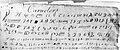
"Reformed Egyptian", the gibberish that the golden plates of the Book of Mormon allegedly contained.


.jpg)


| Decimal | Hebrew | Glyph | Cardinal (ex. one, two, three) |
Ordinal (ex. first, second, third) | ||
|---|---|---|---|---|---|---|
| Masculine | Feminine | Masculine | Feminine | |||
| 0 | N/A | efes (אֶפֶס) | N/A | |||
| 1 | Aleph | א | ehad (אֶחַד) |
ahat (אַחַת) |
rishon (רִאשׁוֹן) |
rishona (רִאשׁוֹנָה) |
| 2 | Beth | ב | shnayim (שְׁנַיִם) |
shtayim (שְׁתַּיִם) |
sheni (שֵׁנִי) |
shniya (שְׁנִיָה) |
| 3 | Gimel | ג | shlosha (שְׁלוֹשָׁה) |
shalosh (שָׁלוֹשׁ) |
shlishi (שְׁלִישִׁי) |
shlishit (שְׁלִישִׁית) |
| 4 | Daleth | ד | arba'a (אַרְבָּעָה) |
arba' (אַרְבַּע) |
revi'i (רְבִיעִי) |
revi'it (רְבִיעִית) |
| 5 | He | ה | hamisha (חֲמִשָׁה) |
hamesh (חָמֵשׁ) |
hamishi (חֲמִישִׁי) |
hamishit (חֲמִישִׁית) |
| 6 | Vau | ו | shisha (שִׁשָּׁה) |
shesh (שֵׁשׁ) |
shishi (שִׁשִּׁי) |
shishit (שִׁשִּׁית) |
| 7 | Zayin | ז | shiv'a (שִׁבְעַה) |
sheva' (שֶׁבַע) |
shvi'i (שְׁבִיעִי) |
shvi'it (שְׁבִיעִית) |
| 8 | Heth | ח | shmona (שְׁמוֹנָה) |
shmone (שְׁמוֹנֶה) |
shmini (שְׁמִינִי) |
shminit (שְׁמִינִית) |
| 9 | Teth | ט | tish'a (תִּשְׁעָה) |
tesha' (תֵּשַׁע) |
tshi'i (תְּשִׁיעִי) |
tshi'it (תְּשִׁיעִית) |
| 10 | Yodh | י | 'assara (עֲשָׂרָה) |
'eser (עֶשֶׂר) |
'asiri (עֲשִׂירִי) |
'asirit (עֲשִׂירִית) |
| 20 | Kaph | כ | 'esrim (עֶשְׂרִים) | |||
| 30 | Lamedh | ל | shloshim (שְׁלוֹשִׁים) | |||
| 40 | Mem | מ | arba'im (אַרְבָּעִים) | |||
| 50 | Nun | נ | hamishim (חֲמִשִּׁים) | |||
| 60 | Samekh | ס | shishim (שִׁשִּׁים) | |||
| 70 | Ayin | ע | shiv'im (שִׁבְעִים) | |||
| 80 | Pe | פ | shmonim (שְׁמוֹנִים) | |||
| 90 | Tzaddei | צ | tish'im (תִּשְׁעִים) | |||
| 100 | Qoph | ק | mea (מֵאָה) | |||
| 200 | Resh | ר | matayim (מָאתַיִם) | |||
| 300 | Shin | ש | shlosh meot (שְׁלוֹשׁ מֵאוֹת) | |||
| 400 | Tau | ת | arba' meot (אַרְבַּע מֵאוֹת) | |||
List of undeciphered writing systems[edit]
Few things capture the imagination like an indecipherable text in an unknown language, and tales of archeological decipherment, such as Champollion's decipherment of Egyptian hieroglyphics, are established heroic narratives in the history of archaeology. These undeciphered scripts also attract a great many cranks and speculative attempts at interpretation. There are fortunately plenty to go around:
Proto-writing[edit]
Certain forms of proto-writing remain undeciphered and, because of a lack of evidence and linguistic descendants, it is quite likely that they will never be deciphered.
- Jiahu symbols — Peiligang culture, from the 7th millennium BCE.
- Vinča symbols — Neolithic Europe, from the 6th millennium BCE.
- Dispilio Tablet — Neolithic Europe, from the 6th millennium BCE.
- Banpo symbols — Yangshao culture, from the 5th millennium BCE.
Bronze Age scripts[edit]
The following is a list of undeciphered scripts from the Bronze Age (3300 to 1200 BCE).
- Indus script — Indus Valley Civilization, proto-writing from ca. 3300 BCE, mature script ca. 2500-1900 BCE.
- Proto-Elamite — Elam, from ca. 3200 BCE.
- Linear Elamite, from ca. 2200 BCE.
- Linear A, from ca. 1900 BCE, a syllabary.
- Cretan hieroglyphs, from ca. 1900 BCE.
- Linear A and Cretan hieroglyphs are both believed to be an example of the Minoan language. Several words have been decoded from the scripts, but no definite conclusions on the meanings of the words have been made (with the exception of kuro, meaning "total").
- Wadi el-Ħôl script, ca. 1800 BCE, likely an abjad.
- Byblos syllabary — the city of Byblos, ca. 1700 BCE.
- Phaistos Disc, ca. 1600 BCE, a unique text found on one single object; a short inscription on the Arkalokhori Axe possibly represents the same type of writing.
- Cypro-Minoan syllabary, from ca. 1500 BCE.
- Southwest Paleohispanic script, from ca. 700 BCE.
- Sitovo inscription,[23][24] probably Phrygian.[25]
Mesoamerican scripts[edit]
Many Mesoamerican writing systems have been discovered by archaeologists, who have made large strides recently in deciphering Mayan inscriptions. The Mayans' neighbors adopted similar systems, and Mayan itself is likely descended from an earlier Olmec system. Many of them remain undeciphered due to a lack of knowledge of the original language. These writing systems were used between 1000 BCE and 1500 CE.
- Cascajal Block — Olmec civilization, ca. 900 BCE, possibly the oldest Mesoamerican script.
- Isthmian script, ca. 500 BCE, apparently logosyllabic.
- Zapotec — ca. 500 BCE.
- Mixtec — 14th century, perhaps pictographic.
South American scripts[edit]
- Quipu — Inca Empire, 15th century, is thought by some to have been a writing system, but is generally believed to be an accounting system. Partially deciphered in 2017.[26]
Medieval and later scripts[edit]
- Alekanovo inscription
- Issyk writing (ancient Turkestan and Afghanistan)
- Khitan scripts — Khitai, 10th century, not fully deciphered.
- Tujia script
- Singapore Stone, a fragment of a sandstone slab inscribed with an ancient Southeast Asian script, perhaps Old Javanese or Sanskrit. At least 13th century, and possibly as early as 10th to 11th century.
- Rongorongo — Easter Island, before 1860.
Possible hoaxes, cryptograms, or undeciphered writing systems[edit]
- Voynich Manuscript, estimated to have been created circa 1450-1520, based on illustrations contained within the manuscript. Recent carbon dating has dated it to the 15th century.[27] In terms of provenance, the earliest confirmed references to the work date only to the early 17th century.
- Rohonc Codex, before 1838.
Confirmed hoaxes/deliberate fiction[edit]
- Codex Seraphinianus, 1981, by the Italian artist, architect, and industrial designer Luigi Serafini. He has stated that there is no meaning hidden behind the script of the Codex.
- Reformed Egyptian, invented by Joseph Smith, Jr. and passed off to his faithful as a divine revelation.
See also[edit]
External links[edit]
Notes[edit]
- ↑ Expanded, because the vowel phonemes of those languages need to be written out in full, something that Arabic does not do natively.
- ↑ Slavic languages are much easier to write in Cyrillic than in Latin, because Cyrillic was built for them. Cyrillic contains characters such as Ж /ʒ/, Ш /ʃ/, and Ч /tʃ/ that have no Latin equivalents, and which stand for Slavic sounds. Cyrillic also easily distinguishes between palatal and velar sounds. The Latin based scripts of Slavic languages such as Polish, Czech, and Slovak typically bristle with diacritical marks because the twenty six unadorned letters are not up to the task.
- ↑ The Greek letter Digamma is no longer a part of the Greek alphabet. It represented the sound of /w/, which was lost in most Greek dialects in historical times. It is descended from, and corresponds to the sixth letter of the Phoenician/Aramaic/Hebrew alphabet, Vau, and was formerly used in Greek dialects that preserved the sound.
When the sound was lost in Attic and Ionic Greek, which formed the basis for the shared Koine dialect of the Hellenistic world, the character was dropped from the writing system, but was preserved with the sole meaning of the number 6. Later, the number was written with the character stigma (ϛ), a ligature of sigma and tau. The character was also present in the Etruscan alphabet, and as such remains in the Latin alphabet, where it continues to stand in sixth place as the letter 'F'.
References[edit]
- ↑ Six or eight thousand years ago, they laid down the law.
- ↑ Florian Coulmas, The Writing Systems of the World, preface
- ↑ 3.0 3.1 David Diringer, The Alphabet: A Key to the History of Mankind (Philosophical Library, 1947; ISBN 81-215-0748-0)
- ↑ Orly Goldwasser, "How the Alphabet Was Born from Hieroglyphs", Biblical Archeology Review 36:02, Mar/Apr 2010.
- ↑ Haley, Allan (1995). Alphabet: The History, Evolution, and Design of the Letters We Use Today. Watson-Guptill Publications. ISBN 9780823001705. Retrieved 20 May 2020.
- ↑ See the Wikipedia article on B.
- ↑ İsmail Güven, "Education and Islam in Turkey". Education in Turkey, p. 177. Eds. Nohl, Arnd-Michael; Akkoyunlu-Wigley, Arzu; Wigley, Simon. Waxmann Verlag, 2008. ISBN 978-3-8309-2069-4
- ↑ E.g. old Djakarta, current Jakarta. Old Soerabaja, current Surabaya.
- ↑ Hyginus, Fabulae, 227.
- ↑ Herodotus, Histories. lib. V, ss. 58.
- ↑ Richard Salomon. A Guide to the Study of Inscriptions in Sanskrit, Prakrit, and the other Indo-Aryan Languages, Oxford University Press (1998), p. 20
- ↑ Gari K. Ledyard, "The International Linguistic Background of the Correct Sounds for the Instruction of the People". In Young-Key Kim-Renaud, ed. The Korean Alphabet: Its History and Structure. (Honolulu: University of Hawai'i Press, 1997. ISBN 0-8248-1723-0.)
- ↑ Guido von List, Das Geheimnis der Runen (The Secret of the Runes), 1907
- ↑ (Penguin, 1999; ISBN 0140196013)
- ↑ The Alphabet Versus the Goddess
- ↑ What was Cratylus trying to say?, idiocentrism.com
- ↑ Arthur Rimbaud, Voyelles, 1895
- ↑ Graham Robb, Rimbaud, (New York: W.W. Norton & Co, 2000; ISBN 978-0330482820)
- ↑ Bill Butler, Encyclopedia of the Tarot (Schocken (1975); ISBN 0-8052-0559-4)
- ↑ Quintus Serenus Sammonicus (Friedrich Vollmer, ed.) Quinti Sereni Liber Medicinalis. Leipzig: Teubner, 1916, chap. LII, v. 4.
- ↑ "'Arepo' in the Magic 'Sator' Square'": J. Gwyn Griffiths, The Classical Review, New Ser., Vol. 21, No. 1., March 1971, pp. 6–8.
- ↑ See generally, Nigel Pennick, Magical Alphabets (Weiser, 1992; ISBN 0877287473)
- ↑ Vasil Ilyov. DISCOVERIES ABOUT THE LITERACY, LANGUAGE AND CULTURE OF THE ANCIENT MACEDONIANS
- ↑ Pavel Serafimov. The Sitovo Inscription
- ↑ Mel Copeland. Phrygian language
- ↑ https://www.atlasobscura.com/articles/khipus-inca-empire-harvard-university-colonialism
- ↑ http://www.monstersandcritics.com/news/europe/news/article_1516863.php/Mysterious-Voynich-manuscript-is-genuine-scientists-find
Categories: [Ancient history] [Language] [Magic] [Pseudolinguistics]
↧ Download as ZWI file | Last modified: 12/27/2025 14:07:35 | 215 views
☰ Source: https://rationalwiki.org/wiki/Alphabet | License: CC BY-SA 3.0
 KSF
KSF