The Democratic Party Platform And Dnc Platform Committees, 2016
 From Ballotpedia
 2016 Democratic National Convention | |
July 25-28, 2016 Location Philadelphia, Pennsylvania | |
President Hillary Clinton Vice President Tim Kaine | |
Platform and Platform Committees • Standing Committee on Rules • Democratic National Committee • Brokered conventions | |
2024 • 2020 • 2016 | |
Have you subscribed yet?
Join the hundreds of thousands of readers trusting Ballotpedia to keep them up to date with the latest political news. Sign up for the Daily Brew.
| |
As the contentious Democratic primary between former Secretary of State Hillary Clinton and U.S. Sen. Bernie Sanders (I-Vt.) drew to a close, questions about the future of the Democratic Party and party unity came to the forefront in both political conversations and media coverage.[1][2] Central to the dispute was what the Democratic Party platform should look like and who should be involved in its formation.
This article breaks down what the Democratic Party platform is and why it’s important; who the members of the Platform Committee and Platform Drafting Committee are; and how the fight over the platform unfolded in July 2016.
What is the party platform?[edit]
The party platform is a written document that outlines the Democratic Party's policy priorities and positions on domestic and foreign affairs. It does not have any binding impact on Democratic elected officials or candidates.[3]
When the party adopted its first platform at the Democratic National Convention in 1840, it featured only nine resolutions and fewer than 1,000 words.[4][5] Over time, the party platform has become increasingly complex in detail and scope. The platform adopted by Democrats in 2012 contained more than 26,000 words and covered a wide range of policy concerns, including campaign finance reform, nuclear proliferation, and counterterrorism in Afghanistan.[6]
The party platform has also been used to distinguish Democratic presidential nominees from their Republican rivals. In three of the four most recent party platforms, the Republican nominee was mentioned by name.[7]
The American Presidency Project at the University of California, Santa Barbara, has archived all 44 of the Democratic Party's platforms here.
Who creates the party platform?[edit]
Every four years, the Platform Committee crafts the party platform and the delegates to the national convention vote to approve or amend the document.
At the 2016 Democratic National Convention, there were 187 members on the Platform Committee, including 25 party leaders and elected officials selected by the Democratic National Committee (DNC).[8][9] A full list of the committee members can be found at the official convention website.
Co-chairs of the Platform Committee[edit]
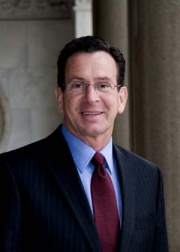
U.S. Rep. Debbie Wasserman Schultz, the chair of the DNC, announced on January 22, 2016, that Connecticut Gov. Dannel Malloy and former Mayor of Atlanta Shirley Franklin (D) would co-chair the committee.[10] Malloy and Franklin both endorsed Clinton prior to their appointments.[11][12]
The Sanders campaign requested on May 27, 2016, that Malloy be removed from the committee. In a letter to Jim Roosevelt and Lorraine Miller of the Rules and Bylaws Committee, Sanders campaign counsel Brad Deutsch described Malloy as an “aggressive attack [surrogate] for the Clinton campaign.”[13]
"Not only is Governor Malloy an avowed loyalist of the Clinton Campaign, he is an incendiary critic of Senator Sanders. While justly criticizing 'Donald Trump and his extremist agenda' in press remarks, Governor Malloy has gone on to draw pejorative comparisons between Mr. Trump and Senator Sanders. Governor Malloy has unfairly ascribed blame for national gun control laws single-handedly to Senator Sanders, referring to the three-day wait provision of the Brady Bill as the 'Charleston-Sanders loophole.' Malloy has even ventured that Senator Sanders should be 'held accountable' for the 'death and destruction' cause [sic] by his 'mistakes,'" Deutsch wrote.[13]
Deutsch asserted that Malloy's "open animosity" toward Sanders would bias his leadership. He wrote, "This platform should be as inclusive as possible, expressing where practicable the input of the significant percentage of Democrats who support Senator Sanders."[13]
The Democratic National Committee rejected Sanders’ request on May 28, 2016, because it failed to allege "any violation of the provisions" governing the 2016 Democratic National Convention.[14]
Party leaders and elected officials of the Platform Committee[edit]
The party leaders and elected officials (PLEOs) serving on the Platform Committee were also announced in January 2016:
- Staff Sgt. (Ret.) Eric Alva
- Stephen Benjamin
- Maya Berry
- Steve Beshear
- Clayola Brown
- Henry Claypool
- Jodi Gillette
- Wash. Sen. Cyrus Habib
- Mary Kay Henry
- Ilyse Hogue
- Mara Keisling
- Carole King
- Dr. Esther Lopez
- Mark Magana
- Robert Martinez
- Minyon Moore
- Wash. Rep. Luis Moscoso
- Karen K. Narasaki
- Donna Payne-Hardy
- Max Richtman
- Lee Saunders
- Marc Stanley
- Dilawar Syed
- Colo. Sen. Jessie Ulibarri
- Randi Weingarten
Forming the party platform[edit]
In the months before the national convention, public hearings were arranged to allow Democrats the opportunity to comment on the direction of the party's future platform through video, written, and in-person testimony. Four 2-day forums were scheduled in June and July 2016 for this purpose:[15]
- Washington, D.C. (June 8-9, 2016)
- Phoenix, Ariz. (June 17-18, 2016)
- St. Louis, Mo. (June 24-25, 2016)
- Orlando, Fla. (July 8-9, 2016)
With input from Democratic Party members and the larger Platform Committee, the Platform Drafting Committee is responsible for producing the initial draft of the party platform.[8]
Who served on the Platform Drafting Committee at the 2016 Democratic National Convention?[edit]

In 2016, the Platform Drafting Committee was to be composed of 15 voting members selected by the DNC chair and one nonvoting member selected by each remaining presidential candidate.[8]
The DNC announced on May 24, 2016, however, that the selection of the Platform Drafting Committee would differ from previous years.[16]
The change in procedure was likely prompted by criticism from Bernie Sanders that the standing committees would not reflect his campaign.[17] In an open letter to Wasserman Schultz on May 6, 2016, Sanders argued in favor of him and Clinton each selecting seven members of the Platform Drafting Committee. A fifteenth member, jointly chosen by both campaigns, would serve as the chairman. "If the process is set up to produce an unfair, one-sided result, we are prepared to mobilize our delegates to force as many votes as necessary to amend the platform and rules on the floor of the convention," Sanders warned.[18]
The DNC decided to allow for each candidate to choose some of the committee members based on a proportional system reflecting the results of the primary process.
"This year, in an effort to make this the most representative and inclusive process in history, the DNC Chair elected to allocate 75% of the committee’s seats to the presidential campaigns, awarding the slots proportionally according to the current vote tally," it said in a statement.[16][19]
As a result, Hillary Clinton selected six of the committee members and Sanders chose five. Wasserman Schultz selected the other four.
On May 31, 2016, The Wall Street Journal reported that RoseAnn DeMoro, the executive director of National Nurses United, had been named on Sanders' list of preferred committee members to be an advocate for universal healthcare but was ultimately vetoed. Platform Committee spokeswoman Dana Vickers Shelley said, “Because union leadership was represented on the full platform committee, a decision was made no union leadership would be represented on the platform drafting committee. That was communicated to the campaigns, and they understood our rationale.”[20][21]
DeMoro said her exclusion was part of a "set-up" to make it appear that Sanders had chosen a primarily male set of committee members. "It fed into the 'Bernie bro' narrative and meme — oh, Bernie picked one woman, he's a sexist. As soon as the list was out, there were articles about how he chose two 'anti-Israel' people. The truth of the matter is that they were choices the DNC had signed off on," she said.[21]
Selected by Debbie Wasserman Schultz[edit]
- U.S. Rep. Elijah Cummings (D-Md.) was selected to chair the committee. He said in a statement, "The Democratic Party has always fought to create a better life for all Americans. I am pleased that we have some of our best and brightest gathered here to assemble our collective vision of our nation's future. We will be going to unprecedented lengths to ensure that the drafting of our party's platform is the most inclusive, open and representative process in the long history of our two major parties."[16]
- U.S. Rep. Barbara Lee (D-Calif.)
- Former U.S. Rep. Howard Berman (D-Calif.)
- Bonnie Schaefer, business executive and philanthropist
Selected by Hillary Clinton[edit]
- Wendy Sherman, former State Department official
- Neera Tanden, president of the Center for American Progress
- Ohio Rep. Alicia Reece (D)
- U.S. Rep. Luis Gutierrez (D-Ill.)
- Carol Browner, former official at the Environmental Protection Agency
- Paul Booth, union advocate
Selected by Bernie Sanders[edit]
- U.S. Rep. Keith Ellison (D-Minn.)
- Bill McKibben, environmental advocate
- Cornel West, professor and social justice advocate
- James Zobgy, president of the Arab American Institute
- Deborah Parker, Native American activist
Nonvoting members[edit]
As initially planned, the committee also includes two nonvoting members representing the interests of Clinton and Sanders.[16]
- Maya Harris, a senior policy adviser to the Clinton campaign
- Warren Gunnells, the policy director for the Sanders campaign
How did the party platform change at the 2016 Democratic National Convention?[edit]
Initial discussions[edit]
In 2016, Sanders repeatedly expressed a desire to see the Democratic Party embrace more progressive policies, regardless of the outcome of the primary process.
In an interview on April 21, 2016, he said that his commitment to the presidential race was not governed solely by the probability of his winning the nomination. Rather, Sanders said that he was motivated by "bringing millions of people together to demand an agenda which says to the one percent they cannot have it all."[22]
After losing four of the five primary contests held on April 26, 2016, Sanders made his intentions to change the party platform even clearer:
| “ | The people in every state in this country should have the right to determine who they want as president and what the agenda of the Democratic Party should be. That’s why we are in this race until the last vote is cast. That is why this campaign is going to the Democratic National Convention in Philadelphia with as many delegates as possible to fight for a progressive party platform that calls for a $15 an hour minimum wage, an end to our disastrous trade policies, a Medicare-for-all health care system, breaking up Wall Street financial institutions, ending fracking in our country, making public colleges and universities tuition free and passing a carbon tax so we can effectively address the planetary crisis of climate change.[23] | ” |
| —Bernie Sanders[24] | ||
In addition to the federal minimum wage, trade agreements, healthcare, banking policy, fracking, and higher education, another platform plank that was given reconsideration was how the Democratic Party characterized the needs of Israel and Palestine. James Zogby, who was selected to sit on the Platform Drafting Committee by Sanders, said that the platform should reflect that although "people are very supportive of Israel, they are not so supportive of various policies supported by Israel."[25]
Clinton's campaign declined to directly address what, if any, changes she would want to see in the party platform regarding this issue. Instead, senior policy adviser Jake Sullivan said in a statement, "Hillary Clinton’s views on Israel and the U.S.-Israel relationship are well-documented and she’s confident that her delegates will work to ensure that the party platform reflects them."[25]
Final draft of the platform[edit]
On June 25, 2016, a draft of the Democratic Party platform was approved by the Platform Drafting Committee. It included calls to raise the minimum wage to $15, abolish the death penalty, more strictly regulate Wall Street, establish a multi-millionaire surtax, and review existing trade agreements such as the Trans-Pacific Partnership.[26] According to J Street's Jeremy Ben-Ami, the draft also featured language on the Israeli-Palestinian conflict that gave “parallel acknowledgment of Israeli and Palestinian rights.”[27]
Sanders said the following day that he would continue to push for more progressive policies, including a carbon tax and fracking ban, in the platform. “We lost some very important fights. We're going to take that fight to Orlando, where the entire committee meets in two weeks. And if we don't succeed there, then we'll certainly take it to the floor of the Democratic convention,” he pledged.[28][29]
The larger Platform Committee approved a final draft of the platform in the early hours of July 10, 2016, which included victories for Sanders backers on climate change, healthcare, and the federal minimum wage. Among their unsuccessful proposals were a rejection of the Trans-Pacific Partnership, language on Israeli settlements, and a ban on fracking. "We got 80% of what we wanted in this platform,” said Warren Gunnels, a foreign policy adviser to Sanders.[30]
When Sanders endorsed Clinton on July 12, 2016, he personally indicated his approval of the platform, saying, "I am happy to tell you that at the Democratic Platform Committee which ended Sunday night in Orlando, there was a significant coming together between the two campaigns and we produced, by far, the most progressive platform in the history of the Democratic Party. Our job now is to see that platform implemented by a Democratic Senate, a Democratic House and a Hillary Clinton presidency – and I am going to do everything I can to make that happen."[31]
The 2016 Democratic Party platform can be viewed here. It was approved by voice vote at the national convention on July 25, 2016.
See also[edit]
Footnotes[edit]
- ↑ The Washington Post, "Clinton praises Sanders, calls for party unity in Nevada," May 26, 2016
- ↑ Politico, "Sanders sticks it to the Democratic Party," May 17, 2016
- ↑ Fortune, "Despite What Bernie Sanders Says, The Democratic Party Platform Doesn't Matter," May 27, 2016
- ↑ The American Presidency Project, "Democratic Party Platform of 1840," accessed May 31, 2016
- ↑ Congressional Research Service, "Presidential Elections in the United States: A Primer," April 17, 2000
- ↑ United States Democratic Party, "The 2012 Democratic Platform," accessed May 31, 2016
- ↑ American Presidency Project, "Political Party Platforms of Parties Receiving Electoral Votes," accessed May 31, 2016
- ↑ 8.0 8.1 8.2 Democratic National Committee, "Call for the 2016 Democratic National Convention," accessed May 31, 2016
- ↑ Democratic National Committee, "Frequently Asked Questions About the National Platform and the Convention Platform Committee," August 10, 2012
- ↑ Democratic National Committee, "Chairwoman Wasserman Schultz’s Nominations for the 2016 Convention Standing Committees," January 22, 2016
- ↑ Hillary Clinton for President, "Clinton Campaign Announces Support of Over 50 African American Mayors from Across the Country," October 20, 2015
- ↑ NBC Connecticut, "Gov. Malloy Endorses Hillary Clinton for President," June 7, 2015
- ↑ 13.0 13.1 13.2 Bernie Sanders for President, "Credentials Challenge to Platform Committee Co-Chair Dannel Malloy and Rules Committee Co-Chair Barney Frank," May 27, 2016
- ↑ The Hill, "DNC rejects Sanders' request to remove committee chairs," May 28, 2016
- ↑ 2016 Democratic National Convention, "Platform," accessed May 31, 2016
- ↑ 16.0 16.1 16.2 16.3 2016 Democratic National Convention, "Democratic National Convention Committee Announces Platform Drafting Committee Members," May 24, 2016
- ↑ The Washington Post, "DNC to offer Sanders a convention concession," May 19, 2016
- ↑ Bernie Sanders for President, "Letter to Debbie Wasserman Schultz," May 6, 2016
- ↑ The Los Angeles Times, "Bernie Sanders gets voices on key Democratic Party committee," May 24, 2016
- ↑ The Wall Street Journal, "Nurses Seek Democratic Showdown," May 31, 2016
- ↑ 21.0 21.1 The Washington Post, "Sanders: DNC vetoed union leader pick for platform committee," June 1, 2016
- ↑ RealClearPolitics, "Sanders Returns: 'It's Not Just About Me,' Clinton Will Have To Change Her Platform To Earn My Support," April 22, 2016
- ↑ Note: This text is quoted verbatim from the original source. Any inconsistencies are attributable to the original source.
- ↑ Bernie Sanders for President, "Sanders Statement on Primary Elections," April 26, 2016
- ↑ 25.0 25.1 The Los Angeles Times, "Bernie Sanders moves toward a fight over Israel, forcing Hillary Clinton to navigate a splintered party," May 29, 2016
- ↑ 2016 Democratic National Convention, "Democratic Platform Drafting Meeting Concludes," June 25, 2016
- ↑ CNN, "Hillary Clinton's views on Israel win out in DNC platform, for now," June 26, 2016
- ↑ The Hill, "Sanders: 'We lost some very important fights' in Democratic platform," June 26, 2016
- ↑ Bernie Sanders for President, "Sanders Statement on Democratic Party Platform," June 26, 2016
- ↑ CNN, "In platform fight, Sanders loses on trade but wins on minimum wage," July 10, 2016
- ↑ Bernie Sanders for President, "Portsmouth Organizing Event with Bernie Sanders and Hillary Clinton," July 12, 2016
| ||||||||||||||||


Categories: [DNC 2016] [National party platforms]
↧ Download as ZWI file | Last modified: 10/12/2022 15:04:43 | 17 views
☰ Source: https://ballotpedia.org/The_Democratic_Party_Platform_and_DNC_Platform_Committees,_2016 | License: CC BY-SA 3.0
 ZWI signed:
 KSF
KSF