State Legislative Incumbent Turnover In 2014
 From Ballotpedia

Incumbent turnover, the combination of legislators retiring or losing in primaries, shifted back down to levels seen in elections four years prior. Nevertheless, 131 major party incumbents lost a primary. Thirty-six percent of those were Democratic seats; 64 percent were Republican.
State legislative elections in 2014 did not see as many defeated incumbents as 2012, primarily due to redistricting. A larger percentage of incumbents chose to seek re-election than in recent years.
Republican incumbents were challenged in the primary elections at a higher rate, suggesting that different segments were continuing to compete over the direction of the party. In an interview with Ballotpedia, Tim Storey, an election expert at the National Conference of State Legislatures, stated that "both parties go through phases where there is a conflict over the identity of the party. Democrats went through a similar phase during the years when President Bill Clinton was in office, and now it's the Republican's turn." Storey said that the change tends to be specific to each state and requires a certain tension in the party. He pointed towards states such as Arkansas, Kansas, Missouri, Montana, North Dakota, South Dakota and Texas as ones with this Republican tension.
Although Republican incumbents received more primary challenges, and there may have been tension within the party, the difference between the percentage of Democrats winning primaries compared to Republicans was fairly insignificant -- just under 3 percent -- and was on par with recent years.
The incumbent turnover rates in 2014 fell in between results from 2010 and 2012. There was a spike in 2012 turnover on account of a large number of incumbents from both parties, but particularly Republicans, being challenged and defeated in primaries. Redistricting played a large role in 2012, moving multiple incumbents into the same district to face off. Additionally, many districts had been redrawn in such a way that left some incumbents in unfamiliar territory and vulnerable to primary challenge. The degree of turnover seen in 2014 was more along the lines of what was seen in 2010.
| Incumbent turnover compared by year | ||||||
|---|---|---|---|---|---|---|
| 2010 | 2012 | 2014 | ||||
| Retired Democrats | 579 | 517 | 466 | |||
| Defeated Democrats | 53 | 70 | 46 | |||
| Total D turnover | 632 | 587 | 512 | |||
| Retired Republicans | 533 | 591 | 545 | |||
| Defeated Republicans | 56 | 124 | 85 | |||
| Total R turnover | 589 | 715 | 630 | |||
For the full set of data, please visit our Google spreadsheet here.
Review of incumbent turnover[edit]
Using official candidate lists, Ballotpedia staff analyzed each chamber for trends in incumbent turnover. Our findings were based on all 46 filing deadlines and primaries. The final primary elections were held on September 9, 2014.
We focused on the following four circumstances for major party incumbents:
- Incumbents who retired, leaving open seats;
- Districts where incumbents faced primary opposition;
- Incumbents who were defeated by primary challengers; and
- Overall turnover and the number of open seats heading into the general election.
Open seats[edit]
In 2014, 1,012 partisan state legislators declined to seek re-election. Some chose to leave office to seek higher office, personal reasons and, in some cases, without choice due to term limits. In any case, the open seats leave an opportunity for new candidates with aspirations towards their state legislature. Around 90 percent of incumbents who run for their current seat win re-election.
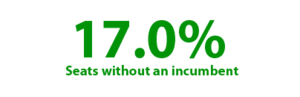
The number of incumbents who did not seek re-election included:
 467 Democrats
 545 Republicans
Primary opposition incumbents & defeated incumbents[edit]
In the 46 states that held a primary election in 2014, 419 Democratic incumbents and 590 Republican incumbents faced primary opposition.
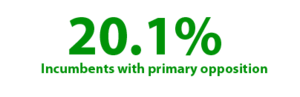
Overall there was little difference between Democrats and Republicans in the percentage of incumbents defeated by an opponent:
- 46 Democrats were defeated, with 89.3 percent advancing past the primary.
- 85 Republicans were defeated, while the remaining 85.6 percent advanced.
Overall turnover[edit]
Republicans controlled 51.6 percent of the seats in the 87 chambers with elections, while Democrats held 47.5 percent. Those figures are based only on districts up for election in 2014. Vacancies are attributed towards the party that previously held the seat.
Republicans felt a slightly greater impact of incumbent turnover in 2014:
- Just under 54 percent of retired incumbents were Republican and about 46 percent were Democrats.
- Republicans accounted for 64 percent of all incumbents defeated in primaries. Democrats represented 36 percent.
- In total, 55 percent of all partisan incumbent turnover was attributed towards Republicans and 45 percent to Democrats.
The following table details what percentage of partisan incumbents retired, incumbents defeated in primary and overall turnover is attributed to each party.
| Incumbent turnover in 2014 state legislative elections | ||||||
|---|---|---|---|---|---|---|
| Incumbents retired | Defeated in primary | Turnover | ||||
| Democrats | Republicans | Democrats | Republicans | Democrats | Republicans | |
| State Senate | 44.56% | 55.44% | 33.33% | 66.67% | 43.32% | 56.68% |
| State House | 46.52% | 53.48% | 36.79% | 63.21% | 45.41% | 54.59% |
| Totals | 46.15% | 53.85% | 36.15% | 63.85% | 45.01% | 54.99% |
States compared by overall turnover[edit]
The following table details, by state, overall incumbent turnover.
"Seats up" represents the number of state senate and state house seats up in the state. The share of those seats as a part of all 6,057 seats up in 2014 is listed under "Total seats up in 2014." "Incs retired" represents the number of incumbents who did not seek re-election. The number of incumbents facing primary opposition, and how many of them were defeated, is listed under "Incs facing primary" and "Incs defeated." "% Incs facing primary" details, of the incumbents who faced a primary challenger, what percentage of the incumbents advanced past the primary. The percentage of seats that will be open heading into the general elections is represented under "Percent of seats up."
| States compared by overall turnover | ||||||||
|---|---|---|---|---|---|---|---|---|
| State | Seats up | Total seats up in 2014 | Incs retired | Incs defeated | Incs facing primary | % Incs winning primary | Total | Percent of seats up |
| Total | 6,057 | 100%[1] | 1,011 | 131 | 1,008 | 87.10% | 1,158 | 19.12% |
| Texas | 165 | 2.72% | 15 | 11 | 39 | 71.79% | 26 | 15.76% |
| Illinois | 137 | 2.26% | 14 | 3 | 14 | 78.57% | 17 | 12.41% |
| Indiana | 125 | 2.06% | 8 | 3 | 11 | 72.73% | 11 | 8.80% |
| North Carolina | 170 | 2.81% | 14 | 4 | 28 | 85.71% | 18 | 10.59% |
| Ohio | 116 | 1.92% | 27 | 3 | 23 | 86.96% | 29 | 25.00% |
| Nebraska | 25 | 0.41% | 17 | 0 | 1 | 100% | 17 | 68.00% |
| West Virginia | 117 | 1.93% | 11 | 7 | 33 | 78.79% | 18 | 15.38% |
| Arkansas | 118 | 1.95% | 31 | 4 | 8 | 50.0% | 35 | 29.66% |
| Idaho | 105 | 1.73% | 11 | 6 | 31 | 80.65% | 17 | 16.19% |
| Georgia | 236 | 3.90% | 17 | 5 | 48 | 89.58% | 22 | 9.32% |
| Kentucky | 119 | 1.96% | 11 | 2 | 14 | 85.71% | 13 | 10.92% |
| Oregon | 76 | 1.25% | 16 | 1 | 5 | 80.0% | 17 | 22.37% |
| Pennsylvania | 228 | 3.76% | 26 | 5 | 42 | 88.10% | 31 | 13.60% |
| Alabama | 140 | 2.31% | 20 | 8 | 40 | 82.50% | 27 | 19.29% |
| California | 100 | 1.65% | 33 | 0 | 43 | 100% | 33 | 33.00% |
| Iowa | 125 | 2.06% | 15 | 0 | 8 | 100% | 15 | 12.00% |
| Montana | 125 | 2.06% | 47 | 2 | 18 | 88.89% | 49 | 39.20% |
| New Mexico | 70 | 1.16% | 11 | 2 | 7 | 71.43% | 13 | 18.57% |
| South Dakota | 105 | 1.73% | 33 | 0 | 17 | 100% | 33 | 31.43% |
| Maine | 186 | 3.07% | 59 | 1 | 3 | 66.67% | 60 | 32.26% |
| Nevada | 53 | 0.88% | 10 | 0 | 13 | 100% | 10 | 18.87% |
| North Dakota | 72 | 1.19% | 13 | 0 | 4 | 100% | 13 | 18.06% |
| South Carolina | 124 | 2.05% | 9 | 2 | 20 | 90.0% | 11 | 8.87% |
| Colorado | 83 | 1.37% | 23 | 0 | 2 | 100% | 23 | 27.71% |
| Maryland | 188 | 3.10% | 50 | 12 | 92 | 86.96% | 62 | 32.98% |
| Oklahoma | 126 | 2.08% | 31 | 0 | 13 | 100% | 31 | 24.60% |
| Utah | 89 | 1.47% | 12 | 3 | 19 | 84.21% | 15 | 16.85% |
| Kansas | 125 | 2.06% | 13 | 3 | 21 | 85.71% | 16 | 12.80% |
| Michigan | 148 | 2.44% | 51 | 1 | 24 | 95.83% | 52 | 35.14% |
| Missouri | 180 | 2.97% | 29 | 1 | 20 | 95.0% | 30 | 16.67% |
| Washington | 123 | 2.03% | 13 | 1 | 17 | 94.12% | 14 | 11.38% |
| Tennessee | 116 | 1.92% | 12 | 8 | 26 | 69.23% | 20 | 17.24% |
| Hawaii | 64 | 1.06% | 5 | 3 | 20 | 85.0% | 8 | 12.5% |
| Connecticut | 187 | 3.09% | 24 | 2 | 9 | 77.8% | 27 | 13.90% |
| Minnesota | 134 | 2.21% | 15 | 0 | 5 | 100% | 15 | 11.19% |
| Wisconsin | 116 | 1.92% | 26 | 0 | 11 | 100% | 26 | 22.41% |
| Alaska | 54 | 0.89% | 8 | 2 | 4 | 50.0% | 10 | 18.52% |
| Wyoming | 75 | 1.24% | 11 | 4 | 27 | 85.19% | 15 | 20.0% |
| Arizona | 90 | 1.49% | 27 | 3 | 24 | 87.50% | 30 | 33.33% |
| Florida | 140 | 2.31% | 17 | 1 | 22 | 95.45% | 18 | 12.86% |
| Vermont | 180 | 2.97% | 24 | 1 | 7 | 85.71% | 25 | 13.89% |
| Delaware | 51 | 0.84% | 2 | 2 | 9 | 77.78% | 4 | 7.84% |
| Massachusetts | 200 | 3.30% | 21 | 1 | 15 | 77.78% | 22 | 11.0% |
| New Hampshire | 424 | 7.00% | 119 | 11 | 98 | 88.78% | 130 | 30.66% |
| Rhode Island | 113 | 1.87% | 7 | 2 | 24 | 91.67% | 9 | 7.96% |
| New York | 213 | 3.52% | 21 | 1 | 30 | 96.67% | 22 | 10.33% |
States compared by year: 2012 vs. 2014[edit]
The following chart details turnover, retired incumbents in addition to incumbents defeated in primary elections, and the percentage of seats up that the turnover represents. The same sets of data for 2012 and 2014 are presented alongside each other for context.
The states that saw the largest change between 2012 and 2014 were:
- Nebraska - 34.62 percent in 2012 to 68 percent in 2014 (33.4%)
- Kansas - 34.55 percent in 2012 to 12.80 percent in 2014 (21.8%)
- Idaho - 36.19 percent in 2012 to 16.19 percent in 2014 (20.0%)
- Florida - 31.88 percent in 2012 to 12.86 percent in 2014 (19.02%)
- North Carolina - 27.65 percent in 2012 to 10.59 percent in 2014 (17.1%)
| Total incumbents out before the general election | ||||
|---|---|---|---|---|
| 2014 | 2012 | |||
| State | Total | Percent of seats up | Total | Percent of seats up |
| Total | 1,158 | 19.12% | 1,314 | 21.85% |
| Texas | 26 | 15.76% | 19 | 12.67% |
| Illinois | 17 | 12.41% | 37 | 20.90% |
| Indiana | 11 | 8.80% | 21 | 16.80% |
| North Carolina | 18 | 10.59% | 47 | 27.65% |
| Ohio | 29 | 25.00% | 16 | 13.68% |
| Nebraska | 17 | 68.00% | 9 | 34.62% |
| West Virginia | 18 | 15.38% | 21 | 17.95% |
| Arkansas | 35 | 29.66% | 49 | 36.30% |
| Idaho | 17 | 16.19% | 38 | 36.19% |
| Georgia | 22 | 9.32% | 20 | 8.47% |
| Kentucky | 13 | 10.92% | 12 | 10.08% |
| Oregon | 17 | 22.37% | 13 | 17.57% |
| Pennsylvania | 31 | 13.60% | 25 | 10.96% |
| Alabama | 27 | 19.29% | No election | -- |
| California | 33 | 33.00% | 44 | 44.00% |
| Iowa | 15 | 12.00% | 27 | 21.43% |
| Montana | 49 | 39.20% | 46 | 36.51% |
| New Mexico | 13 | 18.57% | 26 | 23.21% |
| South Dakota | 33 | 31.43% | 37 | 35.24% |
| Maine | 53 | 28.49% | 65 | 34.95% |
| Nevada | 10 | 18.87% | 18 | 33.33% |
| North Dakota | 13 | 18.06% | 18 | 24.00% |
| South Carolina | 11 | 8.87% | 27 | 15.88% |
| Colorado | 23 | 27.71% | 34 | 40.00% |
| Maryland | 62 | 32.98% | No election | -- |
| Oklahoma | 31 | 24.60% | 21 | 16.80% |
| Utah | 15 | 16.85% | 21 | 23.08% |
| Kansas | 16 | 12.80% | 57 | 34.55% |
| Michigan | 52 | 35.14% | 23 | 20.91% |
| Missouri | 30 | 16.67% | 60 | 33.33% |
| Washington | 14 | 11.38% | 27 | 21.77% |
| Tennessee | 20 | 17.24% | 28 | 24.35% |
| Hawaii | 8 | 12.50% | 10 | 13.16% |
| Connecticut | 26 | 13.90% | 26 | 13.90% |
| Minnesota | 15 | 11.19% | 45 | 22.39% |
| Wisconsin | 26 | 22.41% | 21 | 18.26% |
| Alaska | 10 | 18.52% | 8 | 13.56% |
| Wyoming | 15 | 20.0% | 18 | 24.00% |
| Arizona | 30 | 33.33% | 32 | 35.56% |
| Florida | 18 | 12.86% | 51 | 31.88% |
| Vermont | 25 | 13.89% | 22 | 12.22% |
| Delaware | 4 | 7.84% | 12 | 19.35% |
| Massachusetts | 22 | 11.0% | 10 | 5.00% |
| New Hampshire | 130 | 30.66% | 117 | 27.59% |
| Rhode Island | 9 | 7.96% | 16 | 14.16% |
| New York | 22 | 10.33% | 20 | 9.39% |
See also[edit]
- State legislative elections, 2014
- Impact of term limits on state legislative elections in 2014
- State legislatures compared by extent of electoral competitiveness in 2014
Footnotes[edit]
- ↑ This is the percentage of seats to this date that have held a primary.
| ||||||||||||||||||||||||||||
| |||||||||||
Categories: [Competitiveness analysis of state legislative elections, 2014] [Incumbents_defeated_in_state_legislative_elections] [One-off pages, evergreen]
↧ Download as ZWI file | Last modified: 05/16/2024 20:29:41 | 32 views
☰ Source: https://ballotpedia.org/State_legislative_incumbent_turnover_in_2014 | License: CC BY-SA 3.0
 KSF
KSF