
Traditional Austronesian generalized sail types. C, D, E, and F are types of crab claw sails. G, H, and I are tanja sails.[1]
A Double sprit (Sri Lanka)
B Common sprit (Philippines )
C Oceanic sprit (Tahiti)
D Oceanic sprit (Marquesas)
E Oceanic sprit (Philippines )
F Crane sprit (Marshall Islands)
G Rectangular boom lug (Maluku Islands)
H Square boom lug (Gulf of Thailand)
I Trapezial boom lug (Vietnam)
Austronesian Vessels
 From Handwiki
 Short description: Sailing vessels of Austronesian peoples
Austronesian vessels are the traditional seafaring vessels of the Austronesian peoples of Taiwan, Maritime Southeast Asia, Micronesia, coastal New Guinea, Island Melanesia, Polynesia, and Madagascar .[2] They also include indigenous ethnic minorities in Vietnam, Cambodia, Myanmar, Thailand, Hainan, the Comoros, and the Torres Strait Islands.
They range from small dugout canoes to large lashed-lug plank-built vessels. Their hull configurations include monohulls as well as uniquely Austronesian catamarans and outrigger boats (single-outrigger boats and trimarans). Traditional sail types include a variety of distinctively Austronesian crab-claw and tanja configurations, though modern vessels are typically motorized. These vessels allowed the migrations of the Austronesian peoples during the Austronesian expansion (starting at around 3000 to 1500 BC from Taiwan and Island Southeast Asia) throughout the islands of the Indo-Pacific, reaching as far as Madagascar , New Zealand, and Easter Island. They were also used to establish trading routes, including the Austronesian maritime trade network which formed the maritime leg of the spice trade and later, the maritime silk road.
History
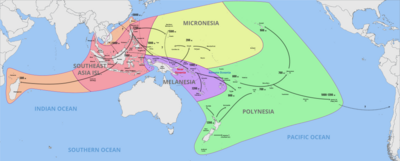
Map showing the migration and expansion of the Austronesians which began at about 3000 BC from Taiwan
Austronesians used distinctive sailing technologies, namely the catamaran, the outrigger ship, tanja sail and the crab claw sail. This allowed them to colonize a large part of the Indo-Pacific region during the Austronesian expansion starting at around 3000 to 1500 BC, and ending with the colonization of Easter Island and New Zealand in the 10th to 13th centuries AD.[3][4] Prior to the 16th century Colonial Era, Austronesians were the most widespread ethnolinguistic group, spanning half the planet from Easter Island in the eastern Pacific Ocean to Madagascar in the western Indian Ocean.[5][6] They also established vast maritime trading networks, among which is the Neolithic precursor to what would become the Maritime Silk Road.[7]
The simplest form of all ancestral Austronesian boats had five parts. The bottom part consists of a single piece of hollowed-out log. At the sides were two planks, and two horseshoe-shaped wood pieces formed the prow and stern. These were fitted tightly together edge-to-edge by sewing or with dowels inserted into holes in between, and then lashed to each other with ropes (made from rattan or fibre) wrapped around protruding lugs on the planks. This characteristic and ancient Austronesian boatbuilding practice is known as the "lashed-lug" technique. They were commonly caulked with pastes made from various plants as well as tapa bark and fibres which would expand when wet, further tightening joints and making the hull watertight. They formed the shell of the boat, which was then reinforced by horizontal ribs. Shipwrecks of Austronesian ships can be identified from this construction, as well as the absence of metal nails. Austronesian ships traditionally had no central rudders but were instead steered using an oar on one side.[8][9][10]
They also independently developed various sail types during the Neolithic, beginning with the crab claw sail (also misleadingly called the "oceanic lateen" or the "oceanic sprit") at around 1500 BCE. They are used throughout the range of the Austronesian Expansion, from Maritime Southeast Asia, to Micronesia, Island Melanesia, Polynesia, and Madagascar . Crab claw sails are rigged fore-and-aft and can be tilted and rotated relative to the wind. They evolved from V-shaped perpendicular square sails in which the two spars converge at the base of the hull. The simplest form of the crab claw sail (also with the widest distribution) is composed of a triangular sail supported by two light spars (sometimes erroneously called "sprits") on each side. They were originally mastless, and the entire assembly was taken down when the sails were lowered.[11]
Hull and sail configurations
Austronesian rigs were used for double-canoe (catamaran), single-outrigger (on the windward side), or double-outrigger boat configurations, in addition to monohulls.[8][9] There are several distinct types of crab claw rigs, but unlike western rigs, they do not have fixed conventional names.[12]
File:CanoeTacking.webm The need to propel larger and more heavily laden boats led to the increase in vertical sail. However this introduced more instability to the vessels. In addition to the unique invention of outriggers to solve this, the sails were also leaned backwards and the converging point moved further forward on the hull. This new configuration required a loose "prop" in the middle of the hull to hold the spars up, as well as rope supports on the windward side. This allowed more sail area (and thus more power) while keeping the center of effort low and thus making the boats more stable. The prop was later converted into fixed or removable canted masts where the spars of the sails were actually suspended by a halyard from the masthead. This type of sail is most refined in Micronesian proas which could reach very high speeds. These configurations are sometimes known as the "crane sprit" or the "crane spritsail". Micronesian, Island Melanesian, and Polynesian single-outrigger vessels also used this canted mast configuration to uniquely develop shunting, where canoes are symmetrical from front to back and change end-to-end when sailing against the wind.[11][12]

Taumako single-outrigger tepukei, an example of the basic mastless crab claw sail
_-_Lakatoi,_Near_Elevala_Island.jpg)
Motuan catamaran lakatoi with crab claw sails on fixed masts
.jpg)
Visayan double-outrigger paraw with a "crane sprit" crab claw sail and a jib
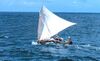
Carolinian single-outrigger shunting wa with a "crane sprit" crab claw sail on a canted mast

Madurese paduwang with crab claw sails on fixed masts
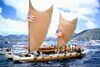
Hokule'a, a fibreglass replica of a Hawaiian catamaran waʻa kaulua, with curved-spar, curved-leech crab claw sails
.jpg)
Iranun double-outrigger lanong with tanja sails on removable bipod masts
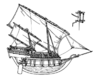
Makassar benawa with tanja sails on removable tripod masts and a jib
The conversion of the prop to a fixed mast led to the much later invention of the tanja sail (also known variously and misleadingly as the canted square sail, canted rectangular sail, boomed lugsail, or balance lugsail). Tanja sails were rigged similarly to crab claw sails and also had spars on both the head and the foot of the sails; but they were square or rectangular with the spars not converging into a point.[11][12]
Another evolution of the basic crab claw sail is the conversion of the upper spar into a fixed mast. In Polynesia, this gave the sail more height while also making it narrower, giving it a shape reminiscent of crab pincers (hence "crab claw" sail). This was also usually accompanied by the lower spar becoming more curved.[11][12]

Melanesian V-shaped square sail

New Zealand V-shaped square sail
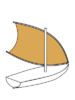
Polynesian crab claw sail

New Guinea crab claw sail

Hawaiian crab claw sail with the upper spar merged with the fixed mast
List of Austronesian vessels by region
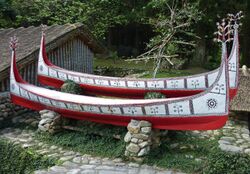
Ipanitika of the Tao people of Taiwan
The following is an incomplete list of traditional Austronesian vessels.
Taiwan
Orchid Island
- Ipanitika
- Tatara
Island Southeast Asia
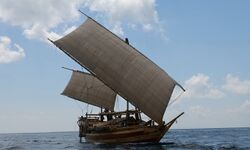
The Kapal Nur Al Marege, a Makassar padewakang from Indonesia
Brunei
- Bajak
- Bangkong
- Gubang
- Jong
- Kakap
- Penjajap
- Tongkang
Indonesia

A jukung from Indonesia
- Abak
- Bagan
- Bago
- Bajak
- Bangkong
- Banting
- Benawa
- Borobudur ship
- Cerucuh
- Chialoup
- Eloha
- Fakatora
- Ghali
- Ghurab
- Golekan
- Janggolan
- Jellore
- Jong
- Jongkong
- Juanga
- Jukung
- Jukung tambangan
- Kakap
- Kalulis
- Kelulus
- Kolay
- Kolekole
- Knabat bogolu
- Kora kora
- Kotta mara
- K'un-lun po
- Lancang
- Lancaran
- Lepa
- Lepa-Lepa
- Leti leti
- Lis-alis
- Londe
- Malangbang
- Mayang
- Orembai
- Padewakang
- Paduwang
- Pajala
- Paledang
- Penjajap
- Pangkur
- Patorani
- Pelang
- Pencalang
- Perahu
- Pinisi (Lambo, Palari)
- Sampan panjang
- Sandeq
- Sarua
- Sekong
- Solu
- Teneh
- Tongkang
- Toop
Malaysia
- Bajak
- Bangkong
- Banting
- Bedar
- Buggoh
- Birau
- Cerucuh
- Ghali
- Ghurab
- Jong
- Juanga
- Kakap
- Kolek
- Lancang
- Lancaran
- Lepa
- Pelang
- Pencalang
- Penjajap
- Perahu payang
- Perahu tambangan
- Pinas
- Sampan panjang
- Tongkang
Philippines

The double-outrigger paraw in Boracay, Philippines
.jpg)
An Iranun lanong warship from the Philippines
- Armadahan
- Avang
- Awang
- Balación
- Balangay (Barangay)
- Baloto
- Bangka
- Bangka anak-anak
- Basnigan
- Batil
- Bigiw
- Bilo
- Birau
- Biray
- Biroko (Birok, Bidok)
- Buggoh
- Casco
- Chinarem
- Chinedkeran
- Dinahit
- Djenging (Balutu)
- Falua
- Garay
- Guilalo
- Juanga
- Junkun
- Junkung
- Karakoa
- Kulibo
- Lanong
- Lapis
- Lepa (Kumpit, Pidlas)
- Ontang
- Owong
- Panineman
- Pasaplap
- Pangayaw
- Paraw
- Salambaw
- Salisipan
- Sapyaw
- Seberen
- Tapake
- Tataya
- Tempel
- Tilimbao (Tinimbao)
- Tiririt (Buti)
- Vinta (Dapang, Pilang)
Singapore
- Sampan panjang
- Tongkang
Micronesia

A single-outrigger wa from Yap, Caroline Islands
Caroline Islands
- Wahr
Kiribati
- Baurua
Marshall Islands
- Tipnol
- Walap
Mariana Islands, incl. Guam
- Ladjak
- Sakman (Flying proa)
Palau
- Kaep
- Wa
Yap
- Chugpin[13]
- Popow[13]
- Wa
Island Melanesia
_-_Lakatoi,_Near_Elevala_Island.jpg)
Lakatoi of the Motu people of Papua New Guinea
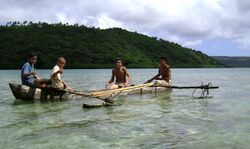
The traditional pōpao of Tonga
Fiji
- Camakau
- Drua (Wangga tabu)
- Takia
Papua New Guinea
- Lakatoi
Solomon Islands
- Tepukei
Vanuatu
- Aka
- Angga
- Wangga
Polynesia

Illustration of a Fijian camakau (1846)
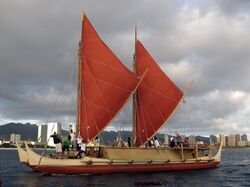
The Hōkūleʻa, a waka hourua from Hawaii
Cook Islands
- Vaka
- Vaka katea
Hawaiʻi
- Malia
- Wa'a
- Wa'a kaulua
Marquesas
- Vaka touʻua
New Zealand
- Waka ama
- Waka hourua
Samoa
- ʻAlia
- Amatasi
- Laʻau
- Lualua (Foulua)
- Paopao
- Vaʻa
- Vaʻa-alo
- Vaʻa-tele
Society Islands
- Ivahah
- Pahi
- Tipairua
- Vaʻa
Tonga
- Hamatafua
- Kalia
- Pōpao
- Tongiaki
Tuvalu
- Paopao
Madagascar
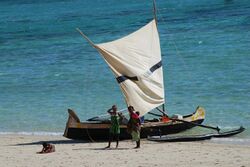
A single-outrigger lakana from Madagascar
- Lakana
See also
- Lashed-lug boat
- Proa
- Crab claw sail
- Tanja sail
References
- ↑ Doran, Edwin B. (1981). Wangka: Austronesian Canoe Origins. Texas A&M University Press. ISBN 9780890961070.
- ↑ Pierron, Denis; Razafindrazaka, Harilanto; Pagani, Luca; Ricaut, François-Xavier; Antao, Tiago; Capredon, Mélanie; Sambo, Clément; Radimilahy, Chantal et al. (2014-01-21). "Genome-wide evidence of Austronesian–Bantu admixture and cultural reversion in a hunter-gatherer group of Madagascar" (in en). Proceedings of the National Academy of Sciences 111 (3): 936–941. doi:10.1073/pnas.1321860111. ISSN 0027-8424. PMID 24395773. Bibcode: 2014PNAS..111..936P.
- ↑ Doran, Edwin Jr. (1974). "Outrigger Ages". The Journal of the Polynesian Society 83 (2): 130–140. http://www.jps.auckland.ac.nz/document//Volume_83_1974/Volume_83,_No._2/Outrigger_ages,_by_Edwin_Doran_Jnr.,_p_130-140/p1.
- ↑ Mahdi, Waruno (1999). "The Dispersal of Austronesian boat forms in the Indian Ocean". in Blench, Roger; Spriggs, Matthew. Archaeology and Language III: Artefacts languages, and texts. One World Archaeology. 34. Routledge. pp. 144–179. ISBN 978-0-415-10054-0.
- ↑ Bellwood, Peter; Fox, James J.; Tryon, Darrell (2006). The Austronesians: Historical and Comparative Perspectives. Australian National University Press. ISBN 978-1-920942-85-4. https://press.anu.edu.au/publications/series/comparative-austronesian-series/austronesians.
- ↑ Bellwood, Peter (2014). The Global Prehistory of Human Migration. p. 213.
- ↑ Bellina, Bérénice (2014). "Southeast Asia and the Early Maritime Silk Road". in Guy, John. Lost Kingdoms of Early Southeast Asia: Hindu-Buddhist Sculpture 5th to 8th century. Yale University Press. pp. 22–25. ISBN 978-1-58839-524-5. https://www.researchgate.net/publication/263007720.
- ↑ 8.0 8.1 Horridge, Adrian (2008). "Origins and Relationships of Pacific Canoes and Rigs". in Di Piazza, Anne; Pearthree, Erik. Canoes of the Grand Ocean. BAR International Series 1802. Archaeopress. ISBN 9781407302898. http://adrian-horridge.org/downloads/Pacific canoes.pdf. Retrieved 22 October 2019.
- ↑ 9.0 9.1 Lacsina, Ligaya (2016). Examining pre-colonial Southeast Asian boatbuilding: An archaeological study of the Butuan Boats and the use of edge-joined planking in local and regional construction techniques (PhD). Flinders University.
- ↑ Heng, Derek (2018). "Ships, Shipwrecks, and Archaeological Recoveries as Sources of Southeast Asian History". in Ludden, David. Oxford Research Encyclopedia of Asian History. doi:10.1093/acrefore/9780190277727.013.97. ISBN 978-0-19-027772-7.
- ↑ 11.0 11.1 11.2 11.3 Campbell, I.C. (1995). "The Lateen Sail in World History". Journal of World History 6 (1): 1–23. https://www.jstor.org/stable/20078617.
- ↑ 12.0 12.1 12.2 12.3 Horridge, Adrian (April 1986). "The Evolution of Pacific Canoe Rigs". The Journal of Pacific History 21 (2): 83–99. doi:10.1080/00223348608572530. https://www.jstor.org/stable/25168892.
- ↑ 13.0 13.1 Tu, Karen Kan-Lun (2017). Wa and Tatala: The Transformation of Indigenous Canoes on Yap and Orchid Island (PDF) (PhD).
 |  |
Categories: [Sailboat types] [Sailing ships]
↧ Download as ZWI file | Last modified: 07/21/2024 23:51:17 | 343 views
☰ Source: https://handwiki.org/wiki/Engineering:Austronesian_vessels | License: CC BY-SA 3.0
✘
ZWI is not signed. [what is this?]
ZWI viewer
by the  KSF
KSF
KSF